
This guide is for clinicians who themselves are neurodivergent or live with a disability. It is not about writing notes for ADHD or neurodivergent clients, that is a different topic with a different audience. If you have ADHD, dyslexia, dysgraphia, AuDHD, autism, carpal tunnel, vision impairment, motor differences, or any condition that makes documentation harder than the textbooks said it would be, this is for you.
I have been a licensed clinical mental health professional for over a decade. I have seen colleagues with ADHD stay late twice a week to finish notes, friends with dyslexia avoid writing intake summaries because the rereading exhausts them, and supervisees with carpal tunnel quietly type through pain. None of these clinicians lacked competence. They lacked workflows that respected how their brains and bodies actually worked. This guide is the workflow.
It pulls together strategies, real interviews with two Mentalyc users (Tiffany Swift and Dr. Matthew Meyers), a side-by-side tools comparison, ready-to-paste templates, and answers to the questions therapists actually search for. If you only have two minutes, skip to Mentalyc’s AI Note Taker (writes structured SOAP, DAP, BIRP, EMDR, intake, and discharge notes from the session) and the AI Progress Tracker (tracks symptom trends across sessions without client questionnaires). Both remove the cognitive load that hits neurodivergent therapists hardest. If you have longer, keep reading.
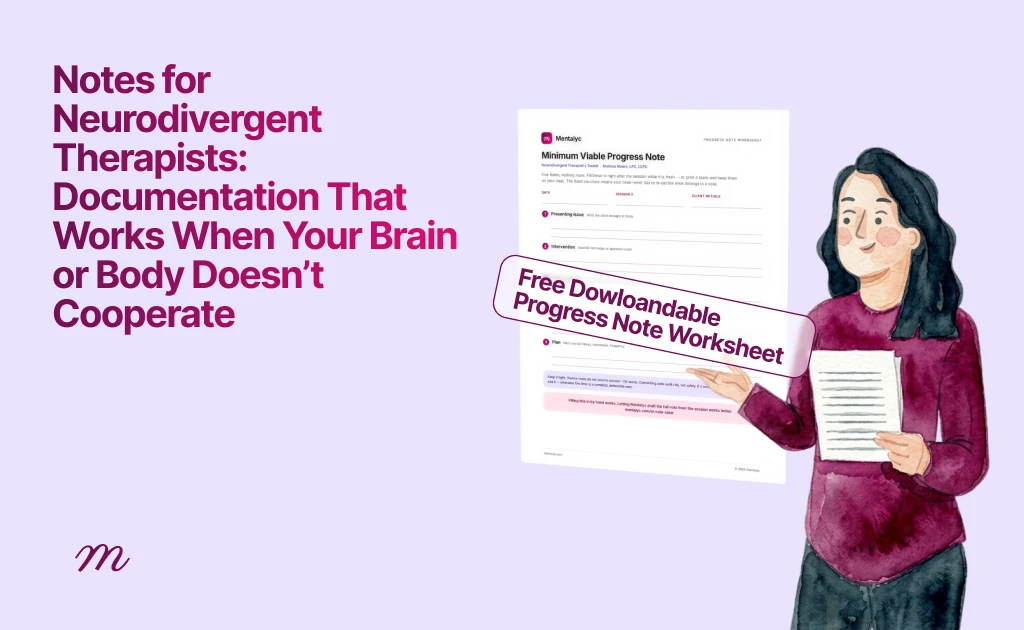
Practical worksheet (PDF). A template for progress notes that is kept to the minimum required fields – short and precise, ideal for a neurodivergent clinician.
What should I try this Monday? A quick-start checklist.
If you only have time to act on three things this week, pick three from the list below. Each one is a documented strategy from working neurodivergent therapists, not generic advice.
Spend less time writing, more time with clients.

- Set a 2-Pomodoro notes block on your calendar today. Two 25-minute focused blocks usually clear a clinical day’s notes. Schedule them like a client appointment, not a hope.
- Open the EHR note within 30 seconds of session end. Three sentences captured now save 20 minutes of reconstruction later.
- Choose your minimum viable note (MVN). Five required elements only: presenting issue, intervention, response, risk, plan. Templates in the section below.
- Try Mentalyc’s AI Note Taker on one session this week. With client consent, let the AI draft the note from the session audio. Review, edit, save.
- Block a 5-minute buffer between every telehealth session. Not for emotional reset, for writing the first three sentences of the note while the session is still in your head.
- If you have a supervisor, decide what to disclose. You are not required to disclose ADHD, dyslexia, or AuDHD. Disclosure can unlock support. Read the letter template in the disclosure section before deciding.
- Set up three text expansion snippets today. Pick three phrases you type 20 or more times a week. Snippets in the ADHD strategies section.
Why does documentation get harder when your brain or body works differently?
Documentation gets harder because neurodivergent and physically disabled clinicians face an extra layer of mechanical friction on top of the cognitive load every therapist carries. Executive function, working memory, reading speed, writing speed, manual typing, and visual scanning are all involved in clinical documentation. Any one of those bottlenecks adds time, anxiety, and the risk of falling behind.
Picture an initial intake. The client has 5 to 6 goals, is speaking quickly, and you are trying to gather background while setting collaborative goals. You want to jot down notes but cannot keep up. You want to clarify but cannot get a word in. You try to stay present and capture everything, but the two tasks fight each other.
The reasons this gets harder for neurodivergent clinicians:
- Many neurodivergent people have trouble processing information quickly.
- Many neurodivergent people have difficulty prioritizing tasks or goals.
- Writing notes is overwhelming when you do not have systems that work.
- Remembering what insurance wants in your documentation is hard.
- The systems and tools most EHRs ship with were not designed for you.
If you are a neurodivergent mental health professional, you have probably asked: How can I be less overwhelmed? What can I do to make documentation easier? How do I find systems that work for me? What tools are available?
Marissa’s note: in supervision, the single biggest predictor I have seen of a neurodivergent therapist getting documentation under control is whether they treat it as a workflow problem instead of a willpower problem. Willpower runs out. Workflows do not.
How does ADHD affect therapist documentation?
ADHD affects therapist documentation at every step: task initiation (starting the note), sustained focus (finishing it), working memory (remembering what happened), executive function (deciding what to include), and the emotional regulation that makes falling behind feel like proof of incompetence rather than a solvable workflow problem. The fix is not willpower. The fix is externalizing the task.
Picture a full day in private practice. You have eight progress notes to write and no idea where to start. The first morning session is blurry. The avoidance grows. The pile gets bigger and the anxiety louder. If you have ADHD, focusing, sitting, and doing the task can feel impossible. Neurodivergent brains often find documentation boring, put it off, and watch it compound.
In our user surveys, a large share of Mentalyc users disclose ADHD. Using time-saving tools so you can focus on the work that actually serves your practice is what most of them point to as the change that mattered.
What does ADHD look like for working clinicians who have ADHD themselves?
Attention-Deficit Hyperactivity Disorder is a neurodevelopmental condition that can cause real disruption to the person living with it. Many individuals with ADHD have trouble holding attention, ignoring distractions, or filtering sensory input.
ADHD presents differently in adults than in children. Adults often become overwhelmed quickly, struggle with emotional regulation, and find executive functioning tasks (like note-writing) draining. Research from 2021 estimates 2.5 to 5 percent of adults have ADHD, and many remain undiagnosed because clinicians were never trained to recognize the adult presentation. ADHD frequently co-occurs with depressive disorders, anxiety disorders, and substance use disorders.
Adults with ADHD may struggle with employment, procrastinate, miss work, or run out of time. None of that disqualifies a therapist from being excellent at the clinical work. It just means the operating system underneath the clinical work needs a different setup.
How does ADHD show up across intake, progress, and discharge notes?
ADHD affects each documentation type differently. Tiffany Swift, interviewed below, has ADHD, dyslexia, hearing impairment, vision impairment, and congenital disabilities. She has talked publicly about how each layer affects what she can capture in session and what she can reconstruct after.
- Intake notes. Intake involves summarizing a large amount of background. With ADHD it is hard to remember all the details and harder to organize them. But intake is the foundation for the treatment plan, so a thin intake costs you for months.
- Progress notes. Progress notes happen after every session. Without proper strategies and tools the backlog grows quickly and the anxiety compounds.
- Discharge notes. Discharge requires you to conceptualize the whole arc of care. For ADHD therapists, summarizing a 6-month arc can feel disproportionately heavy compared to a single session note.
Each documentation type has its own bottleneck. The strategies below cover all three.
How do therapists with ADHD write progress notes faster?
Therapists with ADHD write progress notes faster by externalizing the task. The bottleneck is task initiation and sustained focus, not writing speed. Strategies that remove the “start from a blank page later” step work best: timer-bounded work blocks, body-doubling, collaborative documentation done with the client present, opening the note the moment the session ends, or AI scribes that draft the note during the session itself.
When documenting, you are constantly making micro-decisions about medical necessity, what belongs in a progress note, what to follow up on at intake. That decision load is what stalls many ADHD therapists. The strategies below all reduce decision load.
- Collaborative documentation. Finishing the progress note with the client still in the room (or on the screen) eliminates the recall problem. Some ADHD therapists find this easier; others find it splits their attention. Try both before deciding.
- The Pomodoro technique. 25-minute focused work blocks followed by 5-minute breaks. Many ADHD therapists report this is the single most reliable rule for getting notes done. Two to four Pomodoros usually clears a clinical day’s notes.
- Open the note the moment the session ends. Open the EHR note within 30 seconds of the client logging off. Three sentences captured now save 20 minutes of reconstruction later. This is the most-repeated tactic in r/therapists ADHD threads.
- Virtual body doubling. Focusmate lets you book a 25, 50, or 75-minute working session with another person on video. The free tier (verified in 2026) is 3 sessions per week. You state your task, both work silently with cameras on, then check in at the end.
- Text expansion shortcuts. Tools like aText, TextExpander, Espanso, or your EHR’s built-in macros let you type three characters and get a full sentence. Build snippets for the phrases you write 50 times a week. This removes decision fatigue and protects you from underwriting. Starter library below.
- Templates. A short fixed template with slots for presenting issue, intervention, response, risk, and plan removes the “what do I include?” decision. Most EHRs support custom templates per note type.
- Body-doubling with another therapist. A recurring 60-minute Zoom session with a peer (cameras on, mics off) replicates the Focusmate effect with someone who understands clinical context.
- AI note-takers that produce clinically structured notes. Mentalyc’s AI Note Taker writes the progress note from the session recording in under two minutes, in your chosen clinical format (SOAP, DAP, BIRP, EMDR, intake, discharge, and more). The structure is externalized for you, so an ADHD brain does not have to re-decide what belongs in each section every time. You edit and approve before saving. For most ADHD therapists in our interviews, this is the single biggest workflow change.
- Automated progress tracking across sessions. Working memory is one of the bottlenecks ADHD therapists name most often. Mentalyc’s AI Progress Tracker extracts symptom trends, treatment goal attainment, and therapeutic alliance shifts directly from session content, no client questionnaires required. Walking into next week’s session, you see the trajectory without rereading three months of notes.
Marissa’s note: the most underrated tactic on this list is opening the note within 30 seconds of session end. It feels too small to matter. It is the difference between a 5-minute task and a 30-minute task.
Ready-to-paste text expansion snippets
Set up these triggers in TextExpander, aText, Espanso, or your EHR’s macro feature. Type the trigger, get the full phrase. Semicolon triggers work because most EHRs ignore them in autocomplete. Adjust to your workflow.
| Trigger | Expands to |
|---|---|
;pp
|
Client presented with anxious mood and reported difficulty with [specific area discussed]. |
;interv
|
Intervention focused on [technique] to address [target symptom or pattern]. |
;resp
|
Client engaged actively with the material and demonstrated [insight / affect shift / behavioral commitment]. |
;risk0
|
Client denied current suicidal ideation, homicidal ideation, and intent to harm self or others. Protective factors remain in place. |
;risk1
|
Client endorsed passive suicidal ideation without plan, means, or intent. Safety plan reviewed and updated. Lethal means restriction discussed. Crisis resources confirmed. |
;plan
|
Plan: continue weekly individual therapy. Focus next session on [specific topic]. Homework assigned: [task]. |
;med
|
Medical necessity supported by client’s continued [symptoms / functional impairment] and active engagement in goal-directed treatment. |
;rapp
|
Therapeutic rapport remains strong, evidenced by open disclosure and consistent attendance. |
;cbt
|
CBT-based intervention applied to [target cognition]. Specifically reviewed [cognitive distortion] and practiced [reframe technique]. |
;dap
|
Data: [client report]. Assessment: [clinical interpretation]. Plan: [next steps]. |
HIPAA reminder: never store identifiable client information inside the snippet itself. Snippets are templates. The EHR is where PHI lives.
What are the ADHD productivity rules (24-hour, 1-3-5, 5-3-1, 10-3, 30%, 20-minute, Pomodoro)?
The ADHD productivity rules are shorthand frameworks for bounding tasks so an ADHD brain can actually start them. Each one targets a different bottleneck: time decay, prioritization, focus capacity, or planning accuracy. For ADHD therapists, the most useful for documentation are Pomodoro, the 24-hour rule, and 1-3-5. The others are worth knowing because clients and supervisors will reference them.
- The Pomodoro technique. 25 minutes of focused work, 5-minute break, repeat. It bounds the task and creates a sense of urgency.
- The 24-hour rule. Write every progress note within 24 hours of the session. By hour 48 the cognitive cost of reconstructing the session rises sharply, while the cost of writing it sooner stays roughly constant.
- The 1-3-5 rule. Pick 1 big thing, 3 medium things, 5 small things to accomplish in a day. For a clinical day that is often 1 long intake note, 3 progress notes from harder sessions, 5 quick notes from straightforward sessions. Caps your ambition so you actually finish.
- The 5-3-1 rule. A micro-loop: 5 minutes of planning, 3 minutes of action, 1 minute of reflection. Useful when a single note has stalled you out.
- The 10-3 rule. 10 minutes of work, 3 minutes of movement. Useful when 25-minute Pomodoros are too long, for example when medication is wearing off at the end of a clinical day.
- The 30% rule. Assume any ADHD-related time estimate is off by about 30%. If you think notes will take an hour, block 90 minutes. A planning correction, not a productivity hack.
- The 20-minute rule. Commit to 20 minutes on the task with permission to stop after. Most ADHD therapists report they continue past 20 minutes about 80% of the time. Starting is what was hard.
None of these are clinical rules. They are behavioral frameworks. Pick one or two that match your work pattern and ignore the rest.
How do I stop overwriting progress notes when I have ADHD?
Overwriting happens because ADHD hyperfocus plus perfectionist fear of “missing something” produces three-paragraph notes when one paragraph was the assignment. Overwriting is not safer than underwriting. Too much detail can include information you should not have documented and creates audit risk.
Three fixes that work:
- Define your “minimum viable note” before you start. Pick the five required elements (presenting issue, intervention, response, risk assessment, plan) and write only those.
- Set a maximum. No note longer than 150 words for routine sessions. The cap forces a justification when you exceed it.
- Let an AI scribe generate a tight summary by default. Edit up if a session truly warrants more, rather than edit down from a 400-word draft.
Minimum viable note (MVN) templates
Three scaffolds you can copy into your EHR. Word counts are approximate targets, not rules. The point is to externalize the structure so an ADHD brain does not re-decide it every session.
Intake MVN, target 250 to 350 words:
Presenting concern: Client presents with [primary symptom], duration [X weeks/months], intensity [scale]. Reports [functional impact: work, sleep, relationships].

History: Onset [when]. Triggers [if known]. Prior treatment [yes/no]. Family history relevant: [yes/no, specify].

Risk assessment: SI [denied/endorsed]. HI [denied/endorsed]. Plan/means/intent if relevant. Protective factors [list].

Mental status (brief): Appearance, affect, speech, thought process, insight/judgment.

Diagnostic impression: [DSM-5-TR code and name]. Rule-outs [list]. Confidence [provisional/confirmed].

Treatment plan: Modality [CBT / EMDR / ACT]. Frequency [weekly]. Initial goals [2 to 3 collaborative goals]. Outcome measures [PHQ-9, GAD-7].

Plan for next session: [Specific focus or intervention].
Progress note MVN, target 100 to 150 words:
Presenting issue this session: [What the client brought in today].
Intervention: [Specific technique used].
Client response: [How they engaged, shifts in affect, insight, homework completion].
Risk: [SI/HI denied OR specify and document plan].
Plan: [Next session focus, homework assigned, frequency].
Discharge MVN, target 200 to 300 words:
Treatment summary: Client received [N sessions] of [modality] from [date] to [date] for [primary diagnosis].
Goals reviewed: [Met / partially met / not met / replaced].
Outcome measures: [Baseline vs final].
Client's reported gains: [Symptom, behavior, functional changes].
Reason for discharge: [Mutual agreement / goals met / referred out / lost contact].
Recommendations: [Continued self-care, referrals, follow-up cadence].
Risk at discharge: [SI/HI denied. Safety plan in place if relevant.]
Marissa’s note: copy your EHR’s built-in template first if it is good. The MVN is a fallback when the EHR template is bloated.
Are people with ADHD good therapists?
Yes. Many therapists with ADHD report their lived experience gives them faster pattern recognition for ADHD clients, deeper empathy across neurodivergence, and more creative case formulation. Documentation friction is real, but it is a workflow problem, not a competence problem. Fixing the workflow (especially by removing manual note-writing) fixes most of it.
Can you still be a therapist with ADHD?
Yes. ADHD is not a disqualifying condition for any state mental health licensing board. Most boards only require disclosure of conditions that currently impair safe practice. Having ADHD is not the same as being currently impaired. Tiffany Swift, interviewed below, is a licensed clinician with ADHD running her own practice.
Watch: a clinician with ADHD on what changed when she stopped writing notes manually
Interview with Tiffany Swift (a Licensed Professional Counselor with ADHD)
Tiffany Swift is one of our users. She has ADHD, dyslexia, hearing impairment, vision impairment, and congenital disabilities. She told us:
“Mentalyc is very detailed. It’s an amazing feature that you guys can capture all the details. If we did this on our own, it’s very easy to miss information, so you don’t have to concentrate as heavily on getting all the details. You just let the person talk.”
She also talked about time. Notes used to take her between one and two hours at the end of her day. With Mentalyc, writing a note takes a couple of minutes. She says the tool has alleviated the anxiety she felt about insurance audits and helped her stay present with clients. She has advocated for her own disability accommodations and models that advocacy for her clients.
In combination with an AI note-taker, many therapists with ADHD also use grammar checkers like ProWritingAid, Grammarly, and Hemingway Editor to catch errors before saving. None of these are HIPAA-compliant, so do not paste identifiable client information into them.
Note-taking for ADHD telehealth therapists
Telehealth therapists with ADHD face a sharper version of the documentation problem. The screen is the same surface as the EHR, the calendar, your email, and every distraction. Switching apps inside the same window your brain is already overwhelmed by is its own tax. Three adjustments help.
Write less, focus more
- SOAP, DAP, BIRP, EMDR notes and more
- AI Treatment Planner
- AI Progress Tracker
- Alliance signals
- HIPAA & PHIPA compliant

- Use a second screen. Keep the EHR note open on a side monitor during the session so the moment the client logs off you are already in the right window.
- Build a 5-minute buffer between sessions. Not for emotional reset, for writing the first three sentences of the note while the session is still in your head.
- Use AI session capture. With client consent, a HIPAA-compliant AI note-taker like Mentalyc records the session audio and drafts the note. For ADHD telehealth therapists this removes the cross-screen attention switch entirely.
Note-taking for ADHD grad students, interns, and trainees
Trainees with ADHD have less control than solo private-practice therapists. There is no salary cushion, supervisors review every note, and you are learning clinical documentation at the same time as managing ADHD. Five adjustments that help:
- Disclose strategically to your supervisor, not your clients. Supervisors typically have flexibility on note deadlines and format if they understand what you are managing. Clients do not need to know.
- Use the supervisor’s preferred template literally. Originality on note structure costs you supervision time. Copy your supervisor’s exact section headings.
- Request written feedback on notes, not verbal. ADHD working memory struggles to hold a 10-minute verbal feedback session. Written notes you can reread are accommodating.
- Front-load notes during practicum. Doing notes right after the session matters more during training because supervisors review them faster than in independent practice.
- Ask whether AI note-takers are permitted in your training site. Many training sites now allow HIPAA-compliant AI scribes for trainees, some prohibit them. Always confirm before using.
Documentation when ADHD co-occurs with anxiety, depression, burnout, or demand avoidance
ADHD rarely shows up alone. For practicing therapists, the most common co-occurring conditions affecting documentation are generalized anxiety, depression, burnout, and demand avoidance. Each compounds ADHD differently.
- ADHD with anxiety. Fear of getting a note “wrong” stalls the start. Anxiety adds a perfectionist edit loop on top of ADHD initiation problems. You can write the note in 10 minutes but spend 40 second-guessing. Fix: time-cap with Pomodoro, use a template you trust, accept that 80% of notes are routine and do not need polish.
- ADHD with depression. Energy is the bottleneck. The 1-3-5 rule and the 10-3 rule are better fits than full Pomodoros when depressed energy is low. Body-doubling helps. Willpower does not.
- ADHD with burnout. Documentation accumulates fastest when burnout sets in. The single most important intervention is reducing caseload before notes pile up, then using AI scribes to clear the backlog. If you are already deep in burnout, manual catch-up is unlikely. Consider an AI scribe specifically to rebuild a current note position.
- ADHD with demand avoidance (PDA). Some neurodivergent therapists experience pathological demand avoidance, a strong, often involuntary resistance to perceived demands, including ones you set for yourself. Reframing notes as a choice (“I am keeping my practice safe”) rather than a demand (“I have to do notes”) reduces the resistance for many. AI scribes that remove the felt sense of demand entirely often help more than productivity systems do.
How does AuDHD (combined autism + ADHD) affect therapist documentation?
AuDHD therapists experience both autistic and ADHD traits, and the documentation challenges combine accordingly. ADHD adds task-initiation and sustained-focus difficulty. Autism adds sensory load, social-energy depletion after sessions, and often a need for predictable structure. The combination means many AuDHD therapists need both the bounded-task rules (Pomodoro, 1-3-5) and quiet sensory recovery time between sessions before they can write notes.
Specific patterns AuDHD therapists report:
- Sessions cost more spoons than for neurotypical therapists. The masking, the emotional attunement, and the sensory environment of a session draw down energy that documentation also requires. Build longer buffers than you think you need.
- Predictable structure is calming, not boring. Templates matter even more than they do for ADHD-only therapists because predictable structure reduces decision load and sensory overwhelm.
- Voice-to-text bypasses some social-energy load. Even alone, typing involves a kind of internal performance. Speaking can feel less effortful.
- Disclose selectively. AuDHD identification is newer and less understood than ADHD or autism alone. Disclosure can unlock support but often requires educating your supervisor.
We are recruiting AuDHD therapists for a future interview to add a verbatim story to this section. If that is you, reach out.
How does dyslexia affect therapist documentation?
Dyslexia affects therapist documentation in three places: reading speed (slower review of intake notes and prior progress notes), writing speed (slower drafting), and spelling/decoding (more errors that take longer to catch). The cumulative tax can double the time required for documentation. The good news: every one of those bottlenecks has a high-quality assistive tool.
What is dyslexia, and how does it show up at work?
Dyslexia is a neurodevelopmental disorder that affects the accuracy and speed of decoding words. People with dyslexia have trouble with language: decoding terms, figuring out the sounds associated with letters, holding spelled words in working memory.
Common symptoms include trouble recognizing unfamiliar words, difficulty with reading fluency, challenges with spelling, labored oral reading, trouble writing words, difficulties with reading comprehension, trouble with working memory, reversing letters in a word, and difficulty with organization. Not every person with dyslexia has every symptom.
Dyslexia is typically diagnosed in childhood but persists into adulthood. It is genetic. According to the International Dyslexia Association, there is no link between dyslexia and intelligence. Dyslexia is also commonly comorbid with ADHD (many therapists, including Tiffany Swift, have both) and with dysgraphia, which compounds the typing-and-handwriting difficulties.
How does dyslexia affect mental health professionals who take notes?
If you have dyslexia, note-taking and documentation can feel overwhelming. Listening during a session and trying to jot down notes at the same time is exhausting. Recalling all the details afterward and writing a coherent note is harder when getting a hold of your thoughts is its own task. You may reverse letters, spell words wrong, or struggle to read back what you wrote.
Your brain may struggle to summarize the session into a comprehensive progress note. All the information required in intakes, progress notes, and discharge notes still has to be there. If you cannot summarize and demonstrate medical necessity, an insurance audit becomes much harder.
Reading comprehension and processing speed deficits mean reviewing your own notes between sessions takes longer. Research on dyslexia confirms slower reading speeds in adults compared to non-dyslexic peers, which makes pre-session prep and between-session note review meaningfully more expensive.
The fix in almost every case: do not type the first draft. Dictate it, then run the draft through a grammar checker. Or skip the draft entirely with an AI note-taker.
How do I take notes if I am dyslexic? Tools that work for therapists with dyslexia.
For a dyslexic therapist, the answer almost always involves not typing the first draft. The fastest path is to dictate using voice-to-text (you can speak faster than you type and dictation also bypasses the spelling friction), then run the draft through a grammar checker before saving. AI note-takers go further by removing the writing step entirely.
Proofreading and grammar-checkers
These catch spelling and grammar errors before notes are saved. None are HIPAA-compliant, so never paste protected health information into them. Use them on de-identified drafts.
- Grammarly. Reviews text for clarity, grammar, spelling, punctuation, and style. Suggests revisions.
- ProWritingAid. Editing and proofreading tool with detailed reports on syntax, structure, and style.
- Hemingway Editor. Helps simplify complex sentences and reduce sentence-structure errors. Has a spell-check.
Voice-to-text dictation
For dyslexic therapists, dictation is often more comfortable than typing. The output usually has punctuation and grammar errors, but pairing dictation with a grammar checker handles that.
- Dragon Medical. The only widely-used dictation tool with a HIPAA-compliant tier. Paid. Three times faster than typing.
- Google Docs voice typing. Free, browser-based. Not HIPAA-compliant. Never use for PHI.
- Apple Dictation. Free, built into macOS. Not HIPAA-compliant. Never use for PHI.
- Braina. Windows-based personal assistant. Supports over 100 languages.
AI note-writing tools
The single highest-leverage change for dyslexic therapists.
Mentalyc’s AI Note Taker writes the progress note from the session recording in under two minutes. You choose the note format, Mentalyc handles the rest. It is HIPAA-compliant and provides client consent forms.
Tiffany, who has both ADHD and dyslexia, told us:
“For a person with dyslexia, it saves on writing out a lot of material as well as second-guessing yourself, because we tend to make a lot of common errors along the way. Also, it takes out the worry you go through when writing notes.”
Be careful with other AI tools. ChatGPT is not HIPAA-compliant and should never be used on PHI. Always get client consent, and verify the HIPAA-compliance status of any AI tool before using it on real client information.
Marissa’s note: the dyslexic therapists I supervise are some of the most thorough clinicians I know, because the reading effort cost forces them to slow down on consent forms and intake paperwork in ways neurotypical therapists often do not. Their notes get better when the spelling and decoding tax is removed, never worse.
What about therapists with vision impairment, carpal tunnel, or motor differences?
Therapists with vision impairment, carpal tunnel, or other motor differences face the same documentation requirements as everyone else, with the added barrier that the standard tools (typing on a keyboard, reading a screen) are themselves the source of pain or fatigue. The answer is the same as for dyslexic therapists: move documentation off the keyboard entirely (into dictation, voice capture, and AI scribes), and use assistive hardware to make whatever screen work remains less painful.
What is carpal tunnel?
Carpal tunnel syndrome causes numbness and tingling in the hand, often painful, caused by pressure on the median nerve. Causes include repetitive hand movements, hormonal changes, blood sugar changes, family history, bone or joint disease, and wrist injuries. Many people experience grip weakness. Treatment ranges from hand splints, medication, and surgery to lifestyle changes and exercise. Consult a medical professional for diagnosis and treatment.

What is vision impairment?
Vision impairments range from mild vision loss to total blindness. Unlike refractive errors, vision impairments cannot be corrected with glasses. Symptoms include eye pain, blurry vision, floaters, light sensitivity, dark spots, and rapid loss of vision. Treatment depends on the underlying condition. See a medical professional for rapid vision changes.
Assistive devices for vision impairment and carpal tunnel
For carpal tunnel: wrist brace, ergonomic mouse, wrist cushion, ergonomic pen, mouse cushion. These adjust posture and reduce strain.
For vision impairment: text-to-speech readers (JAWS, NVDA, Apple VoiceOver, Microsoft Narrator), Braille assistants for smartphones, Braille embossers, and built-in screen magnification (available on both macOS and Windows).
Dictation tools for carpal tunnel and vision impairment
If you have carpal tunnel, extended typing is painful. If you have vision impairment, extended screen time is exhausting. Dictation solves both: you can speak faster than you can type, and you do not need to stare at the screen while drafting.
Popular dictation tools: Dragon dictation (Dragon Medical has a HIPAA-compliant tier), Apple dictation, Winscribe, Microsoft dictation, Google Docs voice-to-text. Verify HIPAA compliance before transcribing any identifiable client information.
Mentalyc offers HIPAA-compliant dictation. One of our users, Matthew, told us:
“If your client didn’t want to be recorded, you could use the dictation option.”
Matthew noted that dictation creates specific note formats like SOAP or DAP, useful when clients prefer not to be recorded.
Interview with Dr. Matthew Meyers (a psychotherapist with cerebral palsy, vision impairment, and carpal tunnel)
Matthew Meyers is a psychotherapist with 21 years of experience and a Mentalyc user. He was born with cerebral palsy affecting the left side of his body. He is blind in his right eye, his left hand is not usable, and he has carpal tunnel from overuse of his right hand. He has talked openly with us about working with “half a battery.”
Documenting sessions while staying present with clients and typing with one working hand is its own challenge. Like many therapists, Matthew has felt overwhelmed by documentation. The disabilities added to that challenge.
He tried other tools for writing therapy notes before Mentalyc:
“I tried multiple platforms to take notes through EHRs, and other applicable programs. It wasn’t working out for me. It was still creating barriers.”
When he found Mentalyc, he was not sure such a tool existed:
“I was looking for something to relieve this difficult task for me. I was in awe. The first time I saw it, it was like Christmastime. It was what I was looking for.”
He values the accuracy, the continued improvements, the multiple note formats, and the speed. Since starting Mentalyc, he sees more clients than he did before.
His advice:
“I think it’s a game-changer in the industry. Note-taking, paperwork, it’s stressful for providers. It’s something to help compliance and is good for capturing the session. My advice is to lean into it just as I did, and experience it and test it out.”
Cross-condition strategies: frameworks worth knowing
Some note-taking frameworks travel well across conditions because they all reduce cognitive load.
- Cornell Method. Page split into a left column for prompts, a right column for notes, and a bottom summary section. For clinical notes the left column holds your template prompts (“Presenting issue:”, “Intervention:”, “Plan:”) and the right column holds content. Useful for ADHD because it externalizes structure.
- Mind mapping. Central client name or session theme with branches for symptoms, interventions, response, follow-up. Visual learners and many ADHD therapists prefer this for in-session capture, then convert to prose for the formal note.
- The spoon theory of energy management. Each day is a fixed number of energy units (spoons). Sessions, supervision, documentation, life admin all cost spoons. Useful for neurodivergent therapists who routinely overcommit because it gives numeric language for “I cannot take this on without burnout.”
- Sound to focus. Many ADHD therapists report instrumental music, brown noise, or binaural beats help during note-writing blocks. Noise-canceling headphones reduce the executive cost of filtering ambient distraction.
- Movement breaks between sessions. A short walk resets attention. Research on adult ADHD shows even 30 minutes of aerobic exercise improves cognitive control. Schedule the walk into your day, do not hope you will find one.
Tools that help across conditions: side-by-side comparison
Different tools solve different bottlenecks. This table maps the most common documentation pain points to the tool category that addresses them.
| Tool category | Best for | Cost | HIPAA status | Limitations |
|---|---|---|---|---|
| HIPAA-compliant AI note-takers (Mentalyc) | ADHD task initiation, dyslexia writing friction, carpal tunnel/vision typing limits. Produces structured SOAP, DAP, BIRP, EMDR, intake, and discharge notes from the session. Removes both the drafting step and the structuring decisions. | Paid, free trial available | HIPAA-compliant | Requires client consent. |
| AI progress trackers (Mentalyc AI Progress Tracker) | ADHD working memory load, dyslexia rereading cost. Tracks symptom trends, goal attainment, and alliance shifts across sessions automatically. | Paid (from $14.99/mo), 14-day free trial | HIPAA-compliant | Works alongside or instead of scored measures (PHQ-9, GAD-7). |
| Voice-to-text professional tier (Dragon Medical) | Dyslexia, carpal tunnel, vision impairment | Paid | HIPAA-compliant | Mac/Windows only. Learning curve. |
| Voice-to-text consumer tier (Apple, Google Docs voice, Microsoft) | Personal use only. Never for PHI. | Free | Not HIPAA-compliant | Cannot legally be used for identifiable client information. |
| Grammar/proofreading (Grammarly, ProWritingAid, Hemingway) | Dyslexia, dysgraphia | Free to paid | Not HIPAA-compliant. Never paste PHI. | Editor only. Does not draft for you. |
| Body-doubling apps (Focusmate) | ADHD task initiation | Free (3 sessions/week) to $8/mo Plus | N/A (no client data) | Requires scheduled commitment. |
| Pomodoro timers | ADHD focus blocks | Free | N/A | Self-discipline required to honor the timer. |
| EHRs with collaborative documentation (TherapyNotes, SimplePractice, Theranest) | ADHD, dyslexia (when used as collaborative documentation with the client) | Paid | HIPAA-compliant | Designed for general clinical workflow, not specifically for neurodivergent therapists. |
| Text expansion tools (aText, TextExpander, EHR macros) | ADHD overwriting, dyslexia spelling | Free to paid | N/A (templates only, never store PHI) | Need to build your snippet library. |
| Assistive devices (wrist brace, ergonomic mouse, Braille embosser, text-to-speech reader, screen magnifier) | Carpal tunnel, vision impairment | Varies | N/A | Hardware fixes the physical bottleneck, not the cognitive load. |
Mentalyc’s AI Note Taker and the AI Progress Tracker cover two of the three biggest cognitive bottlenecks for neurodivergent therapists: the drafting step and the cross-session working memory load. Both are HIPAA-compliant and used today by Tiffany and Matthew (interviewed in this guide). For most neurodivergent therapists in our interviews, the structured-notes plus progress-tracking combination is the single biggest leverage point.
Disclosure, accommodations, and your rights
You are under no obligation to disclose a neurodivergent diagnosis or disability to your supervisor, licensing board, or clients. The choice is yours. There are protections and trade-offs worth understanding before you decide.
What are reasonable accommodations for ADHD or disability in a clinical workplace?
Reasonable accommodations for therapists with ADHD or other disabilities typically include AI note-taking software, voice-to-text dictation tools, a quieter workspace, flexible documentation deadlines, modified caseload size, written instead of verbal instructions for admin tasks, ergonomic equipment, screen readers or magnifiers, and additional supervision time on documentation. The ADA requires employers to provide an effective accommodation, not necessarily your preferred one.
Workplace under the ADA. If you are an employee (not a 1099 contractor in private practice), the Americans with Disabilities Act requires employers with 15 or more employees to provide reasonable accommodations for a documented disability. You typically need diagnostic documentation and an interactive process with HR or your supervisor to request them.
Licensing boards. Most state mental health licensing boards do not require disclosure of ADHD, dyslexia, or other neurodivergent conditions on license renewal. They require disclosure only of conditions that currently impair safe practice. Having ADHD is not the same as being currently impaired. Read your state’s exact language and consult a licensing attorney if you are unsure.
Disclosing to clients. Whether to tell clients you are neurodivergent is a clinical and personal call. Some therapists never disclose, some disclose selectively when relevant to the therapeutic frame. There is no professional rule that requires either choice. Tiffany Swift has spoken about advocating for herself and modeling that advocacy for her clients.
Disclosing to supervisors. A relational decision. Disclosure can unlock concrete support (more supervision time on documentation, peer matching, tool recommendations) but exposes you to a supervisor’s biases. Vet supervisors before disclosing.
If a workplace or supervisor responds to an accommodation request with hostility or retaliation, the EEOC handles ADA discrimination complaints. Documentation of every request and response is essential before filing.
Sample ADA accommodation request letter
A starting-point template you can adapt. Have it reviewed by an employment attorney for high-stakes requests.
To: [HR contact name and title]
From: [Your name, license, role]
Date: [Date]
Re: Request for reasonable accommodation under the Americans with Disabilities Act

Dear [HR contact],

I am writing to formally request reasonable accommodations under the Americans
with Disabilities Act in connection with my role as [position title].

I have a documented diagnosis of [condition, e.g. ADHD, dyslexia, AuDHD, carpal
tunnel] that substantially affects [specific work functions, e.g. sustained
focus on documentation, reading speed, prolonged typing]. Documentation from
my treating provider is attached.

Based on my role and the nature of my condition, the following accommodations
would enable me to perform the essential functions of my job effectively:

1. [Accommodation 1, e.g. permission to use a HIPAA-compliant AI note-taker].
2. [Accommodation 2, e.g. extended documentation deadlines from 24 to 72 hours].
3. [Accommodation 3, e.g. ergonomic equipment: vertical mouse, wrist rest].
4. [Accommodation 4, e.g. written rather than verbal supervision feedback].

I am happy to engage in an interactive process to discuss alternative
accommodations that would be equally effective for the organization. I am
also open to a trial period to evaluate effectiveness.

Please confirm receipt of this request and let me know the next steps.

Sincerely,
[Your name]
[License number]
[Contact information]
A note for supervisors of neurodivergent therapists
If you supervise a clinician with ADHD, dyslexia, AuDHD, or another neurodivergent condition, the most useful thing you can do is reduce the cost of disclosure. State openly that the practice or training site supports neurodivergent clinicians. Offer flexible documentation deadlines, written feedback when relevant, and explicit permission to use AI scribes and dictation. Treat your supervisee’s tools and workarounds as competence, not accommodation. Trust built this way usually reduces documentation lag faster than any policy intervention.
FAQ
The bottom line
Neurodiversity covers a wide range of conditions in which a person’s brain develops differently from what is viewed as typical. Neurodivergent people do not have something wrong with them that needs to be cured. They have brains that work differently and need workflows that respect the difference. The same is true for therapists with physical disabilities. Limitations do not have to define a practice. They shape which tools you reach for.
The benefits of choosing the right tools are real: time, energy, lower stress, and attention freed up for the clinical work that matters. The next insurance audit gets less terrifying. The end of the clinical day gets shorter.
The experiences of Tiffany and Matthew show that the right tools are out there. The hardest part is letting yourself use them.
If you want to remove the two biggest cognitive bottlenecks at once, try Mentalyc. The AI Note Taker writes clinically structured notes (SOAP, DAP, BIRP, EMDR, intake, discharge) from the session in under two minutes, so an ADHD brain does not have to re-decide the structure every time. The AI Progress Tracker follows symptom trends, goals, and alliance across every session, so working memory is not the bottleneck between Tuesday’s note and next week’s session. Both are HIPAA-compliant and used today by Tiffany and Matthew, the clinicians interviewed in this guide.
About the clinicians interviewed
Tiffany Swift is a Licensed Professional Counselor who owns Swift Counseling. Tiffany provides virtual therapy to clients in Missouri. Her specialties include trauma, PTSD, internal personality struggles, spirituality, and relationship conflicts.
Dr. Matthew Meyers is a California Licensed Professional Clinical Counselor and Nationally Board Certified Counselor, also licensed in Nevada and Florida, who serves clients via telehealth. He specializes in anxiety, work-related stress, relationships, and self-esteem.
References
- Cleveland Clinic. (2022). Neurodivergent. https://my.clevelandclinic.org/health/symptoms/23154-neurodivergent
- Cleveland Clinic. (2022). Blindness and low vision. https://my.clevelandclinic.org/health/diseases/24446-blindness
- Johns Hopkins University. (n.d.). Carpal Tunnel Syndrome. https://www.hopkinsmedicine.org/health/conditions-and-diseases/carpal-tunnel-syndrome
- Prakash, J., Chatterjee, K., Guha, S., Srivastava, K., & Chauhan, V. S. (2021). Adult attention-deficit hyperactivity disorder: From clinical reality toward conceptual clarity. Industrial Psychiatry Journal, 30(1), 23-28. https://doi.org/10.4103/ipj.ipj_7_21
- Hulme, C., et al. (2016). Reading disorders and dyslexia. https://journals.lww.com/co-pediatrics/fulltext/2016/12000/reading_disorders_and_dyslexia.11.aspx
- Franzen, L., et al. (2021). Individuals with dyslexia use a different visual sampling strategy to read text. https://www.ncbi.nlm.nih.gov/pmc/articles/PMC7979812/
- International Dyslexia Association. Dyslexia Basics.
- Swift, T. Personal Communication. (April 22, 2023).
- Focusmate. (2026). Pricing. Free tier 3 sessions per week confirmed June 2026.
Disclaimer: All examples of mental health documentation are fictional and for informational purposes only.
Why other mental health professionals love Mentalyc

“By the end of the day, usually by the end of the session, I have my documentation done. I have a thorough, comprehensive note … It’s just saving me hours every week.”
CDCII

“It’s so quick and easy to do notes now … I used to stay late two hours to finish my notes. Now it’s a breeze.”
Licensed Professional Counselor
“Having Mentalyc take away some of the work from me has allowed me to be more present when I’m in session with clients … it took a lot of pressure off.”
LPC

“It takes me less than 5 minutes to complete notes … it’s a huge time saver, a huge stress reliever.”
Licensed Marriage and Family Therapist