


Therapists evaluating Upheal reviews are often trying to decide whether transcription-driven AI documentation can keep up with real therapy sessions–especially when accuracy, modality support (like couples or family therapy), and workflow reliability matter.
This article breaks down how Upheal performs in day-to-day clinical use, where clinicians report strengths and limitations, and how Upheal compares with its alternatives, so you can decide whether it fits your practice needs in 2026.
Overview: What Is Upheal?
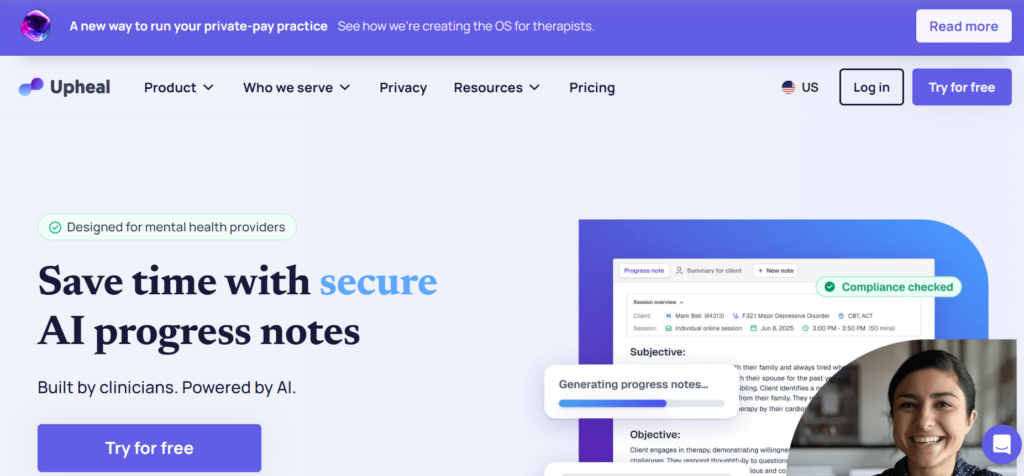
Upheal is an AI tool that helps therapists record sessions and create draft notes. It’s mainly used by solo clinicians and small or early-stage group practices that want basic help with documentation.
Therapists can record sessions, upload files, or connect Upheal to some telehealth platforms. The tool focuses on saving time by turning session audio into summaries and simple metrics. These features can be helpful for quick documentation, but they are mostly focused on capturing what happened in a session, rather than showing how a client is changing over time or how treatment is progressing across multiple sessions.
Spend less time writing, more time with clients.

Upheal Note-taking Review – Real Upheal Therapist Experience
Many clinicians appreciate Upheal’s real-time transcription and session-insight features, particularly for individual therapy sessions where a single speaker is easy to capture. However, public feedback highlights limitations around modality support and transcription accuracy, especially for family therapy, couples work, and multi-speaker sessions.
Some therapists report that advertised support for family therapy does not translate smoothly into practice:
“This software oversells and underdelivers.… they claim to support this modality. Unfortunately, this is a misleading claim. Upheal is not set up to capture family sessions.”– Danielle Drake, via Trustpilot
Others note speaker-identification issues and inconsistent capture, which can undermine confidence in relying fully on transcripts:
“…it doesn’t always accurately record the sessions. It reads my voice as client and doesn’t record the client’s voice accurately…”– Mary, via Trustpilot
These reviews suggest that while Upheal can be helpful for straightforward, single-client sessions, clinicians working with families, couples, or phone-based sessions may need to double-check transcripts or manually adjust notes, reducing overall time savings.
Key Takeaways – Upheal Review 2026
| Area | Summary |
|---|---|
| Core strength | Real-time transcription and session analytics |
| Primary limitation | Accuracy issues in complex, multi-speaker sessions |
| Best fit | Solo therapists & small groups using transcription workflows |
| Modality support | Individual therapy works best; family/couples can be manual |
| Compliance | HIPAA, PHIPA, SOC 2; BAA available |
| Pricing model | Free tier + tiered paid plans |
| Workflow type | Documentation + analytics companion (not a full EHR) |
Who Upheal Is Best For
Upheal is best suited for clinicians who want AI help with transcription, basic documentation, and session summaries. It works well for therapists who mainly need basic note creation and don’t mind editing them later on; since it is not widely known for producing clinically in-depth notes out of the box.
Many clinicians find that the generated notes still require manual editing to fully reflect clinical judgment, treatment intent, and medical-necessity language. As caseloads grow and care becomes more complex, therapists often look for tools that do more than summarize sessions – tools that connect notes across sessions, track progress over time, and support treatment planning and clinical decision-making.
| Clinician Type | Fit | Notes |
|---|---|---|
| Solo therapists | ✅ Good | Works best for straightforward individual sessions |
| Small group practices | ⚠️ Limited | Basic shared insights, but coordination still requires manual effort |
| Family / couples therapists | ❌ Weak | Notes often need significant manual adjustment to reflect multiple dynamics |
| High-volume clinicians | ❌ Poor | Transcription accuracy and editing time can become a bottleneck |
Upheal Features – In-Depth Upheal Review
Notes & Documentation
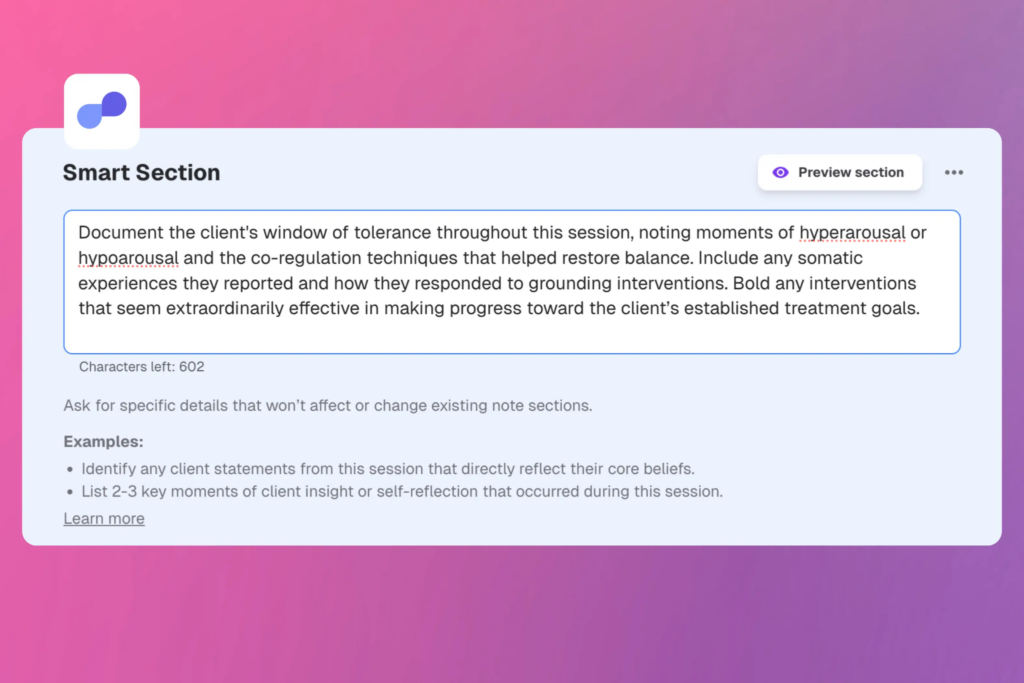
Upheal helps turn recorded sessions into draft therapy notes. These drafts can save time, but they are not clinically complete and usually need editing.
- Draft notes from recordings Notes are generated from audio or video sessions, but therapists still need to review and edit for accuracy, clinical judgment, and alignment with the treatment plan.
- Templates Structured formats are available, but many clinicians adjust them to match their preferred style or required formats like SOAP.
- Clinical depth Notes use general clinical language and often require manual refinement, especially for diagnosis-specific detail and medical necessity.
Bottom line: Helpful for first drafts, but not known for producing clinically in-depth notes without editing.
Recording & Transcription
Recording and transcription are central to how Upheal works.
- Sessions can be recorded live or uploaded through compatible telehealth integrations.
- Transcripts are created automatically, with accuracy depending on audio quality and session complexity.
- Therapists are responsible for client consent and should review data-retention settings.
This workflow works best for clinicians comfortable with recording sessions and reviewing transcripts.
Insights & Analytics
Upheal offers light session-level insights based on transcripts.
- Includes basic indicators like speaking balance and emotional tone but not alliance insights.
- Highlights recurring topics across sessions.
- Does not provide structured or measurable progress tracking over time.
These insights can support reflection but remain descriptive rather than clinically directive.
Group Practice & Workflow Fit
- Supervisors can review transcripts and draft notes from associates.
- Documentation can be shared across a team, but clinical review and coordination remain manual.
- Upheal is not an EHR; most clinicians export or copy notes into existing systems.
Security & Compliance
Upheal states compliance with HIPAA, PHIPA, and SOC 2, and offers a BAA. However, therapists should still review consent, storage, and privacy policies to ensure fit with their practice.
Write less, focus more
- SOAP, DAP, BIRP, EMDR notes and more
- AI Treatment Planner
- AI Progress Tracker
- Alliance signals
- HIPAA & PHIPA compliant

Upheal Pricing (2026)
Pricing is an important factor for therapists comparing documentation tools. Upheal offers tiered plans based on feature depth, session volume, and access to analytics.
| Plan Name | Cost | What’s Included |
|---|---|---|
| Free | US $0 / month | Unlimited notes via typed or dictated text summaries, manual upload of session recordings, telehealth video calls (without AI notes). |
| Starter (Individual) |
US $29 / month (or US $19 / month if billed annually) |
Everything in Free, plus support for all note types, live session capture (in-person or EHR/telehealth calls), Smart Edit, and note-template customization. |
| Premium (Individual) |
US $99 / month (US $69 / month if billed annually) |
All Starter features, treatment plans with “Golden Thread” documentation, custom AI prompts, telehealth with AI-generated notes, Compliance Checker, and advanced analytics. |
| Group / Enterprise |
Custom pricing (session-volume or organization-based) |
Team management, supervisory tools, SSO login, scalable session-based billing, enterprise-grade integrations, and onboarding support. |
What’s Included (depending on plan):
- Unlimited note creation (from summaries, uploads, or live sessions)
- Broad array of note templates (SOAP, DAP, GIRP, BIRP, EMDR, etc.)
- Live session capture (audio/video), session transcripts, and AI-generated clinical notes + treatment plans (Premium)
- Analytics dashboards, compliance checking, and customizable templates (Premium)
- Ability to integrate with EHR/telehealth systems, and export notes to existing EHRs via browser extension.
What’s Not Included:
- On Free plan: no live session capture with AI notes; only manual upload or text-based notes.
- Upheal is not itself a full EHR: scheduling, billing, or client-portal features are limited compared to dedicated EHR/PM platforms.
- For enterprise-level customization (workflow integrations, SSO, API access), you must reach out to sales rather than get a standard plan.
Value for Money
Upheal’s pricing is flexible, with a Free plan that lets therapists try the product with little commitment. This can be useful for clinicians who want to test AI-assisted note drafting before paying for a subscription. For solo therapists with lighter caseloads, the Starter plan may feel reasonably priced if the main goal is basic transcription and draft notes.
However, much of Upheal’s value depends on how much time clinicians are willing to spend reviewing and editing notes. While higher tiers add more features, the platform remains focused on documentation and light analytics rather than end-to-end automation.
Therapists who need deeper workflow support–such as strong EHR integration, built-in progress tracking, or tools that scale smoothly with high session volume–may find the cost harder to justify as needs grow. Overall, Upheal can make sense as a low-commitment starting tool, but its pricing may feel less compelling for clinicians or practices looking for a more comprehensive, long-term solution.
Upheal Pros and Cons
| Pros | Cons |
|---|---|
|
|
Final Verdict: Is Upheal Worth It for Therapists in 2026?
Upheal works best for therapists who want fast transcription, flexible ways to capture sessions, and basic progress monitoring. It’s a practical option for solo clinicians, associate therapists, or small group practices that want to reduce documentation time without changing their current systems. The platform is helpful for creating quick draft notes, using common templates, and reviewing simple session insights.

That said, most notes still need careful editing to meet clinical standards. Transcription can be less reliable in complex sessions, and Upheal does not offer deep EHR integration.
Because of this, it may not be the best fit for clinicians who want highly automated, compliance-ready documentation with minimal manual work. While Upheal remains competitive among transcription-focused tools in 2026, therapists looking for more complete documentation support may want to consider more advanced alternatives.
Best Alternatives to Upheal
If you’re comparing documentation tools in 2026, the main difference comes down to how much clinical depth and automation you actually want. While some tools focus mainly on transcription or admin workflows, others are built to support the full arc of therapy work. Below are the most relevant alternatives–starting with the strongest overall option.
Mentalyc – Best Overall for Therapists Who Want Complete Documentation Support
Mentalyc stands out as the most complete alternative to Upheal for therapists who want more than transcription or draft notes. Here are Mentalyc’s key strengths:
- Clinically structured therapy notes with minimal editing Notes are built from real session data and aligned with psychotherapy workflows, reducing manual cleanup.
- Purpose-built for mental health (not generic AI dictation) Designed specifically for therapy notes, treatment plans, and progress documentation.
- Audit-ready documentation with a clear golden thread Links goals → interventions → progress to support medical necessity and insurance reviews.
- Progress tracking without extra forms Tracks symptom and goal-related change across sessions without client questionnaires.
- Works with any EHR via one-click autofill Send notes directly into your existing EHR using the Chrome extension–no copy-paste or duplicate work.
Mentalyc is best suited for clinicians and practices that want documentation to scale with their work, reduce ongoing admin effort, and clearly reflect real clinical thinking over time.
TherapyNotes – Best for Full Practice Management (EHR)
TherapyNotes is a traditional, all-in-one EHR.
- Includes scheduling, billing, client portals, telehealth, and documentation
- Strong administrative and practice-management features
- Best for practices prioritizing operations over automation
However, documentation remains more manual compared to AI-first platforms, and clinical insight tools are more limited than purpose-built documentation systems like Mentalyc.
Quick Takeaway
- Upheal → best for basic transcription and early-stage needs
- Mentalyc → best for therapists who want high-quality, automated, clinically meaningful documentation
- TherapyNotes → best for full admin and billing workflows
For therapists who want documentation that truly reflects their clinical work–without constant editing–Mentalyc is the strongest long-term choice.
Comparison Table: Upheal Vs Mentalyc
| Feature | Upheal | Mentalyc |
|---|---|---|
| Automation approach | AI-generated transcripts and draft notes created from recorded or uploaded sessions. | Notes, treatment plans, and progress tracking are generated from sessions but remain fully editable and clinician-led. |
| Clinical accuracy | Produces usable drafts, but clinicians often need to edit language, structure, and medical-necessity details for insurance readiness. | Notes are structured around psychotherapy standards and medical necessity, reducing cleanup while preserving full clinical control. |
| Note types supported | Supports common formats (SOAP, DAP, BIRP, GIRP, EMDR, intake, progress notes, treatment plans). | Supports intake, progress notes, treatment plans, and a wide range of therapy-specific formats across modalities (CBT, EMDR, play therapy, psychiatry, etc.). |
| Progress tracking | Session metrics and analytics dashboards; treatment-plan alignment is largely session-based and descriptive. | Built-in longitudinal progress tracking that ties notes to treatment plans and shows symptom and goal change across sessions. |
| Alliance insights | No alliance insights; only simple engagement metrics and speech-pattern indicators. | Exclusive Alliance Genie™ designed to surface alliance patterns, blind spots, and missed opportunities over time. |
| Recording & data handling | HIPAA, PHIPA, SOC 2 compliant. Sessions may be recorded or uploaded; storage depends on plan and settings. | HIPAA- and SOC 2–compliant. Recordings are not stored; audio is used only to generate anonymized transcripts. |
| EHR workflow | Not an EHR. Notes are typically copied or exported into an existing system. | Works alongside any EHR via Chrome Autofill–send notes directly into the EHR with no copy-paste or duplicate work. |
| Pricing model | Free plan available; paid tiers unlock AI notes, analytics, and treatment plans. | Free trial available; tiered plans scale from core documentation to full clinical intelligence (plans, progress, alliance). |
| Best fit | Therapists who want transcription and basic AI draft notes without changing workflows. | Therapists and practices that want high-quality, audit-ready documentation, visible progress over time, and tools that scale with clinical complexity. |
For a more detailed comparison, CLICK HERE.
Frequently Asked Questions: Upheal Reviews and Best Alternatives
Why other mental health professionals love Mentalyc

“A lot of my clients love the functionality where I can send them a summary of what we addressed during the session, and they find it very helpful and enlightening.”
Therapist

“It takes me less than 5 minutes to complete notes … it’s a huge time saver, a huge stress reliever.”
Licensed Marriage and Family Therapist

“Having Mentalyc take away some of the work from me has allowed me to be more present when I’m in session with clients … it took a lot of pressure off.”
LPC

“It’s so quick and easy to do notes now … I used to stay late two hours to finish my notes. Now it’s a breeze.”
Licensed Professional Counselor