

Therapists exploring Heidi reviews are typically trying to understand:
- How reliable Heidi is during real therapy sessions
- Whether it actually reduces documentation time in practice
- How it compares to therapy-specific alternatives when accuracy and privacy matter
This article breaks down what Heidi Health does well, where clinicians report limitations, and what those trade-offs mean for everyday clinical work.
We examine Heidi’s transcription and note-generation workflow, pricing structure, compliance posture, and real therapist experience, using publicly available feedback and documented features. We also compare Heidi side by side with therapy-first tools like Mentalyc, so you can decide: “Is Heidi worth it for therapists?”
The verdict up front: Heidi Health is a capable general medical scribe with a genuinely useful free tier and the broadest language support in the category. For psychotherapy, it remains a transcription-first tool: narrative-heavy sessions need heavy review, therapy-specific structure is missing, and its main paid plan jumped to USD 150 per clinician per month in the early-2026 pricing restructure. Most therapists get more clinical value per dollar from a therapy-first platform.
Spend less time writing, more time with clients.

Disclosure: this blog is published by Mentalyc, which appears below as the recommended alternative. Every claim about Heidi is sourced from Heidi’s official pages or named review platforms. Last verified: June 10, 2026.
Overview: What Is Heidi Health?
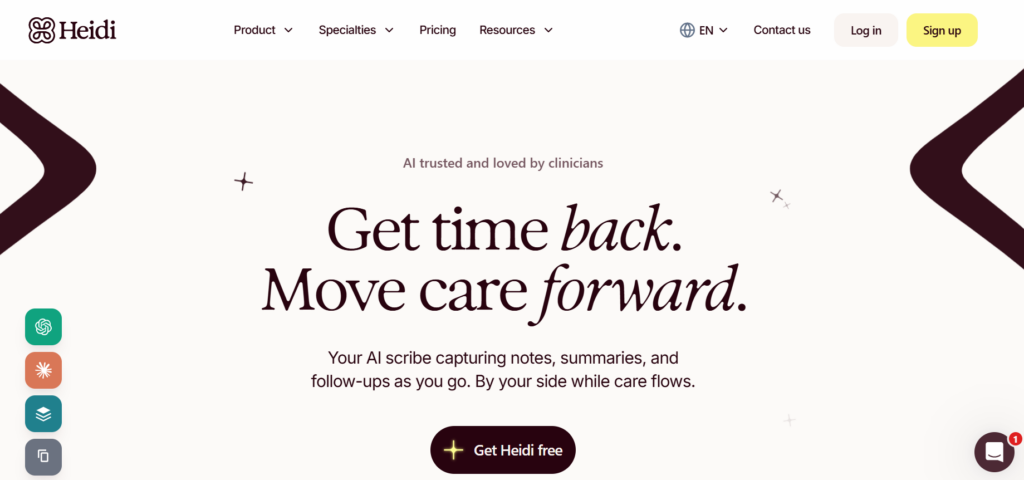
Heidi Health is an AI medical scribe and transcription platform designed to capture clinical conversations and convert them into structured notes. Its primary goal is to reduce documentation time by generating draft notes from recorded encounters across a wide range of medical specialties.
Heidi Health is built mainly for physicians and multi-specialty clinics rather than mental-health-only workflows. While some therapists use it for session transcription, the platform is not specifically tailored to psychotherapy documentation. For mental health use cases, Heidi typically functions as a recording-and-transcription tool that produces editable drafts, which clinicians then need to refine to match therapy-specific language, structure, and clinical intent. Therapy-first platforms such as Mentalyc’s AI Note Taker take the opposite approach and start from psychotherapy formats.
Heidi Scribe Review: Real Therapist Experience
Many clinicians value Heidi Health for its ability to reduce after-hours charting, particularly in structured or medically oriented visits.
However, therapist feedback also highlights reliability concerns around transcription accuracy, especially in psychotherapy sessions where nuance, speaker attribution, and narrative flow matter.
Some clinicians report complete transcription failures, which can significantly increase documentation burden instead of reducing it:
“…Sometimes Heidi stuffs up and no transcript is made of a consultation. This is unacceptable, as the whole consultation needs to be typed from memory after the fact…” (Mark Ruff, via Trustpilot [1])
Others describe inconsistent capture of client speech, leading to uncertainty about how much the tool can be relied on during therapy sessions:
“…There were more than one occasion, the patient’s version was not transcribed at all…” (AP, via Trustpilot [1])
As of June 10, 2026, Heidi holds a 3.3/5 rating across 484 Trustpilot reviews, with 7% one-star and 53 reviews posted in the last 12 months [1]. The positive reviews cluster around speed and reduced after-hours charting. The recurring complaints, each appearing in multiple independent reviews, are lost or failed transcripts, the app freezing when a recording ends, hallucinated content, and slow or generic support responses.

Recent one-star reviews are specific about what fails. A clinician reviewing in late May 2026 reported dictation failing 10 to 20 percent of the time and medication names transcribed wrong, “or worse still it comes up with its own choice of drug at times”, with support not responding for weeks despite repeated complaints (Kean Soon, Trustpilot, May 27, 2026 [1]).

Another, from a UK clinician: “The platform has lost all my transcripts with clients and I am now going to have re-visit them… Support has been poor, not resolved despite it being weeks since it was highlighted.” (Trustpilot, May 18, 2026 [1]). And from May 16, 2026: “App has lost half of multiple consultations, over multiple versions. Simply can’t be trusted – even to simply transcribe the consult… I don’t have 2 hours to deal with engineers.” (Dava, Trustpilot [1]).

Older reviews echo the same themes, including hallucinations: “Started of really well. Now has too many hallucinations. Becoming unsafe. Very poor support from team. Hit and miss of recordings / consultations.” [1]. Several reviewers also describe billing and cancellation friction, including being charged after attempting to cancel a trial through multiple channels [1].
Taken together, these experiences suggest that while Heidi can help documentation for predictable or structured encounters, therapists working with complex, narrative-heavy sessions may still need to double-document or heavily review output, limiting overall time savings.
Key Takeaways: Heidi Health 2026 Review
| Area | Summary |
|---|---|
| Primary function | AI medical scribe for real-time transcription and draft note creation |
| Best strength | Efficiency in structured or medical-style visits |
| Main limitation | Inconsistent accuracy in therapy-style, narrative sessions |
| Ideal users | Mixed medical / behavioral practices |
| Compliance | HIPAA, SOC 2 Type II, ISO 27001; BAAs available – terms permit use of ‘de-identified’ data to improve services (see Security section) |
| Pricing model | Free tier (10 Pro Actions/month); Clinician USD 150/user/month billed annually after the early-2026 restructure |
| User rating | 3.3/5 on Trustpilot (484 reviews, verified June 10, 2026) |
| Therapy fit | Not therapy-first by design |
Who Heidi Health Is Best For
Heidi Health is best suited for clinicians who primarily want help with transcription and basic draft notes, especially those working with mixed medical and mental-health caseloads or handling high documentation volume. It can be a useful entry-level tool for solo clinicians, associates, or small teams focused on reducing typing time. However, because it is a general medical scribe rather than a therapy-specific platform, notes often require additional editing, and it offers limited support for longitudinal progress tracking, treatment-plan continuity, or deeper psychotherapy workflows.
To give Heidi its due: its free tier with unlimited basic transcription is one of the most generous in the market, setup takes minutes, and its support for 110+ languages with mid-session language detection is the broadest in the category. For therapists, however, multilingual capture only reduces documentation burden if the transcription is accurate, and the Trustpilot data above shows that transcription reliability is Heidi’s most-reported failure mode, regardless of language.
Heidi Health Features: In-Depth Heidi AI Review
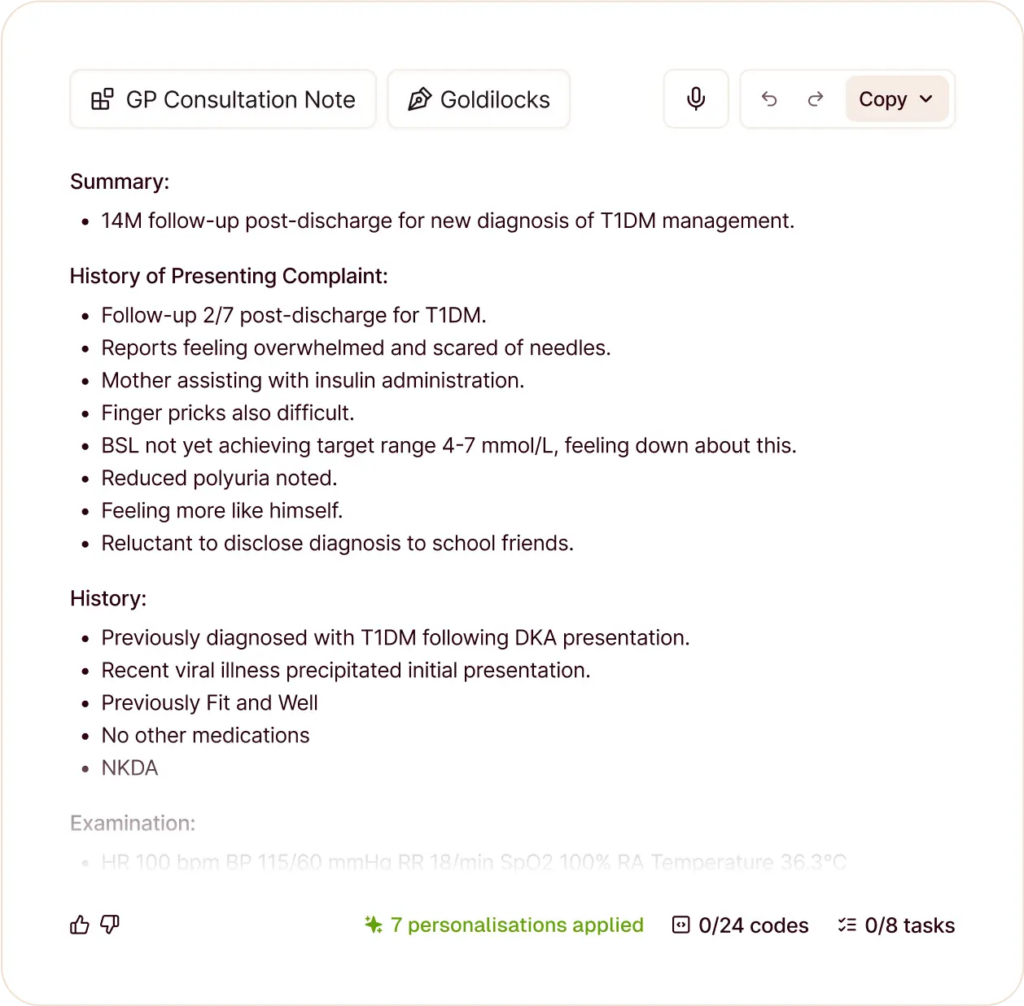
Heidi Documentation Features
- Heidi Health works mainly as a medical transcription and draft-note tool, turning clinician-patient conversations into structured notes during or after a session.
- It supports common formats like SOAP notes and reusable templates, but these are designed to work across many medical specialties, not specifically for psychotherapy. In practice, these are generic medical-scribe templates rather than therapy-specific AI notes: they do not include mental-health treatment planning, medical-necessity framing for therapy claims, or alliance and progress insight.
- While Heidi aims for accurate medical wording, notes are still drafts and usually need clinician review and editing, especially for therapy-specific language and intent.
- The editor helps reduce typing by allowing quick edits or regenerating sections, but clinicians remain responsible for shaping the final note.
- In February 2026, Heidi launched Heidi Evidence, a clinical decision support feature that answers clinical questions with citations. It is sold as its own tier (Evidence Plus) and is aimed at medical decision support rather than psychotherapy documentation.
Heidi Workflow
A therapist using Heidi runs a 50-minute session, exits the app, sees a failed transcript, and now has to reconstruct the session from memory, this is not a hypothetical. It’s the most-cited failure pattern across recent Trustpilot reviews. No workflow shortcut exists for that scenario.
Analytics / Insights
Heidi is mainly a documentation tool, not an insights platform. It helps by consistently capturing what was discussed in sessions, which can make it easier to write clear therapy progress notes over time. However, it does not offer tools for progress tracking, outcome measurement, alliance feedback, or treatment-plan tracking. Any sense of “insight” comes from reading past notes, not from visuals or automated guidance. For therapists under insurance review or facing a clinical audit, documentation with no measurable progress trail is a liability, it cannot demonstrate that treatment is achieving its stated goals.
Collaboration and Group Practice Features
Heidi can be used by multiple clinicians within the same practice. Teams can share note templates so documentation looks more consistent across providers. Supervisors can review notes created by associates, but clinical oversight and interpretation still rely on manual review rather than built-in supervision or progress tools. In a group practice where a supervisor is monitoring six associates, manual note review catches what’s written, not what’s missing. Gaps in progress documentation or alliance deterioration aren’t flagged; they have to be noticed.
Integrations and Workflow Support
Heidi connects with some scheduling or EHR systems to pull in appointments and generate notes. After a session, notes are reviewed and then exported into the EHR. This is usually a one-way flow, meaning edits made in the EHR don’t sync back into Heidi. That means the note Heidi generates for next week’s session may be based on context that the therapist already corrected in their EHR, building from an outdated record. For most therapists, Heidi acts as a separate step rather than a fully integrated part of the chart.
Security, Privacy and Compliance
Heidi states that it meets standard HIPAA requirements and offers a BAA where needed. Session audio is transcribed during the visit and not kept afterward, while notes and transcripts are stored in an access-controlled environment.
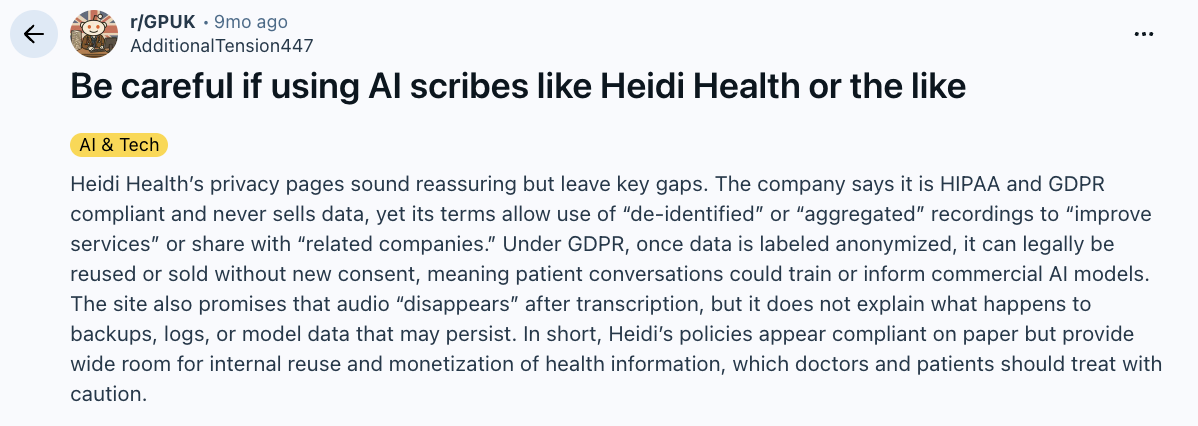
Clinicians in medical communities have looked closely at what Heidi’s terms actually permit. On r/GPUK:
Heidi Health’s privacy pages sound reassuring but leave key gaps. The company says it is HIPAA and GDPR compliant and never sells data, yet its terms allow use of “de-identified” or “aggregated” recordings to “improve services” or share with “related companies.” Under GDPR, once data is labeled anonymized, it can legally be reused or sold without new consent, meaning patient conversations could train or inform commercial AI models. The site also promises that audio “disappears” after transcription, but it does not explain what happens to backups, logs, or model data that may persist. In short, Heidi’s policies appear compliant on paper but provide wide room for internal reuse and monetization of health information, which doctors and patients should treat with caution. – AdditionalTension447 (r/GPUK)
r/doctorsUK raised the same concern, citing an independent review from the Australian consumer group CHOICE:
Write less, focus more
- SOAP, DAP, BIRP, EMDR notes and more
- AI Treatment Planner
- AI Progress Tracker
- Alliance signals
- HIPAA & PHIPA compliant

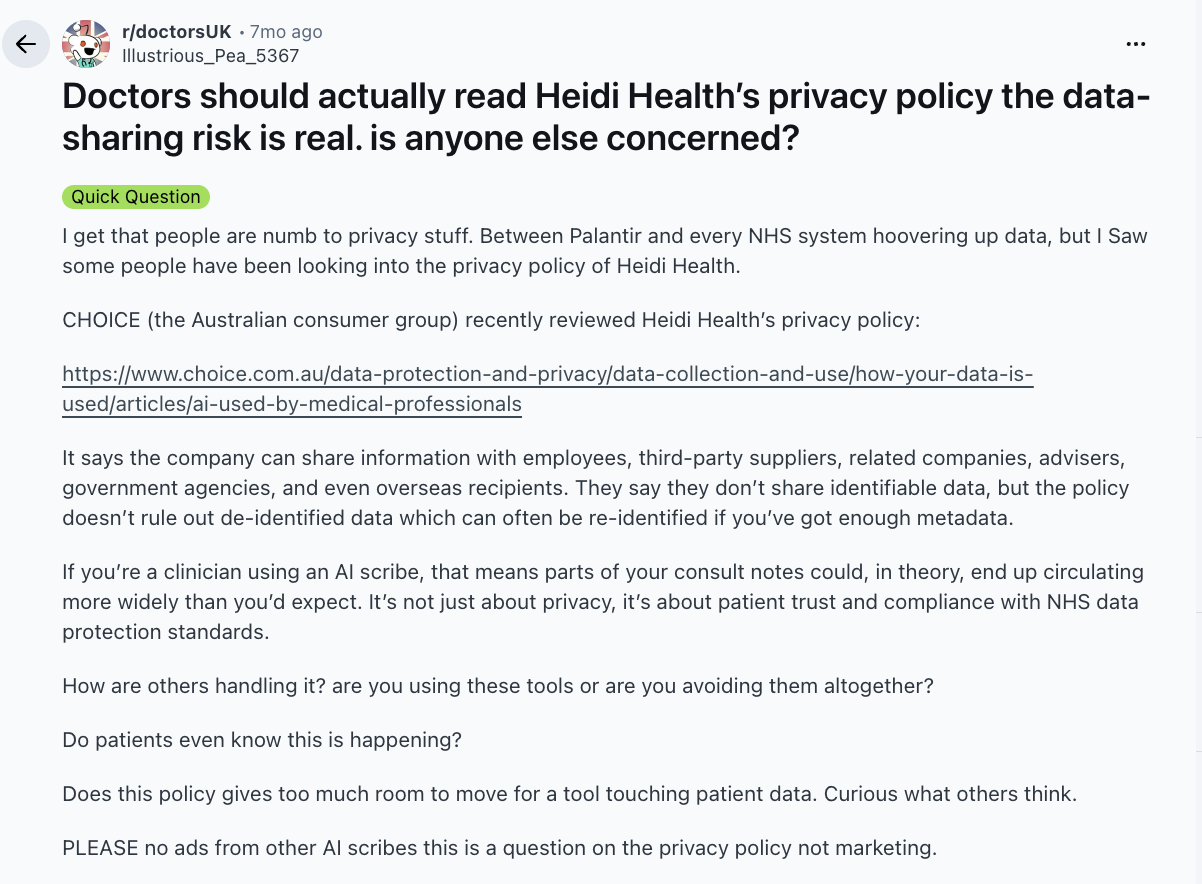
As with any tool that involves recording or transcription, clinicians are still responsible for obtaining informed consent and deciding whether these safeguards align with their own privacy standards and practice policies [2].
Heidi Health Pricing (2026)
Heidi Health restructured its pricing in early 2026. The free tier still includes unlimited basic transcription, but it is now capped at 10 “Pro Actions” per month, the Ask Heidi prompts and template customizations most regular users rely on. The main paid tier, previously around USD 90 per month, is now the Clinician plan at USD 150 per user per month billed annually, roughly USD 1,800 per year. An Evidence Plus tier and team/Enterprise plans round out the lineup. Prices verified June 2026.
| Plan / Tier | Price (USD) | What’s Included | What’s NOT Included / Limitations |
|---|---|---|---|
| Free | $0/month | Unlimited basic transcription / consults. Standard note templates. Healthcare-grade security and encryption. | Only 10 “Pro Actions” per month; works as an evaluation mode rather than a full-time workflow. |
| Evidence Plus | Paid tier (14-day trial) | Clinical evidence answers with citations, CPD/CME tracking. | Scribe Pro Actions remain limited; positioned around Heidi Evidence rather than documentation depth. |
| Clinician | $150/month (per user, billed annually) | Unlimited Pro Actions, advanced/custom templates, personalization, priority support, BAA. | Annual billing; no EHR push-to-chart integration at this tier. |
| Teams / Enterprise | Custom | Team template sharing, session status, coding workflows, SSO, dedicated success support. | Per-clinician cost scales; EHR integration starts at team level; quote required. |
Two practical implications for therapists. First, the price increase moves Heidi from the affordable end of the scribe market to its upper half, so the manual-review overhead on narrative therapy sessions costs proportionally more. Second, the free tier’s 10 Pro Actions cap means the features most people end up depending on, template customization and Ask Heidi edits, effectively require the USD 150 plan.
Heidi Health Pros and Cons
| Pros | Cons |
|---|---|
| ✅ Helps reduce documentation time and after-hours charting | ❌ Some users report missed or failed transcriptions |
| ✅ Performs best in structured, medical-style visits | ❌ Accuracy fails in narrative-heavy therapy sessions, multiple reviewers report having to reconstruct full sessions from memory after failed transcriptions |
| ✅ Standard security and compliance safeguards in place | ❌ Custom templates can behave inconsistently for certain workflows |
| ✅ Free tier with unlimited basic transcription | ❌ Support routinely fails to respond for weeks, documented in multiple May 2026 Trustpilot reviews, leaving clinicians with unresolved data loss |
| ✅ Broadest language support in the category (110+) | ❌ Clinician plan price rose to $150/month in the 2026 restructure |
| ❌ Reviewers report app freezes and lost recordings |
Final Verdict: Is Heidi Health Worth It for Therapists in 2026?
Heidi Health is a strong fit for high-volume clinicians and mixed medical practices that need fast, structured documentation from an AI medical scribe. It performs well for straightforward, medically oriented visits and can meaningfully reduce charting time, especially when sessions follow a predictable format.
For therapists, its generalist design means nuanced or narrative-heavy sessions often require more editing, and the reliability concerns reported across multiple reviews compound that burden. At $14.99/month versus Heidi’s $150 Clinician plan, Mentalyc is a tenth of the cost for a tool built from the ground up for the clinical work therapists actually do. The free trial (14 days, 15 notes, no credit card) makes it a zero-risk comparison.
Heidi vs Mentalyc: How They Compare
For therapists evaluating Heidi against therapy-specific alternatives, Mentalyc is the most direct comparison, built exclusively for mental health documentation and designed to address the core gaps Heidi leaves for psychotherapy workflows. The table below merges both platforms’ key differentiators into one place.
| Feature | Mentalyc | Heidi Health |
|---|---|---|
| Design focus | ✅ Built specifically for mental health professionals and psychotherapy documentation | ⚠️ General medical scribe; not therapy-first by design |
| Recording modalities | ✅ Live (in-person & telehealth), dictated, uploaded, or typed | ⚠️ Live and post-session recording; no dictation, upload, or typed input modes |
| Client types supported | ✅ Individual, group, couple, family, child | ❌ Not specifically supported |
| Note formats | ✅ SOAP, DAP, BIRP, GIRP, PIE, EMDR, MSE, psychiatry, supervision notes, and more | ⚠️ Community templates including SOAP, BIRP, Psychiatric Intake, and others; not purpose-built therapy-specific formats |
| Treatment planning | ✅ SMART goals, modality-aligned, session-based suggestions | ❌ Community-created basic template only |
| Progress tracking | ✅ Tracks symptoms and goals across sessions (Golden Thread) | ❌ No built-in progress tracking |
| Therapeutic alliance tools | ✅ Alliance Genie™ – reflects alliance quality over time | ❌ No therapy-specific alliance tools |
| EHR integration | ⚠️ Works alongside any EHR today; direct plug-in coming soon | ✅ EHR integration available at team tier |
| Starting price | ✅ USD 14.99/month (billed annually) | ❌ USD 150/month, Clinician plan (billed annually) |
| Free trial | ✅ 14 days, 15 full notes, no credit card | ✅ Free tier; 10 Pro Actions/month |
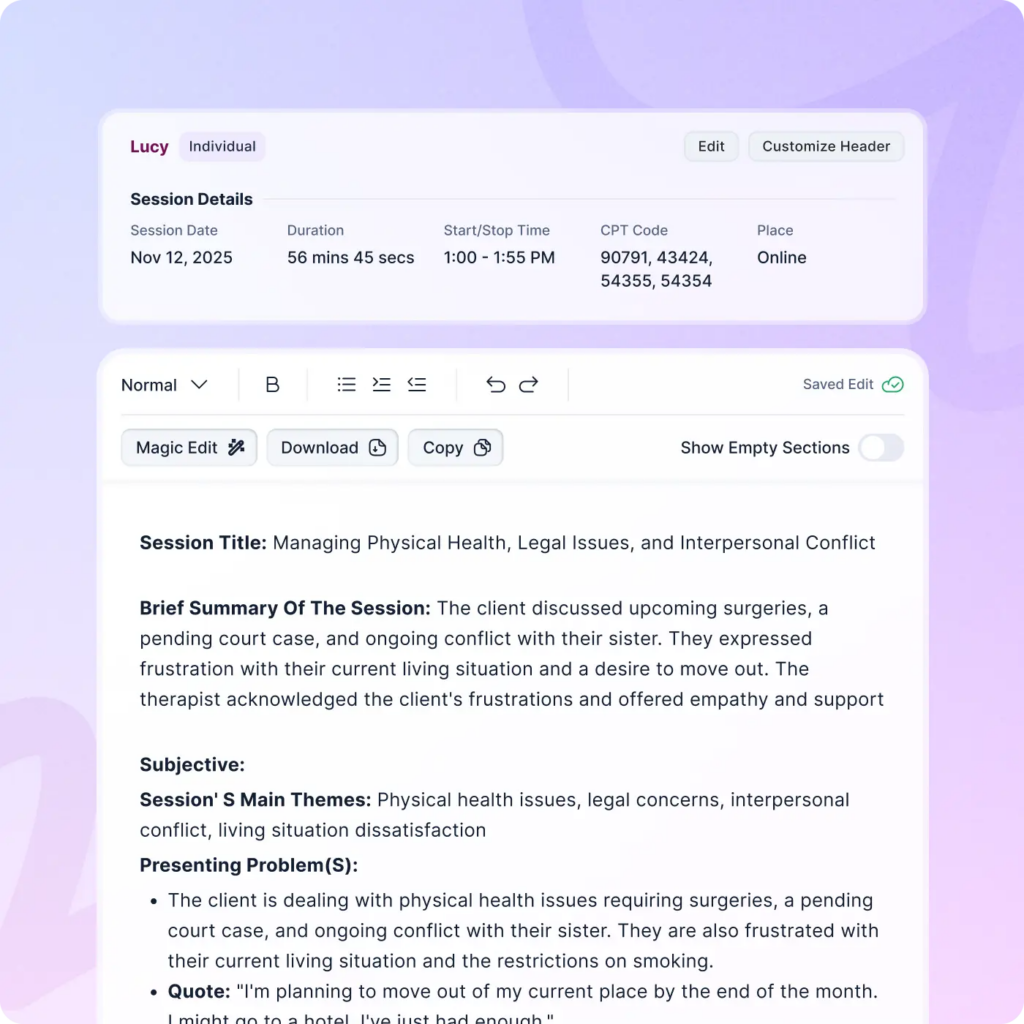
Mentalyc was built from the ground up with input from mental health professionals, and that shows in the specificity of its templates and documentation logic. Every note format, from SOAP to EMDR to MSE, is structured around real therapeutic language and clinical intent, not a generic medical-scribe template adapted for behavioral health. All templates are developed and vetted by experienced therapists through real-world clinical feedback rather than community submissions. That means notes come out clinically relevant and insurance-ready, requiring minimal editing. Heidi’s templates, by contrast, are either generic SOAP formats or community-created, which shifts quality control back onto the therapist at exactly the moment they’re already managing a full caseload.

The depth difference becomes more pronounced beyond note-taking. Mentalyc connects session content to treatment goals across the entire arc of care, what it calls the Golden Thread. Notes from each session feed into progress tracking, SMART goal updates, and alliance monitoring through Alliance Genie™. Heidi captures what happened in a session; Mentalyc connects what happened to where the client is going. This distinction matters most for therapists managing complex caseloads where continuity and longitudinal insight directly affect care quality.
Treatment planning illustrates the gap clearly. In Mentalyc, the treatment plan is tailored to your modality and draws on prior sessions to suggest relevant SMART goals and intervention, making it a dynamic clinical roadmap rather than a static administrative form. You can include only the sections that are clinically relevant and adjust the plan as treatment evolves. Heidi offers only a community-created template with no session-based personalization, progress continuity, or goal tracking. Mentalyc’s clinician-guided workflow is built around that principle.
On pricing, the gap is significant: Mentalyc starts at USD 14.99 per month versus Heidi’s USD 150 Clinician plan, a 10x difference for a tool that is built specifically for the work therapists actually do. Mentalyc’s free trial includes 14 days and 15 full notes with no credit card required. Heidi’s free tier is usable for evaluation but caps the features most clinicians depend on, custom templates and Ask Heidi edits, at 10 Pro Actions per month.
Switching from Heidi: What It Actually Involves
Moving off Heidi is low-friction because Heidi’s output is plain text notes you copy into your EHR, there is no locked-in data format. A realistic path: start a Mentalyc free trial (14 days, 15 notes, no credit card) and run it alongside Heidi for a week of real sessions, comparing the notes each produces for the same session types. If you switch, cancel Heidi from your account before the renewal date and keep written confirmation; per Heidi’s policy you retain access until the end of the billing cycle, so there is no coverage gap. Your historical notes already live in your EHR, so nothing needs to migrate.
If you’re a therapist looking for documentation that truly reflects the clinical work you do, Mentalyc offers a therapy-first alternative built around accuracy, privacy, and ease. It automates session notes, tracks progress toward goals, and helps maintain the golden thread across treatment. For how clinicians describe the switch in their own words, see Mentalyc reviews from therapists.
Frequently Asked Questions
References
[1] Trustpilot. Heidi Health reviews. https://www.trustpilot.com/review/heidihealth.com.au
[2] American Psychological Association. Ethical guidance for AI in the professional practice of health service psychology. https://www.apa.org/topics/artificial-intelligence-machine-learning/ethical-guidance-professional-practice.pdf
Why other mental health professionals love Mentalyc

“It’s so quick and easy to do notes now … I used to stay late two hours to finish my notes. Now it’s a breeze.”
Licensed Professional Counselor

“Having Mentalyc take away some of the work from me has allowed me to be more present when I’m in session with clients … it took a lot of pressure off.”
LPC

“A lot of my clients love the functionality where I can send them a summary of what we addressed during the session, and they find it very helpful and enlightening.”
Therapist

“By the end of the day, usually by the end of the session, I have my documentation done. I have a thorough, comprehensive note … It’s just saving me hours every week.”
CDCII