

Therapists reading an Eleos Health review are usually trying to answer one practical question: does transcription-based AI documentation actually save time, or does it create new friction around reliability, editing, and daily workflow?
This Eleos review looks at how Eleos performs in real clinical settings–where it helps, where clinicians report challenges, and how it compares to therapy-focused alternatives–so you can decide if Eleos is the right fit for your practice in 2026.
Overview: What Is Eleos Health?
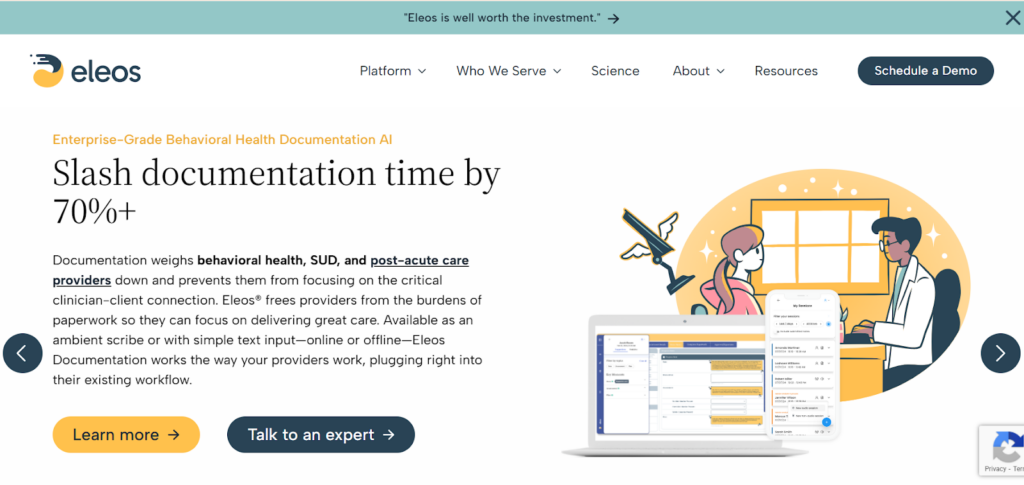
Eleos Health is an AI platform centered on session transcription and standardized documentation. Its workflow focuses on turning recorded sessions into draft notes and surface-level insights, primarily to support supervision and organizational consistency.
While useful at scale, Eleos is designed mainly for enterprise-level group practices that rely on transcription-based workflows and centralized compliance, rather than for clinicians or group practices seeking therapy-first documentation or session-based progress tracking.
Spend less time writing, more time with clients.

Important: Recording & Privacy Considerations When Choosing Eleos
Recording is central to the Eleos workflow. Sessions must be captured (via telehealth or upload) so the platform can generate transcripts and notes.
While Eleos’ marketing language sometimes states that it “does not record or store full sessions,” the platform still requires therapists to capture session audio so the system can generate transcripts, insights, and draft notes.
With this risk in mind, you should consider whether this approach aligns with your privacy standards when comparing it to tools that clearly state they do not retain recordings.
Key Takeaways – Eleos Health Review
| Area | Summary |
|---|---|
| Core strength | Transcription-based documentation at organizational scale |
| Primary limitation | Requires full-session recording and post-session editing |
| Best fit | Enterprise and large group practices with supervision needs |
| Clinical accuracy | Structured drafts, but therapist review required |
| Analytics depth | Process-focused (documentation and supervision), not outcomes |
| Pricing model | Organization-level contracts; not solo-friendly |
| Therapy fit | Works in agencies; less suited to private practice workflows |
Eleos Health Reviews: Real Therapist Experience
Many clinicians find Eleos helpful for reducing documentation work across large organizations, especially where supervision and consistency are priorities. However, real-world feedback and Eleos reviews also points to reliability and hardware-related issues that can make everyday use feel cumbersome.
Reviews of Eleos from Real Users:
Some users report inconsistencies in system behavior, including missing prompts or interruptions that break documentation flow:
“The system sometimes lacks consistency. It doesn’t always give the prompts and pop-ups it’s supposed to.”– Allison G., via Capterra
Others point to connectivity challenges tied to Eleos’ Sensi recording device, which can disrupt sessions and increase staff frustration:
“There is one notable con to mention and it is the Sensi device – it would benefit from a higher ghz to minimize interference issues…”– Lisa K., via Capterra
Overall, these reviews of Eleos suggest that Eleos can work well in structured, team-based settings, but its dependence on recording hardware and transcription workflows means reliability issues can quickly affect clinicians in day-to-day practice–especially in busy environments.
Who Eleos Health Is Best For
| Clinician Type | Fit Level | Why |
|---|---|---|
| Solo therapists | ❌ Low | Cost, complexity, recording-based workflow |
| Small group practices | ⚠️ Limited | Enterprise design, heavy setup |
| Large group practices | ✅ Suitable | Supervision, consistency, scale |
Eleos Health Features – In-Depth Eleos Review
A Quick Snapshot of Eleos:
| Pros | Cons |
|---|---|
|
|
Eleos Documentation & Workflow
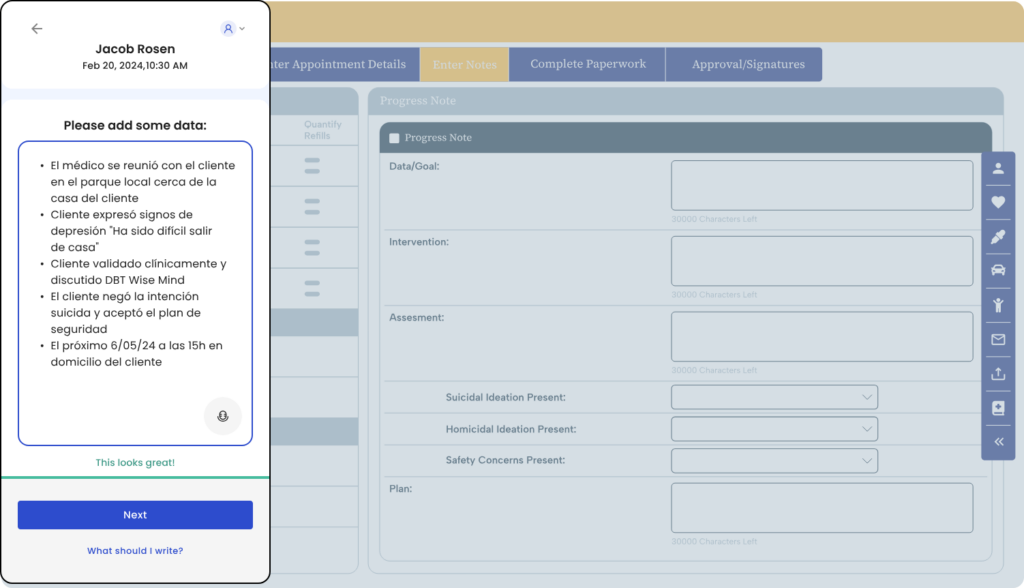
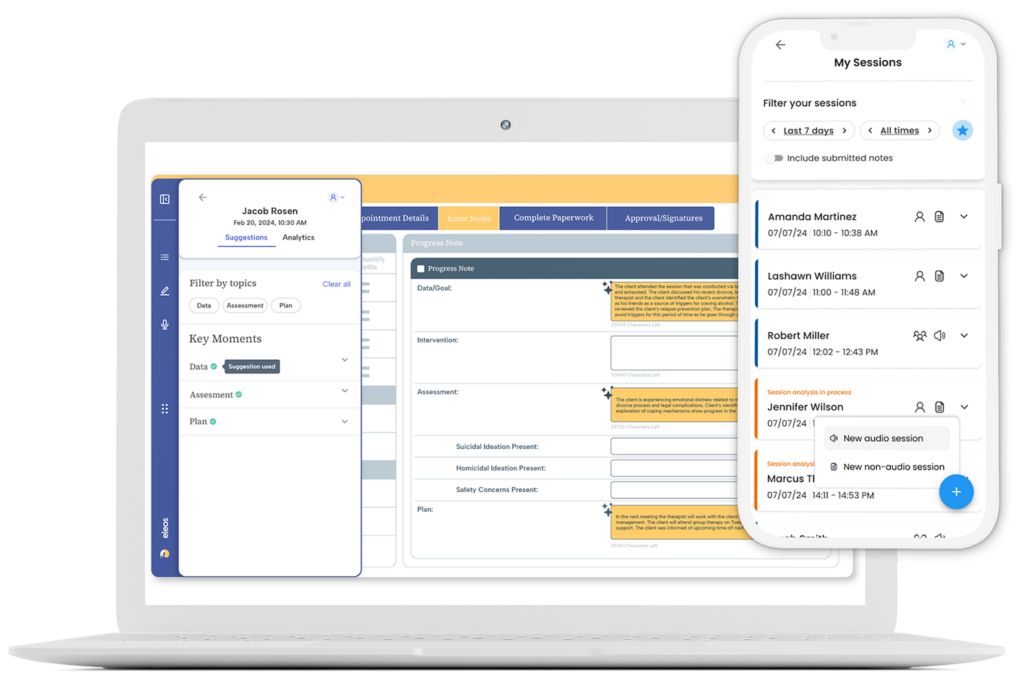
Eleos is built around a transcription-first workflow, using recorded sessions to generate draft clinical documentation. Its core value is helping organizations standardize notes rather than deeply supporting session-level clinical work.
While Eleos can reduce some typing, clinicians should expect to review and revise notes for accuracy, tone, and alignment with treatment goals.
Analytics & Insights
Eleos offers organization-level insights, such as talk-time ratios and common themes across sessions. These are mainly intended for supervision and training, not for tracking client progress over time.
Eleos does not provide structured therapeutic-alliance analytics or automated progress tracking tied to treatment plans like advanced tool such as Mentalyc.
Write less, focus more
- SOAP, DAP, BIRP, EMDR notes and more
- AI Treatment Planner
- AI Progress Tracker
- Alliance signals
- HIPAA & PHIPA compliant

Integrations & Practice Fit
Eleos integrates with several behavioral health EHRs and supports certain telehealth platforms to capture session audio. These integrations are most valuable for large clinics and group practices that prioritize centralized documentation and compliance oversight.
Eleos Health Pricing (2026)
Eleos pricing tends to work for large agencies that can justify the cost through staff time savings, reduced burnout, training efficiency, or meeting grant and RFP requirements.
However, the platform often struggles to fit mid-sized practices (5–50 clinicians) due to complex setup, inflexible pricing, and workflows built for enterprise use.
Eleos does not offer a public free trial, requiring organizations to go through a demo and sales process before testing. As a result, while Eleos may offer value for large, transcription-driven organizations, solo clinicians and smaller practices may find the cost and complexity hard to justify compared to lighter, more flexible alternatives.
Pricing at a Glance
| Item | How Eleos Prices It |
|---|---|
| Who can buy | Organizations only (not solo clinicians) |
| Pricing model | Flat-rate, multi-year contracts |
| Seat tiers | 0–50 clinicians and 50–200 clinicians |
| Typical contract size | ~$220,000 total |
| Contract length | 3-year minimum |
| Payment structure | Often split across Scribe and Replay modules |
| Trial | No free trial; demo and sales process required |
Final Verdict: Is Eleos Health Worth It for Therapists in 2026?
Reviews of Eleos consistently indicate that Eleos is best suited for large clinics and group practices that want transcription-based documentation, supervision tools, and organization-wide oversight. It works well in team settings where detailed transcripts and standardized workflows are priorities.
That said, Eleos can feel heavy for clinicians who want faster, more automated notes or prefer not to record full sessions. Solo therapists and smaller practices often report friction with setup, cost, and workflow–especially when comparing Eleos to lighter, more privacy-first tools.
In 2026, Eleos reviews continue to show that Eleos Health remains a solid option for enterprise behavioral health organizations, but it is often less practical for clinicians seeking simplicity or effortless automation. In those cases, alternatives like Mentalyc may be a better fit.
Best Alternatives to Eleos Health
In large health systems, platforms like Netsmart Bells AI offer deeper EHR integration. In private practice and small-group settings, tools such as Mentalyc is more commonly chosen due to lighter workflows and greater flexibility.

Below are the best Eleos alternatives, matched by practice size and documentation needs.
1. Mentalyc – Best Eleos Alternative for Therapy-Focused Documentation (Solo & Group Practices)
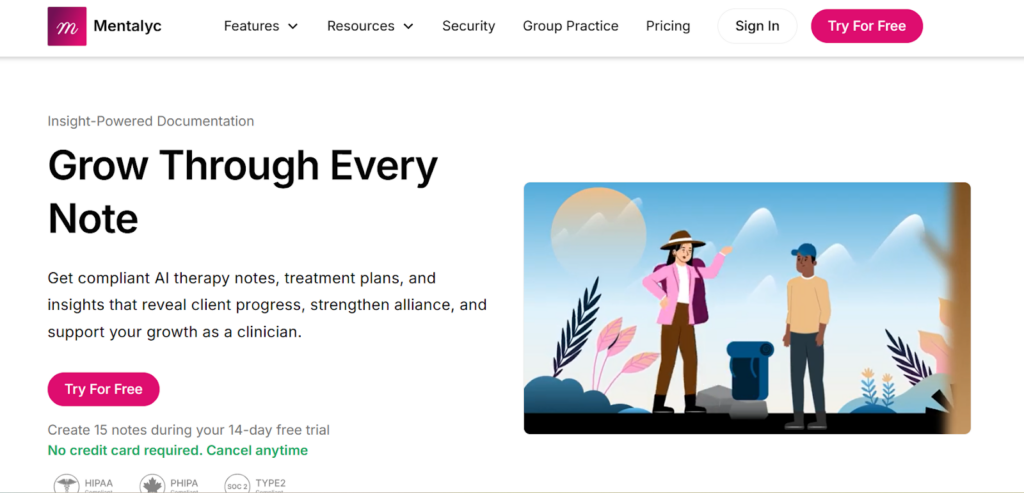
Mentalyc delivers automated, clinically aligned documentation for group practices and growing teams that don’t want Eleos’ enterprise contracts or recording requirements.
Clinicians can generate accurate notes and treatment plans from dictation (short audio), uploaded full-session audio recordings, or text–while maintaining strong privacy controls and audit-ready structure. For group practices evaluating Eleos, Mentalyc offers a simpler, more flexible way to support teams, supervision, and clinical consistency without full-session recording.
Why Group Practices Choose Mentalyc Over Eleos
- Faster notes with minimal edit: Generates accurate notes from dictation, uploaded full-session recordings, or text, giving clinicians control over how sessions are captured.
- Stronger privacy & security posture: No audio storage; built to minimize data risk. Built with HIPAA compliance, PHI safeguards, BAAs, and SOC 2 Type II certification.
- Stronger clinical continuity: Notes, treatment goals, and progress stay linked across sessions (“golden thread”).
- Most advanced treatment planning & progress tracking: Automatically creates measurable goals from sessions and tracks symptoms change over time–without manual data entry.
- Alliance insights: Alliance Genie™ highlights engagement and collaboration patterns to support reflective practice and team oversight.
Quick Pricing Comparision: Eleos vs Mentalyc
| Tool | Who It’s Priced For | Typical Cost | Commitment |
|---|---|---|---|
| Eleos | Large organizations only | ≈ $220,000 (3-year contract) | Multi-year, enterprise contract |
| Mentalyc | Solo to mid-size group practices | $19.99–$119.99 per month | Month-to-month (free trial) |
| Mentalyc Team Plan | Group practices | ~$99.99 → $49.99 per month (discounted) | No long-term contract |
Bottom line: Eleos pricing is built for enterprises. Mentalyc is accessible, flexible, and scalable for real-world clinical practice.
2. Upheal – Best for B noasic Session Insights
Best for: Therapists who want simple visual summaries from recorded sessions.
Upheal focuses on full-session transcription and surface-level analytics, offering features like talk-time metrics and labeled session themes. While it may appeal to clinicians who like visual feedback, its insights are primarily descriptive and less tied to treatment planning or longitudinal progress tracking.
Compared to other tools, Upheal offers:
- Basic session analytics rather than clinically aligned documentation
- Limited support for treatment-plan continuity
- A stronger emphasis on transcription over automation
Upheal can be a reasonable option for independent clinicians curious about session analytics, but it is less suited for those seeking session-based progress tracking.
3. SimplePractice & TherapyNotes (Built-In Notes)
Best for: Clinicians who want minimal AI assistance without leaving their EHR.
Built-in AI note features in EHRs like SimplePractice and TherapyNotes offer light documentation support, mainly focused on drafting or expanding notes within existing templates.
What to expect:
- Convenience for clinicians already using these systems
- Basic AI suggestions and summaries
- No need for separate tools
Limitations:
- Shallow clinical structuring
- No automated link between notes, goals, and progress
- Limited treatment-plan alignment
- Minimal insights beyond documentation drafts
These tools can work for clinicians with simple needs, but they fall short for practices seeking true automation, stronger clinical continuity, or higher-quality documentation with less effort.
Eleos Health vs. Mentalyc: Comparison Table (2026)
| Feature | Eleos Health | Mentalyc |
|---|---|---|
| Automation level | Notes are created after sessions are recorded and transcribed; clinicians typically review and edit transcription-based drafts | Notes are generated from transcription, dictation (short audio), uploaded full-session recordings, or text, with minimal editing needed |
| Clinical accuracy | Good structure but often needs refinement for medical necessity | High clinical accuracy focused on mental-health clinical language, documentation quality, and medical necessity |
| Note types | SOAP, DAP, narrative formats (varies by organization) | SOAP, DAP, BIRP, GIRP, EMDR, intake, plus custom formats |
| Progress tracking | Limited; based on themes and conversational markers | Automatically tracks symptoms and progress toward goals over time based on session conversations and visualizes progress in charts |
| Alliance insights | No dedicated therapeutic alliance insights | Feedback on the therapeutic alliance after each session, highlighting engagement, collaboration, and moments of alignment |
| Recording storage | Requires session recording upload; does not store raw audio long-term but uses recordings for transcription | No recordings stored; privacy-first workflow |
| HIPAA / SOC 2 | HIPAA-aligned, SOC 2 compliant, BAA available | HIPAA, PHIPA, SOC 2 compliant, BAA available |
| Pricing | Custom organizational pricing; no public tiers | Transparent pricing; affordable for solo clinicians and groups |
| Best for | Larger clinics, supervisors, and teams using transcript workflows | Solo therapists and group practices needing fast, private, automated notes |
Find a detailed comparison between Eleos Health and Mentalyc Here.
Frequently Asked Questions (FAQs): Eleos Reviews and Best Alternatives
1. Is Eleos Health HIPAA compliant?
Yes. Eleos Health is designed to support HIPAA-compliant use within behavioral-health settings. The platform provides a Business Associate Agreement (BAA) to covered entities and maintains SOC 2 compliance, which many clinicians look for when evaluating the security of AI therapy documentation software. As with any tool, organizations should confirm compliance details directly with Eleos before onboarding.
2. Does Eleos Health store therapy recordings?
Eleos uses uploaded audio recordings to generate transcripts and session intelligence, but according to its public documentation, it does not store raw recordings long-term. Audio is processed securely and removed after transcription. Any data retained for system improvement is fully de-identified and reviewed only by a security-cleared clinical team. This is an important consideration for therapists comparing privacy features in an Eleos review or evaluating whether Eleos fits their workflow.
3. Are AI tools safe for clinical documentation?
AI tools can be safe when used responsibly and when they follow strict privacy, compliance, and accuracy standards. Clinicians must always review AI-generated notes for clinical accuracy, ensure informed consent, and follow HIPAA or PHIPA requirements. AI can reduce administrative load, but it should never replace clinical judgment. This principle applies to Eleos, Mentalyc, and all other AI note-taking tools for therapists.
4. What note types does Eleos Health support?
Eleos can generate draft notes in several common formats, such as SOAP, DAP, and narrative progress notes. Template availability may depend on the organization’s configuration. Because Eleos relies on transcript-based drafting, clinicians often refine and customize notes to meet medical-necessity, treatment-plan alignment, and agency documentation standards.
5. What are the best alternatives to Eleos Health?
The top alternatives to Eleos Health include Mentalyc, Upheal, and AI-enhanced EHRs like SimplePractice or TherapyNotes. Among these, Mentalyc is widely considered the best Eleos alternative because it provides fully automated notes without storing recordings, offers a privacy-first workflow, and generates high-quality clinical documentation with strong progress-tracking and “golden thread” alignment.
Why other mental health professionals love Mentalyc

“It immediately changed my quality of life, personally and professionally.”
Owner/Independently Licensed Marriage & Family Therapist (LMFT)

“For anyone hesitant: this is a lifesaver. It will change your life, and you have more time to be present with your patients.”
Licensed Clinical Social Worker

“If I were recommending this software to a colleague, I would tell them that it is the best thing that they could do for their practice.”
Licensed Professional Counselor

“Do yourself a favor, make your life easier. I found Mentalyc to be one of the best tools that I’ve ever used.”
Licensed Marriage and Family Therapist