Author: Marissa Moore, LPC, LCPC
Marissa Moore is a licensed mental health professional who owns Mending Hearts Counseling in Southwest Missouri. She holds a Master’s degree in Clinical Mental Health Counseling from South University in West Palm Beach, Florida, and is dual-licensed as an LPC in Missouri and LCPC in Kansas. With 11 years of experience in the mental health field spanning substance use treatment centers, group homes, emergency rooms, and private practice, Marissa specializes in providing affirming counseling services to the LGBTQIA+ community. She is a member of OpenPath Collective and maintains verified profiles on Psychology Today, TherapyDen, and multiple therapist directories. Marissa’s clinical writing has appeared on PsychCentral and American Addiction Centers (Oxford Treatment Center, Greenhouse Treatment Center). At Mentalyc, she contributes clinical content grounded in her direct practice experience across diverse treatment settings.

-
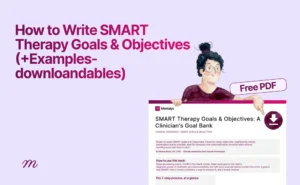
Writing SMART goals in therapy is one of the most important, and most misunderstood, skills in clinical practice. Therapists are trained to think in broad therapeutic aims like “reduce anxiety,” “improve relationships,” or “increase insight,” yet documentation, treatment planning, and insurance review demand something far more precise. SMART goals bridge that gap. They translate clinical […]July 6, 2026·24 min read
-
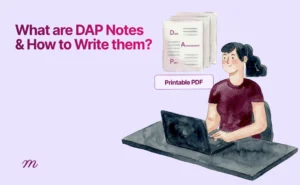
What is a DAP note? A DAP note is one type of therapy progress note with three sections: Data, Assessment, and Plan. The acronym “DAP” stands for Data, Assessment, and Plan, the three sections included in a DAP note. This format is a structured way of formatting your notes and can help you save time. […]July 2, 2026·15 min read
-
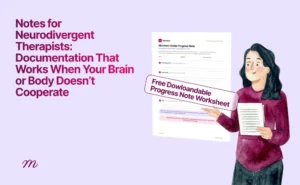
This guide is for clinicians who themselves are neurodivergent or live with a disability. It is not about writing notes for ADHD or neurodivergent clients, that is a different topic with a different audience. If you have ADHD, dyslexia, dysgraphia, AuDHD, autism, carpal tunnel, vision impairment, motor differences, or any condition that makes documentation harder […]July 1, 2026·34 min read
-
This guide gives therapists 15 ready-to-use progress note templates with full worked examples, plus the rules that keep notes audit-ready, HIPAA-compliant, and useful at the next session. Whether you run a solo private practice, work in a group practice, or supervise a team, the same templates apply. There is no single “best” template. Many insurance […]June 11, 2026·24 min read
-
Mental health clinicians use many therapeutic modalities, but across all of them the therapeutic relationship remains one of the most essential elements of treatment. Research consistently shows that the strength of the therapeutic alliance predicts therapeutic outcomes, often more than the specific technique or modality used. A relationship built on collaboration and trust is what […]July 6, 2026·18 min read
-
CPT code 90853 is used to bill group therapy. When you provide a psychotherapy service to a group of people who otherwise are not related to each other and were not previously acquainted, that is group therapy, and 90853 is the code for it. This guide covers the full code description, current reimbursement, modifiers, documentation […]June 17, 2026·8 min read
-
If you’re a mental health professional who owns a private practice, in your initial paperwork, you will need to have clear policies and procedures for your practice. Setting up a practice can initially feel overwhelming, but being thorough can help you be a successful private practice owner. What you decide to put in your private […]November 13, 2025·12 min read
-
Receiving a subpoena is not something many mental health clinicians like to deal with. You may feel overwhelmed and scared if you’ve received a subpoena to release information about a client. Many clinicians have questions about what is and isn’t required of you. Subpoenas are tricky to deal with because psychotherapy notes aren’t a part of the […]September 17, 2025·8 min read
-
The Diagnostic and Statistical Manual of Mental Disorders (DSM) has a long history of revisions and is essential to a mental health professional’s work. If you’re a mental health provider, you most likely work from the DSM-5, one of the more recent manual versions. The DSM-5 (Diagnostic and Statistical Manual of Mental Disorders, Fifth Edition) is […]September 17, 2025·7 min read
-
Therapist burnout is a state of emotional, physical, and mental exhaustion caused by prolonged, unmanaged work stress, and it shows up as depletion, detachment from clients, and a reduced sense of accomplishment. As therapists, we do emotionally demanding work and absorb our clients’ stress and trauma daily, often leaving little time to care for ourselves. […]July 1, 2026·11 min read
-
If you’re a mental health professional, billing can be overwhelming. It’s challenging to know what billing codes you need and when. As a psychotherapist, you must remember many codes to keep on top of getting appropriately reimbursed for your services. You may ask questions like what codes do I use for what services? When do […]September 17, 2025·8 min read
-
When you write psychotherapy notes, you often have to bill a code a current procedural code. Current Procedural Technology (CPT) Codes were developed by the American Medical Association (AMA) to help provide a universal language for billing purposes across medical professionals. Each code means a different service was provided. There are also distinct codes for different […]September 17, 2025·7 min read
-
If you’re a mental health clinician, there will be times when you have to reach out to your clients between sessions. When you contact a client outside of the session, you want to document this in your client’s chart. Documenting all interactions with clients outside of the session is good practice. You may contact a […]September 17, 2025·8 min read
-
Continuing education (CE) is a licensing requirement for therapists, counselors, social workers, and psychologists in every U.S. state. The number of credits, approved providers, and topic mandates vary by state and profession, but the obligation is universal. This guide covers what your licensing board expects, where to find free and affordable CE credits, and how […]June 15, 2026·8 min read
-
Mental health documentation is an essential aspect of psychotherapy sessions. Documentation helps mental health professionals track progress from session to session, bill insurance, and helps justify why the client is there. Many mental health clinicians like to follow a specified format for progress notes. Following a format helps ensure you’re meeting insurance requirements and enables you […]September 17, 2025·8 min read
-
If you are a psychotherapist, the hardest line to write in a progress note is often the intervention: the part that names what you actually did to move the client toward a goal. This guide is a list of therapeutic interventions organized by category, with a ready-to-paste example of how to document each one in […]June 30, 2026·18 min read
-
A treatment plan is a collaborative written document, created by a client and clinician, that records the client’s diagnosis, sets specific measurable goals and objectives, and outlines the interventions and timeline used to reach them. It serves as the roadmap for therapy and is reviewed and updated as the client progresses. As a therapist, I’ve […]July 6, 2026·36 min read
-
If you write notes after a session, HIPAA cares which kind you wrote. The two categories look similar from the outside, but they have completely different legal protections, required content, and storage rules. Get the line wrong and your “psychotherapy notes” lose the extra HIPAA protection they were supposed to have. This guide is the […]June 5, 2026·8 min read
-
If you’re looking for a problem-focused note format, consider writing PIRP notes to document your therapeutic sessions. PIRP notes are a method of clinical documentation used by many therapists and other mental health professionals. PIRP notes have four sections and are easy to write. So if you’re a mental health professional considering a new note […]September 17, 2025·8 min read
-
BIRP notes are a type of note format used by many mental health professionals. BIRP notes have four distinct sections so you can follow along and ensure your documentation is professional and up to standard. If you’ve tried other progress note formats and can’t get on board, you may consider trying a BIRP note. BIRP […]September 17, 2025·8 min read
-
GIRP Notes Most clinicians know the struggle of documentation that actually feel useful, not just like paperwork. GIRP notes were created with this in mind. Instead of getting lost in checkboxes or long narratives, GIRP progress notes guide you to start with a Goal what the client wants to work on. From there, you document […]November 11, 2025·14 min read