

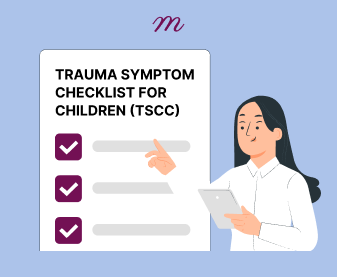
The Trauma Symptom Checklist for Children (TSCC) is a 54-item self-report inventory that screens children aged 8 to 16 for trauma-related symptoms across six clinical scales: Anxiety, Depression, Anger, Post-Traumatic Stress, Dissociation, and Sexual Concerns. Developed by John N. Briere in 1996 and published by Western Psychological Services (WPS), it includes two validity scales, eight critical items, takes 15 to 20 minutes to administer, and produces age- and sex-normed T-scores.
Psychological trauma in children does not always show up the way we expect. Some children present with the typical responses (nightmares, panic attacks, mood swings); others look fine until a quieter shift appears in withdrawal from friends, declining school performance, or a smaller stressor that suddenly takes a disproportionate toll. Early identification matters; the earlier a clinician can find and address trauma symptoms, the better the chance of working through them before they shape long-term behavior and cognition.
The TSCC supports that early identification in two clinical jobs at once. It gives you a structured read on symptom domains a child may not be able to verbalize, and it surfaces critical items (including suicidality and self-harm) that need same-session or next-session follow-up. Re-administered every 8 to 12 weeks, it also produces defensible outcome data for clinical decision-making and insurance documentation. The TSCC sits alongside other clinical-measure instruments therapists pair with their assessment workflow, including the Clinician-Administered PTSD Scale (CAPS) for diagnostic-grade trauma evaluation in older adolescents and adults, and broader outcome measures in mental and behavioral health for ongoing treatment monitoring. Mentalyc’s AI Progress Tracker is built around exactly this re-administration pattern: it tracks T-score change across sessions, surfaces themes between administrations, and produces the longitudinal record insurance reviewers and licensing boards expect.
What is the Trauma Symptom Checklist for Children (TSCC)?
The TSCC is a self-report instrument that screens children aged 8 to 16 for trauma-related symptoms across emotional, cognitive, and behavioral domains. It is not a comprehensive DSM-5 diagnostic measure for PTSD; its items do not fully overlap with DSM symptom clusters, and the manual is explicit that the TSCC should be used to examine symptom profiles and course, not to make a categorical PTSD diagnosis [1][4].
Spend less time writing, more time with clients.

Developed by John N. Briere in 1996 and published by Western Psychological Services (WPS), the TSCC belongs to a family of related instruments: the Trauma Symptom Inventory-2 (TSI-2) for adults, and the Trauma Symptom Checklist for Young Children (TSCYC) for children aged 3 to 12, which uses caregiver report [2]. The TSCC itself remains the standard self-report screener in the 8 to 16 age range and is widely used in clinical, forensic, and research contexts [4].
Key features and structure of the TSCC
The TSCC has 54 items, six clinical subscales, two validity scales, and eight critical items, scored on a 0-3 frequency scale and converted to age- and sex-normed T-scores. Administration takes 15 to 20 minutes.
Six clinical scales
- Anxiety. Worry, hypervigilance, generalized fear.
- Depression. Sadness, hopelessness, withdrawal.
- Anger. Irritability, aggression, hostility.
- Post-Traumatic Stress. Mostly intrusion symptoms (flashbacks, intrusive memories); does not fully cover DSM PTSD criteria.
- Dissociation. Detachment, derealization, depersonalization.
- Sexual Concerns. Sexual distress or preoccupation, often (though not always) linked to sexual abuse exposure.
The Post-Traumatic Stress subscale specifically emphasizes intrusion symptoms; a low PTS score does not rule out a DSM-5 PTSD diagnosis. Use the TSCC to map symptom course, not to confirm or rule out PTSD on its own.
How the scales map onto the child’s daily life
Across the six clinical scales, the TSCC functions like a structured magnifying glass on three overlapping ways trauma can present in a child’s day-to-day functioning: emotional, behavioral, and cognitive. The categories are not separate scales; they are a clinical lens for reading the profile against what the caregiver and the child are noticing at home and at school.
- Emotional presentation. Is the child struggling with anxiety, falling into despair, frozen by terror, easily angered, or emotionally withdrawn? Reads against the Anxiety, Depression, and Anger scales.
- Behavioral presentation. Is the child suddenly becoming aggressive, withdrawing from friends and family, injuring themselves, or showing regressive behaviors like bedwetting or being unusually clingy? Reads against the PTS, Anger, and critical items.
- Cognitive presentation. Is the child struggling to concentrate, losing problem-solving capacity, showing memory lapses, or having trouble thinking ahead? Reads against the Dissociation and PTS scales.
Walking the TSCC profile through these three lenses with the caregiver makes the scored numbers concrete and grounds the treatment conversation in observed daily life, not abstractions.
Sample item content (paraphrased, not actual TSCC items)
The actual TSCC items are copyrighted by Western Psychological Services and cannot be reproduced. The item content covers the kinds of experiences below, rated on the 0 to 3 frequency scale:
- Emotional content. Feeling scared without knowing why; trouble feeling happy; sudden anger that surprises the child.
- Behavioral content. Avoiding people or places that bring up bad memories; sudden anger outbursts; doing things that could hurt the child.
- Cognitive content. Trouble concentrating on schoolwork or other tasks; recurring nightmares; intrusive memories of the event.
Clinicians must use the official WPS manual and test booklets for actual administration.
Two validity scales: Underresponse (UND) and Hyperresponse (HYP)
The TSCC includes two validity indicators that frame how the clinical scales should be read:
- Underresponse (UND). Elevations suggest minimization, denial, or socially desirable responding. Common in custody, forensic, or parent-pressured contexts.
- Hyperresponse (HYP). Elevations suggest exaggeration, random responding, or anxious over-endorsement.
If either validity scale is elevated, treat the clinical T-scores with caution. Highly traumatized children sometimes score very low on the TSCC because they are denying symptoms or trying to present in a positive light [4].
Eight critical items
Eight items are flagged for immediate clinical attention regardless of the subscale T-scores. They include items related to suicidality, self-harm, and sexual behavior of concern. Any critical-item endorsement requires focused follow-up the same session or one scheduled within a few days. This is not optional; it overrides scaled interpretation.
Scoring: 0 to 3 frequency scale
Each item is rated 0 (Never), 1 (Sometimes), 2 (Lots of times), or 3 (Almost all of the time). Raw subscale totals convert to T-scores using age- and sex-specific norm tables from the WPS manual [1].
Administration
15 to 20 minutes. Self-administered is the standardized format; reading items aloud is sometimes done with younger children or children with reading difficulty, but this is not part of the standardized administration and should be noted in the chart.
TSCC score interpretation: how to read T-scores
TSCC score interpretation converts raw subscale totals to T-scores on a 50-mean, 10-SD scale, so the child’s profile can be compared against age- and sex-matched norms. The cutoffs are simpler than the four-band interpretations sometimes seen online.
| T-score range | Interpretation | Action |
|---|---|---|
| Below 60 | Within normal range | Routine monitoring |
| 60 to 65 | Subclinical, suggestive of difficulty | Closer monitoring; consider re-administration |
| 65 and above (all scales except SC) | Clinically significant | Active clinical attention |
| 70 and above (Sexual Concerns scale only) | Clinically significant | Active clinical attention |
Source: TSCC manual [1] and NCTSN measure review [4].
Practical interpretation rules:
- Always convert to T-scores. Raw subscale totals are not interpretable across age and sex.
- Read validity scales first. An elevated clinical profile with elevated UND tells you symptoms are likely worse than reported.
- Critical items override scaled interpretation. Even with all subscale T-scores below 60, a critical-item endorsement requires follow-up.
- A T-score is not a diagnosis. The TSCC supports diagnostic formulation; it does not produce one.
The TSCC clinical scales show internal consistency alpha coefficients of 0.77 to 0.89 in the standardization sample, and test-retest reliability ranging from 0.51 to 0.81 [3][4].
Write less, focus more
- SOAP, DAP, BIRP, EMDR notes and more
- AI Treatment Planner
- AI Progress Tracker
- Alliance signals
- HIPAA & PHIPA compliant

The standardization sample
The TSCC was normed on 3,008 children and adolescents drawn from inner-city, urban, and suburban settings, plus clinical samples from trauma and child abuse centers. Sample demographics: 47% male / 53% female; 44% Caucasian, 27% Black, 22% Hispanic, 2% Asian, 4% other [4]. The instrument has been translated into Chinese, Dutch, French (Canadian), Japanese, Latvian, Slovenian, Spanish, and Swedish, with varying levels of cross-cultural validation [4].
TSCC-A: when to use the alternate form
The TSCC-A is a 44-item alternate version that drops the Sexual Concerns scale and makes no reference to sexual activity. Use it in school settings, primary care screening, intake contexts where parental consent for SC content is not feasible, or any setting where the SC items are not clinically appropriate. The TSCC-A has only seven critical items rather than eight.
Administering the TSCC
Set the assessment up so the child feels safe to respond truthfully, let them control the pace, and treat administration as part of the clinical alliance.
Children are more likely to respond truthfully when they feel safe. Whether the child fills out the TSCC independently or with you reading items:
- Explain the purpose in the child’s language. “I want to know what your worry looks like inside, not just outside.”
- Let the child set the pace. Do not push past an item before they have answered or skipped.
- Stay present for hard items. Some items will surface feelings; acknowledge them briefly, do not interrupt the assessment to do therapy in the middle of it.
- For younger children or children with reading difficulty, read items aloud and note in the chart that this was a clinician-read administration.
- Note pace and engagement. A child who races through in three minutes is telling you something different from a child who takes 25.
Interpreting scores in clinical context
A TSCC profile only means something against the child’s norms, the validity-scale read, the developmental context, and the cultural frame of the symptoms.
- Norm-matched. Convert to age- and sex-specific T-scores; never interpret raw totals.
- Validity-checked. Read UND and HYP before the clinical scales.
- Developmentally framed. Acute reactions in the four weeks after a known exposure differ from a stable elevated profile.
- Culturally read. Trauma expression varies. A flat profile in a child whose family does not discuss emotional content is informative but not conclusive.
- Critical items first. Endorsements get attention before scaled interpretation.
Pairing the TSCC with other assessments
The TSCC works best alongside structured clinical interviews and at least one collateral measure.
- Child Behavior Checklist (CBCL). Caregiver report with broad internalizing/externalizing scales. The standard pairing: TSCC + CBCL triangulates self-report and caregiver observation.
- TSCYC. Caregiver-report version of the TSCC family, for ages 3 to 12 [2]. Useful when assessing younger siblings or when the child is under 8.
- Structured clinical interview. Diagnostic clarity comes from the interview, not the TSCC.
- Session documentation. Re-administering the TSCC every 8 to 12 weeks and tracking T-score change is a standard outcome-monitoring approach; change of 5+ on a clinical scale is clinically meaningful. Keeping the scored profile, validity-scale read, critical-item response, and session narrative in one record matters for medical-necessity documentation and continuity of care.
Limitations of the TSCC
The TSCC is a strong screener, not a diagnostic test, and has known limitations.
Self-report bias. The TSCC depends on the child accurately reporting their internal state. Younger children, children with communication challenges, and children with strong shame or fear responses tend to underreport. UND catches some of this. Cross-reference with caregiver report and clinical observation.

The face-validity problem. The TSCC is highly face valid; children can see what is being asked. Highly traumatized children sometimes score very low because they are denying symptoms or attempting to present positively. Read low scores with the same caution as elevated ones in trauma-exposed children.
Cultural and linguistic context. The TSCC was normed in primarily English-speaking US samples. Translations exist for several languages, but cross-cultural validity is uneven; approach scores from non-dominant cultural samples with humility and triangulate.
PTS subscale incompleteness. The Post-Traumatic Stress subscale emphasizes intrusion symptoms and does not fully cover DSM PTSD criteria. Do not use it as the sole basis for a PTSD diagnosis or exclusion.
Does not assess root causes. The TSCC tells you a child is symptomatic; it does not tell you what happened. Exposure history comes from the clinical interview and caregiver collateral.
State versus trait. Recent stressful events, the child’s mood on the day of administration, or the testing context can shift results. Re-administration is part of clinical use, not a sign of an unreliable instrument.
Case example: using the TSCC in early treatment
Nine-year-old Jake’s caregivers brought him in six weeks after a serious car accident. He had disturbed sleep, refused to ride in cars, and was described by his mother as “checking out” mid-conversation.
His TSCC profile showed clinically significant elevations on Anxiety, Post-Traumatic Stress, and Dissociation, with Depression and Anger in normal range and unremarkable validity scales. The pattern gave his therapist a clear treatment focus: targeted trauma intervention with attention to dissociation, rather than generalized anxiety treatment.
The therapist began trauma-focused CBT with gradual exposure, taught Jake grounding skills for dissociative episodes, and involved Jake’s parents in reinforcing the coping skills between sessions. Re-administering the TSCC at twelve weeks documented meaningful reductions on the elevated scales, giving the family and the insurance reviewer the same defensible read of progress.
Best practices and ethical considerations
Use the TSCC inside the same ethical frame as any clinical instrument.
- Informed consent. The child and the legal guardian both need to understand what the TSCC is, why you are administering it, what happens with the results, and the limits of confidentiality around critical-item disclosures. Document the conversation.
- Mandatory reporting. Critical-item content, including disclosures of sexual abuse and self-harm, may trigger state-mandated reporting. Know your state’s rules; document your response.
- Trauma-informed administration. The TSCC asks about distressing content. Pacing, breaks, and grounding are part of the assessment, not interruptions to it.
- Bias awareness. Cultural, linguistic, and developmental factors shape response patterns. Interpret with humility.
- Scope. The TSCC supports diagnostic formulation. It does not produce a diagnosis. Diagnoses come from the structured interview and the clinician’s integrated formulation.
Frequently asked questions
Putting it together: assessment, documentation, and follow-up
Trauma assessment generates a lot of clinical content: the scored profile, the validity-scale read, the critical-item response, the caregiver collateral, and the session narrative. Keeping all of that in a single defensible record matters for medical-necessity documentation, insurance audit, and continuity of care if the child transitions clinicians.
For the longitudinal side of trauma assessment, see our guides on symptom trend tracking in therapy and the best progress tracking tools for therapists. For wider trauma-informed work after the assessment, see trauma-informed CBT, play therapy interventions for children with anxiety, and the printable trauma worksheets we publish for use between sessions.
References
[1] Briere, J. (1996). Trauma Symptom Checklist for Children: Professional Manual. Western Psychological Services. https://www.wpspublish.com/tscc-trauma-symptom-checklist-for-children
[2] Briere, J., Johnson, K., Bissada, A., Damon, L., Crouch, J., Gil, E., Hanson, R., & Ernst, V. (2001). The Trauma Symptom Checklist for Young Children (TSCYC): reliability and association with abuse exposure in a multi-site study. Child Abuse & Neglect, 25(8), 1001-1014. https://doi.org/10.1016/s0145-2134(01)00253-800253-8)
[3] Morelli, N. M., Elson, D., Duong, J. B., Evans, M. C., & Villodas, M. T. (2021). Examining the Factor Structure and Measurement Invariance of the Trauma Symptom Checklist for Children in a Diverse Sample of Trauma-Exposed Adolescents. Assessment, 28(5), 1471-1487. https://doi.org/10.1177/1073191120939158
[4] National Child Traumatic Stress Network. (n.d.). Trauma Symptom Checklist for Children (TSCC). https://www.nctsn.org/measures/trauma-symptom-checklist-children
Why other mental health professionals love Mentalyc

“A lot of my clients love the functionality where I can send them a summary of what we addressed during the session, and they find it very helpful and enlightening.”
Therapist

“It takes me less than 5 minutes to complete notes … it’s a huge time saver, a huge stress reliever.”
Licensed Marriage and Family Therapist

“By the end of the day, usually by the end of the session, I have my documentation done. I have a thorough, comprehensive note … It’s just saving me hours every week.”
CDCII

“Having Mentalyc take away some of the work from me has allowed me to be more present when I’m in session with clients … it took a lot of pressure off.”
LPC