
Therapists choosing a progress-tracking tool in 2026 want one thing: a clear view of whether clients are actually improving without creating more paperwork. But tools vary widely. Some only track symptoms through questionnaires, while others miss what matters most in real clinical work: changes in symptoms, progress toward goals, and the quality of the therapeutic alliance.
With insurers demanding measurable outcomes and clients wanting visible progress, choosing the right therapy progress tracking software has become essential. The best tools surface meaningful trends, flag risks early, and turn session work into actionable insights for better clinical decisions.
This guide reviews and ranks the top progress-tracking tools of 2026 based on real clinician feedback, usability testing, and the accuracy of insights so you can confidently choose what fits your practice.
Ranked List: Best Therapy Progress Tracking Tools for Therapists in 2026
| Tool | Best For | Outcome Measures | Alliance Metrics | Data Privacy | Price | Overall Rating |
|---|---|---|---|---|---|---|
| Mentalyc | Session-based progress tracking + alliance insights | Session-derived trends (no questionnaires needed) | Yes – Alliance Genie™ (exclusive) | HIPAA + SOC 2, zero recording storage | Free trial available | A+ |
| Blueprint | Standardized, survey-based progress tracking | PHQ-9, GAD-7, ORS/SRS | Limited (survey-only) | HIPAA compliant | $0.24–$1.49 per session | A |
| Better Outcomes Now | OQ-45 & SRS evidence-based scales | OQ-45, SRS (FIT/PCOMS model) | Limited (SRS only) | HIPAA compliant | Org-based pricing; individual ~$299/year | B+ |
| Owl Insights | Population-level outcome reporting | PHQ-9, GAD-7, SRS/ORS | Limited | SOC 2 | Enterprise pricing | B |
| CarePaths | Integrated EHR + built-in outcome forms | PHQ-9, GAD-7, OQ-45, ORS/SRS | No | HIPAA compliant | Bundled with EHR | B |
| Greenspace Health | Measurement-Based Care programs | Large scale library of validated measures | Limited | HIPAA/SOC2 depending on plan | Org-based pricing | B |
| Mirah | High-frequency assessment programs | PHQ-9, GAD-7, disorder-specific forms | Limited | HIPAA compliant | Enterprise pricing | B |
| MyOutcomes | FIT/PCOMS outcome feedback workflows | ORS/SRS | Limited | HIPAA compliant | Contact for pricing | B |
| KIPU Outcomes | Addiction treatment organizations using KIPU EHR | PHQ-9, GAD-7, withdrawal & substance-use metrics | Limited | HIPAA compliant | Bundled with KIPU EHR | C+ |
What Makes a Good Progress Tracking Tool in 2026?
Therapists need progress tracking tools that do three things well: (1) surface real, clinically meaningful change, (2) fit into a therapist’s workflow without extra busywork, and (3) protect client privacy. Below we break those requirements into practical capabilities you can evaluate – with notes on how each should look in real use.
Track progress automatically from your sessions

Session-to-Session Change Detection
High-quality mental health progress trackers must detect and display clinically meaningful change between sessions not just show isolated survey scores.
| What The Best Progress Tool Should Surface | Why It Matters |
|---|---|
| Changes in symptoms over time | Helps therapists see whether clients are stabilizing, improving, or needing intervention adjustments |
| Movement toward treatment goals | Aligns ongoing work with medical necessity and treatment direction |
| Quality of the therapeutic alliance | Alliance predicts dropout, engagement, and outcomes |
| Clinical risks or important shifts in client presentation | Early detection supports timely intervention and reduces liability |
| Overall trajectory across sessions | Gives clinicians and supervisors a clear narrative of progress |
Important: choose tools that link each data point back to session text or transcript so you can understand why a change occurred.
Client Engagement Insights
Therapeutic relationship is a primary driver of outcomes. As it directly influences outcomes, and the best progress tracking tools need to help therapists stay aware of shifts in alliance or client presentation.
- Alliance quality signals – highlights attunement, collaboration, and relational shifts.
- Change-related cues – risk language and notable shifts surfaced directly from session notes.
- Session-to-session continuity – summaries and longitudinal patterns help therapists notice decreases in participation or energy that may affect engagement.
Note: This is precisely where Alliance Genie™ by Mentalyc adds unique value – it gives supervision-like feedback on alliance dynamics, highlights micro-ruptures and missed opportunities, and connects those insights to actual session excerpts so therapists can reflect and change practice. Alliance Genie’s approach is designed to be modality-agnostic and privacy-first.
Tracking Progress Against Treatment Goals
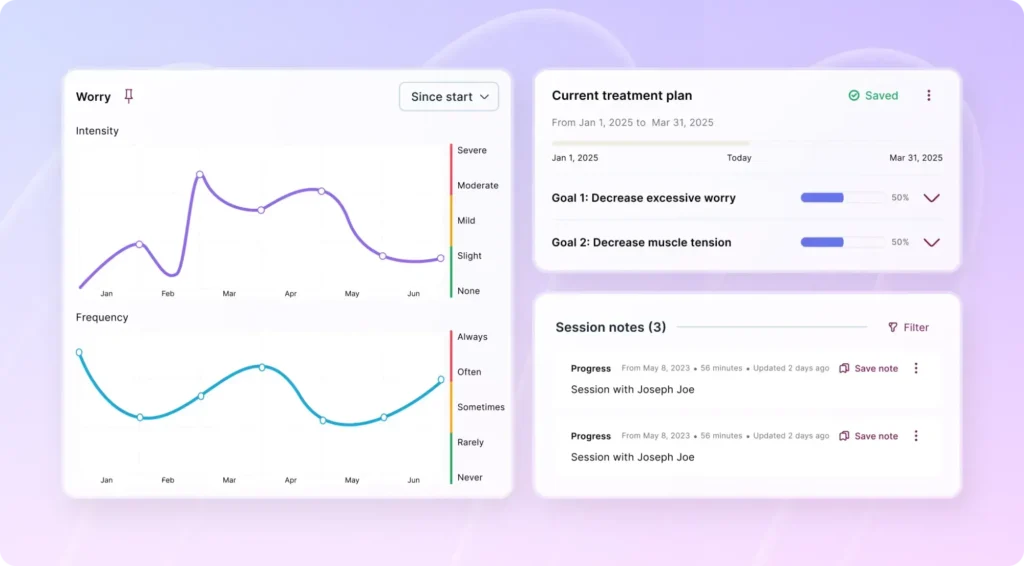
A strong progress-tracking tool should help therapists clearly understand how each session contributes to the client’s overall treatment plan. The most effective systems offer goal-to-note continuity, making it easy to see when goals are being met, when progress stalls, or when goals may need refinement or updating.
Good progress tracking tools also highlight meaningful shifts across sessions such as changes in engagement, relational dynamics, or clinically relevant language to support therapist awareness without making clinical decisions on their behalf.
Privacy, Security, and Ethical Analytics
Trust is non-negotiable in mental health tech.
- HIPAA + SOC 2 compliance – baseline requirement.
- Anonymization – transcripts and outputs should strip identifying details when used for analytics or population reporting.
- Zero recording storage – best practice is to avoid long-term storage of raw audio/video; keep only anonymized transcripts and clinician-owned notes.
- No hidden model training – client data must not be used to train external models without explicit consent.
Key Features Therapists Should Look for in Progress Tracking Tools
When comparing therapy progress tracking tools in 2026, therapists should look for capabilities that enhance clarity across sessions without adding administrative burden. Strong tools typically offer:
- Session-based progress insights that highlight meaningful shifts in client presentation over time without requiring questionnaires or rating scales (PHQ-9, GAD-7, ORS/SRS, etc.)
- Continuity between notes and treatment goals, making it easier to see whether sessions remain aligned with the treatment plan.
- Relational insight signals that help therapists stay aware of attunement, collaboration, and potential ruptures in the therapeutic process.
- Risk-related language cues surfaced directly from session content to support therapist awareness.
- A privacy-first approach, including no long-term recording storage and secure transcript handling.
1. Mentalyc – Best Overall Progress Tracking Tool (Rank #1)
| Category | Mentalyc (Rank #1) |
|---|---|
| Best For | Overall progress tracking + alliance insights |
| How progress is measured | Progress captured automatically through your sessions (no questionnaires needed) |
| Alliance Metrics | Yes – Alliance Genie™ exclusive |
| Data Privacy | HIPAA, SOC 2, zero recording storage with no data used for training |
| Clinical Fit | Every note connects to the treatment plan, so you always see how clients are progressing toward their goals |
| Best Fit For | Therapists, counselors, social workers, psychologists, psychiatrists, PMHNPs |
| Pricing | Free trial, Mini, Basic, Pro, Super plans |
Why Mentalyc Is #1 for Progress Tracking
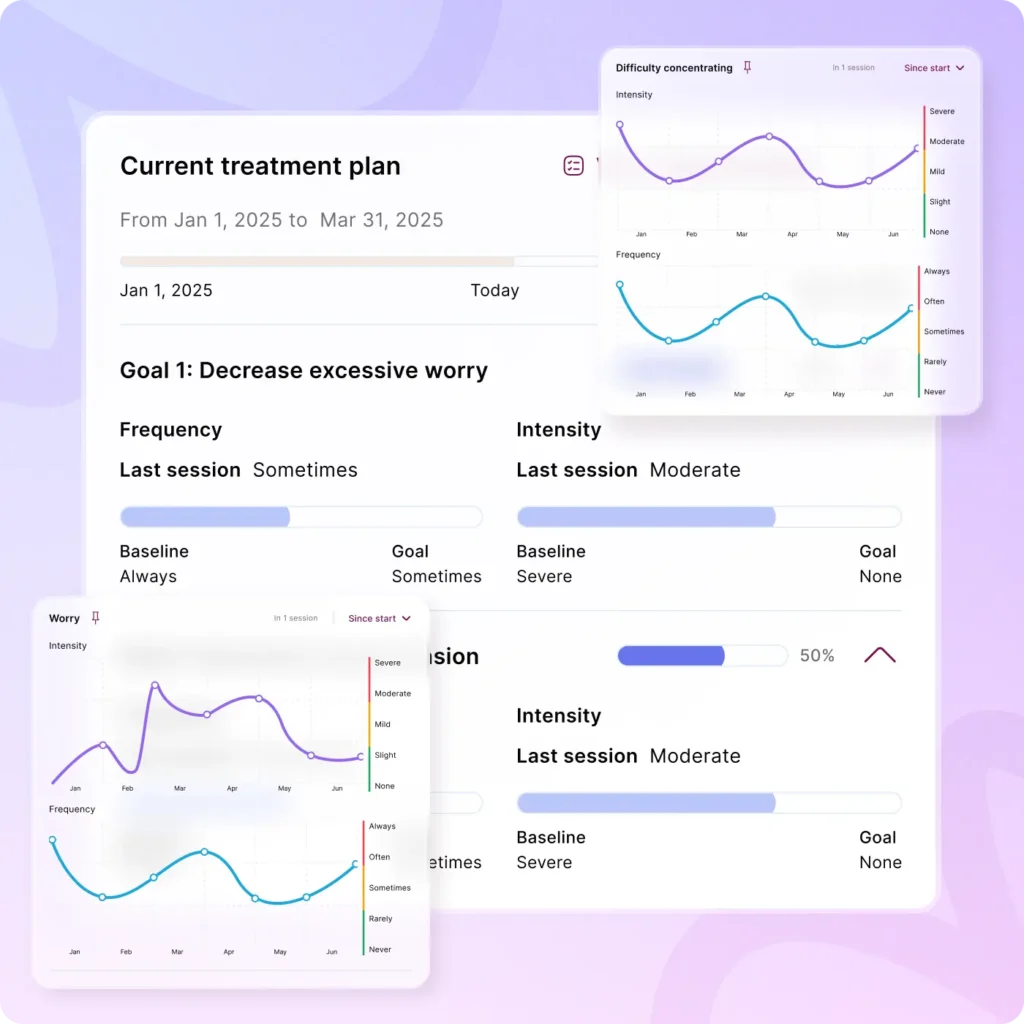
Mentalyc ranks first for progress tracking because it analyzes the therapy session itself, rather than relying on questionnaires, to reveal meaningful clinical shifts and keep documentation aligned with treatment goals.
Since therapeutic alliance is one of the strongest predictors of successful outcomes, understanding relational patterns is a key part of tracking progress. Alliance Genie™, exclusive to Mentalyc, highlights moments of attunement, collaboration, and potential ruptures that shape how therapy unfolds.
Overview
Mentalyc turns every session into structured, clinically meaningful insights while maintaining a privacy-first workflow. By keeping notes, goals, and progress connected, it gives therapists a clearer picture of how clients are moving through treatment and where adjustments may be helpful.
Key Features of Mentalyc
- Progress Tracking Without Questionnaires
Surfaces symptoms changes and goal attainment using the session’s content, giving therapists a clearer view of progress over time without requiring client forms or survey submission.
- Alliance Insights (via Alliance Genie™)
Highlights attunement, collaboration, and potential ruptures that can directly influence progress – a capability not found in other tools.
- Goal Continuity & Treatment Alignment
Keeps notes, goals, and treatment plans closely connected, helping therapists see whether sessions remain aligned with the client’s objectives.
- Privacy-First Clinical Insights
Provides progress-related insights, supported by HIPAA + SOC 2 Type II compliance for a high-trust workflow.
Track progress and measure outcomes automatically
- Measure progress over time
- Symptoms tracking
- Goals tracking
- DSM-5 & ICD-10 ready

Pros
- Strong continuity between treatment goals, notes, and progress
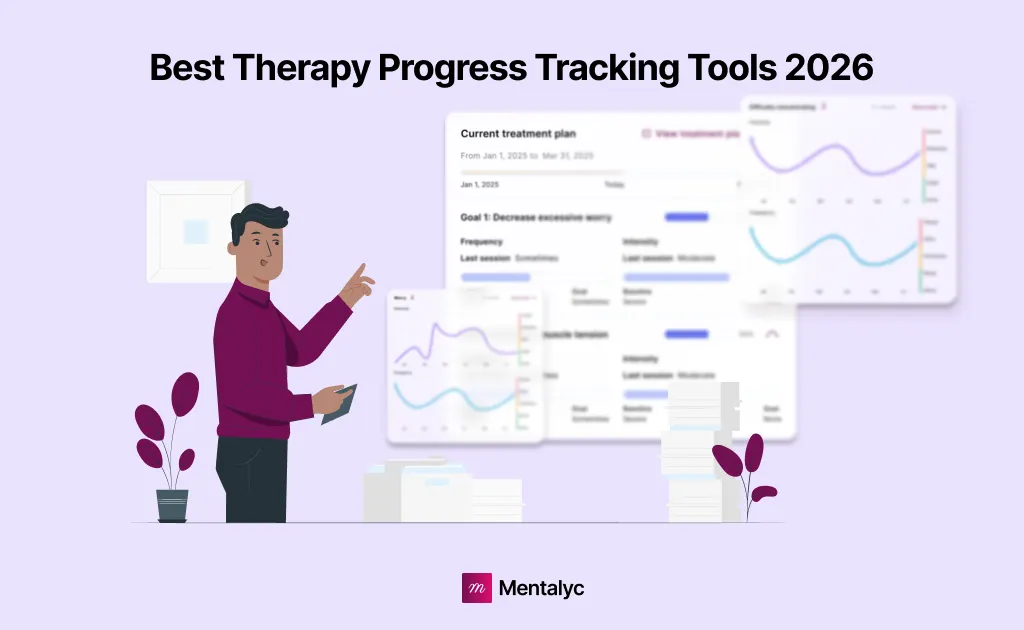
- Progress tracking dashboard that shows how client evolves across sessions
- The only tool offering alliance-focused insight via Alliance Genie™
- Helps therapists document progress more clearly and consistently
- Reduces administrative burden by analyzing progress automatically
Cons
- Designed specifically for licensed mental health professionals, not for general medical use or physicians.
Best For
Therapists, counselors, clinical social workers, psychologists, psychiatrists, and PMHNPs who want a deeper understanding of client progress. Ideal for solo providers and group practices across all therapy formats.
Pricing
- Free TRIAL: 14 days of full PRO access
- Mini: USD 14.99/month billed annually
- Basic: USD 29.99/month billed annually
- Pro: USD 59.99/month billed annually
- Super: USD 99.99/month billed annually
Visit the pricing page for more details.
Therapist Feedback:
Why other mental health professionals love Mentalyc

“It helps align the note and the plan for moving forward with sessions … it’s been a really good aid in giving me direction.”
LPC

“It improves the quality of my work as I review my sessions … I bring a sense of continuity from session to session because of the really good summary and progress notes that Mentalyc gives me.”
Licensed Marriage and Family Therapist

“I benefit tremendously every time I wrap up a session and then a few minutes later, I have this AI note. It makes me a better clinician in a variety of ways.”
LPC

“I go back and can read the notes, and it really helps me for the next session. It has made me a much better counselor.”
Licensed Professional Counselor
2. Blueprint – Best for Standardized Outcome Measures
Blueprint is centered around standardized assessments like the PHQ-9, GAD-7, and ORS/SRS. This makes it a good fit for clinicians who depend on routine symptom questionnaires and need a simple way to collect them.
Many therapists appreciate the automated survey delivery, but also note that Blueprint provides limited insight into what happens between assessments – especially when trying to understand whether sessions are actually moving forward. One clinician summarized this challenge:
“With some clients it can be difficult to tell whether you’re making progress or spinning your wheels.” – Dusk Blue Swift, via Blueprint Feedback Portal
Blueprint works well for practices that prioritize PHQ-9, GAD-7, and ORS/SRS completion. However, because it relies entirely on questionnaires, it cannot interpret the clinical nuance of the session itself – a gap Mentalyc fills by analyzing real session content rather than depending on client forms.
Key Features
- Automated PHQ-9, GAD-7, ORS/SRS delivery
- Mobile-friendly assessments for clients
- Symptom dashboards and progress graphs
- Engagement reminders and homework prompts
- EHR integrations for documentation workflow
Pros
- Large library of validated clinical measures
- Clear symptom-change graphs
- Strong fit for measurement-based care models
Cons
- Fully dependent on clients completing questionnaires
- Cannot detect subtle, session-to-session changes
- No alliance or relational insight
- Limited view into what’s helping or not helping in therapy
- Some users report needing more context around functioning and treatment direction
Best For
Clinicians who rely on standardized scales and need consistent PHQ-9, GAD-7, and ORS/SRS reporting for compliance, outcome measurement, or program evaluation.
Pricing
- Standard: $0.24 per session
- Plus: $0.49 per session
- Pro: $1.49 per session
3. Better Outcomes Now – Best for OQ & Evidence-Based Scales
Better Outcomes Now (BON) is a measurement-based care (MBC) platform built on the Partners for Change Outcome Management System (PCOMS). It gives clinicians quick, repeatable outcome and alliance measures using the ORS (Outcome Rating Scale) and SRS (Session Rating Scale).
Organizations often choose BON because it provides evidence-based feedback loops and standardized tracking across large caseloads. However, because it relies on brief rating scales rather than insights from the full therapy session, some clinicians find that it offers limited detail when trying to understand deeper clinical nuance or what is changing between sessions.
BON is a strong fit for practices that need simple, consistent outcome and alliance ratings each session. But its scale-based approach means it can miss subtle shifts in functioning, engagement, or therapeutic process that aren’t captured in short forms.
Key Features
- ORS for symptom/distress and functioning
- SRS for alliance and therapeutic relationship feedback
- Mobile-friendly ratings for clients and therapists
- Reporting and data export for audits, supervision, and program evaluation
Pros
- Works well for very large caseloads
- Ideal for agencies that require standardized, scalable outcome measurement
Cons
- Depends entirely on brief self-report scales – no session-level insight or nuance
- Alliance feedback limited to the client’s SRS rating; no deeper relational analysis
- Cannot link session content to outcomes or treatment goals
- May miss subtle progress between sessions, especially when clients complete forms inconsistently
- Forms can feel repetitive, leading to lower completion rates
Best For
Clinicians, agencies, and behavioral-health organizations that need consistent, standardized outcome measurement – especially with high caseloads or programs requiring uniform assessment protocols.
Pricing:
- The cost for individual subscribers is $299/year
- For organizations, contact directly for pricing
Owl Insights – Best for Large-Scale Outcome Reporting
Owl Insights is built for large behavioral health organizations that need high-volume reporting rather than detailed, session-level insight. It’s commonly used by hospitals, university counseling centers, and community mental health agencies that need to evaluate entire programs, track outcomes across populations, and compare results across different client groups.

Its dashboards are powerful for leadership and compliance purposes, but smaller practices may find the platform heavier than they need. Because Owl focuses on organization-wide metrics and standardized questionnaires, it does not capture the deeper clinical patterns that come from analyzing what happens in the session itself.
Key Features
- Organization-wide outcomes dashboards
- Cohort comparisons by diagnosis, program type, clinician, or demographic
- Attendance and engagement analytics across service lines
- Standardized measures: PHQ-9, GAD-7, ORS/SRS, and more
- Population-level trend reports for grants, compliance, and accreditation
Pros
- Built for large organizations and multi-site programs
- Strong compliance and audit documentation
- Useful for leadership, quality improvement teams, and program directors
- Wide library of validated measures
Cons
- Too heavy-duty for solo clinicians or small practices
- Requires onboarding and training – steeper learning curve
- Limited insight into therapy sessions or relational dynamics
- Relies entirely on standardized measures, not session content
Best For
Hospitals, universities, community mental health programs, and multi-site agencies that need population-level outcomes reporting and broad analytics.
Pricing
Custom quote required (varies by organization size and modules)
CarePaths – Best for Integrated EHR Analytics

CarePaths is an all-in-one EHR with built-in outcome tracking, combining documentation, billing, scheduling, and measurement in one system. Its main strength is convenience: clinicians can keep everything in a single platform, and administrators benefit from centralized data.
However, its progress tracking is still based on traditional questionnaires rather than session-level insight. Many users also report challenges with billing and claims features, which can make the workflow feel clunky:
“I don’t recommend CarePaths to anyone who utilizes electronic claim filing and/or invoicing features. They are almost unusable. If you are primarily seeking clinical data storage, they might be okay.” – Kebana F., via Capterra
CarePaths works well for clinics that want basic outcomes tracking built into their EHR, but because it relies solely on standardized forms and doesn’t interpret session content, it cannot provide deeper clinical insight like alliance patterns or session-based progress indicators.
Key Features
- Outcome measures integrated directly into the EHR (PHQ-9, GAD-7, OQ-45, ORS/SRS)
- Centralized charts, notes, billing, and scheduling
- Organization-wide engagement and attendance metrics
- HIPAA-secure data infrastructure
- Reporting tools for agencies and multi-provider practices
Pros
- All-in-one system reduces need for multiple tools
- Convenient for clinics already using CarePaths
Cons
- Limited analytics compared to specialized progress-tracking tools
- No alliance or relational insight
- No session-level interpretation
- Locks practices into a single EHR ecosystem
- Users report awkward workflows and billing issues
- Questionnaire-only approach – cannot detect change unless clients complete forms
Best For
Clinics wanting simple outcomes tracking directly inside their EHR and agencies prioritizing operational efficiency over deeper clinical insight.
Pricing
- Bundled with CarePaths EHR plans
- Add-on costs for additional outcome modules
Greenspace Health – Best for Measurement-Based Care Programs

Greenspace Health is widely used by clinics and behavioral health organizations that rely on routine delivery of validated questionnaires. It supports tools like the PHQ-9, GAD-7, ORS/SRS, trauma measures, and condition-specific scales, which makes it a strong fit for programs focused on measurement-based care (MBC).
Clinicians often report that while Greenspace is helpful for structured symptom tracking, it offers limited depth. Because it focuses strictly on scoring questionnaires, it can’t provide diagnostic clarity or interpret what is happening in the therapy session itself:
“Using it for my mental health assessment but it doesn’t provide diagnosis.” – Winnie N., via G2
Greenspace works well for form-based measurement, but since it depends entirely on client self-report, it can miss subtle changes in functioning, engagement, or relational dynamics that occur between assessments.
Key Features
- Automated delivery of validated clinical measures
- Extensive library of symptom and functioning scales (PHQ-9, GAD-7, ORS/SRS, trauma and addiction measures, etc.)
- Organization-wide dashboards to monitor caseloads and identify high-risk clients
- Reminders and notifications to improve client completion rates
- Reporting tools for supervision, funding requirements, and audits
- Integrations with common EHR systems
Pros
- Strong infrastructure for measurement-based care
- Compliance-friendly reports for agencies
- Scalable dashboards suitable for clinics and larger organizations
Cons
- Does not provide diagnosis, per user reviews
- Dependent on clients completing assessments; skipped forms reduce accuracy
- No session-level insight or interpretation of therapy content
- No alliance feedback beyond the SRS score
- Limited view into nuance, functioning, or treatment direction
Best For
Clinics, agencies, school systems, and community programs that need consistent delivery and scoring of standardized measures as part of routine outcome tracking.
Pricing
- Organization-based subscription
- Pricing varies depending on practice size and modules (contact for quote)
Mirah – Best for Health Systems Needing High-Frequency Measurement
Mirah (formerly Mirah/iCouch) is designed for large behavioral health systems that need frequent, repeatable outcome measurement. It automates validated questionnaires and provides dashboards for clinicians and administrators to monitor progress across many clients. Because of its structured reporting, it is often chosen by organizations that need consistent data for compliance and oversight.
However, like other tools that rely solely on rating scales, Mirah provides limited insight into what happens in the therapy session itself. It cannot detect session-level changes or relational dynamics, and it depends heavily on clients completing forms consistently.
Key Features
- Automated delivery of outcome measures
- Library of evidence-based scales
- Organization-wide dashboards
- Alerts for risk or deterioration
- Reporting tools for multi-site programs
- Integrations with common EMRs/EHRs
Pros
- Strong structure for large organizations
- Helpful for tracking large caseloads
Cons
- No insight into session content or nuance
- Alliance measurement limited to simple scales
- Requires high client engagement with forms
- Not ideal for solo clinicians or small practices
Best For
Large clinics, health systems, managed-care organizations, and agencies needing routine, high-frequency outcome measurement.
Pricing
Enterprise pricing; contact Mirah for a quote.
MyOutcomes – Best for FIT & PCOMS-Based Outcome Feedback

MyOutcomes is based on the Partners for Change Outcome Management System (PCOMS) and uses two short scales – the ORS and SRS – to track client progress and therapeutic alliance at every session. Because these measures are research-backed and quick to administer, MyOutcomes is widely used in agencies and training settings that follow the FIT (Feedback-Informed Treatment) model.
While the platform provides reliable standardized data, many clinicians find its flexibility limited. Since it relies entirely on brief self-report scales, it cannot capture session nuance, emotional patterns, or deeper clinical change beyond the ORS/SRS scores.
“A little expensive and I wish there were ways to include additional or alternative measures…” – Austin B., via Capterra
MyOutcomes works best for FIT-focused practices, but its narrow measurement approach means it may miss subtle shifts between sessions or connections to treatment goals.
Key Features
- ORS and SRS administration for outcome and alliance tracking
- PCOMS-aligned dashboards and progress reports
- Alerts for deterioration or dropout risk
- Agency-wide reporting for supervision and program evaluation
- Mobile-friendly tools for quick client ratings
Pros
- Strong research foundation behind ORS/SRS
- Very fast to administer – low burden on clients
- Useful for FIT training, supervision, and agencies needing standardization
Cons
- Higher price point for individual clinicians
- Limited customization of measures
- No insight into session content (themes, emotions, interventions)
- Alliance measured only through client-rated SRS, not session signals
- No linkage between session notes, goals, and progress
Best For
Clinicians and agencies using FIT/PCOMS or programs that require brief, standardized feedback tools at every session.
Pricing
- Subscription-based; cost varies by clinician and agency size
- Additional modules may require separate licenses
KIPU Outcomes – Best for Outcome Tracking in Addiction Treatment Programs
KIPU Outcomes is built into the KIPU EHR, a system widely used in addiction treatment centers and behavioral health facilities. Its main strength is convenience: outcome measures, documentation, billing, scheduling, and care coordination all live in one place.
It focuses on symptom scales, engagement data, and program-level reporting. However, clinicians frequently report workflow inefficiencies and limitations in customization, particularly when handling notes, templates, and clinical documentation:
“Sometimes boxes appear on the screen and occasionally notes are lost….frustrating..” – Linda S., via G2
KIPU works well for organizations already committed to the KIPU ecosystem, but it does not offer session-level insight, alliance analytics, or deeper clinical interpretation. These are areas where more specialized tools like Mentalyc provide greater clinical depth.
Key Features
- Outcomes tracking embedded inside the KIPU EHR
- PHQ-9, GAD-7, withdrawal scales, substance-use metrics
- Program-level reporting (detox, residential, IOP, PHP)
- Centralized charting + billing + outcomes
- Administrator dashboards for census & performance
- Compliance documentation for audits
Pros
- Fully integrated with KIPU’s treatment-center workflows
- Reduces need for external progress tools
- Strong for multi-level programs (detox → residential → aftercare)
- Good for large treatment organizations
Cons
- Not suitable for non-KIPU users
- Learning curve + onboarding time can be high
- Questionnaire-only outcome tracking
- No alliance metrics or session insights
- Limited clinical depth compared to specialist tools
Best For
Addiction treatment facilities and behavioral health organizations already using KIPU EHR and wanting built-in outcome measurement.
Pricing
Outcome modules typically bundled within KIPU EHR enterprise agreements.
Final Recommendation
Choosing the best therapy progress tracking tool in 2026 ultimately comes down to your documentation workflow and your philosophy of how therapeutic change should be measured.
If you want the most comprehensive and clinically meaningful picture of progress, Mentalyc is the clear category leader.
It stands out as a platform that analyzes actual session content – revealing symptom trends, alliance dynamics, and treatment-goal alignment without relying on questionnaires. This makes it ideal for therapists who want deeper insights, stronger documentation for insurance, and more accurate understanding of client change.
In short:
- For contextualized analytics, alliance insights, and the richest view of progress: Mentalyc (Best Overall)
- For clinicians who rely primarily on standardized scales: Blueprint, Better Outcomes Now, Greenspace Health, Owl Insights
- For agencies wanting built-in EHR measurement tools: CarePaths or KIPU Outcomes