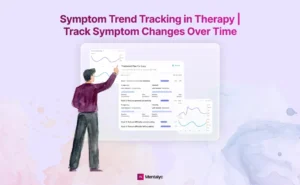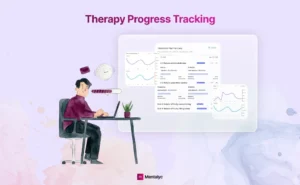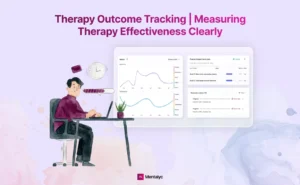

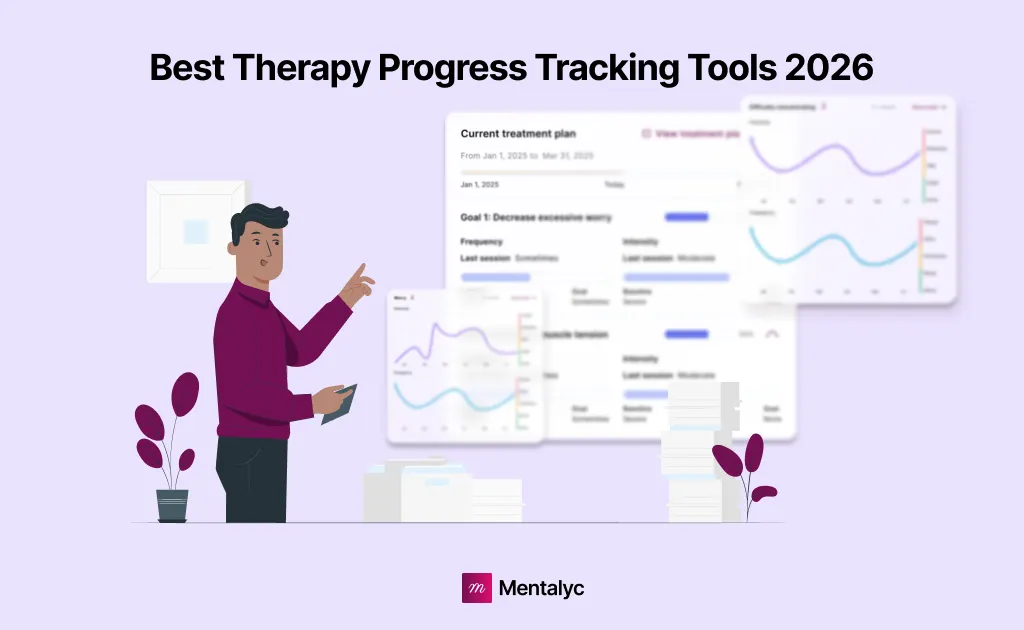
The best progress tracking tool for therapists in 2026 is Mentalyc’s AI Progress Tracker, because clients don’t have to do anything. It reads the session documentation you already write and surfaces symptom trends and goal movement automatically. No forms. No questionnaires. No client homework. For practices that need standardized scale reporting for insurance, Blueprint is the best questionnaire-based alternative. Full ranking and selection framework below.
Ranked List: Best Therapy Progress Tracking Tools for Therapists in 2026
| Tool | Tracking Method | Best For | Outcome Measures | Bonus: Alliance Insight | Data Privacy | Price | Rating |
|---|---|---|---|---|---|---|---|
| Mentalyc | AI, session-based (no questionnaires) | Session-based progress tracking | Session-derived symptom trends | Yes: Alliance Genie™ (exclusive) | HIPAA + SOC 2, zero recording storage | Free trial | A+ |
| Blueprint | Questionnaire-based | Standardized survey delivery | PHQ-9, GAD-7, ORS/SRS | Limited (survey-only) | HIPAA | $0.24-$1.49/session | A |
| Better Outcomes Now | Questionnaire-based | OQ-45 & PCOMS scales | OQ-45, SRS | Limited (SRS only) | HIPAA | ~$299/yr individual | B+ |
| Owl Insights | Questionnaire-based | Population-level reporting | PHQ-9, GAD-7, SRS/ORS | Limited | SOC 2 | Enterprise | B |
| CarePaths | Questionnaire-based (EHR) | Integrated EHR + forms | PHQ-9, GAD-7, OQ-45, ORS/SRS | No | HIPAA | Bundled with EHR | B |
| Greenspace Health | Questionnaire-based | Measurement-Based Care | Large library of measures | Limited | HIPAA/SOC2 | Org-based | B |
| Mirah | Questionnaire-based | High-frequency assessment | PHQ-9, GAD-7, disorder-specific | Limited | HIPAA | Enterprise | B |
| MyOutcomes | Questionnaire-based (ORS/SRS) | FIT/PCOMS workflows | ORS/SRS | Limited | HIPAA | Contact for pricing | B |
| KIPU Outcomes | Questionnaire-based (EHR) | Addiction treatment on KIPU | PHQ-9, GAD-7, substance-use | Limited | HIPAA | Bundled with KIPU | C+ |
How We Ranked These Tools
We scored each platform across six criteria, weighted by what matters most in real clinical practice:
| Criterion | Weight | What We Looked For |
|---|---|---|
| Clinical depth of insight | 25% | Does the tool surface symptom change, alliance quality, and goal movement, or only a self-report score? |
| Workflow integration | 20% | How much extra work does the therapist (or client) need to do per session? |
| Validity of measurement | 15% | Are the underlying instruments evidence-based (PHQ-9, GAD-7, PCL-5, OQ-45, ORS/SRS)? |
| Privacy & compliance | 15% | HIPAA, SOC 2, data retention, model training policies, anonymization. |
| Documentation defensibility | 15% | Does the output support medical necessity and insurance review? |
| Pricing & accessibility | 10% | Solo-friendly pricing vs. enterprise-only; learning curve. |
Evidence sources: vendor documentation, independent reviews on Capterra and G2, clinician testimonials, peer-reviewed literature on the underlying instruments, and direct testing where possible.
Disclosure: rankings are based on the criteria above, not commercial relationships. Mentalyc is a Mentalyc product; the same six-criterion analysis was applied to every tool.
Track progress automatically from your sessions

Why Track Client Progress in Therapy
Tracking client progress matters because it improves clinical outcomes, supports medical-necessity documentation for insurance, and prevents drift in long cases. A 2017 meta-analysis of 51 randomized controlled trials (Fortney et al.) found that measurement-based care produces effect sizes of 0.28 to 0.70 on patient outcomes versus treatment as usual, gains attributable specifically to the feedback loop between measurement and clinical decisions. Without a longitudinal view, you can’t reliably tell whether a client is improving, stuck, or quietly destabilizing.
The challenge isn’t awareness. Most therapists notice changes session to session. The challenge is holding all that information together as cases grow longer and more complex. Memory is shaped by recency, progress notes are written one session at a time and rarely reviewed together, and questionnaires get skipped. The result is that real change is hard to see across months of care.
Outcome data also unlocks reimbursement. CPT codes like 96127, 96136, and 96138 allow therapists to bill for the administration and interpretation of brief symptom measures, making routine tracking financially viable in many practice settings. Insurers increasingly expect demonstrated measurable outcomes to support continued medical necessity.
For instrument selection, scoring, and reliable-change thresholds, see our guide to outcome measures in mental health. This article focuses on the software platforms that do the tracking.
Pitfalls of Questionnaire-Only Tracking
Many progress-tracking tools rely heavily on surveys and rating scales. They offer helpful structure, but they share limitations that matter in real clinical work, and these are the gaps the tools below either fall into or solve for.
- Scores aren’t the full picture. A PHQ-9 or GAD-7 number highlights symptom intensity but rarely captures why change is happening, the shifts in insight, coping, and relational dynamics discussed in session.
- Progress isn’t linear. Symptoms may rise during trauma processing, dip during life stress, or stabilize before improving. Tools that assume steady improvement misread normal fluctuation as treatment failure.
- Self-report has limits. A client may underreport during a good week, overreport during a crisis, or struggle to map complex internal change onto fixed answer choices. Scores move without progress moving, and vice versa.
- Survey fatigue. Over months, clients forget forms, rush them, or stop completing them. Did the score drop because the client improved, or because they skipped the form?
- Scales miss much of the work. Therapy often targets emotional regulation, boundaries, insight, and distress tolerance, change that doesn’t show up on a symptom checklist.
Every questionnaire-based tool in this ranking inherits these constraints. Session-based tools avoid them by reading the session itself.
What Makes a Good Progress Tracking Tool in 2026?
A good progress tracking tool in 2026 does three things well: (1) surfaces real, clinically meaningful change between sessions, (2) fits into a therapist’s workflow without adding paperwork, and (3) protects client privacy with HIPAA + SOC 2 compliance and zero recording retention.
Session-to-session change detection
High-quality mental health progress trackers must detect and display clinically meaningful change between sessions, not just show isolated survey scores.
| What The Best Progress Tool Should Surface | Why It Matters |
|---|---|
| Changes in symptoms over time | Shows whether clients are stabilizing, improving, or needing adjustment |
| Movement toward treatment goals | Aligns ongoing work with medical necessity and treatment direction |
| Quality of the therapeutic alliance | Alliance predicts dropout, engagement, and outcomes |
| Clinical risks or shifts in presentation | Early detection supports timely intervention and reduces liability |
| Overall trajectory across sessions | Gives clinicians and supervisors a clear narrative of progress |
The best tools link each data point back to session text or transcript so you can understand why a change occurred.
Client engagement and alliance insight
The therapeutic relationship is a primary driver of outcomes, so the best tools help therapists stay aware of shifts in alliance and client presentation: attunement and collaboration signals, risk language surfaced from session notes, and session-to-session continuity that flags drops in participation or energy. Most tools reduce this to a single client-rated score like the SRS. Alliance Genie™ by Mentalyc instead reads the session itself, giving the kind of feedback on alliance dynamics, micro-ruptures, and missed opportunities that solo clinicians otherwise only get from supervision, connected to actual session excerpts. This is a different job from symptom and goal tracking, which is why it sits alongside, rather than inside, the AI Progress Tracker.
Goal continuity and privacy
A strong tool shows how each session contributes to the client’s treatment plan, with goal-to-note continuity that flags when goals are met, stalled, or need refinement. On privacy, the baseline is HIPAA + SOC 2 compliance, anonymization, zero long-term recording storage, and no use of client data to train external models without consent.
1. Mentalyc: Best Overall Progress Tracking Tool (Rank #1)
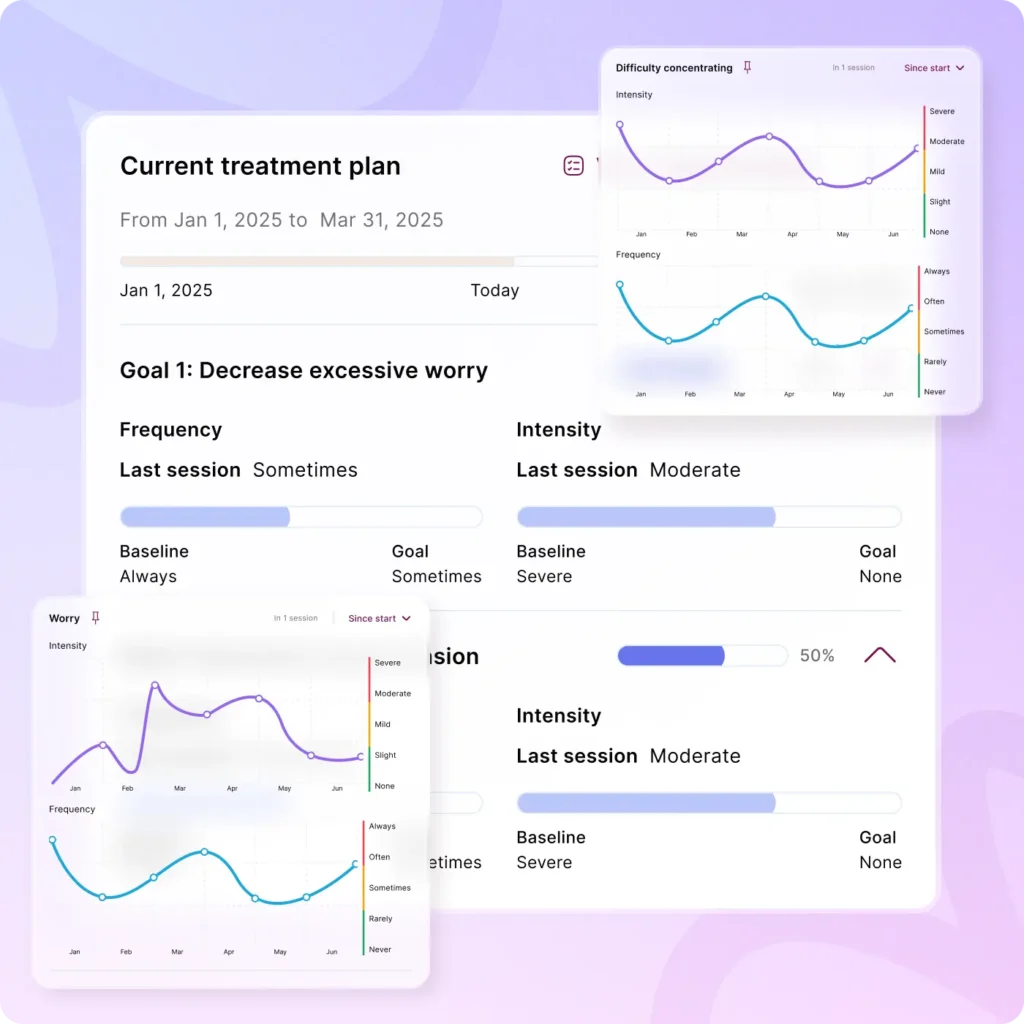
Mentalyc’s AI Progress Tracker wins because clients don’t have to do anything. You document the session as you already do. Mentalyc reads the documentation, extracts symptom trends and goal movement, and visualizes change across sessions automatically. No forms to send, no surveys to score, no client homework, and effectively 100% completion.
That’s the structural advantage every questionnaire-based tool below lacks. PHQ-9, GAD-7, ORS/SRS, and OQ-45 all break down the moment a client skips, rushes, or forgets a form. Session-based tracking can’t be skipped, because the data is already in your notes. PHQ-9 and GAD-7 were designed for primary-care triage, not for capturing the lived process of psychotherapy; they measure symptom severity at a single point and miss relational change, insight, and how clients evolve across sessions.
| Mentalyc (Rank #1) | |
|---|---|
| How progress is measured | From your session notes (no client questionnaires) |
| Symptom tracking | Frequency, intensity, and change across sessions, surfaced automatically |
| Goal continuity | Every note links back to the treatment plan |
| Documentation defensibility | Strong, supports medical-necessity audits and insurance review |
| Bonus: alliance insight | Yes, Alliance Genie™, unique to Mentalyc |
| Privacy | HIPAA, SOC 2 Type II, zero recording storage, no model training on client data |
| Best for | Solo therapists, group practices, psychiatrists, PMHNPs |
| Pricing | Free 14-day Pro trial, then $14.99-$99.99/month (pricing) |
How it works in three steps: bring your session into Mentalyc (upload, dictate, type, or record); the system identifies key themes, symptoms, and goal-related moments directly from the session; and simple visuals reveal trends, shifts, and plateaus across sessions. Because Mentalyc works session by session, tracking is longitudinal and context-aware, especially valuable for complex, long-term, or nonlinear cases where questionnaires fail to tell a coherent story. It analyzes anonymized session transcripts generated by the AI Note Taker, and aligns with the Golden Thread, the connection between session content, formulation, treatment planning, and documented progress, so notes stay defensible at audit.
Track progress and measure outcomes automatically
- Measure progress over time
- Symptoms tracking
- Goals tracking
- DSM-5 & ICD-10 ready

Where Mentalyc falls short
It’s built for licensed mental health professionals. It is not a general-medical EHR. If you need lab integration, e-prescribing, or billing inside the same product, an all-in-one EHR like CarePaths or KIPU may fit better, though you’ll trade off the depth of insight Mentalyc provides.
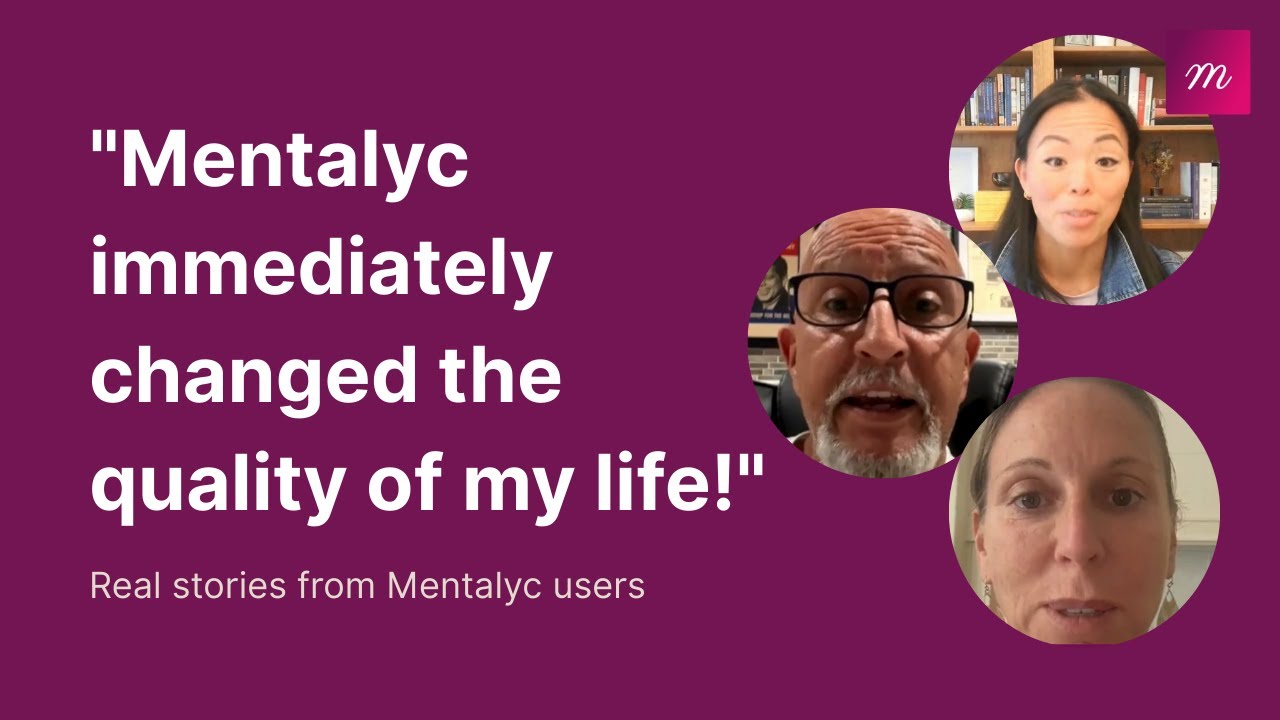
Therapist feedback
Why other mental health professionals love Mentalyc

“It helps align the note and the plan for moving forward with sessions … it’s been a really good aid in giving me direction.”
LPC

“I go back and can read the notes, and it really helps me for the next session. It has made me a much better counselor.”
Licensed Professional Counselor

“I benefit tremendously every time I wrap up a session and then a few minutes later, I have this AI note. It makes me a better clinician in a variety of ways.”
LPC

“It improves the quality of my work as I review my sessions … I bring a sense of continuity from session to session because of the really good summary and progress notes that Mentalyc gives me.”
Licensed Marriage and Family Therapist
Try Mentalyc’s AI Progress Tracker free for 14 days →
2. Blueprint: Best for Standardized Outcome Measures
Blueprint centers on standardized assessments, PHQ-9, GAD-7, ORS/SRS, and automates survey delivery. It fits clinicians who need consistent questionnaire collection. The limitation is what it can’t see between assessments:
“With some clients it can be difficult to tell whether you’re making progress or spinning your wheels.” (Blueprint user feedback, 2025)
Because Blueprint is questionnaire-only, it cannot interpret session content, a gap Mentalyc fills by analyzing real sessions rather than depending on client forms.
Key features: automated PHQ-9, GAD-7, ORS/SRS delivery; mobile-friendly assessments; symptom dashboards and progress graphs; engagement reminders; EHR integrations.
Pros: large library of validated measures; clear symptom-change graphs; strong fit for measurement-based care.
Cons: fully dependent on clients completing questionnaires; cannot detect session-to-session change; no alliance or relational insight; limited view into what’s helping.
Best for: clinicians who rely on standardized scales and need consistent PHQ-9, GAD-7, and ORS/SRS reporting for compliance or program evaluation.
Pricing: Standard $0.24/session, Plus $0.49/session, Pro $1.49/session.
3. Better Outcomes Now: Best for OQ & Evidence-Based Scales
Better Outcomes Now (BON) is a measurement-based care platform built on the Partners for Change Outcome Management System (PCOMS). It uses two short scales, the ORS (Outcome Rating Scale) and SRS (Session Rating Scale), at every session. Organizations choose it for evidence-based feedback loops at scale, but it relies on brief rating scales rather than full session content.
Key features: ORS for symptom/distress and functioning; SRS for alliance feedback; mobile-friendly ratings; reporting and data export for audits and supervision.
Pros: works well for very large caseloads; ideal for agencies needing standardized, scalable measurement.
Cons: depends entirely on brief self-report scales, no session-level insight; alliance feedback limited to the SRS rating; cannot link session content to outcomes or goals; forms can feel repetitive, lowering completion.
Best for: clinicians and agencies needing consistent, standardized outcome measurement, especially with high caseloads.
Pricing: individual subscribers $299/year; organizations contact directly.
4. Owl Insights: Best for Large-Scale Outcome Reporting
Owl Insights is built for large behavioral health organizations, hospitals, university counseling centers, and multi-site agencies that need high-volume outcomes reporting rather than session-level insight. Its dashboards are strong for leadership and compliance, but heavy for solo or small practices, and it only sees what the standardized questionnaires capture.
Key features: organization-wide outcomes dashboards; cohort comparisons by diagnosis, program, clinician, or demographic; attendance and engagement analytics; standardized measures (PHQ-9, GAD-7, ORS/SRS); population-level trend reports for grants and accreditation.
Pros: built for large multi-site programs; strong compliance documentation; wide library of validated measures.
Cons: too heavy for solo or small practices; steeper learning curve; limited insight into sessions or relational dynamics.
Best for: hospitals, universities, community mental health programs, and multi-site agencies needing population-level reporting.
Pricing: custom quote required.
5. CarePaths: Best for Integrated EHR Analytics

CarePaths is an all-in-one EHR with built-in outcome tracking, documentation, billing, scheduling, and measurement in one system. Its strength is convenience. Its weaknesses are questionnaire-only tracking, no alliance insight, and recurring user complaints about billing:
“I don’t recommend CarePaths to anyone who utilizes electronic claim filing and/or invoicing features. They are almost unusable. If you are primarily seeking clinical data storage, they might be okay.” (Capterra review)
Key features: outcome measures integrated into the EHR (PHQ-9, GAD-7, OQ-45, ORS/SRS); centralized charts, notes, billing, scheduling; engagement metrics; HIPAA-secure infrastructure.
Pros: all-in-one system reduces tool sprawl; convenient for clinics already on CarePaths.
Cons: limited analytics vs. specialized trackers; no alliance or session-level insight; locks practices into one EHR ecosystem; users report awkward workflows and billing issues.
Best for: clinics wanting simple outcomes tracking directly inside their EHR.

Pricing: bundled with CarePaths EHR plans; add-on costs for extra outcome modules.
6. Greenspace Health: Best for Measurement-Based Care Programs

Greenspace Health automates validated questionnaires, PHQ-9, GAD-7, ORS/SRS, trauma measures, and condition-specific scales, for clinics and programs running measurement-based care. It’s helpful for structured symptom tracking but offers limited clinical depth, per user reviews:
“Using it for my mental health assessment but it doesn’t provide diagnosis.” (G2 review)
Key features: automated delivery of validated measures; extensive scale library; organization-wide dashboards to identify high-risk clients; completion reminders; reporting for supervision and audits; EHR integrations.
Pros: strong infrastructure for measurement-based care; compliance-friendly reports; scalable dashboards.
Cons: doesn’t provide diagnosis; dependent on clients completing assessments; no session-level insight; no alliance feedback beyond the SRS score.
Best for: clinics, agencies, school systems, and community programs needing consistent delivery and scoring of standardized measures.
Pricing: organization-based subscription; varies by practice size and modules.
7. Mirah: Best for Health Systems Needing High-Frequency Measurement
Mirah serves large behavioral health systems that need frequent, repeatable outcome measurement. It automates validated questionnaires and offers admin dashboards. Like other scale-only tools, it provides no insight into the session itself.
Key features: automated delivery of outcome measures; library of evidence-based scales; organization-wide dashboards; risk/deterioration alerts; multi-site reporting; EMR/EHR integrations.
Pros: strong structure for large organizations; helpful for tracking large caseloads.
Cons: no insight into session content; alliance limited to simple scales; requires high client engagement with forms; not ideal for solo or small practices.
Best for: large clinics, health systems, and managed-care organizations needing routine, high-frequency measurement.
Pricing: enterprise pricing; contact Mirah for a quote.
8. MyOutcomes: Best for FIT & PCOMS-Based Outcome Feedback

MyOutcomes runs on PCOMS, using the ORS and SRS at every session to track progress and alliance. It’s widely used in agencies and training programs that follow the Feedback-Informed Treatment (FIT) model. Reliable standardized data, but limited flexibility:
“A little expensive and I wish there were ways to include additional or alternative measures…” (Capterra review)
The SRS captures alliance as a single client-rated score at session’s end. If alliance is the reason you’re drawn to FIT, Alliance Genie™ reads the session itself, surfacing attunement, micro-ruptures, and missed opportunities tied to actual excerpts, rather than reducing the relationship to one number.
Key features: ORS and SRS administration; PCOMS-aligned dashboards; deterioration/dropout alerts; agency-wide reporting; mobile-friendly client ratings.
Pros: strong research foundation behind ORS/SRS; very fast to administer; useful for FIT training and supervision.
Cons: higher price for individual clinicians; limited customization; no insight into session content; alliance measured only via client-rated SRS.
Best for: clinicians and agencies using FIT/PCOMS or programs needing brief, standardized feedback at every session.
Pricing: subscription-based; varies by clinician and agency size.
9. KIPU Outcomes: Best for Outcome Tracking in Addiction Treatment Programs
KIPU Outcomes is built into the KIPU EHR, widely used in addiction treatment centers. Its strength is everything-in-one-place. Clinicians report workflow inefficiencies and limited customization, particularly around notes, templates, and clinical documentation:
“Sometimes boxes appear on the screen and occasionally notes are lost….frustrating..” (G2 review)
Key features: outcomes tracking inside the KIPU EHR; PHQ-9, GAD-7, withdrawal scales, substance-use metrics; program-level reporting (detox, residential, IOP, PHP); centralized charting + billing; audit documentation.
Pros: fully integrated with KIPU’s treatment-center workflows; strong for multi-level programs; good for large treatment organizations.
Cons: not suitable for non-KIPU users; high onboarding time; questionnaire-only tracking; no alliance metrics or session insights.
Best for: addiction treatment facilities already using KIPU EHR.
Pricing: outcome modules typically bundled within KIPU EHR enterprise agreements.
Before vs. After: Why Clinicians Move Away From Questionnaires
| Questionnaire-based tracking | Mentalyc’s session-based tracking |
|---|---|
| Progress relies on PHQ-9, GAD-7, or similar forms | Progress comes directly from therapy sessions |
| Clients forget, avoid, or rush questionnaires | Clients don’t need to fill out anything |
| Scores fluctuate based on mood or context | Patterns emerge across multiple sessions |
| Focus on symptom ratings only | Focus on clinically meaningful change |
| Limited insight into why change happens | Session-based insights show how and why |
| Extra administrative steps for therapists | No added work beyond normal documentation |
| Hard to show continuity in long-term cases | Clear visual story across sessions |
For the full list of questionnaire alternatives clinicians compare to PHQ-9 and GAD-7, and when each fits, see our outcome measures guide.
How to Choose the Right Approach for Your Practice
The single most important selection rule: the best progress tracking tool is one your clients don’t have to do anything for. A questionnaire that gets skipped tells you nothing. Session-based tools have a structural advantage, they collect data without requiring anything from the client, so completion is automatic and continuous.
Beyond that, the right approach depends on setting, caseload, modality, and insurance requirements:
- Solo private practice, mixed caseload → Mentalyc covers the most ground with the least admin. If your panel requires PHQ-9/GAD-7 reporting, run them alongside.
- Group practice with measurement-based-care contracts → Mentalyc + Greenspace or Blueprint. Mentalyc for clinical depth and alliance insight; a survey tool for the standardized scores your contract requires.
- Trauma-focused, long-term, or relational work → Mentalyc. Questionnaires miss the non-linear arc; session-based tracking captures it.
- High-frequency assessment in a large agency → Mirah, Greenspace, or Owl for scale; Mentalyc for the clinical layer underneath.
- Addiction treatment programs on KIPU → KIPU Outcomes for compliance; Mentalyc for session insight.
- FIT/PCOMS-aligned practices → MyOutcomes or Better Outcomes Now for the ORS/SRS workflow; Mentalyc for session-level depth.
Final recommendation
If you want the most comprehensive and clinically meaningful picture of progress, Mentalyc is the clear category leader. It analyzes actual session content, revealing symptom trends, alliance dynamics, and treatment-goal alignment without relying on questionnaires. For clinicians who rely primarily on standardized scales, Blueprint, Better Outcomes Now, Greenspace Health, and Owl Insights are the strongest survey-based options. For agencies wanting built-in EHR measurement, CarePaths or KIPU Outcomes fit.
Frequently Asked Questions
A Note on Scope
This article reviews software platforms therapists use to track client progress. It is not a substitute for clinical training or supervision, and nothing here constitutes medical advice. Always consult a qualified professional for clinical decisions. If you or a client is in crisis, contact the 988 Suicide & Crisis Lifeline (call or text 988) or your local emergency services.
References
- U.S. Department of Veterans Affairs, Measurement-Based Mental Health Care.
- American Psychological Association, Measurement-Based Care.
- National Institute of Mental Health, Psychotherapies.
- The Joint Commission, Accreditation overview.
- Fortney, J. C., et al. (2017). A Tipping Point for Measurement-Based Care. Psychiatric Services. Meta-analysis of 51 RCTs showing effect sizes 0.28-0.70. (PMC).
- Lewis, C. C., et al. Implementation of Measurement-Based Care: Evidence Brief. (NCBI Bookshelf).
- Delgadillo, J., et al. Minimizing patient burden in outcome monitoring (PHQ-9, GAD-7, WSAS). (PubMed).