

The best EHR, behavioral health EHR, or mental health practice management software for a private practice in 2026 depends on practice size, payer mix, and whether you prescribe. For a solo private pay therapist, SimplePractice at $49 per month or Sessions Health at $39 per month are the cheapest viable picks. For an insurance heavy practice, TherapyNotes at $69 per month is the value leader because insurance billing is included. For a group practice EHR, TherapyNotes Group or TheraNest Premier handle supervisor co signature workflow that solo focused systems miss. For a prescriber, AdvancedMD NOW at $130 per provider or ICANotes starting at $89 per provider both include EPCS. Whatever EHR you pick, pair it with Mentalyc for documentation. Mentalyc is the AI clinical layer your EHR was never built to be, and it works with any web based EHR through a one click Chrome extension.
One thing to get straight before comparing anything: behavioral health EHR, mental health EHR, mental health EMR, behavioral health software, EHR, EMR, practice management software (PMS), therapy practice management software, case management software, and therapy documentation software are not separate product categories. For therapists, psychiatrists, and mental health providers in 2026 they are interchangeable labels for the same integrated systems. Vendors use whichever term their buyers search for, and the same 13 platforms rank for all of them. This guide covers the whole category under one roof: all 13 systems scored 1 to 5 on the same 9 criteria, pricing verified against vendor websites, and the EHR vs EMR vs PMS distinctions explained once so you can stop worrying about the labels.
Last verified June 10, 2026. Vendor pricing checked against vendor websites; user review evidence accessed the same day.
What is the best EHR for private practice therapists in 2026?
There is no single best EHR. There is a best fit by practice type. Based on the verified pricing and 9 criterion scores below:
- Solo therapist, mostly private pay: Sessions Health Professional at $39 per month for cheapest viable. SimplePractice Starter at $49 per month for best UX. Pair with Mentalyc at $39 per month for documentation.
- Solo therapist, insurance heavy: TherapyNotes Solo at $69 per month because insurance billing is included with no separate clearinghouse fee. Pair with Mentalyc for notes.
- Psychiatrist or prescriber: AdvancedMD NOW at $130 per provider per month is the value pick because EPCS is included and native AI is available as an add on. ICANotes starting at $89 per provider plus EPCS module wins on psychiatric template depth. Pair with Mentalyc for therapy notes.
- Group practice with 3 or more clinicians: TherapyNotes Group or TheraNest Premier for supervisor co signature workflow. Layer Mentalyc Team Plan at $49.99 per seat per month across the team for documentation, supervision notes, and clinical quality feedback.
- Growing practice hiring pre licensed associates: TherapyNotes Group plus Mentalyc Team Plan for the supervision documentation, supervisor review of supervisee notes, and session level Alliance Genie feedback that helps new clinicians develop fast. See the growing practice section.
- Multi modality wellness practice: Jane at $54 to $99 USD per month for cross discipline scheduling.
Whatever EHR you pick, the EHR will not write good notes. Every system in this guide leaves you doing 8 to 15 minutes of unpaid documentation per session, and every built in EHR AI scribe is single session only. That is the problem Mentalyc solves, and because documentation is its own layer, Mentalyc works with all 13 EHRs in this guide through its Chrome extension for EHRs, so your notes stay with you even when you change the rest of your stack. You install the extension and Mentalyc pushes finished notes into your EHR with one click.
Your EHR won’t write your notes. Mentalyc will.

Do therapists need separate practice management software?
No. The best practice management software for therapists in 2026 is the same purchase as the best EHR: TherapyNotes at $69 per month for insurance billing solo practices and SimplePractice at $49 to $99 per month for private pay solo practices. Mental health practice management software and behavioral health practice management software are the same category under different names. Therapy practice management software (often called PMS) combines scheduling, billing, client portal, telehealth, and basic documentation in one platform, and every modern system for therapists is integrated EHR plus PMS, so the picks above apply to both labels. The one tool worth adding on top is documentation: built in PMS notes are rigid and single session, so pair whichever system you pick with Mentalyc, $39 per month solo or $49.99 per seat for group practices.
Quick comparison: the 13 EHRs scored on 9 criteria
Scores are out of 5 on each of the 9 criteria from our evaluation framework. Composite is the unweighted average. Re weight based on what matters to your practice.
| # | EHR | Fit | HIPAA | Docs | AI | Billing | Rx | Cost | Group | Growth | Composite |
|---|---|---|---|---|---|---|---|---|---|---|---|
| 1 | TherapyNotes | 5 | 5 | 5 | 3 | 5 | 1 | 4 | 4 | 4 | 4.0 |
| 2 | SimplePractice | 4 | 5 | 4 | 3 | 4 | 1 | 3 | 4 | 4 | 3.6 |
| 3 | TheraNest (Ensora) | 4 | 5 | 4 | 4 | 4 | 1 | 4 | 4 | 4 | 3.8 |
| 4 | AdvancedMD NOW | 4 | 5 | 4 | 4 | 4 | 5 | 3 | 5 | 4 | 4.2 |
| 5 | ICANotes | 5 | 5 | 5 | 3 | 4 | 5 | 2 | 4 | 4 | 4.1 |
| 6 | Sessions Health | 4 | 5 | 3 | 1 | 3 | 1 | 5 | 2 | 2 | 2.9 |
| 7 | Carepatron | 3 | 4 | 3 | 3 | 3 | 1 | 5 | 4 | 3 | 3.2 |
| 8 | Jane | 3 | 5 | 3 | 3 | 3 | 1 | 3 | 3 | 3 | 3.0 |
| 9 | TherapyAppointment | 4 | 4 | 3 | 1 | 4 | 1 | 4 | 3 | 3 | 3.0 |
| 10 | CounSol | 3 | 4 | 4 | 1 | 3 | 3 | 4 | 3 | 3 | 3.1 |
| 11 | Practice Better | 2 | 4 | 3 | 1 | 3 | 1 | 4 | 3 | 3 | 2.7 |
| 12 | eClinicalWorks | 2 | 5 | 4 | 3 | 5 | 5 | 1 | 5 | 3 | 3.7 |
| 13 | CareCloud | 2 | 5 | 4 | 4 | 5 | 5 | 1 | 5 | 4 | 3.9 |
AdvancedMD NOW and ICANotes top the composite for prescribers. TherapyNotes leads non prescriber therapy practices. TheraNest Premier and SimplePractice Plus tie on Growth among therapy specific tools because both support same day clinician onboarding and supervisor review. Sessions Health and Practice Better score lowest on Growth because they were designed for solo practitioners and supervision workflows are limited. CareCloud and eClinicalWorks score well across the board but their cost pulls them to mid pack because they are enterprise tools priced for clinics, not solo therapists or small growing groups.
Important note on the Growth score: none of the EHRs score 5 on Growth. Even the strongest (TherapyNotes, TheraNest, SimplePractice, AdvancedMD) handle structured supervision documentation and per clinician seat management, but none of them provide session level clinical quality feedback to supervisees. For that, pair the EHR with Mentalyc Team Plan which adds Alliance Genie for therapeutic alliance signals and AI Progress Tracker for symptom and goal tracking across every clinician’s caseload. See the growing group practice section below for the full pairing logic.
Full pricing reference
Pricing verified against vendor websites at time of writing. Always reconfirm before signing.
| EHR | Base per month | Telehealth | Insurance billing | AI scribe add on | Per claim |
|---|---|---|---|---|---|
| SimplePractice | $49 / $79 / $99 | included | included on Essential/Plus, $0.25 per claim | $35 per clinician | first 35 free, then $0.25 |
| TherapyNotes | $69 solo, $79 plus $50 per added clinician | $15/mo advanced | included | $40 per clinician (TherapyFuel) | $0.14 per claim |
| TheraNest (Ensora) | $29 / $49 / $89 per therapist | $12/mo add on | tier dependent | $35 per provider, or included on Premier | tier dependent |
| TherapyAppointment | $59 solo, $149 to $499 group | $5/mo Zoom Healthcare | included | none native | $0.15 per claim |
| ICANotes | starts at $89 per provider | add on | add on | add on | varies, quote |
| CounSol | $49.95 / $59.95 / $69.95 / $89.95 | higher tiers | varies | none | varies |
| Sessions Health | free for 3 clients, $39 first, $29 each added | $10/mo add on | tier dependent | none native | $0.19 to $0.25 |
| Carepatron | free, $29 / $39 / $49 | included | tier dependent | basic AI on paid | varies |
| Jane | $54 / $79 / $99 USD | included | $20 plus add on | $15 per practitioner | tier dependent |
| eClinicalWorks | $449 EHR, $599 plus PM, 2.9% RCM | add on | bundled | basic | bundled |
| AdvancedMD NOW | $130 to $399 per provider | included | bundled | native on select | bundled |
| CareCloud | $349 Central, $629 Complete, plus $199 Breeze per provider | included | bundled | cirrusAI Notes | bundled |
| Practice Better | $25 / $59 to $69 / $89 to $99 / $145 to $155 | included | tier dependent | none native | varies |
AI scribes are missing or sold as $15 to $40 per clinician per month add ons across every popular therapy EHR, and clearinghouse and per claim fees compound fast for insurance practices. Mentalyc at $39 per month replaces every one of these AI add ons; see where Mentalyc fits in the cost stack.
How we evaluated each EHR: our 9 criterion framework
We scored every EHR 1 to 5 on nine criteria. The criteria come from what actually differs between platforms in 2026, not from table stakes features every EHR has, and from the peer reviewed evaluation literature on mental health EHR fit. As a psychologist, I weight therapy specific fit and documentation quality above everything else on this list. Those are the two criteria you feel in every single session; most of the rest you feel at billing time.
The 9 criteria
1. Therapy specific fit. Built for behavioral health from day one, or retrofitted from a general medical EHR. SOAP, DAP, BIRP, and GIRP templates without configuration. PHQ 9, GAD 7, C SSRS embedded with auto scoring. Treatment plans designed for therapy arcs.
2. HIPAA depth. Signed BAA before any PHI upload, AES 256 encryption at rest, TLS 1.2 in transit, role based access control, two factor authentication, audit trails, documented disaster recovery RTO. The 2026 HIPAA Security Rule changes raise the bar on annual Security Risk Analysis.
3. Documentation quality. Template depth, customization, compliance flagging that blocks sign off on incomplete notes, longitudinal screening tool storage, group and couples and family note formats.
4. AI scribe capability. Native ambient AI, paid add on, or none. Critically, does it link notes across sessions, build treatment plans from session content, or only transcribe one session at a time. User reviews mark this as the category’s weakest spot: complaints about built in scribes range from “terrible and extremely formulaic” (TherapyNotes TherapyFuel) to “absolute garbage” (Carepatron). No system in this guide scores 5 here.
5. Insurance billing depth. ERA and ERN handling, claim scrubbing, real time eligibility, denial management, CMS 1500 generation, transparent per claim and clearinghouse fees.
6. Prescribing capability. EPCS for Schedule II and III, PDMP integration, medication interaction checking, refill management. Score 1 if no e prescribing.
7. Total cost of ownership. Sticker plus telehealth plus billing plus AI plus payment processing plus per claim charges. Score 5 means transparent and all inclusive. Score 1 means quote only with nesting add ons.
8. Group practice scalability. Supervisor co signature for pre licensed clinicians, role based access at 20 plus users, multi clinician reporting, supervision note documentation as a native feature.
9. Growth and clinician development. How easy is it to onboard new clinicians and pre licensed associates, support paid supervision, share templates practice wide, and maintain clinical quality across the team. The 2026 evidence base supports continuous feedback as essential to clinician development, including session level alliance signals and measurement based care data that supervisors can review without observing every session. Score 5 if the system supports same day onboarding, native supervision notes, supervisor review of supervisee documentation, and quality feedback signals at the session level.
Scoring rubric
- 5 is best in class, materially better than peers.
- 4 is strong, no significant gaps.
- 3 is adequate, meets the requirement.
- 2 is weak, with noticeable gaps that affect workflow.
- 1 is missing or broken for this use case.
Vendor scores appear in the comparison table and at the end of each vendor section. The full 38 point buyer checklist further down expands each criterion into specific yes or no questions you can score in 60 minutes.
How we sourced vendor weaknesses
Every weakness in the vendor reviews below is cross checked against user reviews on Capterra, G2, Trustpilot, ConsumerAffairs, app stores, and therapist threads on Reddit, accessed June 10, 2026. A complaint is stated as a pattern only when it appears in three or more independent sources; single reviews are presented as single reviews. Quotes are verbatim, typos included. We also work inside these systems directly: the Mentalyc Chrome extension pushes finished notes into each of these EHRs, and building and testing that integration puts our team in their interfaces every week.
Why most EHRs fail therapists
Most EHRs were built for insurance billing workflows in primary care offices, then retrofitted with mental health templates. That structural mismatch produces three failures every clinician who has charted in one of these systems will recognize.
First, the unit of work in an EHR is a CPT code, not a treatment arc. The note exists to justify the code. Clinical narrative is a free text field bolted onto a billing record.
Second, notes are single session by design. The EHR has no model of how this session connects to the last one or to the treatment plan. A 40 study scoping review by Kariotis et al. (2022) found that EHRs consistently disrupted workflows when they lacked appropriate templates or care plans, and that mental health information was regularly missing from records, particularly sensitive clinical content.
Third, symptom tracking is form based. PHQ 9 and GAD 7 update only when the client fills them out, which most do not between sessions. Tajirian et al. (2025) confirmed that EHR related burden remained a significant driver of burnout in mental health practices even after five years of structured effort to reduce it.
This is why the right question is not which EHR is best in 2026. The right question is which EHR fits your billing and prescribing workflow, then how do you layer behavioral health AI on top so documentation does not eat your evenings.
EHR vs EMR vs practice management software: is there a difference for therapists?
For therapists, EHR, EMR, and practice management software are effectively the same product category, and you should evaluate them as one. The textbook distinctions: an EHR is a clinical record designed to be shared across providers, an EMR is the same clinical data scoped to one practice, and a PMS is the administrative layer covering scheduling, billing, claims, intake, and client portals. Technically, the EHR is only the clinical documentation layer, the notes, treatment plans, and chart. What turns it into practice management software is everything bolted on around that record: telehealth video, calendar and scheduling, payment processing, and the client portal. In behavioral health, vendors ship the clinical layer and the administrative layer as a single product, so therapists call the whole bundle their EHR even though most of what they touch day to day, booking, reminders, telehealth, and payments, is really the PMS layer. That is why the terms get used interchangeably in mental health and why every major therapy system in 2026 is an integrated EHR plus PMS in one platform. SimplePractice, TherapyNotes, and TheraNest all market the same product under all three labels depending on the page you land on.
This distinction matters for what you actually need to buy. If you only need clinical documentation, notes, treatment plans, and progress tracking, that is the EHR layer alone, and a dedicated documentation tool like Mentalyc covers it without buying a full platform. If your definition is broader and includes scheduling, telehealth, billing, and payments, you have two routes. Buy one all in one system that does everything, which only the most complete platforms in this guide do well. Or assemble your own toolkit from best of breed tools, documentation from one vendor, scheduling and payments from another, so you are not locked into a single company for the entire stack. The toolkit route trades a little integration convenience for independence and the ability to swap any one piece without migrating everything.
Integrated is what you want if you prefer one login and one bill, unless you have a specific reason to split clinical and administrative systems or you want to avoid single vendor lock in. Running separate clinical and billing systems doubles the data entry and is the single most common source of billing errors, so the toolkit route is strongest when the pieces connect cleanly, which is exactly why a documentation tool that pushes finished notes straight into any system matters.
| Function | EHR only | PMS only | Integrated EHR + PMS |
|---|---|---|---|
| Clinical notes, treatment plans | Yes | No | Yes |
| Scheduling | Sometimes | Yes | Yes |
| Billing, claims | Sometimes | Yes | Yes |
| Client portal | Sometimes | Yes | Yes |
| Right pick when | you need lab and pharmacy interop | you bolt onto a separate clinical system | default for therapy practices |
What actually makes an EHR HIPAA compliant?
The best HIPAA compliant EHRs for therapists in 2026 are TherapyNotes, SimplePractice, TheraNest, ICANotes, and AdvancedMD NOW. All five sign Business Associate Agreements, encrypt PHI at rest with AES 256 and in transit with TLS 1.2, support role based access control and two factor authentication, log every action in audit trails, and provide documented disaster recovery. Every EHR in this guide claims HIPAA compliance. The phrase is meaningless without these specifics, so confirm each item below before signing.
- Signed Business Associate Agreement. If the vendor will not sign a BAA before you upload any PHI, the system is not HIPAA compliant for your use, regardless of marketing claims.
- Encryption at rest and in transit. AES 256 at rest, TLS 1.2 or later in transit, both documented in the BAA.
- Role based access control. Admins, billers, supervisors, and clinicians see only what they need.
- Audit trails. Every view, edit, delete, and export logged with timestamp and user identity.
- Two factor authentication. Required for every clinician login.
- Disaster recovery. Multi region backups with a published recovery time objective.
- PHI handling commitments. The vendor does not train AI on your client data, does not sell aggregated data, and restricts third party scripts on the clinical portal.
The 2026 HIPAA Security Rule changes raise the bar on Security Risk Analysis. Every mental health practice will need an annual SRA documented, and your EHR vendor BAA must support that.
A note on psychotherapy notes. Under HIPAA, psychotherapy notes require separate authorization for disclosure beyond treatment, payment, and healthcare operations. That is unlike standard clinical notes. Make sure your EHR distinguishes psychotherapy notes from progress notes in its data model. Many do not.
What should a behavioral health EMR include out of the box?
The best behavioral health EHR or mental health EMR for therapists and mental health providers in 2026 is TherapyNotes for documentation rigor, ICANotes for psychiatry, AdvancedMD NOW for mid to large groups, and SimplePractice for cleanest UX. Behavioral health software, behavioral health EHR, and mental health EMR all describe the same thing here, and a good one should include therapy specific note formats, embedded screening tools with auto scoring, treatment plan tools with measurable goals, group and couples and family documentation, outcome measurement across sessions, integrated telehealth, and native behavioral health CPT code handling. Generic medical EHRs retrofitted with mental health templates fail on at least two of these.
Specifically:
- Note formats: SOAP, DAP, BIRP, GIRP, PIE, plus customizable templates for assessment, treatment plan, discharge summary, group note, couples note, and family note.
- Embedded screening tools: PHQ 9 for depression, GAD 7 for anxiety, CAGE and AUDIT for substance use, PCL 5 for PTSD, C SSRS for suicide risk, MDQ for bipolar, ASRS for adult ADHD. Auto scoring and longitudinal storage matter more than the list itself.
- Treatment plan tools: Measurable goals, intervention library, session over session progress tracking.
- Group, couples, and family documentation: Separate notes per attendee tied to one session.
- Outcome measurement: Repeat administer assessments and compare scores over time.
- Integrated telehealth: In portal video with audit logging, not a Zoom link.
- Behavioral health CPT codes: 90832, 90834, 90837 for psychotherapy, 90791, 90792 for evaluations, 90833 and 90836 add ons for medication management with psychotherapy.
Every EHR in this guide leaves the same gap: notes are scoped to one session at a time. None of these systems link a Tuesday session theme to last Tuesday, surface emerging symptom patterns, or track goal attainment from session content. That gap is what Mentalyc closes (see the documentation layer comparison).
What does HIPAA compliant scheduling need that a calendar app lacks?
The best HIPAA compliant scheduling software for therapists in 2026 is built into SimplePractice, TherapyNotes, TheraNest Premier, Jane, and Sessions Health. Standalone HIPAA compliant scheduling software for therapy is rarely worth buying separately in 2026 because every integrated EHR plus PMS in this guide includes it. Therapy scheduling needs HIPAA compliant SMS and email reminders that do not expose PHI, recurring appointments set up in one step, client self scheduling, waitlist management, two way calendar sync, multi clinician switching, no show tracking, and audit logging. A generic calendar app fails on at least three.
The features that actually differentiate therapy scheduling:
- HIPAA compliant reminders. “You have an appointment Tuesday at 3pm” is fine. “Your CBT session for depression” is not. Confirm the BAA covers reminder traffic.
- Recurring appointments. Set up a weekly client in one step with conflict warnings.
- Client self scheduling. Through the portal with rules for eligible client types, slot types, and lead time.
- Waitlist management. Automatic offers when a slot opens.
- Calendar sync. Two way with Google Calendar and Outlook without exposing PHI in event titles.
- Multi clinician switching. Easy for group practices.
- No show tracking. Automated fees when allowed, plus no show rate reports per client and per clinician.
- Audit logs. Every reschedule, cancel, and no show logged.
All 13 EHRs handle these basics. Jane has the strongest multi modality cross clinician calendar. SimplePractice has the cleanest client self scheduling. ICANotes lags here.
What is mental health case management software?
Mental health case management software is a system that manages client care planning, care coordination, caseload visibility, measurement based care, connected documentation workflows, and inter provider collaboration. The best mental health case management software in 2026 includes TheraNest, SimplePractice, ICANotes, TherapyNotes, CareCloud, eClinicalWorks, AdvancedMD, Jane, and Mentalyc on top. Behavioral health case management software overlaps heavily with EHR features. In 2026, every major therapy EHR includes case management. You do not need a separate tool unless you run a group practice with 5 plus clinicians, in which case case management becomes more important than the EHR layer.
The features that get used in practice:
- Long term care planning with treatment plans broken into phases, goals, and assigned interventions.
- Care coordination by secure messaging with PCPs, psychiatrists, and social workers, plus referral tracking.
- Caseload visibility: active vs inactive clients, flags for missed sessions, risk indicators.
- Measurement based care: longitudinal PHQ 9 and GAD 7 plots tied to treatment phases.
- Connected documentation: assessment then treatment plan then progress notes then discharge as one connected flow.
- Inter provider collaboration: task assignment, note sharing, role based access for group practices.
For solo practice, your EHR is your case management tool. For 5 plus clinicians, TherapyNotes, ICANotes, and AdvancedMD lead on case management depth.
Psychiatry vs therapy: how the best EHR differs for prescribers
The best EHR for psychiatry and the best EMR for psychiatry in 2026 (the same systems, different label) are ICANotes for psychiatric note depth or AdvancedMD NOW for an all in one prescriber platform, because both include EPCS, which therapy focused systems like SimplePractice and TherapyNotes do not. This is the psychiatry EHR question specifically: psychiatrists and psychiatric nurse practitioners need different things from the platform than talk therapists do. The dividing line between a psychiatry EHR and a therapy EHR is prescribing. If you write prescriptions, the EHR has to do three things a talk therapy system never has to: electronic prescribing of controlled substances (EPCS), medication interaction checking, and prescription drug monitoring program (PDMP) integration. If you do not prescribe, none of that matters and you should pick on documentation and billing instead.
What a prescriber needs that a therapy EHR skips:
- EPCS for Schedule II and III, the federal requirement for e-prescribing controlled substances, included on ICANotes, AdvancedMD, eClinicalWorks, and CareCloud; not available on SimplePractice or TherapyNotes.
- PDMP integration to check a state prescription database before prescribing.
- Medication interaction checking and refill management built into the chart.
- Structured psychiatric documentation, medication management notes, the Columbia Suicide Severity Rating Scale, and safety planning, which ICANotes does best.
Do therapists need e-prescribing?
No. E-prescribing and EPCS only matter if you hold prescriptive authority, which talk therapists, counselors, and social workers do not. E-prescribing is the electronic creation and transmission of a prescription directly to a pharmacy, and EPCS is the controlled-substance version of it. These are decisive features for psychiatrists and psychiatric nurse practitioners and irrelevant for everyone else. That split is exactly why this guide scores prescribing as one of nine criteria rather than a make-or-break: for most therapists it scores a 1 and changes nothing, while for a prescriber it is the single most important line. If you prescribe, start with ICANotes or AdvancedMD NOW above; if you do not, ignore the Rx column entirely. Either way, the EHR still will not write your therapy notes for you, which is where Mentalyc fits for the talk therapy side of a prescriber’s caseload.
The 13 systems, ranked and reviewed
Vendors are ranked for private practice fit: the composite score weighted by what a solo or small group therapy practice can realistically afford and run. That is why two enterprise grade systems with strong composites sit at the bottom of the list. The best fit line tells you which practice profile matches each one.
1. TherapyNotes
Best fit: Practices doing significant insurance billing. Solo or small group.
Realistic all in: $69 plus $15 advanced telehealth plus $40 AI plus about $14 in claim fees on 100 claims plus $7 on 50 SMS reminders equals about $145 per month for an insurance billing solo practice. Without AI, about $105 per month. Materially cheaper than SimplePractice for any practice billing insurance.
Strengths: Best note templates in the category, SOAP, DAP, BIRP, GIRP, plus strong treatment plan tools. Compliance flags catch incomplete documentation before sign off. Mature billing with ERA and ERN support. Reliable uptime.
Weaknesses: No EPCS, so psychiatrists need a separate prescribing tool. Telehealth is more basic than competitors. Therapists on Reddit repeatedly call the interface clunky with too many clicks, and the mobile app holds a 2.8 App Store rating from just 33 ratings. Early TherapyFuel feedback is rough; one user wrote “Honestly the notes it creates are terrible and extremely formulaic”.
Score, composite 4.0 out of 5, highest among non prescriber EHRs: Fit 5, HIPAA 5, Docs 5, AI 3, Billing 5, Rx 1, Cost 4, Group 4, Growth 4.
TherapyNotes plus Mentalyc: Most TherapyNotes users who add AI pick Mentalyc over TherapyFuel for the cross session linking and treatment plan generation TherapyFuel does not provide, pushed into TherapyNotes by the Chrome extension.
Cross references: TherapyNotes alternatives, TherapyNotes AI reviews, TherapyNotes vs TherapyAppointment, TheraNest vs TherapyNotes, TheraPlatform vs TherapyNotes, SimplePractice vs TherapyNotes vs TheraNest.
2. SimplePractice
Best fit: Solo therapists and small practices that want the lowest friction setup. Mostly private pay or mixed payer.
Realistic all in: $79 Essential (the tier that unlocks insurance billing) plus $35 AI plus about $25 in claim fees on 100 claims at $0.25 equals about $139 per month for an insurance billing solo practice. Add $49 per month only if you need the ePrescribe add on. Without AI and without insurance, Starter is $49 per month.
Strengths: Most polished UX in the category. Strong client portal where clients book, intake, pay, and message in one place. Integrated telehealth. Mobile app actually works.
Weaknesses: Pricing tiers stack up, and price increases are the loudest recurring complaint on r/therapists, where users describe the Starter plan jumping from $29 to $49. One wrote “SimplePractice continues to raise their prices and I feel like I am trapped”. The built in AI Note Taker is single session transcription with no cross session linking, supports only SOAP and DAP, and SimplePractice’s own support documentation concedes the AI “may generate notes with mistakes, missing details, incorrect statements, accidental bias, or irrelevant information”; named Capterra reviewers separately flag no autosave (constant manual saving), too many clicks, and hours spent building note templates. Insurance billing depth is thinner than TherapyNotes. Recent App Store reviews report calendar and chat bugs in the clinician app, and at 5 plus clinicians admin reporting feels secondary to the solo first design.
Score, composite 3.6 out of 5: Fit 4, HIPAA 5, Docs 4, AI 3, Billing 4, Rx 1, Cost 3, Group 4, Growth 4.
SimplePractice plus Mentalyc: SimplePractice handles scheduling and billing; Mentalyc handles documentation, pushing finished notes into the SimplePractice client chart through the Chrome extension.
Cross references: SimplePractice vs TherapyNotes, SimplePractice vs Jane, Sessions Health vs SimplePractice, SimplePractice reviews, SimplePractice AI reviews, SimplePractice vs TheraNest, SimplePractice vs TherapyAppointment, SimplePractice vs Practice Better, Simple Practice vs Mentalyc.
3. TheraNest, now Ensora Mental Health
Best fit: Solo clinicians who want flexibility across plan tiers and plan to grow into a small group. As of April 2025, parent company Therapy Brands rebranded to Ensora Health and TheraNest became Ensora Mental Health; the product is still active and sold, and many therapists and search results still call it TheraNest.
Realistic all in: Essentials plus telehealth plus AI equals $76 per month. Premier at $89 per month includes everything. Premier is the better deal for any practice using telehealth plus AI.
Strengths: Per therapist pricing competitive across tiers. Strong form builder and customizable templates. HIPAA compliant video on Premier. Insurance claims handled in platform.
Weaknesses: Interface has a real learning curve. Add on stack on lower tiers makes Essentials less competitive than it looks. Since the Ensora acquisition, r/therapists threads describe glitches and product stagnation, one reviewer writing “it became clunky and really lacked in any improvement updates”, with separate reports of unresolved billing errors.
Score, composite 3.8 out of 5: Fit 4, HIPAA 5, Docs 4, AI 4, Billing 4, Rx 1, Cost 4, Group 4, Growth 4.
TheraNest plus Mentalyc: Premier’s built in AI Session Assistant transcribes a session but stops there; Mentalyc adds the connected-record capabilities in the comparison above.
Cross references: TheraNest vs TherapyNotes, SimplePractice vs TheraNest, SimplePractice vs TherapyNotes vs TheraNest.
4. AdvancedMD NOW
Best fit: Mid to large therapy practices needing EHR plus scheduling plus telehealth plus billing plus EPCS in one platform.
Realistic all in: Smallest behavioral health practice on AdvancedMD NOW is about $130 per provider per month for the base. The native AI scribe is a separate add on (about $100 per provider per month, or $0.99 per encounter), so a fair comparison is roughly $230 per provider with AI. Still competitive for a prescriber once you include EPCS, which is bundled.
Strengths: User friendly for an enterprise tool. Single application architecture with scheduling, docs, billing in one login. Native EPCS bundled. Native AI available as a paid add on. No long term lock in.
Weaknesses: Setup is time and technical intensive. Limited third party integrations. Pricier than therapy specific tools for very small practices. ConsumerAffairs reviewers (1.9 from 235 reviews) repeatedly describe contract lock in and early termination fee disputes, and a steep curve: “There is absolutely nothing intuitive about this EHR that has a thousand moving parts.” Get every contract term in writing before signing.
Score, composite 4.2 out of 5, highest among prescriber capable EHRs: Fit 4, HIPAA 5, Docs 4, AI 4, Billing 4, Rx 5, Cost 3, Group 5, Growth 4.
AdvancedMD plus Mentalyc: AdvancedMD’s native AI handles basic ambient documentation; Mentalyc adds cross session linking, AI treatment plans, and Alliance Genie.
5. ICANotes
Best fit: Psychiatrists, psychiatric NPs, and practices where medication management is core. EPCS for Schedule II and III is included in the eRx module.
Realistic all in for a psychiatrist: Expect $155 to $200 plus per provider per month once eRx, EPCS, telehealth, and PDMP are added. Always get an itemized quote.
Strengths: Built from day one for behavioral health. Button driven note builder generates fast, consistent psychiatric documentation. Native EPCS. Built in Columbia Suicide Severity Rating Scale, structured risk assessment templates, safety planning workflow. Strong claims tooling.
Weaknesses: Dated UI relative to modern competitors, and Capterra reviewers have said so for years. Recurring complaints cover the outdated interface, clearinghouse connection problems (“billing is too complicated; the connection with clearninghouse is very poor”, June 2025), and support gaps; G2 shows just 12 reviews at 3.6. On documentation specifically, June 2025 reviewers note there is no native voice to text (“ICANotes does not offer the convivence of voice to text”), that it is “not able to interface with AI”, and that it is hard to reference prior notes mid session. Steep learning curve. Pricier than therapy only competitors. Talk therapy only practices will find the psychiatric depth more than they need.
Score, composite 4.1 out of 5, top pick for prescribers: Fit 5, HIPAA 5, Docs 5, AI 3, Billing 4, Rx 5, Cost 2, Group 4, Growth 4.
ICANotes plus Mentalyc: ICANotes covers psychiatric documentation and prescribing; Mentalyc covers the talk therapy notes for clients receiving both.
Cross references: ICANotes vs TherapyNotes, ICANotes vs SimplePractice, ICANotes vs Kareo Clinical, ICANotes vs Mentalyc.
6. Sessions Health
Best fit: Solo therapists who want a clean, lightweight system and do not need enterprise features.
Realistic all in for solo with insurance: $39 plus $10 telehealth plus about $22 on 100 claims equals about $71 per month. Without insurance billing, $39 to $49 per month.
Strengths: Free tier for new therapists building a practice. Minimalist UX. Transparent pricing with renewal cap commitment. Covers essentials.
Weaknesses: Fewer integrations. Documentation customization is limited. No native AI scribe. Not built for groups beyond a handful of clinicians, and Capterra reviewers confirm the ceiling: “The types of reports you can run on revenue, client sessions, retention, and outcomes are limited”, with one group reporting they outgrew it at about 10 clinicians.
Score, composite 2.9 out of 5, top score on cost transparency but weak on growth: Fit 4, HIPAA 5, Docs 3, AI 1, Billing 3, Rx 1, Cost 5, Group 2, Growth 2.
Sessions Health plus Mentalyc: No native AI scribe; Mentalyc adds full AI documentation, treatment planning, and progress tracking.
Cross references: Sessions Health vs SimplePractice.
7. Carepatron
Best fit: Medium and larger practices that want strong team collaboration features and a usable free tier.
Realistic all in: Free tier is genuinely usable for solo practitioners with low client volume. Plus at $39 per month is the typical landing tier for serious solo use. Cheapest viable EHR in this guide if you can live on the free tier.
Strengths: Task management built into the EHR. Secure client portal. AI features included on paid tiers. Good fit for multi clinician workflows. Genuinely free entry tier.
Weaknesses: Solo practice features are thinner than competitors. Initial setup harder than SimplePractice. Insurance billing less mature than TherapyNotes. Spring 2026 Capterra reviews describe recurring crashes and outages, including during telehealth sessions, and a run of harsh verdicts on the built in AI notes from named clinicians that same quarter: one reviewer called the AI “absolute garbage” and “nowhere near as accurate as products like Blueprint”; a psychologist wrote “I did not find the AI note writing options to be very sophisticated clinically”; a counsellor concluded “the AI scribe while initially promising is not very good”; and an SLP reported the dictation “needs a lot of adjustment” and added information “inaccurately.”
Score, composite 3.2 out of 5: Fit 3, HIPAA 4, Docs 3, AI 3, Billing 3, Rx 1, Cost 5, Group 4, Growth 3.
Carepatron plus Mentalyc: Reviewers rate Carepatron’s built in AI poorly; Mentalyc replaces it with the clinical documentation layer scored in the comparison above.
Cross references: Carepatron vs SimplePractice.
8. Jane
Best fit: Practices that combine therapy with other modalities, including massage, chiropractic, naturopathy, and nutrition.
Realistic all in: Practice plus 1 practitioner plus AI Scribe plus insurance billing is roughly $95 to $120 per month USD depending on exchange rate.
Strengths: Cross discipline scheduling is unmatched. Polished interface. Integrated telehealth and online booking included.
Weaknesses: Pricier than therapy only competitors once you add practitioners. Template customization limited. No EPCS. For US therapists the bigger catch is billing depth: electronic claims run through a separate Claim.MD integration, and Trustpilot reviewers describe client login friction, one writing “Jane’s user experience falls apart at the most basic level: logging in.”
Score, composite 3.0 out of 5: Fit 3, HIPAA 5, Docs 3, AI 3, Billing 3, Rx 1, Cost 3, Group 3, Growth 3.
Jane plus Mentalyc: Jane’s AI Scribe is single session transcription; Mentalyc adds cross session insight, treatment planning, progress tracking, and full suite documentation in Jane App.
Cross references: SimplePractice vs Jane.
9. TherapyAppointment
Best fit: Solo or small group therapists who want transparent tiered pricing without complex add ons.
Realistic all in for solo: $59 plus $5 telehealth plus about $15 on 100 claims equals about $79 per month.
Strengths: Transparent pricing. Simple interface. Audit trail and disaster recovery backups in place. Lower per claim fees than most competitors.
Weaknesses: Limited template customization. No advanced reporting. No native AI scribe. Thin third party integrations. Trustpilot reviewers call it “the most inflexible EHR I have encountered”, and a December 2023 Capterra reviewer was blunter: “you cannot customize your notes and No treatment plan? Its also not user friendly at all!!!” Others describe the interface as “clunky”, “antiquated”, and “more typing, less click-and-go” than competitors. The validation base is thin at about 109 Capterra reviews, a fraction of SimplePractice’s footprint.
Score, composite 3.0 out of 5: Fit 4, HIPAA 4, Docs 3, AI 1, Billing 4, Rx 1, Cost 4, Group 3, Growth 3.
TherapyAppointment plus Mentalyc: No native AI scribe makes the pairing essential: Mentalyc generates the notes, treatment plans, and supervision documentation TherapyAppointment leaves manual.
Cross references: TherapyNotes vs TherapyAppointment, SimplePractice vs TherapyAppointment.
10. CounSol
Best fit: Practices that need to bend the system around an unusual workflow. Non standard intake, custom forms, niche specialties.
Realistic all in: Premium Plus at $89.95 per month is the tier where everything is included. Lower tiers require add ons. Additional counselors are $35 to $45 per month each.
Strengths: Most customizable workflows, forms, and templates in this guide. Secure messaging built in. Strong client portal.
Weaknesses: Setup investment is real because flexibility cuts both ways. Interface less polished than SimplePractice, and Capterra reviewers report cumbersome form creation plus a buggy built in video platform. One wrote “The virtual platform is not very good, it has a lot of bugs” and moved sessions elsewhere. The progress note template is also rigid: a January 2025 Capterra reviewer flagged “not being able to edit/add to the progress note template to include specific information that are requirements for specific insurance companies”, and another reported “sometimes the notes delete or don’t save correctly and I have to redo them.” No native AI scribe, no mobile app.
Score, composite 3.1 out of 5: Fit 3, HIPAA 4, Docs 4, AI 1, Billing 3, Rx 3, Cost 4, Group 3, Growth 3.
CounSol plus Mentalyc: CounSol customization plus Mentalyc AI gives tailored workflows with automated documentation.
11. Practice Better
Best fit: Therapists practicing alongside nutrition, lifestyle, or integrative health work.
Realistic all in for solo: $69 per month Professional is the typical landing tier for a cash pay therapy plus integrative practice with telehealth.
Strengths: Cross disciplinary features including meal planning and lifestyle tracking. Real time client progress tracking. Strong client portal.
Weaknesses: Steep learning curve. Premium features behind higher tiers. No native AI scribe. The platform grew out of nutrition and wellness care, and it shows: ChoosingTherapy’s January 2026 review finds the feature set “geared more toward integrative or total wellness care models than strictly insurance-based therapy”, with electronic claims requiring a paid third party Claim.MD account.
Score, composite 2.7 out of 5: Fit 2, HIPAA 4, Docs 3, AI 1, Billing 3, Rx 1, Cost 4, Group 3, Growth 3.
Practice Better plus Mentalyc: No native AI scribe; Mentalyc adds full AI documentation.
Cross references: SimplePractice vs Practice Better.
12. eClinicalWorks
Best fit: Large group practices, community mental health centers, and clinics needing a full enterprise EHR stack.
Realistic all in: Expect $500 to $700 plus per provider per month once telehealth, scribe, and EPCS add ons layer on. This is a general purpose EHR, not therapy specific. Most solo and small therapy practices will pay 5 to 10 times what a specialty platform costs.
Strengths: Full feature stack including billing, telehealth, claims, portal, analytics. Native EPCS. Built for scale.
Weaknesses: Massive overkill for solo therapists. Customer service is uneven. Not therapy specific. Two findings any buyer should weigh: in 2017 eClinicalWorks paid $155 million to settle US Department of Justice allegations that it falsely obtained its EHR certification, and ConsumerAffairs reviewers report cancellation and data export traps, one writing “We tried to cancel and it’s been over 7 months and they refuse to allow us to cancel.”
Score, composite 3.7 out of 5: Fit 2, HIPAA 5, Docs 4, AI 3, Billing 5, Rx 5, Cost 1, Group 5, Growth 3.
eClinicalWorks plus Mentalyc: eClinicalWorks handles enterprise RCM and EPCS; Mentalyc supplies the therapy-specific documentation layer its general-medical scribe was never built for.
13. CareCloud
Best fit: Group practices that want strong analytics and cirrusAI on top of standard EHR and PMS features.
Realistic all in: Complete plus Breeze is about $828 per provider per month. Substantially more expensive than therapy specific platforms. Positioned for mid to large groups that want enterprise analytics plus AI.
Strengths: Best reporting and analytics in this tier. Native AI (cirrusAI). Modern interface. Customizable features.
Weaknesses: Not solo friendly on pricing. Setup requires technical proficiency. Total cost is 8 to 10 times SimplePractice for a solo therapist. Vendor stability deserves a check too: CareCloud reported a $48.7 million net loss for 2023, suspended preferred dividends, and announced an $18 million cost cutting plan, while reviewers report glitches and long support holds. Capterra sits at 3.6 from 112 reviews.
Score, composite 3.9 out of 5: Fit 2, HIPAA 5, Docs 4, AI 4, Billing 5, Rx 5, Cost 1, Group 5, Growth 4.
CareCloud plus Mentalyc: cirrusAI is single session; Mentalyc adds the connected, therapy-built capabilities in the comparison above.
Mentalyc plus your EHR: the documentation layer every EHR is missing
Full disclosure: Mentalyc is our product. The EHR scores above stand on their own; judge this section on the evidence. Pair any EHR in this guide with Mentalyc to fix the one problem every EHR fails at: writing notes. Mentalyc generates progress notes, treatment plans, and supervision documentation from session recording, dictation, upload, or text, then pushes the finished note directly into your EHR client chart with one click through a Chrome extension. No API integration. No migration. No copy paste.
Every EHR in this guide has the same structural blind spot. The EHR cannot link one session content to the next, build a treatment plan from session material, automatically track symptoms across sessions, or monitor the therapeutic alliance. That gap will not close, because EHRs were designed as billing systems with clinical documentation bolted on. The note is a CPT code receipt with narrative attached. Mentalyc is built around the inverse problem: it is the clinical layer your EHR was never going to be.
The part that no EHR can match is that Mentalyc does all of this in the background, from the one note you were already going to write. You record, dictate, or type the session once. From that single input, and with no forms to send, no scales to score, and no extra data entry, Mentalyc links the note to prior sessions, updates the treatment plan, tracks whether symptoms and goals are moving, and reads the therapeutic alliance for engagement drops. An EHR makes you do each of those as a separate manual task, if it can do them at all. Mentalyc makes them a byproduct of documenting. That is also why it helps you grow as a clinician: instead of finding out months later that a client was disengaging, you get session level signals on alliance and progress while there is still time to change course, the kind of continuous feedback the evidence base links to faster clinician development and better outcomes.
To be clear about scope: Mentalyc is HIPAA compliant and covers the full clinical layer, documentation, treatment planning, and progress tracking, which is most of the clinical tooling a therapist actually needs. It does not do the operational PMS work: no scheduling, no insurance claims, no payment processing, no client portal. That is by design. You keep an EHR or PMS for the operational layer and use Mentalyc for the clinical one.
Because the documentation layer is separable from the administrative one, Mentalyc also stays constant when the rest of your stack changes. Switch EHRs, add a separate billing tool, or move scheduling to another platform, and your notes, templates, and clinical history stay in one place instead of being trapped inside whichever system you happen to be paying for that year. That is the practical upside of treating documentation as its own tool rather than a feature you rent from your EHR.
This independence matters more than it used to, because therapists have watched what happens when control of the practice sits with someone else. Clinicians who joined insurance credentialing platforms like Alma and Headway found that the platform, not the therapist, holds the payer contract, leaving them as effective subcontractors with no leverage when terms change. When UnitedHealth’s Optum cut platform-contracted rates, therapists on these platforms saw per-session reimbursement fall sharply, with reported annual income losses ranging from $6,000 to $28,000, and discovered that leaving means re-credentialing independently, a 90-to-120-day process that hands every billing, scheduling, and intake function back to them at once. The lesson generalizes to the whole tool stack: the more of your practice lives inside one company’s system, the less independent you are when that company changes the deal. Owning your documentation layer as a separate, portable tool is one concrete way to keep control of the clinical core of your practice regardless of what any platform or EHR vendor decides next.
- AI Note Taker generates progress notes (SOAP, DAP, BIRP, GIRP, intake, biopsychosocial, MSE, supervision, group, couples, family) from session recording, HIPAA compliant dictation, upload, or text. Every note links to prior sessions, goals, symptoms, and interventions automatically, using the clinical language insurance reviewers expect.
- AI Treatment Planner builds SMART treatment plans from session content. Goals update as therapy progresses. Diagnosis is not required.
- AI Progress Tracker tracks symptoms and goal attainment automatically from what was said in session, so you get measurement based care without sending a single PHQ 9 form or scoring anything by hand.
- Alliance Genie reads the therapeutic alliance every session and flags engagement drops and missed therapeutic moments, in the background, with no survey to the client and no extra step for you. These are capabilities no EHR was built to provide, and the ones that help you catch a faltering alliance early and keep improving as a clinician.
Here is how the clinical documentation layer compares between a built in EHR AI scribe and Mentalyc:
| Documentation capability | Built in EHR AI scribe | Mentalyc |
|---|---|---|
| Transcribe a single session | Yes | Yes |
| Links notes across sessions | No | Yes |
| Builds treatment plans from session content | No | Yes |
| Tracks symptoms and goals automatically | No | Yes |
| Measurement based care with no forms to send or score | No | Yes |
| Therapeutic alliance monitoring | No | Yes |
| Runs in the background from the note you already write | No | Yes |
| Group, couples, and family note formats | Limited | Yes |
| Supervision note generation | No | Yes |
| Pushes into any web based EHR | No | Yes |
| HIPAA compliant with audio deletion | Yes | Yes |
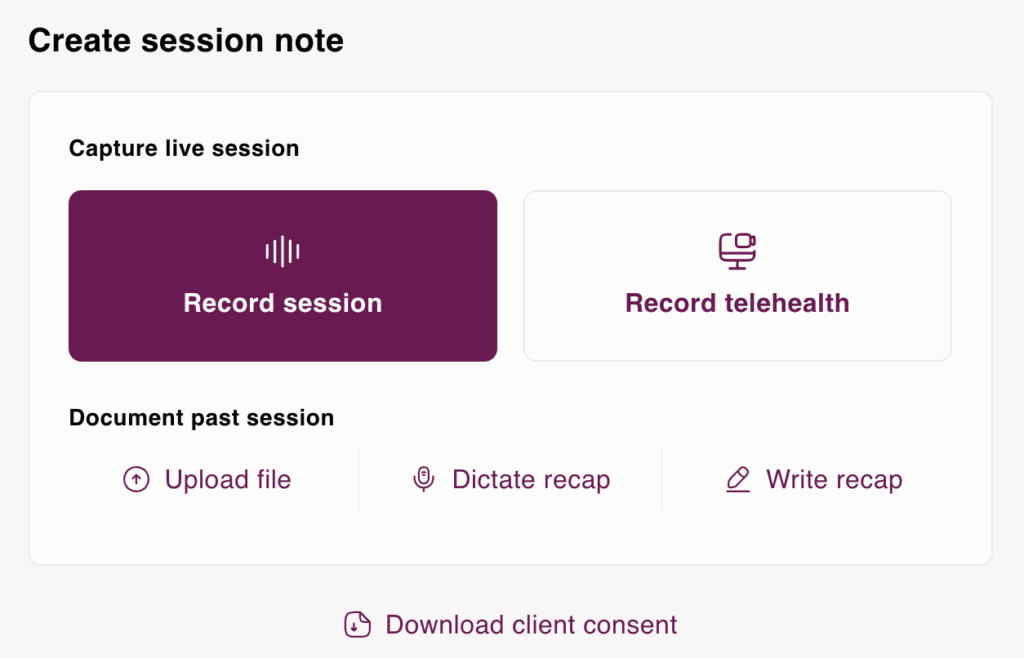
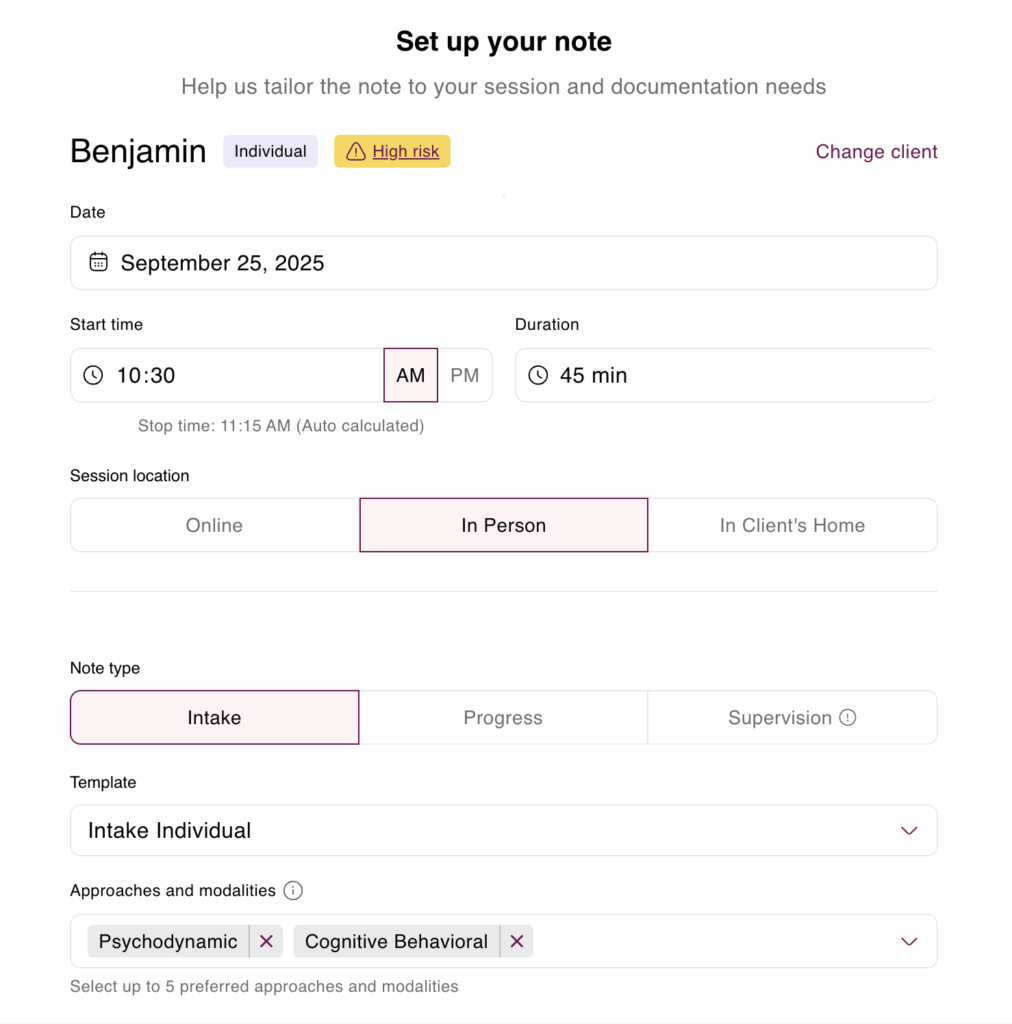
Mentalyc works with every EHR in this guide. SimplePractice, TherapyNotes, TheraNest, TherapyAppointment, ICANotes, CounSol, Sessions Health, Carepatron, Jane App, eClinicalWorks, AdvancedMD, CareCloud, Practice Better, and any other web based EHR. The Mentalyc Chrome extension pushes a finished note directly into the right fields in your EHR client chart, with no copy paste, reformatting, or API setup.
Your EHR stays the system of record. Mentalyc closes the documentation gap.
Mentalyc is HIPAA compliant by design with a signed BAA, SOC 2 Type II certification, session audio deleted after processing, encryption in transit and at rest, and a commitment that session data is never used to train models. Pricing starts at $39 per month with a free trial. If you are still deciding how to structure documentation itself, see the guides to therapy notes, progress notes, psychotherapy notes, and choosing a HIPAA compliant note taking app.
Watch therapists describe how Mentalyc fits alongside the EHR they already use.
Mentalyc is the clinical layer your EHR was never built to be
- Progress notes linked across sessions, in SOAP, DAP, BIRP, GIRP and more
- AI treatment plans and automatic symptom and goal tracking
- Alliance Genie reads the therapeutic alliance every session
- One click push into any web based EHR, no copy paste

What is the best group practice EHR and group therapy software? Supervision, scaling, and clinical quality
The best group practice EHR for therapists in 2026 is TherapyNotes Group at $79 plus $50 per added clinician or TheraNest Premier at $89 per therapist. The best group therapy software pairs either of those with Mentalyc Team Plan at $49.99 per seat per month for AI generated group therapy notes per attendee, supervision documentation, and clinical quality feedback. For group practices with 3 or more clinicians, the EHR decision changes because solo practice features stop mattering and three new constraints become decisive: supervision documentation as a legal requirement, role based access at scale, and clinical quality across the team. A fourth, the way per clinician costs scale, is covered in the cost scaling section below.
For practices that are actively growing or onboarding pre licensed associates, see the dedicated growing practice section below.
Supervision documentation is a legal requirement, not a feature
If your practice includes pre licensed clinicians, LPCs, LCSWs, MFTs working toward licensure, supervision notes are required by state law for licensure hours to count. Most EHRs treat supervision documentation as a bolt on workflow where a supervisor co signs an existing note with no structured documentation of the supervision session itself. TherapyNotes and ICANotes handle this best. SimplePractice does it adequately on the Plus tier. TheraNest Premier supports it. Many others require workarounds.
Role based access becomes the highest risk surface
At 10 plus users, permissions complexity goes up combinatorially. Billers should not see therapy notes. Front desk should not see clinical content. Supervisors should see supervisee notes but not peer notes. An EHR with weak role based access creates either compliance risk if too open, or workflow friction if too closed. Verify the role based access model on a live demo with five mocked user roles before you commit.
Clinical quality and supervisor visibility at scale
This is where most EHRs fail growing practices. The EHR shows you that notes were written. It does not show you that notes were good. A supervisor managing five supervisees cannot review every session by attending, and reading 100 notes per week is not realistic. The 2025 literature on routine outcome monitoring and clinical feedback in group treatment confirms that continuous session level feedback significantly outperforms periodic chart review for clinician development and client outcomes. Pair your EHR with a tool that surfaces clinical signals at the session level. Mentalyc Alliance Genie and AI Progress Tracker deliver exactly this.

AI scribe friction compounds invisibly across the team
At one clinician, copying an AI scribe note into your EHR takes 30 seconds and saves 12 minutes. At five clinicians seeing 20 sessions per week each, that is 100 copy paste operations per week. Over 50 minutes of unpaid admin time multiplied by 50 weeks. This is where Mentalyc for Group Practices becomes a different value proposition than at solo scale. The Chrome extension eliminates that friction entirely across every clinician using any EHR in this guide.
Top group practice picks for 2026
1. TherapyNotes Group: Supervisor sign off workflow plus claims rigor at $79 first plus $50 per added clinician.
2. TheraNest Premier: Per therapist pricing at $89 stays flat regardless of caseload, includes AI and telehealth.
3. AdvancedMD NOW: Enterprise tooling with bundled EPCS and native AI available as an add on when you scale past 10 clinicians.
4. SimplePractice Plus: Cleanest UX, supervisor workflows adequate, but per claim fees and the higher tier required for billing add up across clinicians.
5. eClinicalWorks or CareCloud: Community mental health centers and clinics that need full enterprise stack.
Whichever EHR you choose, pair it with Mentalyc Team Plan: it adds the documentation, supervision, and clinical quality layer no EHR provides, across the whole team through one Chrome extension.
How the tool stack changes as your practice grows
The best tool stack for a growing group practice combines three things: an EHR that handles per clinician scheduling, billing, and supervision documentation. A documentation system that does not multiply admin work per added clinician. A clinical quality system that lets supervisors see whether new and pre licensed clinicians are delivering good therapy without reading every note. Most growing practices solve the first one and underestimate the other two until clinician burnout or audit risk forces the issue.
This section covers the tool side of scaling only. For the business side (caseload, marketing, fees, and when to make the leap), see how to grow your private practice and private practice vs group practice.
What changes when you go from 1 to 3 to 10 clinicians?
The right tool stack changes with team size. At 1 to 2 clinicians, solo focused EHRs work fine. At 3 to 5, supervision workflows and team dashboards become necessary. At 6 to 10, role based access and supervisor visibility into clinical quality become the bottleneck. At 10 plus, the cost stack and bulk operations matter more than feature lists.
| Team size | EHR priority | Documentation priority | Key risk |
|---|---|---|---|
| 1 to 2 | Solo focused, low setup, $49 to $79 per month | Pair with Mentalyc at $39 per month | Solo overwhelm, no team safety net |
| 3 to 5 | Add supervisor workflows. TherapyNotes Group or TheraNest Premier | Mentalyc Team Plan for centralized notes and supervision documentation | Supervisor cannot review every session, quality drift starts |
| 6 to 10 | Multi clinician reporting, RBAC. SimplePractice Plus, TherapyNotes, AdvancedMD NOW | Mentalyc Team Plan plus Alliance Genie for clinical quality signals | Clinical quality drift, audit risk on supervision documentation |
| 10 plus | Enterprise tooling. AdvancedMD NOW, eClinicalWorks, CareCloud | Mentalyc Team Plan with practice wide templates and ROI dashboard | Cost compounds non linearly, hidden per clinician fees explode |
How do EHR costs scale with team size?
EHR costs scale non linearly because each platform stacks per clinician fees differently. Below is the real all in monthly cost for a 5 clinician insurance billing practice with AI for every clinician, based on verified 2026 pricing.
| Platform | 1 clinician | 5 clinicians | 10 clinicians |
|---|---|---|---|
| Sessions Health plus telehealth plus claims | $71 | about $211 | about $431 |
| TheraNest Premier (AI included) | $89 | $445 | $890 |
| TherapyNotes Group plus telehealth plus AI | $138 | about $554 | about $1,109 |
| SimplePractice Essential plus clearinghouse plus AI | $183 | about $815 | about $1,580 |
| AdvancedMD NOW base (with 40% multi product discount) | $130 | about $650 | about $1,170 |
| eClinicalWorks EHR plus PM | $599 | about $2,995 | about $5,990 |
| CareCloud Complete plus Breeze | $828 | about $4,140 | about $8,280 |
AdvancedMD figures are the base platform; its native AI scribe is a separate add on (about $100 per provider per month or $0.99 per encounter) if you want it, which is one more reason a flat documentation layer can be cheaper than stacking the EHR’s own AI per seat.
Mentalyc Team Plan adds $49.99 per clinician per month annual ($59.99 monthly) on top of whichever EHR you choose. Every seat gets unlimited notes, supervision notes, Alliance Genie, and Progress Tracker. No tiers, no per session charges. For a 5 clinician practice, that is $250 per month for the entire documentation and clinical quality layer across the team, regardless of EHR choice.
How do you onboard new clinicians fast?
To onboard a new clinician fast, you need an EHR with per clinician seat assignment, role based access, practice wide template sharing, and a documentation tool the new clinician can start using on day one without a separate procurement cycle. Most EHRs handle the seat and access part. Where practices stall is documentation onboarding, because new clinicians have to learn the team’s note style, template structure, and supervision workflow before they can be productive.
Mentalyc Team Plan addresses this directly. Each clinician gets an invite link, signs in, and starts documenting the same day. Practice wide templates are configurable centrally so a new hire writes notes in the team format from session one. The owner can view all team notes including unsaved drafts, which gives supervisors immediate visibility into how a new clinician documents without scheduling additional review meetings.

How do you support pre licensed and associate clinicians?
To support pre licensed and associate clinicians, your tool stack needs three things: structured supervision documentation that satisfies state licensing boards, billing under the supervisor’s NPI when required, and supervisor review of supervisee notes before sign off. Supervision compliance is non negotiable: botched supervision documentation can invalidate licensure hours and trigger insurance clawbacks. The EHRs that handle this well are the same top group practice picks above. Pair them with Mentalyc Team Plan, which adds native supervision note generation and the dropout-risk signals covered in clinical quality and supervisor visibility at scale. In effect, Alliance Genie and Progress Tracker give every clinician a continuous, AI generated supervision layer between human supervision sessions, which for pre licensed clinicians is the difference between learning slowly on the job and developing rapidly with structured feedback every session.
What are the most common growing pains?
The most common growing pains for a therapy practice scaling from solo to group are administrative overload on the owner clinician, inconsistent documentation across the team, supervision compliance gaps, copy paste tax from AI scribes that did not integrate with the EHR, and cost surprises from per clinician add ons that compound. The first one drives owners out of the chair and into management. The other four create audit risk and clinical quality risk.
A 5 clinician practice with Mentalyc Team Plan typically reports 27 plus hours of documentation time saved per week across the team. That recovered time can be re invested in supervision, intake, or marketing.
Before you hire your first associate, verify these
Hiring therapists is its own discipline; the checks below are the tool stack side.
- Per clinician pricing math. Re run the cost scaling table above using your actual EHR pick and AI choice. Confirm what 5 clinicians costs all in.
- State supervision board requirements. Confirm the specific documentation format your state board requires for supervised hours to count. Some states require structured supervision notes separate from co signed clinical notes. Plan paid supervisor capacity around a supervision model that fits your state.
- Insurance billing under supervisor NPI. Confirm your EHR supports billing under the supervisor NPI for pre licensed clinicians, and that your payer mix allows it.
- Tool stack day one. Make sure your EHR plus Mentalyc plus payment processor are all in place before the new hire starts. Onboarding into a half built system is the fastest way to lose a new clinician.
Before signing for a group practice, verify per clinician seats vs caseload pricing, supervisor co signature workflow, supervision note documentation, role based access tested with mocked user types, and group reports including productivity per clinician, no show rates, and claim aging.
How do I evaluate an EHR before buying? 38 point buyer checklist
To evaluate an EHR, score each candidate against the 38 point checklist below during a free trial, not during a vendor demo. A 60 minute self evaluation saves a 12 month bad fit subscription. Score each item 0 (missing or broken), 1 (partial), or 2 (full). Anything under 50 out of 76 disqualifies a vendor for serious therapy practice use in 2026.
How to use this checklist:
1. Spend 60 minutes scoring your top 2 or 3 EHRs. Do not try to evaluate 8 vendors. Pick a shortlist first, then score deeply.
2. Score from a live trial or sandbox, not from a vendor demo. Demos hide the painful parts.
3. Have the BAA in hand before you start. Anything the vendor will not put in writing scores 0.
4. Run five mocked sessions through the documentation flow during your trial. Notes that take more than 8 minutes per session are a failure.
A. Therapy specific fit (12 points)
- SOAP, DAP, BIRP, GIRP note templates available without configuration (0 / 1 / 2)
- Templates customizable, including adding fields, reordering, hiding sections (0 / 1 / 2)
- Group, couples, and family session note formats native (0 / 1 / 2)
- PHQ 9, GAD 7 embedded with auto scoring and longitudinal storage (0 / 1 / 2)
- C SSRS or other structured risk assessment instrument (0 / 1 / 2)
- Treatment plan tool designed for therapy arcs, not problem oriented encounter notes (0 / 1 / 2)
B. HIPAA and security (10 points)
- Signed BAA available before PHI upload (0 / 2, no partial credit; if they will not sign, score 0 and walk)
- AES 256 encryption at rest, TLS 1.2 plus in transit, documented in the BAA (0 / 1 / 2)
- Role based access control with custom roles (0 / 1 / 2)
- Two factor authentication required (0 / 1 / 2)
- Audit trails on every view, edit, delete, export with user and timestamp (0 / 1 / 2)
C. Documentation quality (8 points)
- Compliance flagging that blocks sign off on incomplete notes (0 / 1 / 2)
- Note template library covers psychiatric eval, intake, biopsychosocial, MSE, discharge (0 / 1 / 2)
- Supervision note documentation as native feature, not workaround (0 / 1 / 2)
- Long form free text fields do not cap session content (0 / 1 / 2)
D. AI scribe capability (8 points)
- Native AI note generation or documented paired AI workflow (0 / 1 / 2)
- AI links notes across sessions, not single session only transcription (0 / 1 / 2)
- AI generates treatment plans from session content (0 / 1 / 2)
- AI is HIPAA compliant with audio deletion after processing (0 / 1 / 2)
E. Insurance billing depth (10 points)
- ERA and ERN handling for primary and secondary claims (0 / 1 / 2)
- Real time eligibility verification (0 / 1 / 2)
- Claim scrubbing that catches errors before submission (0 / 1 / 2)
- CMS 1500 generation and superbills (0 / 1 / 2)
- No separate clearinghouse fee, or clearinghouse fee under $25 per month (0 / 1 / 2)
F. Prescribing (6 points, skip if you do not prescribe)
- EPCS for Schedule II and III included or under $40 per month (0 / 1 / 2)
- PDMP integration available (0 / 1 / 2)
- Medication interaction checking and refill management (0 / 1 / 2)
G. Total cost of ownership (10 points)
- All in monthly cost (base plus telehealth plus billing plus AI) under $150 per clinician (0 / 1 / 2)
- Per claim fees under $0.20 (0 / 1 / 2)
- Payment processing under 3.0% (0 / 1 / 2)
- No setup fees or one time onboarding charges over $100 (0 / 1 / 2)
- Pricing published on vendor website, not quote only (0 / 1 / 2)
H. Group practice scalability (12 points, skip if solo)
- Supervisor co signature workflow native (0 / 1 / 2)
- Role based access supports 5 plus distinct user roles without workarounds (0 / 1 / 2)
- Per clinician productivity reports for sessions, no show rates, claim aging (0 / 1 / 2)
- Multi clinician scheduling with conflict detection (0 / 1 / 2)
- Bulk operations including assign clients, transfer caseloads, archive batches (0 / 1 / 2)
- Per clinician AI scribe push to the right chart with no copy paste tax (0 / 1 / 2)
I. Growth and clinician development (10 points, skip if solo and not hiring)
- Same day new clinician onboarding with self serve invite link (0 / 1 / 2)
- Native supervision note documentation that satisfies state licensing boards (0 / 1 / 2)
- Supervisor can review supervisee drafts before sign off (0 / 1 / 2)
- Practice wide template sharing configurable centrally (0 / 1 / 2)
- Session level clinical quality signals available to supervisors, including alliance feedback or measurement based care data (0 / 1 / 2)
Scoring guide
- Solo therapist (skip H and I): Max 64 points. Look for 45 plus.
- Solo prescriber (include F, skip H and I): Max 64 points. Look for 45 plus.
- Group practice (include H and I): Max 86 points. Look for 60 plus.
- Growing or hiring practice (include H and I): Max 86 points. Look for 65 plus.
Anything 80 percent or higher on your applicable max is a strong fit. 60 to 80 percent is a buy with reservations. List the gaps and have a plan. Under 60 percent means look harder before signing.
Six pre purchase questions to ask any vendor
These are the questions that distinguish vendors who actually understand therapy from vendors retrofitting general medical software.
1. Can you show me how your AI scribe handles a 50 minute couples session note?
2. What is the workflow when a pre licensed clinician needs supervisor co signature on a note?
3. What is the exact per claim fee, and is there a separate clearinghouse subscription?
4. What is your annual Security Risk Analysis support, and do you provide the documentation needed under the 2026 HIPAA Security Rule?
5. Can I see a sandbox account where I can score this checklist myself before committing?
6. What happens to my data if I cancel? Export format, timeline, fees?
If a vendor cannot answer question 5 with a yes, that alone is reason to keep looking.
How much does an EHR cost for therapists in 2026?
A solo private pay therapist EHR costs $0 to $70 per month all in. A solo insurance billing practice costs $70 to $180 per month. A psychiatrist needing EPCS costs $130 to $200 plus per provider per month. A 5 clinician group practice costs $450 to $3,100 per month depending on platform tier.
The sticker price misleads. The real all in cost is sticker plus telehealth plus insurance billing plus AI plus per claim fees plus payment processing.
For private pay only practices, base price is the whole story: Carepatron free tier and Sessions Health (up to 3 clients) are $0, then Practice Better Starter $25, TheraNest Essentials $29, Sessions Health Professional and Carepatron Plus $39, SimplePractice Starter $49, Jane Balance $54, TherapyAppointment Solo $59, TherapyNotes Solo $69. Insurance billing is where the stack starts compounding:
Solo therapist, insurance billing, no AI
| EHR | Base | Telehealth | Insurance and claims | All in |
|---|---|---|---|---|
| Sessions Health | $39 | $10 | about $22 (100 claims at $0.22) | about $71 |
| TherapyAppointment | $59 | $5 | about $15 (100 claims at $0.15) | about $79 |
| TherapyNotes | $69 | $15 | about $14 (100 claims at $0.14) | about $98 |
| SimplePractice Essential | $79 | included | about $25 (100 claims at $0.25) | about $104 |
The hidden cost on SimplePractice is the jump to the $79 Essential tier to unlock insurance billing at all, plus $0.25 per claim and a separate $49 per month ePrescribe add on if you prescribe. Most solo insurance billing practices end up at $105 to $140 per month all in once AI is added.
Solo therapist, insurance billing, with AI
| EHR | Base plus billing plus telehealth | AI scribe | All in |
|---|---|---|---|
| Sessions Health plus Mentalyc | about $71 | $39 (Mentalyc) | about $110 |
| TheraNest Premier (AI included) | $89 | included | about $89 |
| TherapyNotes plus TherapyFuel | about $98 | $40 | about $138 |
| TherapyNotes plus Mentalyc | about $98 | $39 | about $137 |
| SimplePractice Essential plus AI | about $104 | $35 | about $139 |
| SimplePractice Essential plus Mentalyc | about $104 | $39 | about $143 |
For a psychiatrist needing EPCS, the realistic all in per provider is about $130 on AdvancedMD NOW (EPCS bundled, native AI a separate add on of about $100) or $155 to $200 plus on ICANotes once EPCS, telehealth, and PDMP are added.
Group practice, 5 clinicians, insurance, AI for all
| EHR | Estimate |
|---|---|
| TheraNest Premier x 5 | about $445 |
| TherapyNotes Group ($79 plus $50 x 4, plus $15 telehealth, plus $40 AI per clinician) | about $554 |
| AdvancedMD NOW (with 40% multi product bundle discount) | about $650 |
| SimplePractice Essential x 5 plus clearinghouse x 5 plus AI x 5 | about $815 |
| eClinicalWorks | about $2,250 plus ($449 x 5 plus add ons) |
| CareCloud Complete | about $3,140 plus ($629 x 5 plus Breeze) |
Where Mentalyc fits in the cost stack
Mentalyc at $39 per month is a drop in replacement for the AI scribe add on charged by every EHR above, and every built in scribe is single session only:
| Built in AI scribe | Price per month | Capability |
|---|---|---|
| Jane AI Scribe | $15 | single session transcription |
| SimplePractice AI Note Taker | $35 | single session transcription |
| TheraNest AI Session Assistant | $35 | single session transcription |
| TherapyNotes TherapyFuel | $40 | single session transcription |
| ICANotes AI Scribe | non public, add on | single session transcription |
| Mentalyc | $39 | cross session linking, treatment plans, progress tracking, alliance monitoring |
Mentalyc replaces the single session scribes with cross session note linking, AI built treatment plans from session content, automated symptom and goal tracking from session material, and Alliance Genie for therapeutic alliance monitoring. None of the built in scribes offer these.
For a solo insurance billing therapist, switching SimplePractice $35 AI add on for Mentalyc at $39 adds $4 per month and adds capabilities the built in tool does not provide. For group practices, the math compounds across the team.
Add on traps that catch first time buyers
- Insurance billing: included on most therapy plans (sometimes only on higher tiers, as with SimplePractice Essential), plus $0.14 to $0.25 per claim; standalone clearinghouses add a monthly fee
- Telehealth: $0 to $30 per month, included on most newer platforms, add on on TheraNest non Premier and SimplePractice Starter
- AI notes: $15 to $45 per clinician per month for built in scribes, or $39 per month for Mentalyc for the full clinical layer
- Wiley Practice Planners: $25 per month per provider add on on TheraNest
- E prescribing and EPCS: $30 to $80 per month plus annual fees, included on ICANotes, AdvancedMD, eClinicalWorks; not available on SimplePractice or TherapyNotes
- Payment processing: 2.9 to 3.15% plus $0.30 per transaction; SimplePractice 3.15% is on the high end
- SMS appointment reminders: $0.14 per SMS on TherapyNotes, included on most others
- Annual CPT license: $19.50 per therapist per year on TheraNest
- PDMP integration: $500 one time setup plus $50 per year per provider on ICANotes
Why other mental health professionals love Mentalyc

“I really like that the treatment plans make sense, and they’re based on the case notes I’ve been entering.”
Therapist

“The treatment plan gives me a place to look with clients and say, here’s where we are and here’s where we’re aiming to go. It’s such a huge help.”
LPC

“It immediately changed my quality of life, personally and professionally.”
Owner/Independently Licensed Marriage & Family Therapist (LMFT)

“If I were recommending this software to a colleague, I would tell them that it is the best thing that they could do for their practice.”
Licensed Professional Counselor
Frequently asked questions
References
1. Kariotis, T. C., Prictor, M., Chang, S., and Gray, K. (2022). Impact of electronic health records on information practices in mental health contexts: scoping review. Journal of Medical Internet Research, 24(5), e30405.
2. Tajirian, T., Lo, B., Strudwick, G., et al. (2025). Assessing the impact on electronic health record burden after five years of physician engagement in a Canadian mental health organization: mixed methods study. JMIR Human Factors, 12, e65656.
3. HHS Office for Civil Rights. (2025). HIPAA Security Rule Notice of Proposed Rulemaking on strengthening cybersecurity protections for electronic protected health information.
4. Sinsky, C., Colligan, L., Li, L., et al. (2016). Allocation of Physician Time in Ambulatory Practice: A Time and Motion Study in 4 Specialties. Annals of Internal Medicine, 165, 753 to 760.
5. Lukac, M., et al. (2025). Randomized trial of AI ambient scribes in outpatient medicine. NEJM AI.
6. Zanaboni, P., Kristiansen, E., Lintvedt, O., et al. (2022). Impact on patient provider relationship and documentation practices when mental health patients access their electronic health records online: a qualitative study. BMC Psychiatry, 22, 508.
7. American Medical Association. (2024). AMA Organizational Biopsy National Report: 2024 national burnout benchmarking.
8. Reddit r/therapists. (April 2025). Thread on SimplePractice pricing increases. https://reddit.com/r/therapists/comments/1k9khmy/
9. Reddit r/therapists. (April 2025). Thread discussing TherapyNotes TherapyFuel AI notes. https://reddit.com/r/therapists/comments/1jz5xrk/
10. Reddit r/therapists. (March to April 2025). Threads on TheraNest/Ensora service quality. https://reddit.com/r/therapists/comments/1hvi69j/
11. Trustpilot. TherapyAppointment reviews. https://www.trustpilot.com/review/therapyappointment.com
12. Capterra. ICANotes reviews. https://www.capterra.com/p/17102/ICANotes/reviews/
13. Capterra. CounSol.com reviews. https://www.capterra.com/p/124769/CounSol-com/reviews/
14. Capterra. Sessions Health reviews. https://www.capterra.com/p/10002269/Sessions-Health/reviews/
15. Capterra. Carepatron reviews. https://www.capterra.com/p/195467/Care-Patron/reviews/
16. Trustpilot. Jane App review, January 2026. https://www.trustpilot.com/reviews/697b8f6b8b41ce74bc913cda
17. US Department of Justice. (2017). Electronic Health Records Vendor to Pay $155 Million to Settle False Claims Act Allegations. https://www.justice.gov/archives/opa/pr/electronic-health-records-vendor-pay-155-million-settle-false-claims-act-allegations
18. ConsumerAffairs. eClinicalWorks reviews. https://www.consumeraffairs.com/emr-software/eclinicalworks.html
19. ConsumerAffairs. AdvancedMD reviews. https://www.consumeraffairs.com/emr-software/advancedmd.html
20. CareCloud, Inc. (2024). CareCloud Reports Full Year 2023 Results. GlobeNewswire. https://www.globenewswire.com/news-release/2024/03/21/2850077/16541/en/CareCloud-Reports-Full-Year-2023-Results.html
21. ChoosingTherapy. (2026). Practice Better Review. https://www.choosingtherapy.com/practice-better-review/
22. ClearHealthCosts. (November 2025). Therapists have misgivings on the platforms: Alma, Headway etc. and the business of therapy. https://clearhealthcosts.com/blog/2025/11/therapists-have-misgivings-on-the-platforms-alma-headway-etc-and-the-business-of-therapy/
23. ClearHealthCosts. (November 2024). 2 digital mental health platforms cut pay rates for therapists with UnitedHealth’s Optum, stirring anger. https://clearhealthcosts.com/blog/2024/11/2-digital-mental-health-platforms-cut-pay-rates-for-therapists-with-unitedhealths-optum-stirring-anger/
24. Upstate Healthcare Administration. (2026). Leaving Headway, Alma, or Grow Therapy: How to Start Your Own Private Practice. https://www.upstatehealthcareadmin.com/post/leaving-headway-alma-or-grow-therapy-how-to-start-your-own-private-practice
25. Capterra. TherapyAppointment reviews. https://www.capterra.com/p/110508/TherapyAppointment/reviews/
26. Ensora Health. (April 2025). Therapy Brands rebrands to Ensora Health; TheraNest becomes Ensora Mental Health. https://ensorahealth.com/ai-company-overview/
27. SimplePractice Support. Note Taker FAQs (AI accuracy and format disclosures). https://support.simplepractice.com/hc/en-us/articles/35507783848973-Note-Taker-FAQs
28. Capterra. SimplePractice reviews. https://www.capterra.com/p/130710/SimplePractice/reviews/
Vendor pricing verified against vendor websites and user review evidence accessed June 10, 2026. Pricing, features, and reviews change; always confirm directly with the vendor before signing.