


The short answer: TherapyNotes ($69/month solo) is the better value for most solo and small practices: documentation, billing, basic telehealth, and 24/7 phone support are all included in one price, and it holds a 4.7/5 rating across 963 Capterra reviews. SimplePractice ($49-$99/month) costs more once you add the features most practices actually need, but wins on mobile apps, polish, and practice-growth tools like its website builder and Monarch directory. TheraNest, now sold as Ensora Mental Health, has the lowest entry price ($29/month) and the only fully managed billing option, but reviewers report support and stability problems since its 2025 rebrand. And whichever you pick, note-writing stays your biggest time cost. The documentation section below covers how therapists automate it inside all three (including with Mentalyc).
| Verified June 10, 2026 | SimplePractice | TherapyNotes | TheraNest (Ensora) |
|---|---|---|---|
| Pricing model | Per practitioner | Per clinician | Per therapist |
| Monthly cost | $49 / $79 / $99 | $69 solo; $79 + $50 per added clinician | $29 / $59 / $89 |
| Telehealth | Built in | Basic free (2 participants); Premium $15/mo (16, HD) | Add-on $12/mo (included on Premier) |
| AI documentation | Note Taker add-on, $35/clinician/mo | TherapyFuel add-on, $40/clinician/mo | AI Session Assistant add-on, $35/provider/mo |
| Capterra rating | 4.6 (2,827 reviews) | 4.7 (963 reviews) | 4.4 (1,033 reviews) |
| e-Prescribing | No | $65/mo per prescriber | $45/mo per therapist + $135 setup |
| Mobile app | iOS + Android, full-featured | iOS + Android (new; no notes or billing yet) | No full-featured app |
| Managed billing | No | No (self-service; billing partner referral) | Yes (RCM, priced separately) |
| Wiley planners | Add-on | No | $25/mo add-on; included on Premier |
| Free trial | 30 days | 30 days | 21 days (Premier access) |
| Hidden fees to know | Annual AMA CPT fee; paid reminders | Claims 14 cents; cards 3.1% + 30 cents | AMA CPT $19.50/yr; admins $19-29/mo; claims 23 cents after 30 free |
All three are HIPAA-compliant and sign Business Associate Agreements. Prices were verified on each vendor’s official pricing page on the date above; all three vendors have changed pricing within the last two years, so re-check before you commit.
SimplePractice and TherapyNotes are the two most shortlisted EHR and practice management platforms for mental health professionals, with TheraNest the usual third candidate. TherapyNotes delivers simple efficiency, while SimplePractice offers a wealth of premium options. This article explores how each platform differs in features, cost, and value, and how TheraNest compares to both.
SimplePractice vs TherapyNotes vs TheraNest: How User-Friendly are the Platforms?
TherapyNotes is known for its user-friendly and intuitive interface. It has a straightforward design that’s easy to navigate, making it suitable for both beginners and experienced users, and earns some of the highest ease-of-use praise in its Capterra review set.
Spend less time writing, more time with clients.

SimplePractice also offers an intuitive and user-friendly interface. It’s designed to be easy to use and has a clean, modern look, with a faster onboarding experience than the other two.
TheraNest (Ensora Mental Health) has a functional, accessible interface, though post-rebrand Capterra reviews describe more instability and a steeper adjustment curve than before. New users should take full advantage of the 21-day trial to assess current usability.
SimplePractice vs TherapyNotes vs TheraNest: Features and Functionality
All three platforms cover the core EHR workflow for mental health professionals, appointment scheduling, billing and invoicing, insurance claims, clinical note templates, treatment planning, client portals, telehealth, and HIPAA-compliant security, but differ significantly in execution, pricing structure, and what’s included versus paid as an add-on. The sections below compare each area directly.
Telehealth Capabilities in SimplePractice vs TherapyNotes
Both platforms now include built-in, HIPAA-compliant telehealth; the difference is what’s included free.
TherapyNotes includes Basic Telehealth at no extra cost on every plan: standard-definition video for up to 2 participants, with a virtual waiting room, guest access, and chat. Practices that run group sessions or want full HD, screen sharing, and closed captions need Premium Telehealth at $15 per clinician per month, which supports up to 16 participants (verified on TherapyNotes’ official documentation, June 2026; earlier versions of TherapyNotes required a third-party video tool, which is no longer the case).
SimplePractice includes integrated telehealth functionality, so mental health professionals can conduct online therapy sessions without the need for additional third-party tools or integrations. The built-in telehealth feature is convenient, as practitioners won’t have to manage multiple software applications. It streamlines the process of scheduling, conducting, and documenting online sessions, making it easier for therapists to provide remote care to their clients.
TheraNest (Ensora Mental Health) offers telehealth as a paid add-on: $12 per therapist per month on Essentials and Advanced plans, with telehealth included on the Premier plan ($89/month). HIPAA-compliant video sessions are supported, though the feature is less deeply integrated than in the other two platforms, consistent with post-rebrand reviews describing some product instability.
For mostly 1:1 virtual caseloads, all three work out of the box (with TheraNest requiring the add-on or Premier). For group telehealth, TherapyNotes’ Premium tier ($15/month) supports up to 16 participants; SimplePractice handles groups within its existing plans; TheraNest covers group sessions on Premier.
Customization and Templates in TherapyNotes and SimplePractice
TherapyNotes provides customizable templates for clinical notes and treatment plans, allowing mental health practitioners to tailor their documentation to their specific needs. Therapy modalities like CBT and DBT are easier with TherapyNotes, which offers different customizable templates for documentation and note-taking. That said, template depth is TherapyNotes’ most common criticism: multiple Capterra reviewers describe the customization as minimal, and some call the inability to build fully custom electronic forms a dealbreaker for specialized documentation.
SimplePractice also offers customizable note templates and the ability to create intake forms and assessment templates.
TheraNest includes general note and treatment plan templates, plus an optional Wiley Treatment Planner add-on ($25/month; included on Premier), a meaningful differentiator, as Wiley is a well-recognized standard in structured treatment planning. Template flexibility is broader than TherapyNotes’ in some respects, though reviewers describe usability issues when building fully custom electronic forms.
One distinction worth keeping in mind: across all three EHRs, these are pre-built templates you still complete manually (or, with their paid AI add-ons, have partially drafted for you). That is not the same as fully automated, therapy-specific AI notes generated from the session itself; the documentation section below covers that gap.
SimplePractice vs TherapyNotes Pricing Comparison
This is where the platforms have changed most, so here is the complete, itemized breakdown as of June 10, 2026.
How much does TherapyNotes cost?
TherapyNotes costs $69 per month for a solo practitioner. Group practices pay $79 per month for the first clinician and $50 per month for each additional clinician, with unlimited non-clinical users (practice administrators, schedulers, and billers) free. Enterprise pricing uses the same group rates for accounts with 30+ users and adds a dedicated account manager.
Every plan includes a 30-day free trial, unlimited clients and notes, unlimited file storage, free data import from another EMR, the client portal, basic telehealth, and 24/7 phone and email support. The a la carte fees: electronic claims and ERAs at 14 cents each, text or voice appointment reminders at 14 cents (email reminders free), credit card processing at 3.1% + 30 cents per transaction, Premium Telehealth at $15 per clinician per month, ePrescribe at $65 per prescriber per month, and the TherapyFuel AI documentation suite at $40 per clinician per month.
How much does SimplePractice cost?
SimplePractice offers three plans: Starter at $49, Essential at $79, and Plus at $99 per month per practitioner (it periodically discounts the first months for new accounts). The 30-day free trial requires no credit card. The AI Note Taker is a $35/month per-clinician add-on on any plan. Be aware that the final cost depends heavily on which plan unlocks the features you need: long-term reviewers on Capterra repeatedly note that costs have risen over the years. Also note an annual AMA fee for CPT code access, disclosed in SimplePractice’s own pricing FAQ.
The practical takeaway: TherapyNotes’ sticker price is now higher than it used to be, but more is included at one price. SimplePractice’s entry price looks lower, yet most insurance-billing practices end up on Essential or Plus, which costs more than TherapyNotes solo.
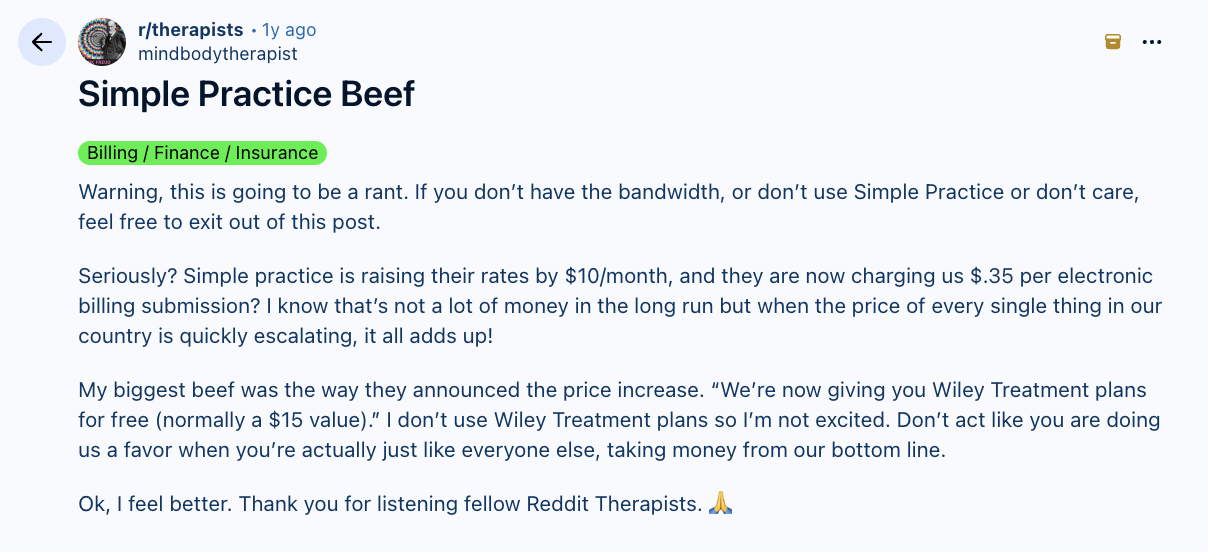
That cost trajectory frustration shows up directly on r/therapists:
Simple practice is raising their rates by $10/month, and they are now charging us $.35 per electronic billing submission?… – u/mindbodytherapist (r/therapists)
Customer Support Comparison: SimplePractice vs TherapyNotes
TherapyNotes now advertises 24/7 phone and email support on every plan, and its support team is the single most praised aspect of the product across review platforms: Capterra reviewers consistently describe it as prompt, well-trained, and effective. SimplePractice offers customer support via email and live chat during extended hours, including weekends, plus an extensive knowledge base and webinars, but several recent Capterra reviews pair pricing complaints with frustration about support responsiveness.
HIPAA Compliance: SimplePractice, TherapyNotes, and TheraNest
All three platforms are HIPAA-compliant: they encrypt client data in transit and at rest, use role-based access controls, conduct regular security audits, and sign Business Associate Agreements with practices, as noted in the comparison table above. SimplePractice additionally publishes HITRUST certification on its Trust Center, the highest level of third-party security assurance among the three. When emailing clients, the same BAA requirement applies to your email provider.
SimplePractice vs TherapyNotes Based on Reviews (2026)
What do verified reviewers actually say? All ratings and quotes below were read directly on the named platforms on June 10, 2026.
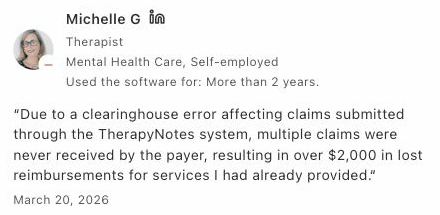
TherapyNotes holds 4.7/5 across 963 Capterra reviews (unusually high for an EHR at that volume), with ease of use and customer service both at 4.7. The praise clusters around documentation structure, billing reliability, and support: “24 hour customer service that is second to none,” wrote a clinic coordinator in July 2024. The recurring criticisms are template depth (“The templates in TherapyNotes offered minimal customization and that was ultimately a dealbreaker for me,” wrote a therapist who switched platforms in October 2024), telehealth reliability (“the program can be glitchy for the video conferencing, so I do have to have a back up alternative link for clients,” March 2026), and cost for solo users (“The price is quite steep for solo practitioners”). One March 2026 reviewer reported a clearinghouse error in which “multiple claims were never received by the payer, resulting in over $2,000 in lost reimbursements,” with claims “marked as successfully sent within the system”. It’s a single account, but a useful reminder to reconcile claims independently whatever platform you use.
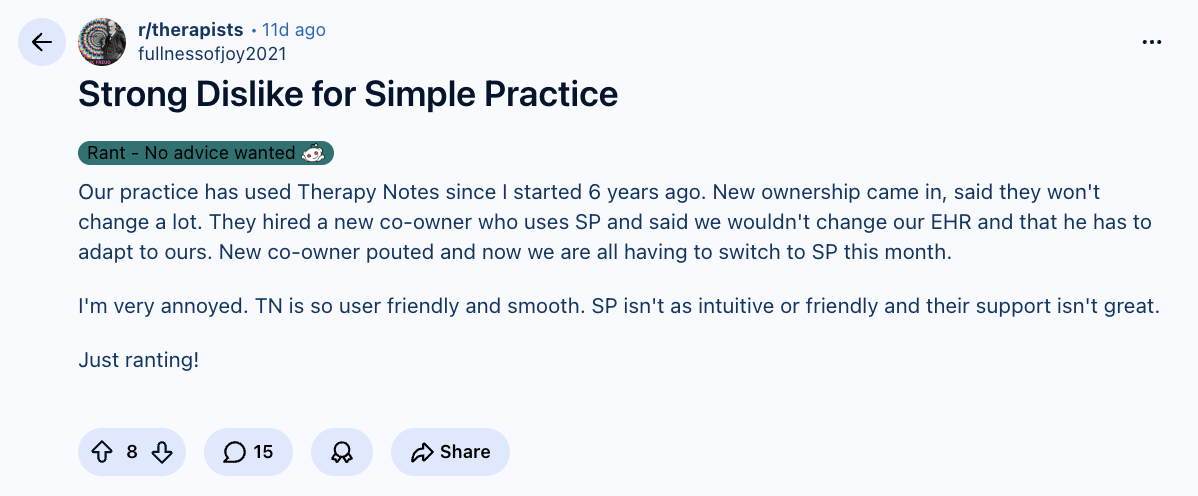
That preference for TherapyNotes shows up in Reddit comparisons too – including from therapists switching involuntarily:
Write less, focus more
- SOAP, DAP, BIRP, EMDR notes and more
- AI Treatment Planner
- AI Progress Tracker
- Alliance signals
- HIPAA & PHIPA compliant

Our practice has used Therapy Notes since I started 6 years ago. New ownership came in, said they won’t change a lot. They hired a new co-owner who uses SP and said we wouldn’t change our EHR and that he has to adapt to ours. New co-owner pouted and now we are all having to switch to SP this month. I’m very annoyed. TN is so user friendly and smooth. SP isn’t as intuitive or friendly and their support isn’t great. – u/fullnessofjoy2021 (r/therapists)
SimplePractice holds 4.6/5 across 2,827 Capterra reviews (ease of use 4.4, support 4.4, value for money 4.3). Reviews skew positive on usability and the client portal. The most consistent criticism is cost trajectory: “The cost has increased over the years… I do not need most of the features they have added as a single practitioner,” wrote a five-year user in November 2025; another practice concluded “It is expensive and the benefits did not outweigh what we were missing that other EHRs had” and called the reporting side “lacking compared to other EHRs” (December 2025). Support experiences are mixed: one August 2025 reviewer wrote “I’ve been unable to reach SimplePractice support despite multiple attempts,” while a March 2026 reviewer praised responsive service and noted the price had recently held stable. Larger group practices most often describe the per-practitioner cost as hard to justify without more automation.
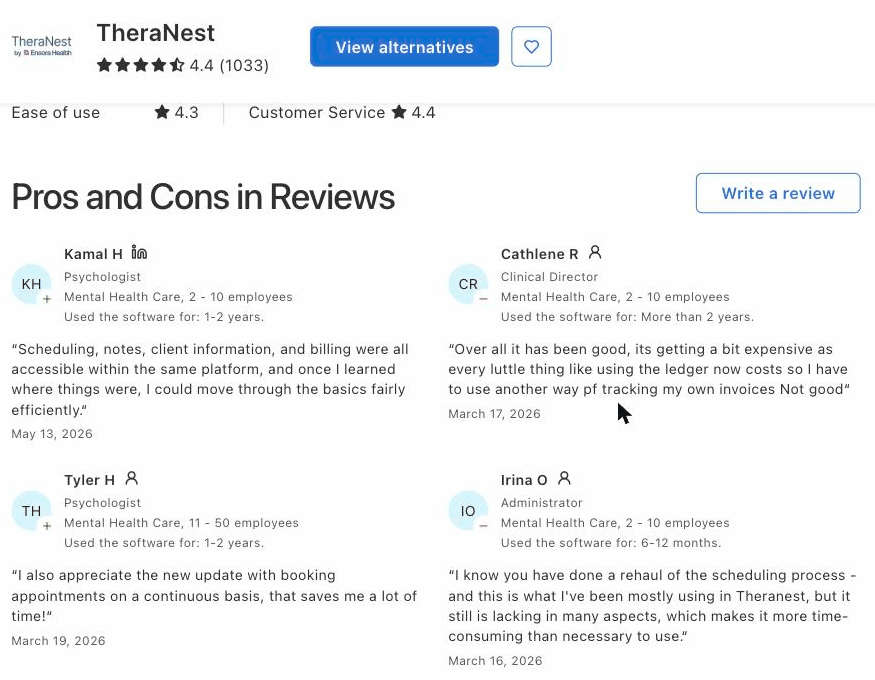
TheraNest (Ensora Mental Health) holds 4.4/5 across 1,033 Capterra reviews (ease of use 4.3), the lowest of the three, and recent reviews are noticeably rougher than older ones. The post-rebrand pattern across Capterra: “The quality of the product deteriorates with each update since aquiring therapy brands” [sic] (February 2025); “we have lost some documents or can’t seem to find it because of these updates” (October 2025); and a practice owner describing “the most frustrating experience since Ensora took over,” citing a scheduling glitch that caused “repeated scheduling disruptions and financial loss” (October 2025). Cost complaints are rising too: “its getting a bit expensive as every luttle thing like using the ledger now costs” [sic] (March 2026), and “very costly as your practice grows, and difficult to get ahold of customer service” (December 2025).
At the Better Business Bureau, Ensora Health shows 24 complaints in the last three years (10 in the last 12 months), the largest categories being billing and customer service. One complainant wrote in May 2026: “I have been trying to reach support with this company for the last 6 weeks… You can never get a live person.”
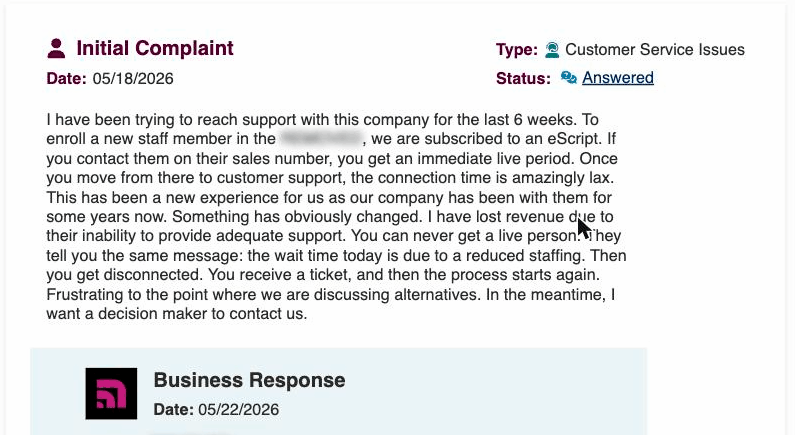
For balance: Ensora Health is BBB-accredited with an A+ rating, and satisfied long-term users still praise the value (“Price for value. Good features. Fairly intuitive. Good tech support,” January 2025).
Links to every review page are in the References section. Review patterns shift quickly; check the current pages before deciding.
Pros and Cons of TherapyNotes
TherapyNotes provides a top-notch electronic health records (EHR) system, complete with included basic telehealth and a user-friendly experience. Although it’s straightforward and easy to set up, TherapyNotes falls short in offering personalized customization options and detailed data reporting.
Pros
- All-inclusive one-month free trial; no credit card required.
- Excellent user experience.
- Basic telehealth included; Premium tier supports up to 16 participants.
- Easy to learn and quick to implement.
- 24/7 phone and email support, consistently praised in reviews.
- Supports e-prescriptions ($65/month add-on per prescriber).
- New native mobile app for iOS and Android.
Cons
- Customization is lacking.
- Poor selection of pre-generated content such as treatment plan templates, progress note templates, forms, and outcome measures.
- Limited reporting capability.
- Mobile app does not yet cover notes or billing.
- Reviewers report yearly price increases.
Pros and Cons of SimplePractice
SimplePractice provides several helpful tools, such as a user-friendly interface, easy-to-use scheduling and calendar options, along with extras like the Wiley Treatment Planner add-on and a website creation tool for professionals. However, it is more costly than similar services once typical features are added.
Pros
- Excellent onboarding experience.
- Attractive, modern interface.
- Intuitive calendar.
- Professional website builder and Monarch directory listing.
- Full-featured mobile app for practitioners and clients (iOS and Android).
Cons
- Relatively expensive; long-term reviewers report costs rising over the years.
- No e-prescribing features.
- The billing system is not as easy or efficient as it should be, for the cost.
- The system may not be customizable enough for larger practices.
- Reporting described as lacking compared to other EHRs by group-practice reviewers.
Beyond these two, TheraNest (rebranded as Ensora Mental Health in April 2025) is another practice-management option some therapists consider: it has the lowest entry price of the three ($29/month per therapist) and the only fully managed billing (RCM) option. Its post-rebrand reviews are the weakest of the three, so test support responsiveness during its 21-day trial if you shortlist it.
SimplePractice vs TherapyNotes vs TheraNest: Three-Way Comparison
Comparing all three head-to-head: SimplePractice wins on mobile access and polish, TherapyNotes wins on documentation, included value, and support, and TheraNest wins on entry price and managed billing. All three are popular EHRs and practice management software for mental health practices.
Billing and Claims Management
The billing and claims management features of SimplePractice support automatic invoicing. It also has insurance claims integration and allows practitioners to conduct eligibility checks.
TherapyNotes has a solid billing and insurance processing setup. The platform supports electronic claims submission. Thus, enabling practitioners to manage large insurance claims without hassles.


TheraNest supports electronic claims and invoicing, with 30 free claims per month on Advanced and unlimited on Premier, and it uniquely offers fully outsourced billing through its RCM service.
Client Management
SimplePractice is a secure and easy-to-navigate portal that won’t stress clients. Clients can easily book appointments, fill out forms and communicate with their therapist.
Like SimplePractice, TherapyNotes has an easy-to-navigate client portal. The platform supports document sharing and safe messaging between clients and their therapists.
TheraNest has a functional client portal. It supports document sharing and filling of intake forms. Yet, the user experience can be improved upon to give a more seamless experience.
Mobile Accessibility
SimplePractice is available on iOS and Android devices. Its mobile app also supports the platform’s telehealth features, making it the strongest choice for on-the-go practice.
TherapyNotes launched a native mobile app for both iOS and Android (free with any subscription). It currently covers scheduling, client directory, secure messaging, and joining telehealth sessions, but not notes or billing yet, so documentation still happens in the browser.
TheraNest does not yet have a full-featured mobile app. This may be a major limitation for therapists who love to work at any time and in any place.
Best Use
SimplePractice is great for solo practitioners and practices that prefer mobile accessibility and practice-growth tools.
TherapyNotes is best for practices that prefer comprehensive documentation and insurance billing features, especially if they constantly deal with high insurance claims.
TheraNest is great for small practices that want the lowest entry price, Wiley planners, or fully managed billing.
The Documentation Gap All Three Platforms Share
Whichever EHR you pick, documentation is still the part therapists report spending evenings on, and it’s where all three platforms are weakest relative to their price. Each now sells an embedded AI add-on at a similar price: TherapyNotes’ TherapyFuel at $40 per clinician per month, SimplePractice’s Note Taker at $35 per clinician per month, and TheraNest’s AI Session Assistant at $35 per provider per month (all verified June 2026). They share the same two limitations: the AI is locked to that one EHR, and it drafts note components into pre-built templates rather than producing complete, modality-aligned clinical documentation with continuity across sessions. Pre-built manual templates, or limited-scope AI drafting inside them, is not the same thing as fully automated, therapy-specific notes generated from the session itself.
| AI documentation, compared | SimplePractice Note Taker | TherapyNotes TherapyFuel | Mentalyc |
|---|---|---|---|
| Fully automated notes from session audio | Drafts note components | Drafts note components | Complete notes from recording, dictation, or a written summary |
| Note formats | Template-based | Template-based | All major formats (SOAP, DAP, BIRP, EMDR, and more) |
| Treatment planning continuity (golden thread) | Per-session note drafting only | Per-session note drafting only | Golden-thread treatment planning |
| Therapeutic-alliance insights | No | No | Alliance Genie |
| Works beyond one EHR | Locked to SimplePractice | Locked to TherapyNotes | Works alongside either EHR, no switching needed |
Full disclosure: this blog is published by Mentalyc, so judge the following claims against the free trial rather than our word. Mentalyc’s AI Note Taker generates fully automated, structured, insurance-ready notes (SOAP, DAP, BIRP, EMDR, and all other major formats) from session recordings, dictation, or written summaries, and covers individual, couples, family, and group sessions. The AI Treatment Planner keeps a golden thread from treatment plan to progress notes, the AI Progress Tracker monitors outcomes over time, and Alliance Genie surfaces insights about the therapeutic alliance. And it works across EHRs: with the Mentalyc Chrome Extension, you can insert a finished note directly into SimplePractice, TherapyNotes, or TheraNest in one click. No copy-paste, no reformatting. Your EHR stays the system of record; switching EHRs later doesn’t mean retraining your documentation tool. It’s HIPAA and PHIPA compliant and SOC 2 Type II certified (security details), and you can read what therapists say in Mentalyc reviews or compare plans on the pricing page; the free trial needs no credit card.
Which Platform Is Right for You?
SimplePractice is a great choice if you can afford a premium service and you want to expand your practice. TherapyNotes is a great option if you want the most included for one predictable price. TheraNest fits if entry price or outsourced billing is the deciding factor.
Ask yourself the following questions before you choose a practice management/EHR platform:
- What are the essential features I require?
- What are the more advanced features I’d like to integrate?
- What is my budget, including add-ons like telehealth tiers, e-prescribing, and AI?
- How many clients do I serve? In-person or remotely?
- Do I have multiple practitioners or administrative staff in my practice?
- Will I be billing insurance? How much experience do I have with this?
- Do I need to build a website?
The Bottom Line on SimplePractice vs TherapyNotes: Which Is Better for Therapists?
SimplePractice and TherapyNotes are both excellent electronic health record (EHR) and practice management systems for mental health professionals, and TheraNest (Ensora Mental Health) is a credible third option depending on your priorities. TherapyNotes delivers the most included features at one predictable price, documentation, billing, basic telehealth, and 24/7 phone support with no surprise add-ons, making it the stronger value for most solo and small practices. SimplePractice costs more once features are fully loaded, but offers superior mobile apps, a professional website builder, a spot in the Monarch therapist directory, and practice-growth analytics that therapists actively building their caseload often find worth the premium. TheraNest fits if entry price ($29/month) or fully outsourced insurance billing (RCM) is the deciding factor, but its post-rebrand reviews warrant stress-testing support responsiveness during the 21-day trial before committing.
For solo practitioners and small practices who want predictable costs and strong clinical documentation, TherapyNotes is the clearer value. For practices focused on growth, mobile accessibility, or client-facing polish and marketing tools, SimplePractice is the better long-term investment. For practices needing the lowest entry price or managed billing, TheraNest is worth evaluating, with eyes open on support quality. If group telehealth is a priority, TherapyNotes’ Premium Telehealth tier ($15/month) supporting up to 16 participants is the most cost-effective option of the three.
All three platforms offer free trials (30, 30, and 21 days respectively). Pricing in this article was verified on June 10, 2026 and changes often, so confirm current numbers before committing.
Frequently Asked Questions
Disclosure: This blog is published by Mentalyc Inc. Every factual claim about SimplePractice, TherapyNotes, and TheraNest was verified against their official documentation or read directly on the named review platforms, and all pricing was verified on June 10, 2026. Review quotes are reproduced verbatim with their posting dates.
References
1. SimplePractice reviews on Capterra (accessed June 10, 2026)
2. TherapyNotes reviews on Capterra (accessed June 10, 2026)
3. TheraNest reviews on Capterra (accessed June 10, 2026)
4. Ensora Health complaints at the Better Business Bureau (accessed June 10, 2026)
5. “Therapy Brands is now Ensora Health,” Ensora Health announcement, April 2025
6. Pricing verified on each vendor’s official pricing documentation, June 10, 2026
Disclaimer
All examples of mental health documentation are fictional and for informational purposes only.
Why other mental health professionals love Mentalyc

“It’s so quick and easy to do notes now … I used to stay late two hours to finish my notes. Now it’s a breeze.”
Licensed Professional Counselor

“By the end of the day, usually by the end of the session, I have my documentation done. I have a thorough, comprehensive note … It’s just saving me hours every week.”
CDCII

“It takes me less than 5 minutes to complete notes … it’s a huge time saver, a huge stress reliever.”
Licensed Marriage and Family Therapist

“A lot of my clients love the functionality where I can send them a summary of what we addressed during the session, and they find it very helpful and enlightening.”
Therapist