


Quick answer: SimplePractice’s AI Note Taker is a $35/month per-clinician add-on inside the SimplePractice EHR that drafts SOAP, DAP, or BIRP notes from session audio or dictation. It works fine for therapists who already use SimplePractice and want basic note drafting, but it doesn’t analyze sessions, track therapeutic progress, surface alliance insights, or work outside SimplePractice. The headline plan price ($49-$99/month) is less than 15% of what therapists actually pay. Here’s how the real bill stacks up:
How the real monthly bill is built (full-time solo therapist, 30 sessions/week)
| What you see at signup | What gets added later | Monthly |
|---|---|---|
| Essential plan | base subscription | $79 |
| + AI Note Taker add-on ($35/clinician) | $35 | |
| + Online payment processing (3.15% + $0.30 per transaction on ~130 client payments) | ~$653 | |
| + Per-claim filing fees (65 claims/mo, 10 free on Essential, 55 x $0.50) | ~$28 | |
| + AMA royalty ($20/yr per clinician, amortized) | $1.67 | |
| Headline price: $79 | Effective all-in: ~$797/month | +910% |
For a part-time therapist (15 sessions/week, ~$9,750/mo in payments) on Starter the same buildup runs roughly $430/month, still about 9x the $49 headline. Full math and a 5-clinician group scenario are below in SimplePractice Pricing 2026.
I’ve worked with both tools across my own caseload and in supervision with therapists I oversee. The verdict from that experience: Note Taker is a competent in-EHR scribe that has matured fast in 2025-2026, but the moment a practice needs treatment-plan continuity, alliance feedback, or notes that survive an EHR switch, you hit its ceiling. The fix is not to drop SimplePractice (most therapists who try keep it for scheduling and billing), but to pair it with a therapy-first AI tool that handles the clinical layer.
Three practical ways to get better AI notes than Note Taker, without abandoning your workflow:
Spend less time writing, more time with clients.

- Path 1 (most therapists): Stay on SimplePractice, drop the $35/month Note Taker add-on, and pair it with Mentalyc. Notes go into the SimplePractice chart in one click via the Mentalyc Chrome Extension. You keep your EHR; you upgrade your notes.
- Path 2: Use any other EHR + Mentalyc. The Chrome Extension transfers notes into TherapyNotes, TheraNest, Jane, ICANotes, and others with the same one-click flow.
- Path 3: Mentalyc standalone (no full EHR) + Stripe direct + a free calendar. Skip SimplePractice’s 3.15% online payment markup and pay Stripe’s standard rate. Full clinical workflow at a fraction of SimplePractice’s cost.
Below: the honest SP review, real cost breakdown, the structural things Note Taker can’t do, and the full Mentalyc comparison.
Does SimplePractice have AI notes?
Yes. SimplePractice offers an AI Note Taker as a paid add-on to its EHR. The tool transcribes session audio (or clinician dictation) and drafts progress notes in SOAP, DAP, BIRP, or custom templates directly inside the client chart. Note Taker is available on the Starter, Essential, and Plus EHR plans for $35/month per clinician after a 30-day Note Taker free trial.
What is SimplePractice and who uses it?
SimplePractice is one of the most widely used EHRs for private practice, with over 250,000 practitioners on the platform. Founded in 2012 by Howard Spector and Ralph Zimmermann, it covers scheduling, billing, telehealth, client portal, documentation, and (since 2024) AI-assisted notes via the Note Taker add-on. SimplePractice was acquired by Vista Equity Partners as part of the EngageSmart portfolio in January 2024 for approximately $4 billion, taking the company private. Many longtime users connect this change to subsequent price increases.
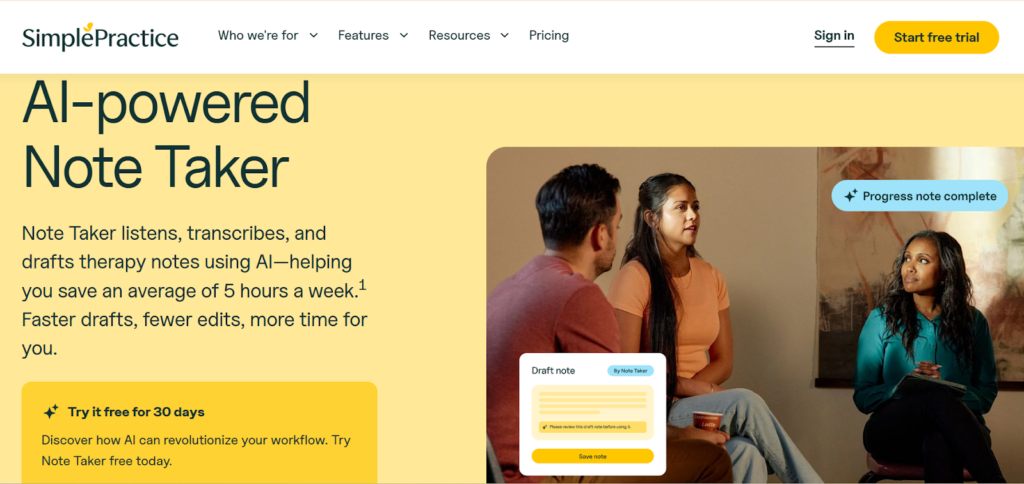
SimplePractice AI is built into the EHR rather than offered as a standalone tool. It focuses on streamlining documentation inside the client chart, which works well for clinicians who want basic note automation in their existing workflow. It does not evaluate patterns across sessions, surface clinical blind spots, or provide insight into therapeutic progress or the client-therapist relationship over time.
Key Takeaways: SimplePractice AI Review 2026
| Area | Summary |
|---|---|
| What it does well | AI-assisted draft notes inside an existing EHR |
| Main limitations | A note-assist feature, not a clinical-insight or progress-tracking platform; locked to SimplePractice |
| Workflow fit | Best for clinicians already committed to SimplePractice |
| Compliance | HIPAA compliant, BAA included, SOC/HITRUST-level controls |
| Pricing model | Monthly EHR subscription plus paid AI add-on |
| Real all-in cost | ~$430/mo (part-time, 15 sessions/wk) or ~$800/mo (full-time, 30 sessions/wk) including SimplePractice’s 3.15% + $0.30 online payment fee |
| Best value for | Clinicians who want one platform for everything and have basic AI note needs |
Is SimplePractice good for therapists?
For most general therapy practices, yes. SimplePractice is a workable EHR with one of the most polished interfaces in the category. It’s the right fit if you want one platform for scheduling, billing, telehealth, client portal, and basic AI notes, and you’re comfortable with tiered pricing that escalates as your practice grows. It’s a poor fit if you do specialized clinical work (intensive measurement-based care, supervision-heavy training programs, AI-driven progress and alliance insights), if you need transparent flat pricing without per-claim and per-SMS fees, or if you want AI notes that go beyond SOAP and aren’t locked to one EHR.
SimplePractice Note Taker reviews from real therapists
Pricing and performance are two recurring themes in therapist feedback on SimplePractice’s AI note-taking features. Several users note that costs can increase over time as usage grows, making long-term budgeting less predictable:
“The monthly fee keeps increasing… I started paying the basic price, two years later I’m paying twice as much.” – Rossana, via Trustpilot
Time-to-completion is another common concern, particularly for clinicians working with tight schedules between sessions:
“My main gripe is the amount of time it takes to generate a progress note. I only have 10 minutes between patients… With other programs, writing a note can take me as little as three minutes. It generally takes more than five minutes with SimplePractice.” – Jenn Fernandez, via Trustpilot
Taken together, these reviews suggest that while SimplePractice is effective for centralizing practice management and documentation, cost scalability and note-generation speed are important factors to consider, especially for clinicians who rely heavily on AI features or are planning long-term practice growth.
In my own practice I’ve seen the same pattern. Note Taker drafts a clean SOAP note inside the chart, but on weeks with back-to-back sessions the lag between session end and draft availability is the bottleneck. I’d already be in the next intake before the previous note loaded.
SimplePractice AI Features and Workflow
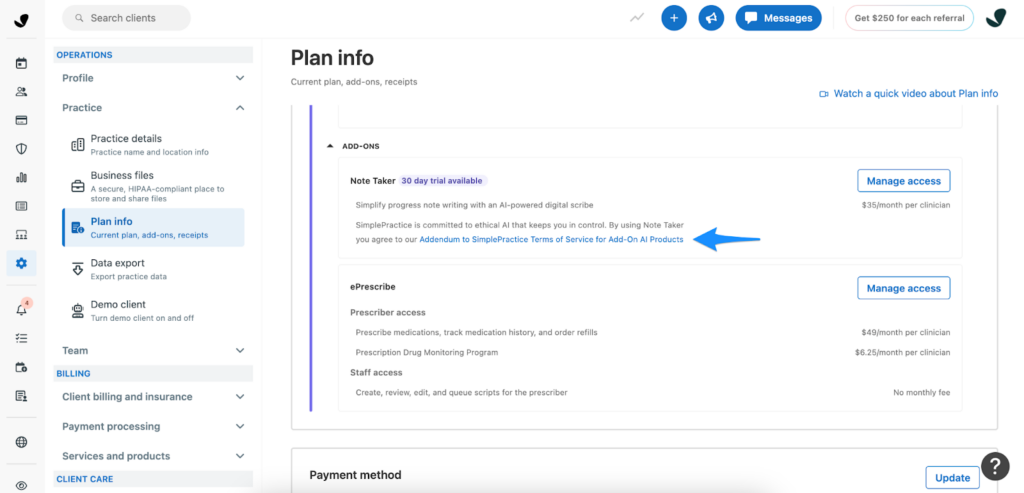
SimplePractice AI Note Taker generates draft progress notes from session audio or dictation, in SOAP, DAP, BIRP, or custom templates configured in your client chart. It supports live telehealth recording, uploaded audio files, and dictated summaries, and is HIPAA-compliant with a BAA, SOC/HITRUST-level controls, and audio deletion after transcription.
AI documentation features
AI-assisted note generation. Transcribes session audio or clinician-dictated summaries and generates draft progress notes directly inside the EHR. These drafts require clinician review before being finalized.
Supported note templates. SOAP, DAP, and BIRP, following the template structure configured in SimplePractice. Note structure is constrained by the EHR’s existing templates.
Clinical language and accuracy. Draft notes follow a clear, structured clinical format, but they are not intended to replace clinical reasoning. Clinician review remains essential to refine diagnostic language, ensure clinical nuance, and adjust phrasing for medical necessity, particularly in complex presentations or long-term care.
Editing and customization. Clinicians maintain full control over all documentation. Notes can be edited, customized, signed, or locked within the chart. SimplePractice positions AI strictly as a drafting aid rather than a source of clinical interpretation.
Speed and usability. Transcripts and draft notes are generally available within 10 minutes after a session, slower than dedicated AI scribes that aim to deliver drafts within 1-3 minutes. Mentalyc typically returns drafts in under 5 minutes and supports dictation, uploads, and live recording (Note Taker now supports the same channels as of 2026, but remains tied to the SimplePractice app for capture). For a clinician seeing 6-8 clients in a day, the 5-minute vs 10-minute difference compounds. It’s the difference between finishing notes the same day and carrying them into the evening.
Recording and transcription workflow
Session capture options. Live telehealth sessions, uploaded session audio files, and dictated session summaries. Telehealth sessions support up to 15 participants with screen sharing, an interactive whiteboard, and a virtual waiting room, all on a HITRUST-certified platform.
Recording storage and privacy. SimplePractice deletes audio recordings after transcription. Transcripts may be retained depending on account settings. Retention behavior varies by configuration, so clinicians should review controls carefully and ensure consent language reflects how session data is handled.
Does SimplePractice need an AI consent form?
Yes. Because Note Taker records or transcribes session content, you must obtain explicit, informed client consent before using it in any session. SimplePractice provides template consent language and clinicians can layer their own. The consent should disclose: that audio is captured and processed by AI, that recordings are deleted after transcription but transcripts may be retained, that the AI generates a draft only and the clinician is responsible for the final note, and the client’s right to decline.
How do I use AI in SimplePractice?
Enable Note Taker in your subscription settings (it adds $35/month per clinician after the 30-day trial). For a recorded session, start your SimplePractice Telehealth call with recording enabled, or upload a pre-recorded audio file to the client chart. Note Taker transcribes the session and drafts a progress note in your selected template within 10 minutes. You then review, edit, and sign the note inside the chart. You can also dictate notes after a session instead of recording. This is useful for in-person sessions where you don’t want to record clients.
Analytics and insights
SimplePractice provides operational dashboards (appointments, revenue, claims, documentation status), but these are practice-management reports rather than clinical-progress reports. The AI Note Taker does not assess therapeutic alliance, session dynamics, or relational shifts. Treatment plans and goal fields can be referenced within notes, but automated analysis of symptom trends or outcomes is limited. Monitoring therapeutic progress typically requires manual review across multiple notes.
Security, Privacy and Compliance
SimplePractice is HIPAA compliant with a BAA, SOC/HITRUST-level controls for Note Taker, and HITRUST certification on the telehealth platform. Audio recordings are deleted after transcription. The main caveats are around third-party AI training data and transcript retention, both of which require clinician attention.
Compliance does not remove clinician responsibility. Audio is deleted after transcription, but written transcripts may be retained depending on account settings. Even when recordings are removed, AI-generated session content can persist in the clinical record. Clinicians must understand retention settings, explain AI use to clients, and document informed consent accurately.
Third-party data handling. SimplePractice states in their Terms that they sometimes partner with other companies to help improve their add-on AI products. These partners are bound by contracts to follow the same data restrictions that apply to SimplePractice. However, involving third parties introduces potential exposure: outsourcing data handling opens the door to misuse, there is limited transparency about who these vendors are, and currently there is no option to opt out of AI training if you use Note Taker. As APA’s official standards warn, EHR systems can be vulnerable to breaches if proper encryption and access controls aren’t in place. Not all AI tools meet the same security standards.
How Mentalyc handles this differently. Mentalyc is HIPAA + BAA and SOC 2 Type II compliant (plus PHIPA, PIPEDA, GDPR, NZ Privacy Act), audio is deleted after processing, transcripts are anonymized, Mentalyc does not use your data for AI training, and clinicians can opt out of AI features entirely on the SUPER Plan. The opt-out is the piece I personally care about most as a clinician. Once a client knows their session is feeding a vendor’s training data with no off-switch, the consent conversation gets uncomfortable fast.
SimplePractice Pricing 2026: The Real Cost After Add-Ons and Hidden Fees
SimplePractice plans run $49-$99/month for solo clinicians, but the all-in cost is meaningfully higher once you add the $35/month Note Taker add-on, online payment processing (3.15% + $0.30/transaction), per-claim billing fees, SMS reminder fees, and the $20/year AMA royalty per clinician. For a part-time therapist (15 sessions/week) the real total is roughly $430/month; for a full-time solo practice (30 sessions/week) it climbs to ~$800/month, far above the headline $49-$99 plan price.
Base plan pricing
| Component | Cost |
|---|---|
| Starter plan (solo) | $49/month |
| Essential plan (solo) | $79/month |
| Plus plan (solo) | $99/month |
| AI Note Taker add-on | $35/month per clinician (after 30-day trial) |
| ePrescribe add-on | $49/month + one-time $89 setup fee |
| Additional clinician (groups, Plus plan) | starting at $74/month per clinician |
| Practice manager / admin staff | $39/month per person |
| Free trial | 30 days |
Sources: SimplePractice Pricing and Note Taker FAQs.
The fees most therapists don’t see at signup
- Online payment processing. SimplePractice’s own support documentation states: “The integration fee for online payments is 3.15% + $0.30 for each successful transaction” (updated December 2025). This rate is also disclosed in the footnote on SP’s pricing page, which lists “Stripe credit card processing fees” as a service not included in the 50% promotional discount. On a $5,000/month practice with ~80 transactions, processing fees alone run roughly $182/month, more than five times the Note Taker add-on cost, every month.
- Per-claim billing fees. SimplePractice’s pricing page lists “Electronic claim filing” on Starter, “10 free insurance claims/mo” on Essential, and “35 free insurance claims/mo” on Plus. Claims above the free allowance carry a per-claim fee, reported at approximately $0.50/claim by CarePaths’ SimplePractice review; SP does not publish the exact overage rate on its public pricing page. Automatic claim creation requires the separate Managed Billing add-on. A practice filing 65 claims/month on Essential would pay roughly $28/month in overage fees.
- SMS appointment reminders. When enabled, SMS reminders carry a per-message fee that compounds over a full caseload.
- AMA royalty fee. A $20/year per clinician charge covers CPT code licensing, broken down as $18 royalty plus $2 processing per SimplePractice’s pricing page.
- Price increases. SimplePractice raised list prices effective March 3, 2025, moving Starter from $29 to $49/month per clinician, a 69% single-step increase, with Essential moving to $79 and Plus to $99. The move was widely discussed in r/therapists threads such as “For those hit by the SimplePractice price hike: what features do you actually use?” and “Preferred EMR system? SimplePractice just doubled my rate.” Trustpilot reviewers report similar trajectories; one wrote that their fee “doubled” over two years. The trend tracks with the January 2024 Vista Equity Partners acquisition and is the most consistent complaint about SimplePractice on therapist forums in 2025-2026.
Real-cost scenarios
The headline plan price is rarely what therapists actually pay. Modeled below: a full-time solo therapist (30 sessions/week), a part-timer (15 sessions/week), and a 5-clinician group. Assumes $150 average session rate and that roughly half of sessions are billed to insurance.
Full-time solo therapist: 30 sessions/week, Essential plan, AI notes, ~$19,500/month in client payments
| Line item | Monthly |
|---|---|
| Essential plan | $79 |
| AI Note Taker | $35 |
| Online payment processing (3.15% + $0.30 on ~130 transactions) | ~$653 |
| Per-claim fees (65 claims, 10 free on Essential, 55 x $0.50) | ~$28 |
| AMA fee (amortized) | $1.67 |
| Effective total | ~$797/month |
For a full-time practice, the headline $79 plan is less than 10% of the real all-in monthly cost. Online payment processing alone is over 8x the Note Taker add-on.
Part-time therapist: 15 sessions/week, Starter plan, AI notes, ~$9,750/month in client payments
| Line item | Monthly |
|---|---|
| Starter plan | $49 |
| AI Note Taker | $35 |
| Online payment processing (3.15% + $0.30 on ~65 transactions) | ~$327 |
| Per-claim fees (33 claims x $0.50, no free claims on Starter) | ~$17 |
| AMA fee (amortized) | $1.67 |
| Effective total | ~$430/month |
A part-time therapist still pays roughly $430/month all-in for what’s advertised at $49.
Write less, focus more
- SOAP, DAP, BIRP, EMDR notes and more
- AI Treatment Planner
- AI Progress Tracker
- Alliance signals
- HIPAA & PHIPA compliant

5-clinician group, Essential plan, AI notes for all:
| Line item | Monthly |
|---|---|
| Lead clinician (Plus, to enable group features) | $99 |
| 4 additional clinicians @ $74 | $296 |
| AI Note Taker x 5 | $175 |
| AMA fee x 5 | $8.33 |
| Subtotal before payment processing and claims | $578.33/month |
For the group, payment processing scales linearly with revenue. At $50k/month combined client payments, group processing fees alone run ~$1,650/month.
Where SimplePractice actually makes its money
Look at the line items above. The base subscription ($49-$99) is a small fraction of revenue per practice. The structural revenue drivers are the 3.15% + $0.30 payment processing fee on every client payment and the per-claim filing fees on insurance billing. Across 250,000+ practitioners, those usage-based fees compound into a much larger revenue line than the headline subscriptions. This matters when reading SimplePractice’s product roadmap: the AI Note Taker is a $35 add-on; billing-and-payments is the platform’s core monetization. Therapists watching where SP invests engineering effort tend to see that priority reflected in feature releases.
How quickly does AI Note Taker pay for itself?
For a solo therapist seeing 20 clients/week, AI note drafting typically saves 5-10 minutes per session, roughly 100-200 minutes/week. At a self-pay rate of $150/session, two reclaimed sessions per month would more than cover the $35/month AI add-on. Break-even varies with billing rate, session volume, and how much editing the AI draft requires; therapists who write detailed notes from scratch see faster ROI than those who already use templates efficiently. In my own practice the time saving is real, but the bigger payoff is reducing the cognitive load of recalling clinical detail at the end of a long day, a benefit that doesn’t show up in a $35-vs-time spreadsheet.
SimplePractice AI Pros and Cons
SimplePractice AI’s main strength is integration: drafts appear inside the existing EHR chart, in standard templates, with HIPAA compliance and clinician review built into the workflow. Its main weaknesses are scope and lock-in: it only drafts notes (no treatment-plan continuity, no alliance insights, no symptom tracking), only outputs SOAP-style notes natively, doesn’t allow opting out of AI training, and only works inside SimplePractice.
Pros
- Integrated EHR workflow: AI drafting happens inside the existing client chart
- AI-assisted note drafting in SOAP, DAP, BIRP, and custom templates
- Standard clinical templates with consistent structure
- HIPAA compliance with BAA, SOC/HITRUST-level controls, HITRUST-certified telehealth
- Audio deleted after transcription
Cons
- Add-on costs increase total spend ($35/month per clinician on top of base plan)
- SimplePractice’s online payment processing (3.15% + $0.30 per transaction) adds ~$150-$200/month on a $5k/month practice
- Per-claim filing fees on Starter; capped free claims on Essential and Plus
- No cross-session clinical thread; each note is generated against one session at a time
- Treatment plans are static fields, not auto-generated from session content
- No therapeutic alliance insights; PHQ-9/GAD-7 progress tracking depends on client form completion
- Notes can take longer than 5 minutes to generate, slower than dedicated AI scribes
- Reports of compounding price increases over time, accelerating since the 2024 Vista Equity acquisition (Starter went $29 -> $49 in March 2025, a 69% single-step increase)
- No native support for note formats beyond SOAP-style drafts within SimplePractice templates
- No supervision notes
- No option to opt out of AI training while using Note Taker
- Locked to SimplePractice; you lose the tool if you ever switch EHRs
What Note Taker structurally cannot do
SimplePractice has steadily added capabilities to Note Taker through 2025 and 2026: in-person sessions, dictation, audio uploads, pre-session summaries. The remaining gaps are not “missing features” SP might add next quarter. They are structural to how Note Taker is scoped: a per-session AI scribe living inside the SimplePractice EHR. If any of these matter to your practice, you will not get them by waiting for Note Taker to improve:
- One note per session, no clinical thread across sessions. Note Taker generates a draft against one session (plus the previous note). It does not link symptoms, themes, goals, and interventions across the arc of treatment. Mentalyc builds that connection automatically: every note linked to prior sessions, goals, and treatment plan progress.
- Treatment plans are stored, not built. SimplePractice has plan fields and Wiley Treatment Planners (Essential and Plus). Both are static documents you fill in and update manually. Mentalyc’s AI Treatment Planner generates SMART goals from session content and updates them as therapy progresses, without requiring you to maintain the plan separately.
- No alliance or relationship insights. Note Taker drafts notes; it does not flag engagement drops, rupture signals, or alliance shifts. Alliance Genie(TM) in Mentalyc does exactly this, each session.
- Progress tracking depends on client forms. PHQ-9 and GAD-7 in SimplePractice only score if clients fill out the questionnaires. Mentalyc tracks symptoms and goal attainment directly from session content, with no forms.
- No supervision notes. If you supervise other clinicians, Note Taker does not produce supervision documentation. Mentalyc does.
- Locked to SimplePractice. Note Taker only runs inside SimplePractice’s chart and only writes to SimplePractice templates. If you ever switch EHRs, you lose the tool. Mentalyc’s Chrome Extension pushes finished notes into any web-based EHR (SimplePractice, TherapyNotes, Jane, TheraNest, ICANotes, Valant) so your AI documentation is portable.
- No opt-out of AI training while using Note Taker. Mentalyc lets you opt out on the SUPER Plan and never trains models on PHI.
The shorthand: Note Taker writes a note about one session. Mentalyc builds a clinical record across every session, then puts each note where your EHR expects it.
Three Practical Ways to Get Better AI Therapy Notes
You do not have to choose between staying on SimplePractice and getting therapy-first AI documentation. Most therapists fit one of three setups:
Path 1: Stay on SimplePractice, add Mentalyc on top
If you like SimplePractice for scheduling, billing, and client portal, keep it. Drop the $35/month Note Taker add-on. Use Mentalyc for AI notes, treatment planning, progress tracking, and Alliance Genie(TM) instead. With the Mentalyc Chrome Extension for SimplePractice and any other web-based EHR, Mentalyc-generated notes go into your SimplePractice client chart in one click, with no copy-paste and no lost formatting. You keep your EHR; you upgrade your notes. This is the most common setup for therapists who already use SimplePractice.
Path 2: Use any other EHR + Mentalyc
Mentalyc works alongside any EHR. If you are on TherapyNotes, TheraNest, ICANotes, Jane, CarePaths, or anything else, Mentalyc generates the notes and transfers them into your EHR’s chart with the same one-click flow. See Mentalyc’s EHR Integration page for the full list of supported EHRs and how the Chrome Extension works. This is the right setup for therapists who don’t love SimplePractice but want documentation that doesn’t depend on which EHR they choose.
Path 3: Mentalyc standalone (no full EHR)
For many solo practices, a full EHR is overkill. You can run a full clinical workflow with Mentalyc for documentation, Stripe directly (without an EHR middleman, at Stripe’s standard rate) for payments, and Google Calendar or Calendly for scheduling. You get insurance-ready notes, treatment plans, progress tracking, and alliance insights at a fraction of the cost of a full EHR subscription with an AI add-on bolted on. Many therapists start solo with this setup and only add an EHR later when group practice or insurance billing requires one.
Mentalyc vs Note Taker by SimplePractice: Detailed Comparison
The short version: Mentalyc is built for therapy documentation as a standalone product; Note Taker is an in-EHR drafting add-on. Mentalyc supports more note formats (SOAP, DAP, MSE, BIRP, EMDR, intake, treatment plans, supervision notes, custom templates), works with any EHR via 1-click Chrome Extension, includes treatment planning with SMART goals and Alliance Genie(TM) insights, and lets you opt out of AI training. Note Taker is simpler, lives inside SimplePractice, only outputs SOAP-style notes natively, and doesn’t allow opting out of AI training.
Features comparison chart
This chart reflects Note Taker’s 2026 capabilities (verified against SimplePractice’s Note Taker support documentation; Note Taker now supports in-person sessions, dictation, and uploaded audio, all rolled out across 2025-2026). The remaining gaps are structural: Note Taker is scoped as an in-EHR single-session AI scribe, while Mentalyc is a cross-session clinical-intelligence platform that pushes finished notes into any EHR.

| Feature | Mentalyc | Note Taker by SimplePractice |
|---|---|---|
| Data usage transparency (publicly documented retention + opt-out) | Full opt-out of AI training on SUPER Plan; no training on PHI | No opt-out for AI training while using Note Taker |
| Support for all client types (individual, couple, family, child, group with separate participant notes) | Yes | Individual, couple, group session notes only; no per-participant notes for groups |
| In-person sessions | Yes | Added in 2026 via Clinicians mobile app |
| Telehealth sessions | Yes – any video tool (Zoom, Google Meet, etc.) | Only inside SimplePractice Telehealth |
| Dictation (talk-and-summarize without recording the client) | Yes | Added in 2026 |
| Upload pre-recorded session audio | Yes – any file from any source | Added in 2026 (within Note Taker workflow) |
| Note formats | SOAP, DAP, MSE, BIRP, EMDR, intake, biopsychosocial, safety plan, supervision, custom templates | SOAP-style draft inside SimplePractice templates |
| Cross-session continuity (golden thread linking notes, goals, symptoms across sessions) | Yes – automatic | Each note generated against one session + previous note only |
| Treatment planning | Yes – AI-generated SMART goals from session content, auto-updated as therapy progresses | Static plan fields and Wiley library; manual to maintain |
| Progress tracking | Yes – automated symptom and goal tracking from session content; no client forms required | Manual review across notes; PHQ-9/GAD-7 scoring depends on client completing assessments |
| Therapeutic alliance insights | Yes – Alliance Genie(TM) flags engagement drops and rupture signals each session | Not available |
| Supervision notes | Yes | Not available |
| Works with other EHRs | Yes – one-click Chrome Extension into SimplePractice, TherapyNotes, Jane, TheraNest, ICANotes, Valant, and any web-based EHR | Locked to SimplePractice |
Data security and privacy
Mentalyc data security:
- Mentalyc meets HIPAA, SOC 2 Type II, PHIPA, PIPEDA, GDPR, and the New Zealand Privacy Act
- Every Mentalyc user gets a Business Associate Agreement (BAA)
- Mentalyc never sells your data or shares with third-party providers
- Mentalyc does not use your data for training AI models
- All data is fully de-identified
- You can opt out of AI features anytime with the SUPER Plan
SimplePractice Note Taker privacy considerations:
- SimplePractice says they never sell PHI (Protected Health Information). PHI is a narrow legal term, so that statement might leave out other types of data, like usage or behavioral info
- SimplePractice states in their Terms that they sometimes partner with other companies to help improve their add-on AI products. These partners are bound by contracts requiring them to follow the same data restrictions that apply to SimplePractice. However, involving third parties introduces potential risks: outsourcing data handling opens the door to potential exposure, there is no transparency about who these vendors are or how they manage sensitive data
- Currently there is no option to opt out of AI training if you decide to use Note Taker
Notes and customization
Mentalyc supports your entire clinical workflow (intake, treatment planning, risk assessments, biopsychosocial evaluations, safety plans, supervision notes, and progress notes) across SOAP, DAP, MSE, BIRP, EMDR, and custom templates, for individual, couple, family, and group sessions, across modalities (CBT, DBT, EMDR, Play Therapy, Brainspotting, and others). Note Taker handles individual, couple, and group appointments but outputs SOAP natively only, doesn’t produce supervision notes, and relies heavily on the previous note’s quality for context (poor prior notes degrade new drafts).
Recording and integration
Mentalyc supports built-in audio recording, Zoom integration, uploaded audio files, dictation, and manual typing. After a note is created, the Mentalyc Chrome Extension sends notes into any EHR (including SimplePractice, TherapyNotes, TheraNest, Jane, ICANotes, Valant) in one click without copy-paste or lost formatting. As of 2026, SimplePractice’s Note Taker has expanded beyond live Telehealth to also support in-person sessions (via the Clinicians mobile app), dictation, and uploaded session audio. The remaining differences are scope and lock-in: Note Taker only runs inside SimplePractice, only writes to SimplePractice templates, and there’s no way to take the tool with you if you ever switch EHRs.
Treatment planning and analytics
This is the area where the two tools diverge most clearly. SimplePractice has treatment plan fields and Wiley Treatment Planners (on Essential and Plus), plus PHQ-9/GAD-7 measurement-based care features. But treatment plans are static documents you maintain manually, and progress tracking depends on clients completing assessment forms. Mentalyc generates SMART-goal treatment plans from session content with one click, auto-updates goals as therapy progresses, runs Alliance Genie(TM) for supervision-style alliance feedback each session, and tracks symptoms and goal attainment directly from session notes (no client questionnaires required). The structural difference: SimplePractice stores the treatment plan; Mentalyc builds and updates it from the actual therapy work.
Pricing comparison
| Feature | Mentalyc | Note Taker by Simple Practice |
|---|---|---|
| Base pricing model | Subscription, starts at $14.99/month | $35/month per clinician add-on (requires active SimplePractice plan, $49-$99/month) |
| Free trial | Yes (with demo note + limited uploads) | 30-day Note Taker trial inside SimplePractice |
| Included note formats | SOAP, DAP, MSE, BIRP, EMDR, and more | SOAP only |
| Add-on or standalone? | Fully standalone | Only accessible within SimplePractice |
| Custom templates and features | Included in all plans | Not available |
| Works with other EHRs | Yes – one-click transfer via Chrome Extension | Locked to SimplePractice |
| Best value for | Therapists needing rich documentation and flexible AI workflows | Therapists already on SimplePractice who want basic AI notes inside Telehealth |
Ease of use and support
Mentalyc has no setup process, includes a demo note for testing, and is designed with neurodivergent users (ADHD, autism) in mind. Support is direct: you can book a call with a real person, no bots, no long waits. SimplePractice has a polished, professional interface, but Trustpilot reviews consistently flag slow customer service response times and difficulty reaching a real human, even on phone support.
Final Verdict: Is SimplePractice AI Worth It in 2026?
Verdict: SimplePractice AI Note Taker is worth the $35/month if you already use SimplePractice as your EHR, your note needs are basic (SOAP-style drafts), and you primarily see clients via SimplePractice Telehealth. It is not worth it if you want note formats beyond SOAP, treatment-plan continuity, alliance or progress insights, the ability to switch EHRs later, or AI documentation that’s portable. For most therapists in that second group (and based on what I see in supervision with clinicians on both sides of this decision), pairing SimplePractice with Mentalyc via the Chrome Extension delivers everything Note Taker delivers, plus everything it doesn’t, often at a similar all-in cost (or less, if you drop the Note Taker add-on entirely).
AI add-ons inside EHRs are still working their way up before they can really compete with systems built specifically for therapy documentation. With Note Taker, you get AI-generated notes that cover only SOAP. With Mentalyc, every therapist can pick a note format that fits their style, create notes tailored to their approach, and get helpful insights to keep therapy moving in the right direction.
If you are on SimplePractice and want better notes without switching EHRs, Path 1 above is the most common path: keep SimplePractice, drop the Note Taker add-on, add Mentalyc. The Chrome Extension makes the transition invisible to your workflow. If you are still EHR-shopping rather than locked into SimplePractice, see our broader review of the best EHRs for private practice for the head-to-head across the category.
Frequently Asked Questions
References
1. Vista Equity Partners. Vista Equity Partners Completes Acquisition of EngageSmart – $4.0 billion, January 26, 2024. https://www.vistaequitypartners.com/news/vista-equity-partners-completes-acquisition-of-engagesmart/
2. Trustpilot. SimplePractice customer reviews. https://www.trustpilot.com/review/www.simplepractice.com
3. American Psychological Association. APA standards for electronic records and patient data security. https://www.apa.org/
4. olihealth.ai. SimplePractice raised Starter 69% in one step – what that tells us. April 28, 2026. https://olihealth.ai/blog/simplepractice-price-increase-march-2025
5. SteadyPractice. SimplePractice Price Increase 2025: What To Do. https://www.steadypractice.app/blog/simplepractice-price-increase-2025
6. Pimsy EHR. SimplePractice Limitations for Behavioral Health (cites 63-69% 2025 price increase). February 10, 2026. https://pimsyehr.com/simplepractice-limitations-for-behavioral-health/
7. r/therapists threads on the 2025 price hike – e.g. “For those hit by the SimplePractice price hike – what features do you actually use?” and “Preferred EMR system? SimplePractice just doubled my rate.” https://www.google.com/search?q=site:reddit.com/r/therapists+simplepractice+price+hike
8. SimplePractice Support. Note Taker FAQs – $35/month per clinician add-on. Updated January 31, 2026. https://support.simplepractice.com/hc/en-us/articles/35115898488599-Note-Taker-FAQs
9. SimplePractice. EHR Pricing and Plans. Accessed May 28, 2026. https://www.simplepractice.com/pricing/
10. SimplePractice Support. Processing online payments – 3.15% + $0.30 per successful transaction. Updated December 22, 2025. https://support.simplepractice.com/hc/en-us/articles/360038123272-Getting-started-with-online-payments
11. CarePaths. SimplePractice Review 2025. https://carepaths.com/simplepractice-review/
12. SimplePractice Support. AMA fee FAQs – $20/year per clinician. Updated December 14, 2025. https://support.simplepractice.com/hc/en-us/articles/360037632591-AMA-fee-FAQs
13. SimplePractice Support. Note Taker section (in-person sessions, dictation, uploads, pre-session summaries). https://support.simplepractice.com/hc/en-us/sections/4406066226203-Note-Taker
14. SimplePractice. About SimplePractice – 250,000+ practitioners. https://www.simplepractice.com/about-us/
15. SEC. EngageSmart Agrees to Be Acquired by Vista Equity Partners for $4.0 Billion (Form 8-K filing). https://www.sec.gov/Archives/edgar/data/1842566/000110465923113189/tm2328707d1_8k.htm
Why other mental health professionals love Mentalyc

“It immediately changed my quality of life, personally and professionally.”
Owner/Independently Licensed Marriage & Family Therapist (LMFT)

“Do yourself a favor, make your life easier. I found Mentalyc to be one of the best tools that I’ve ever used.”
Licensed Marriage and Family Therapist

“For anyone hesitant: this is a lifesaver. It will change your life, and you have more time to be present with your patients.”
Licensed Clinical Social Worker

“If I were recommending this software to a colleague, I would tell them that it is the best thing that they could do for their practice.”
Licensed Professional Counselor