


Our verdict in brief: TherapyNotes AI (TherapyFuel) is a capable documentation assistant if you already live inside the TherapyNotes EHR, and since late 2025 it has improved meaningfully, adding draft treatment plans and earning an AI-focused HITRUST certification. But it remains an EHR add-on: SOAP-centric notes, capture locked to the TherapyNotes ecosystem, and no session-derived progress or alliance insight. Therapists who want deeper clinical documentation typically pair their EHR with a therapy-first platform like Mentalyc instead, without switching EHRs.
Therapists exploring a TherapyNotes AI review are often trying to understand whether an AI notetaker inside a traditional EHR can reduce documentation time or simply shift work around existing templates.
In this guide based on real clinicians’ reviews, we examine how well this platform performs in real clinical workflows, where its limitations appear, and when a dedicated AI documentation platform may be a better fit. It will help answer the most practical question: “Is TherapyNotes AI worth it in 2026?”
Overview: What Is TherapyNotes AI?
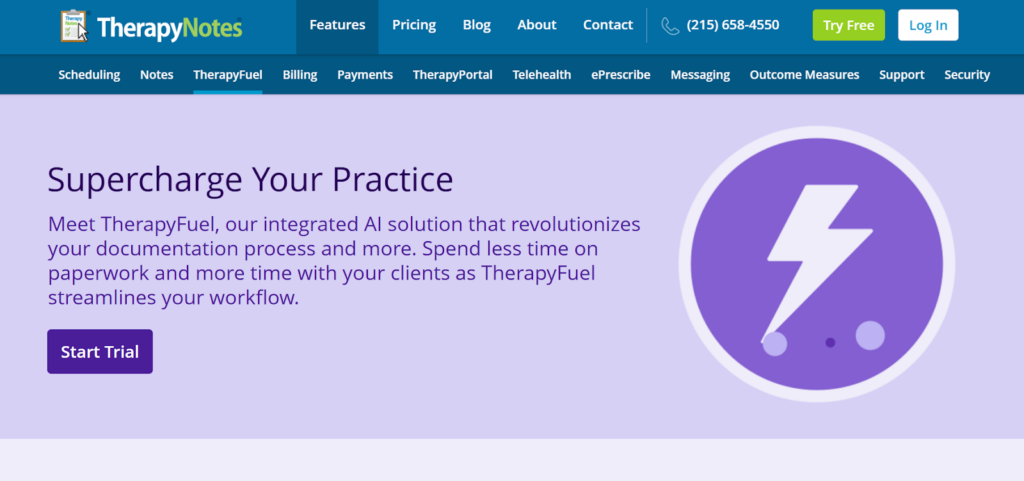
TherapyNotes is a long-established behavioral health EHR. Its AI features are provided through TherapyFuel, an integrated tool designed to help clinicians draft therapy notes within the TherapyNotes platform.
Spend less time writing, more time with clients.

TherapyNotes AI works in two main ways. Clinicians can enter a short session summary that TherapyFuel expands into a draft note, or use TherapyFuel Scribe to transcribe in-person or TherapyNotes telehealth sessions and generate SOAP-style progress notes.
Because it is built directly into TherapyNotes, the AI is best suited for clinicians already using the platform for scheduling, billing, and compliance. It functions as an EHR add-on rather than a standalone AI documentation tool.
TherapyNotes reports HIPAA compliance, provides a Business Associate Agreement (BAA), and applies the same security standards to its AI features as to the rest of the platform. In addition, TherapyNotes reports an AI-focused HITRUST security certification for TherapyFuel (verified June 2026).
Key Takeaways: TherapyNotes AI Review 2026
| Area | Summary |
|---|---|
| What it does best | Drafts structured progress notes and treatment-plan drafts from summaries or transcripts inside a full EHR |
| Main limitation | AI is assistive, not fully automated; review and editing remain essential; capture locked to the TherapyNotes ecosystem |
| Best practice fit | Clinicians, group practices, and agencies already using TherapyNotes |
| Compliance posture | HIPAA compliant, BAA provided, HITRUST AI Security Certified |
| Pricing model | Base EHR subscription ($69/mo solo) plus $40/mo per-clinician AI add-on (verified June 2026) |
| Best value for | Practices that need EHR, billing, and AI notes in one system |
TherapyNotes Scribe Review: Real Therapist Experience
Let’s be accurate about the overall picture first: TherapyNotes is a well-liked EHR. On Trustpilot it holds a 4.9/5 TrustScore across roughly 3,000 reviews (checked June 10, 2026), and most visible reviews on G2 are positive, including praise for the AI note-writing tool. Any criticism below should be read against that backdrop.
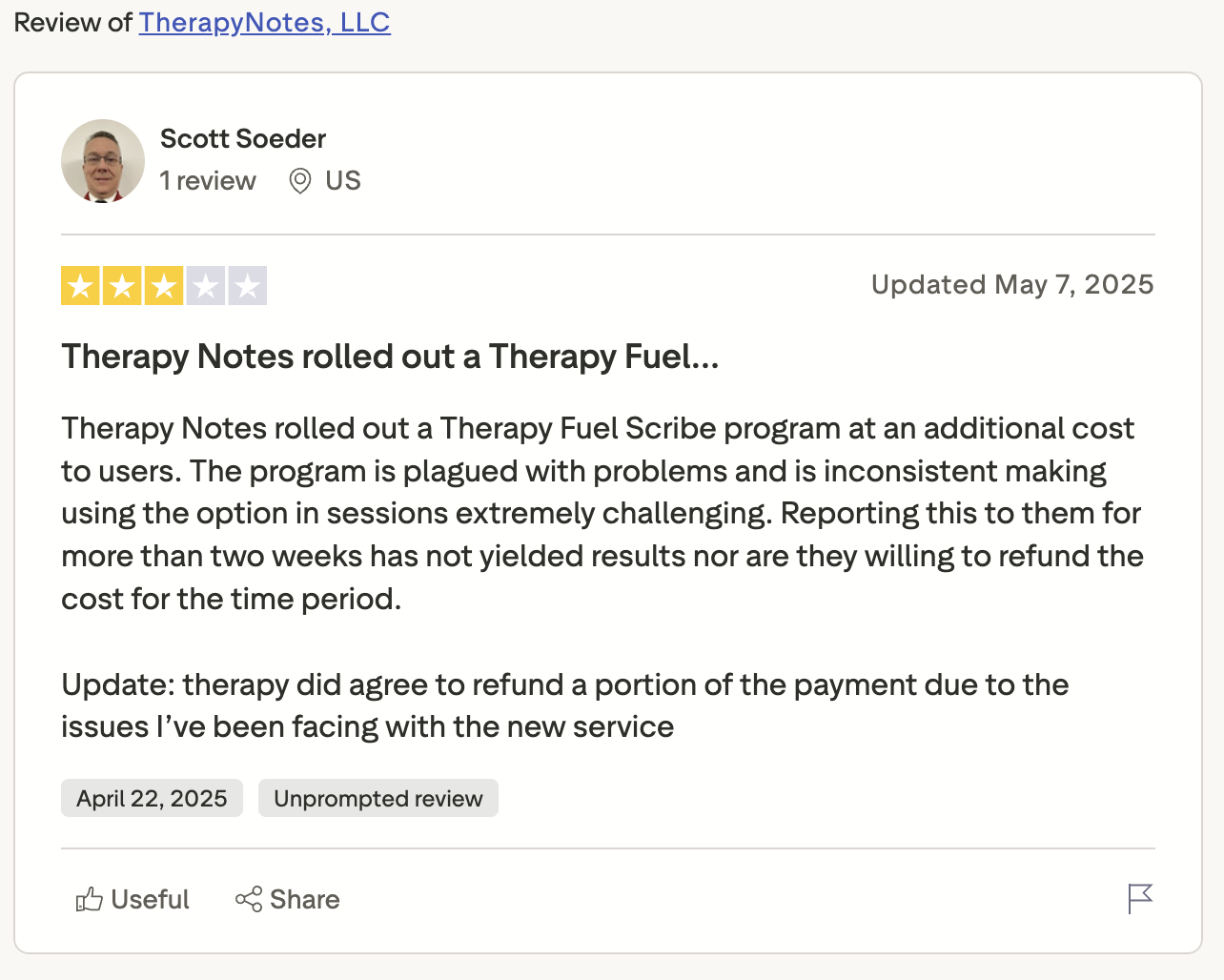
That said, feedback around TherapyFuel Scribe specifically has been more mixed, particularly during rollout and ongoing use in live sessions. Some users report that the Scribe feature can feel inconsistent and unreliable, making it difficult to depend on during therapy sessions where stability matters. One clinician described challenges with both functionality and follow-up after reporting issues:
“The program is plagued with problems and is inconsistent… using the option in sessions extremely challenging.” (Scott Soeder, via Trustpilot)
Support responsiveness for AI-specific issues appears in some feedback as well:
“I’ve requested updates on when this will be fixed and got no response at all.” (Amy M., via G2)
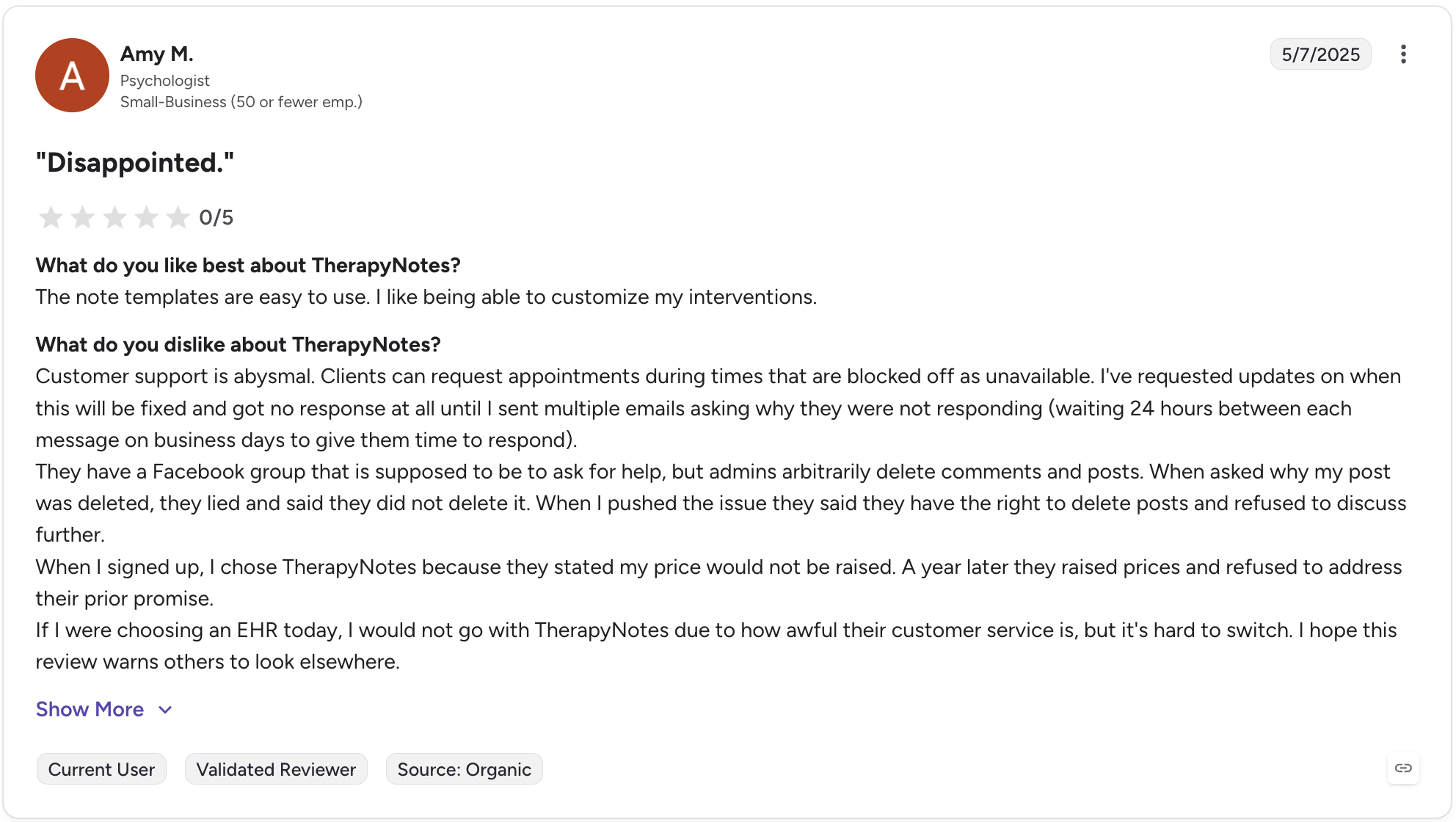
“A year later they raised prices… it’s hard to switch.” (Amy M., via G2)
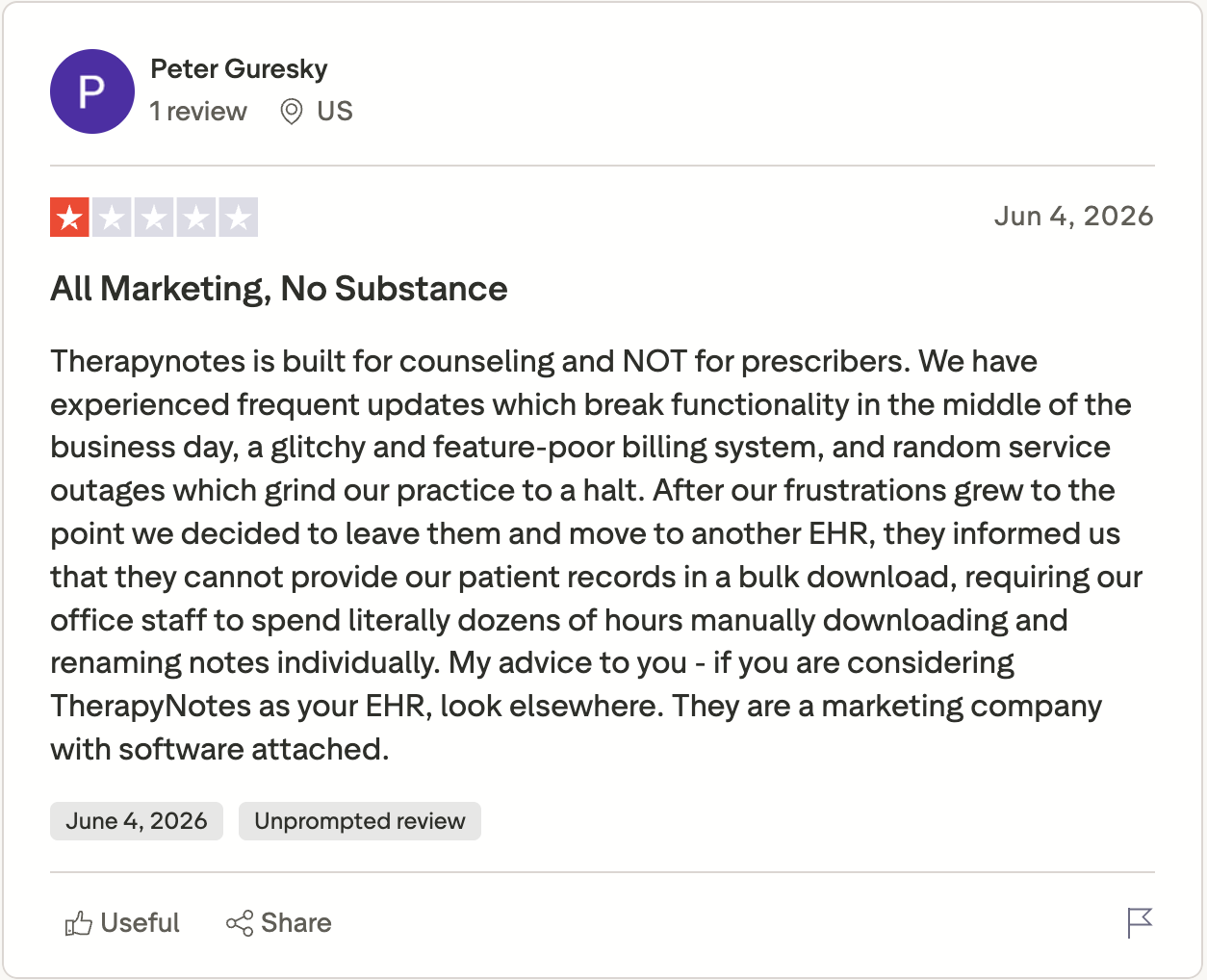
A more recent concern, relevant if you ever decide to leave, is data portability. One practice owner described the exit process in June 2026:
“They informed us that they cannot provide our patient records in a bulk download, requiring our office staff to spend literally dozens of hours manually downloading and renaming notes individually.” (Peter Guresky, via Trustpilot, June 4, 2026)
Concerns about company practices extend beyond the AI feature. One practice posted this to r/therapists:
While the TherapyNotes platform is organized and functional, we cannot recommend this company due to serious ethical concerns. Our experience involved the use of a falsified contract, something we never agreed to – u/Known-Bunch2860 (r/therapists)
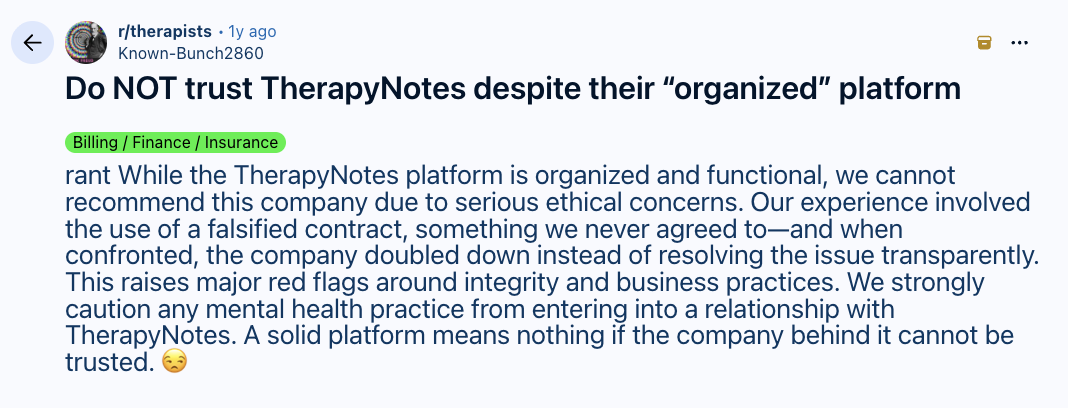
Taken together: most TherapyNotes users are happy with the EHR, while the recurring risk areas are Scribe reliability during live sessions, support responsiveness for AI-specific issues; ethical concerns and switching friction if you later migrate away.
For clinicians considering AI-assisted transcription inside an EHR, these factors are important to weigh; especially if session-level reliability and responsive support are critical to day-to-day practice.
Who TherapyNotes AI Is Best For
TherapyNotes AI is best suited for clinicians who are already committed to the TherapyNotes EHR and want AI-assisted documentation built directly into their existing workflow.
Because TherapyNotes AI is designed to support documentation efficiency within the EHR, its note drafts emphasize template completeness and standard phrasing. Clinicians often need to refine language to reflect clinical nuance, evolving formulations, or session-specific detail.
For therapists who care most about note quality, clinical depth, and how sessions connect over time, EHR-based AI drafting may feel limiting; especially compared to tools built specifically around therapy documentation rather than administrative workflows.
TherapyNotes AI Features
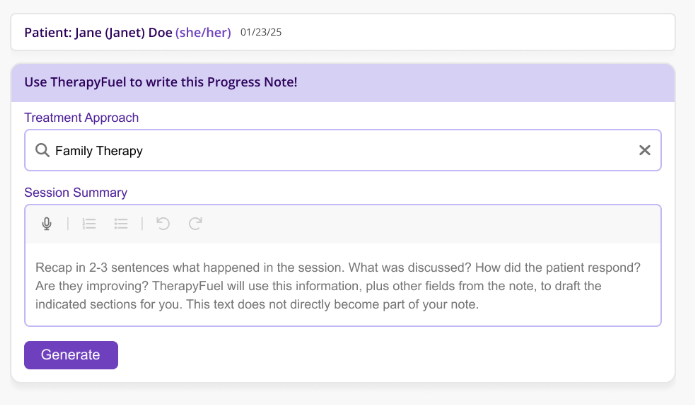
TherapyNotes AI Documentation
TherapyNotes is a template-driven behavioral health EHR. Its AI layer, TherapyFuel, is designed to assist with documentation rather than transform how notes are written.
How AI drafting works
Clinicians either enter a short session summary or enable TherapyFuel Scribe. The AI then drafts SOAP-style progress notes based on existing EHR templates.
Treatment-plan support
TherapyFuel generates draft goals, objectives, and interventions for each treatment focus, tied to diagnoses already documented in the chart (feature verified June 2026). Ongoing alignment between notes and plans still requires clinician review: the system does not track plan progress from session content.
Clinical accuracy & review burden
Drafts are structured and compliant, but clinicians still need to review and adjust language for diagnostic nuance, risk documentation, and medical necessity. The AI does not independently assess session content or clinical change.
Customization & control
Clinicians retain full control over tone, content, and length before signing. Notes are never auto-finalized by AI. Clinician Voice settings and a tone-adjustment tool let you nudge the writing style, and a built-in clinical dictation feature supports hands-free capture.
Additional AI features
TherapyFuel now also generates Client History Form summaries before intake, summarizes secure-message conversations into Contact Notes, and extracts policy details from uploaded insurance cards. Intake note and psychiatry note generation are listed as upcoming, not yet available (verified June 2026).
Overall, TherapyNotes AI functions as a documentation assistant inside the EHR. It is improving steadily, but it’s not built for note quality or clinical insight.
Recording & Transcription Workflow (TherapyFuel Scribe)
TherapyFuel Scribe supports session capture only within the TherapyNotes ecosystem:
- Works during in-person sessions (when Scribe is enabled) or TherapyNotes Telehealth
- Does not accept external uploads or recordings from other platforms
- For sessions without Scribe, clinicians can still enter summaries for AI drafting
Recording & retention
Session audio is encrypted, transcribed, and deleted after transcription. Transcripts are encrypted and retained until the note is signed or for up to 30 days, whichever comes first. All data handling falls under the TherapyNotes BAA.
Consideration: Because capture is limited to TherapyNotes environments, flexibility may be reduced for clinicians who work with other tools.
Analytics & Outcome Tracking
TherapyNotes supports measurement-based care, with outcomes interpreted by the clinician:
- Built-in outcome measures such as PHQ-9 and GAD-7 via the client portal
- Automatic scoring and graphs over time
- Scores can be inserted into progress notes to document baseline and change
However, TherapyNotes AI does not generate automated insights about session quality, patterns across notes, or therapeutic alliance. Progress interpretation remains largely manual.
TherapyNotes AI Integrations & Workflow Support
As a full EHR, TherapyNotes centralizes most workflows:
- Scheduling, billing, telehealth, documentation, outcomes, and AI drafting
- Integrated claims submission and tracking
- Limited reliance on third-party tools
This consolidation simplifies operations, but also means AI functionality is closely tied to the broader EHR system.
Security, Privacy & Compliance
TherapyNotes follows standard EHR security practices and provides a HIPAA Business Associate Agreement (BAA). Session audio used for AI note drafting is deleted after transcription, while written transcripts remain until the note is signed or for up to 30 days. TherapyNotes states that patient data is not sold, that data stays within the TherapyNotes system and is not used to train outside AI models, and that AI features follow the same privacy rules as the rest of the EHR. In 2025-2026 TherapyNotes also obtained an AI-focused HITRUST security certification for TherapyFuel, a genuine trust signal worth crediting (verified June 2026).
As with any AI documentation tool, clinicians who want extra certainty should confirm AI training and data-minimization policies directly, in writing, and make sure client consent language reflects how session data is processed. For comparison, Mentalyc publishes its full security posture on its security page.
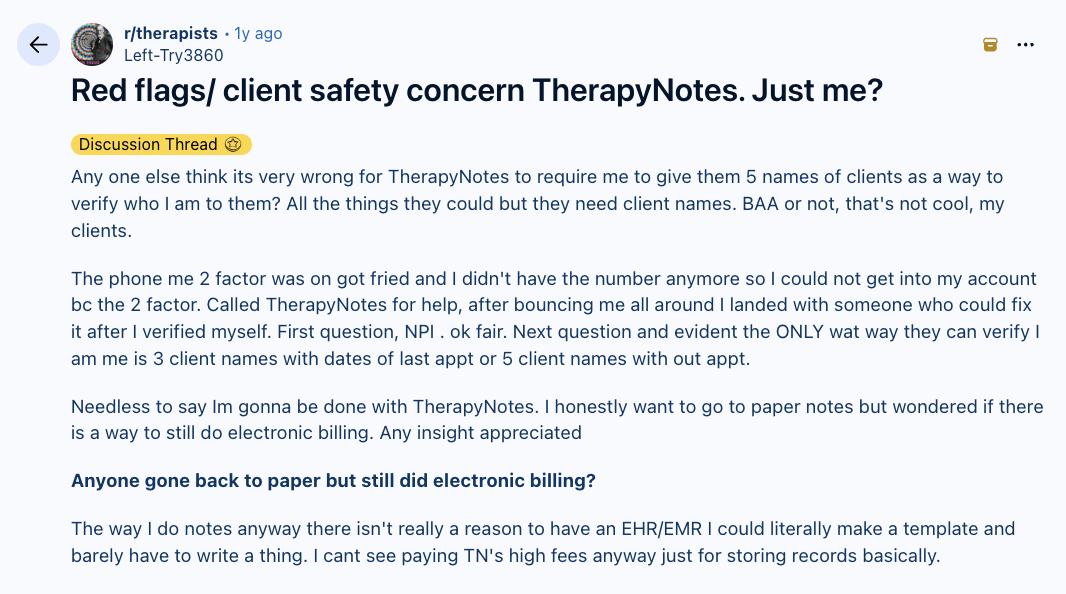
Beyond data handling policies, some therapists have flagged how TherapyNotes itself handles account verification, raising a concern that cuts closer to client privacy than most EHR discussions:
Any one else think its very wrong for TherapyNotes to require me to give them 5 names of clients as a way to verify who I am to them? All the things they could but they need client names. BAA or not, that’s not cool, my clients. – u/Left-Try3860 (r/therapists)
What Does the TherapyNotes EHR Include Beyond the AI?
Beyond TherapyFuel, TherapyNotes is a comprehensive practice management system that offers a wide range of features to help therapists and mental health professionals effectively manage their scope of work. It is a complete solution that provides everything you need to manage patient records, schedule appointments, meet with patients remotely, create detailed documentation, and bill insurance, all from the convenience of your computer.
1. Scheduling
Scheduling appointments with clients is crucial to running a successful therapy practice, and TherapyNotes helps you with that. You can schedule sessions, intakes, or personal vacations, ensuring that your schedule is always up-to-date and accurate.
2. Notes
Pre-created templates are designed to make note-taking a breeze. They provide a simple and easy-to-use framework that you can utilize when creating your notes. Keep in mind that these are manual, pre-built templates you fill in yourself, not AI-generated notes; the AI layer (TherapyFuel) only drafts SOAP-style progress notes. They also allow you to easily upload any counseling notes that you have created using other tools onto the platform, providing you with a centralized location to store all of your notes. This makes organizing and retrieving your sessions a hassle-free experience.
3. Billing
Platform is designed to streamline the process of handling insurance billing, client payment tracking, and medical billing. It’s easy for you to manage all aspects of your billing process. The platform also includes a reporting tool that helps you create detailed statements and billing reports. The platform offers a secure and safe way to charge clients through their credit cards, ensuring that sensitive financial information is protected at all times.
4. Client Portal
The client portal on TherapyNotes is an easy way to share important documents with your clients and sign forms digitally with their built-in forms. You do not always have to create new forms from scratch as the client portal offers templates that you can customize to your specific needs. Clients can also schedule sessions with you directly from the client portal and make payments using their credit cards.
5. Telehealth
The TherapyNotes telehealth feature allows you to meet your clients from anywhere in the world, providing flexibility and convenience for both you and your clients. With the ability to conduct one-on-one sessions virtually, you can provide high-quality care and support to your clients, regardless of their location.
6. ePrescribe
The ePrescribe feature on TherapyNotes is a powerful tool that allows you to manage and prescribe your client’s medications with ease. By connecting to a pharmacy, you can refill prescriptions, view medication histories and ensure that your clients are receiving the best care possible. This feature saves time and improves the overall efficiency of managing your client’s health.
Overall, TherapyNotes is a great tool for running your practice day-to-day, but if you’re looking for a specialized tool to write quick and high-quality notes, it may not be the best option for you. It’s important to have the right tools to provide the best care for your clients, and TherapyNotes is a great option for managing a practice, but it may not be the best fit for all note-taking needs.
TherapyNotes AI Pricing (2026)
Prices below verified on the official TherapyNotes pricing page, June 10, 2026.
| Component | Cost |
|---|---|
| Solo EHR plan | $69/month (one user) |
| Group EHR plan | $79/month first clinician + $50/month per additional clinician (non-clinical staff free) |
| TherapyFuel AI | +$40/month per clinician |
| Premium Telehealth | +$15/month per clinician |
| ePrescribe | +$65/month per prescriber |
| Free trial | 30 days (EHR), no credit card required, no long-term contract |
Pricing insight:
TherapyNotes AI offers reasonable value if you need the full EHR. If you only want AI-generated notes, the realistic minimum is $109/month (solo EHR + TherapyFuel), which exceeds most standalone AI documentation tools.
TherapyNotes AI Pros and Cons
Pros
Write less, focus more
- SOAP, DAP, BIRP, EMDR notes and more
- AI Treatment Planner
- AI Progress Tracker
- Alliance signals
- HIPAA & PHIPA compliant

- Full EHR + AI in one system
- SOAP-based documentation plus draft treatment plans (goals, objectives, interventions)
- Integrated outcomes (PHQ-9, GAD-7)
- HITRUST AI Security Certification on top of HIPAA/BAA
Cons
- Scribe reliability can be inconsistent during live sessions (per user reviews)
- Notes still need manual editing for accuracy and nuance
- Limited flexibility beyond standard EHR templates; capture locked to TherapyNotes telehealth/recording
- Support and pricing concerns reported by some clinicians
- No session-derived progress tracking or alliance insight
Final Verdict: Is TherapyNotes AI (TherapyFuel) Worth It for Therapists in 2026?
TherapyNotes AI (TherapyFuel) is primarily an add-on for clinicians already using the TherapyNotes EHR. It has improved through 2025-2026 (treatment-plan drafting and the HITRUST AI certification are real steps forward), and if your practice already runs on TherapyNotes, the $40/month add-on is worth trialing.
For therapists who want more than template-driven documentation, TherapyNotes AI still falls short. Note quality depends heavily on manual edits, plan-to-progress alignment remains manual, and meaningful insight across sessions is limited. Combined with add-on pricing and mixed reports around reliability and support, it may not be the most efficient option for clinicians focused on clinical depth.
Therapists looking for more accurate notes, actionable treatment planning, and session-level insight, without the overhead of a full practice-management system, are likely to find better options, and they don’t have to leave TherapyNotes to get them (see the switching path below).
Best Alternatives to TherapyNotes AI (TherapyFuel)
Disclosure: Mentalyc, listed first below, is our product. The comparison dimensions and competitor facts are sourced and dated so you can check them yourself.
Mentalyc: The Most Complete Therapy-Focused AI Platform
Mentalyc is designed for therapists who want better clinical documentation without switching EHRs. Instead of focusing on administrative workflows, it supports how therapy progresses from session to session, keeping notes, goals, and progress aligned. Therapists searching for the best AI for therapy notes typically compare exactly this trade-off: EHR convenience versus clinical depth.
Watch real stories from Mentalyc users
Mentalyc stands out for clinicians who want:
- High-quality, insurance-ready progress notes and treatment plans generated from session audio, uploads, dictation, or brief summaries.
- Session-derived progress tracking, where change is reflected directly from clinical notes rather than relying only on questionnaires or self-report measures.
- Clear treatment continuity across sessions, keeping goals, interventions, notes, and progress aligned over time (the “golden thread”).
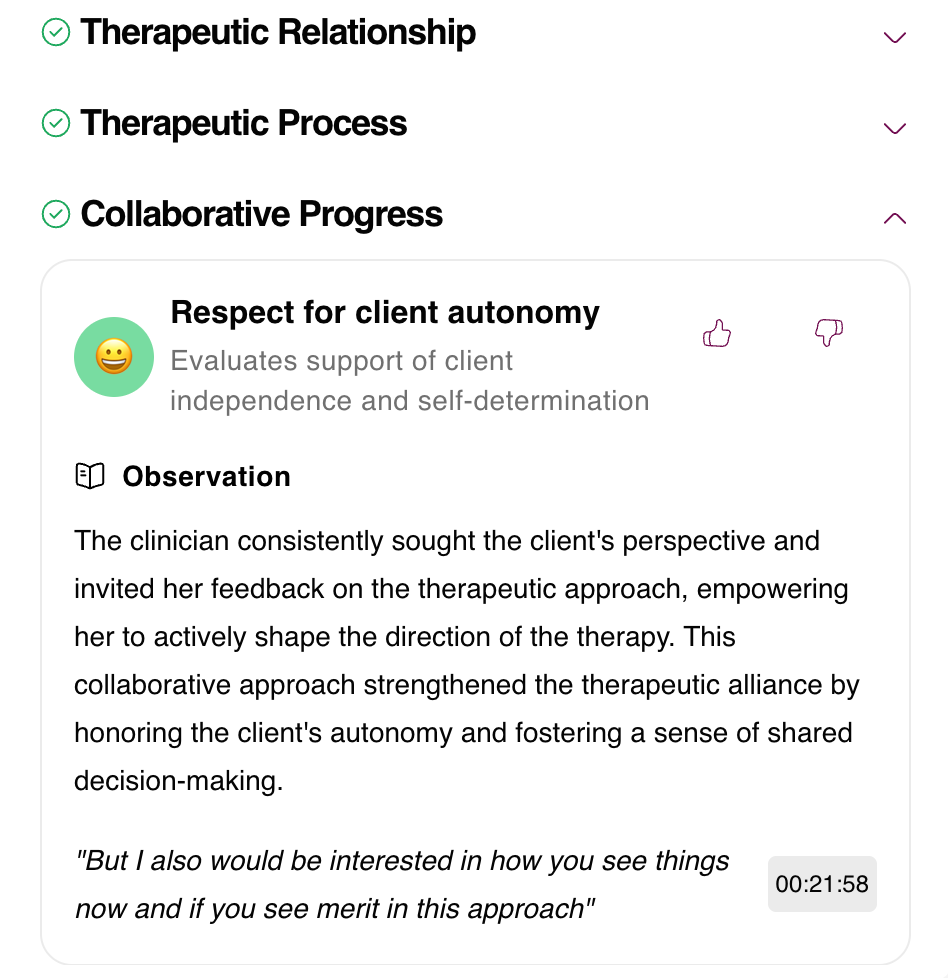
- Helps therapists stay attuned to the therapeutic relationship and spot potential blind spots early, using insights from Alliance Genie™.
- Built with privacy in mind, meeting HIPAA + PHIPA and SOC 2 Type II standards, with clinicians in control of their data.
Because Mentalyc works alongside your existing EHR, clinicians can keep their current scheduling, billing, and claims workflows while using AI purely for documentation quality, treatment planning, and clinical insight, without EHR lock-in. See what therapists say in Mentalyc’s reviews.
Best for: Therapists who want higher-quality, modality-aware clinical notes and clearer continuity across sessions, beyond what EHR add-on AI tools can produce.
Other Options, Briefly
For completeness: SimplePractice AI is the equivalent EHR add-on for SimplePractice users, and Blueprint focuses on questionnaire-based outcome tracking (PHQ-9/GAD-7) with AI notes attached. Both are EHR-adjacent tools rather than therapy-first documentation platforms: neither tracks progress from session content or surfaces alliance insight.
Looking to Replace the Whole TherapyNotes EHR?
If your question is bigger than the AI feature (you want out of the EHR entirely), the established replacements are general practice-management systems (SimplePractice, TheraNest, Tebra). Two things to weigh before migrating:
- Data export friction is real. One practice owner reported in June 2026 that TherapyNotes could not provide patient records as a bulk download, requiring staff to download notes individually (see the review section above). Budget time for migration regardless of where you go.
- Check whether you actually need to switch. If the EHR works for you and documentation is the pain point, adding a dedicated AI documentation tool alongside TherapyNotes is faster and cheaper than a full migration: see the workflow below.
TherapyFuel vs Mentalyc: Feature-by-Feature Breakdown
For therapists weighing the two head-to-head, here is the detailed comparison. Pricing and current TherapyFuel features were re-verified on official pages in June 2026; hands-on usability observations are from our testing of TherapyFuel in September 2025 and are dated as such.
Mentalyc vs TherapyFuel: features comparison at a glance (September 2025 testing; pricing and feature lists re-verified June 2026)
| Feature | Mentalyc | TherapyNotes AI (TherapyFuel) |
|---|---|---|
| What it’s built for | Therapy-first AI documentation, treatment planning, and clinical insight | EHR-based AI documentation inside TherapyNotes |
| Security & privacy | ✅ HIPAA, SOC 2 Type II, PHIPA, PIPEDA, BAA; de-identified transcripts; no model training on client data | ⚠️ HIPAA with BAA; HITRUST AI Security Certified; audio encrypted and deleted after transcription; transcripts retained up to 30 days |
| Automation level | ✅ Drafts notes and treatment plans from session audio or text | ⚠️ Drafts notes from summaries or Scribe transcripts; clinician review/editing required |
| Note quality | ✅ Therapy-specific, insurance-ready notes designed for clinical clarity and consistency | ⚠️ Structured, template-driven notes; quality may depend on manual refinement |
| Note formats & customization | ✅ SOAP, DAP, BIRP, GIRP, intake, psychiatry, group, custom formats/templates | ⚠️ Mainly SOAP-style progress notes; contact notes, client history summaries, and intake/psychiatry note generation are available or upcoming |
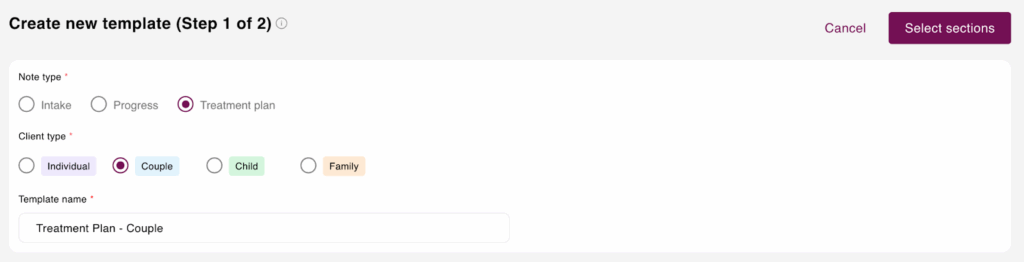
| Session types | ✅ Individual, couples, family, kids, and group sessions | ⚠️ More limited; primarily individual-session documentation based on available testing |
| Recording & input options | ✅ Built-in recorder, uploads, Zoom, dictation, typed summaries, or text input | ⚠️ TherapyNotes Telehealth, in-person Scribe, or summaries inside TherapyNotes; limited outside-tool flexibility |
| Treatment planning | ✅ Automated treatment plans with SMART goal suggestions and ongoing tracking across sessions | ⚠️ Generates draft goals, objectives, and interventions tied to documented diagnoses; progress alignment appears more manual |
| Progress tracking | ✅ Progress tracking generated from session notes, keeping goals, notes, and outcomes connected | ❌ No clear automated session-derived progress tracking; relies more on questionnaire-based outcomes such as PHQ-9 and GAD-7 |
| Alliance / clinical insights | ✅ Alliance Genie™ highlights alliance, engagement, and session-quality patterns | ❌ Not available |
| Ease of use | ✅ Intuitive, standalone tool; no EHR switch required | ⚠️ Best suited for users already working inside TherapyNotes |
| Support | ✅ Human support, FAQs, and in-app guidance | ⚠️ 24/7 support advertised; AI-specific issue delays reported in testing |
| Pricing approach | ✅ Subscription tiers for solo and team plans, from $14.99/month annual billing | ⚠️ TherapyNotes EHR subscription + $40/month TherapyFuel add-on per clinician |
| Best for | Clinicians who want better notes, treatment plans, and clinical insights without switching EHRs | Practices that already use TherapyNotes and want AI documentation inside their EHR |
How Does TherapyFuel Compare on Price?
Mentalyc starts at $14.99/month as a standalone tool (Mini plan, billed annually; $19.99 billed monthly). TherapyFuel requires a TherapyNotes subscription plus the AI add-on: a realistic minimum of $109/month solo (all prices verified on official pages, June 10, 2026).

For more details, visit the pricing page.
Notes & Customization: Which One Covers More Clinical Ground?
Mentalyc supports the full clinical workflow across session types and note formats; TherapyFuel covers individual SOAP progress notes, with intake and psychiatry notes still listed as upcoming (June 2026).
Mentalyc goes far beyond progress notes: it supports the entire clinical workflow, including intake, treatment planning, risk assessments, biopsychosocial evaluations, and safety plans. From solo practice to team settings and supervision, Mentalyc adjusts to your needs and supports work with individuals, couples, families, and groups. It supports multiple note formats, including SOAP, DAP, MSE notes, and more works with a wide range of therapy modalities: CBT (Cognitive Behavioral Therapy), DBT, EMDR, Play Therapy, Brainspotting, and others.
Mentalyc offers flexible, customizable templates to match your clinical style and workflow.
TherapyFuel, on the otherhand (after hands-on testing September 2025; feature list re-checked June 2026), we found that it supports only individual (1-on-1) therapy sessions. Group, family, or couples sessions are not available. It provides progress notes only, in SOAP format; intake and psychiatry note generation announced but not yet shipped (June 2026). Also, there is no supervision notes. Even when notes are automated, you still need to add important details manually, filling in sections like Current Mental Status, Risk Assessment, and Interventions before generating the note to ensure better results.
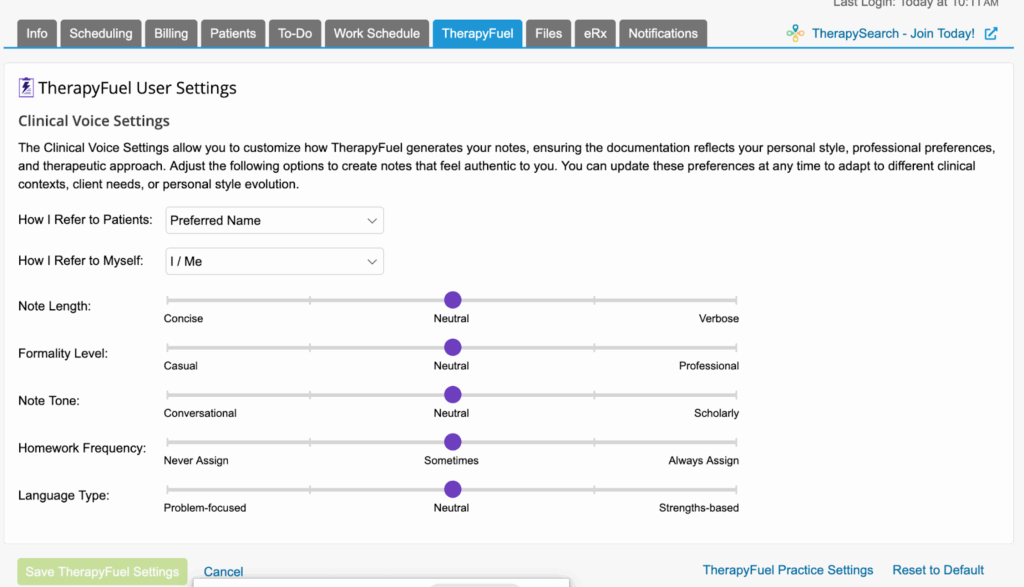
TherapyFuel allows only one primary approach to treatment per note, used to guide the overall tone and structure. While you can still include interventions from different modalities, this setup may feel limiting for therapists who use a more eclectic approach. The Clinical Voice settings feature felt confusing in our testing: the terms are vague, there’s no preview to show how changes affect the note, and it’s hard to tell how much impact moving a slider will have.
Recording & Integration: How Flexible Is Each Tool?
Mentalyc captures sessions via built-in recording, uploads, Zoom, dictation, or typed summaries; TherapyFuel works only inside TherapyNotes telehealth and recording.
| Mentalyc | TherapyFuel |
|---|---|
| ✅ Whether you’re seeing clients in person or online, you’ve got flexible ways to capture your sessions. Use the built-in audio recorder or stick with tools you already know and prefer (e.g., Zoom). | ✅ You can manually enter a session summary to create a foundation for a progress note, and built-in clinical dictation is available. |
| ✅ Already have a recording? No problem: just upload your pre-recorded sessions and let the platform take it from there. | ❌ Uploading transcripts isn’t supported, which limits the ability to create AI-generated therapy progress notes from existing sessions. |
| ✅ Not into recording? You can also summarize your session afterward by dictating your notes or typing them out manually, whatever works best for your flow. | ❌ Works exclusively with its built-in telehealth platform and integrated audio recording. Third-party recording tools (e.g., Zoom) are not supported. |
| ❌ TherapyFuel fills in only the SOAP sections in the note, leaving the rest for the user to complete manually (September 2025 testing). |

Treatment Planning & Analytics: What Does Each Offer?
TherapyFuel now drafts treatment plan components; Mentalyc additionally tracks progress against the plan from session content and surfaces alliance insights.
| Mentalyc | TherapyFuel |
|---|---|
| ✅ Treatment planning made easy: set SMART goals, choose from suggested objectives and interventions, and tailor everything to fit your approach and each client’s unique needs. | ✅ Generates draft goals, objectives, and interventions for treatment plans (added since our original review; verified June 2026). |
| ✅ Build your way: start with audit-ready templates or customize your treatment plans by selecting the exact sections you need. | ❌ No session-derived progress tracking: plan-to-progress alignment remains manual, and outcomes rely on questionnaires (PHQ-9/GAD-7). |
| ✅ Golden Thread: Mentalyc keeps your notes consistent and connected, so the full story of your client’s progress is always visible. | ❌ No analytics or alliance insights. |
| ✅ Progress tracking: automatic updates and clean visual dashboards let you easily spot client growth over time. | – |
| ✅ Therapeutic Alliance insights: with the Alliance Genie™ feature, you get constant feedback from the session, as if you had a supervisor. | – |
Ease of Use: Which Tool Is Simpler Day to Day?
Mentalyc is built to be usable without setup or training; TherapyFuel’s interface drew recurring complaints in our September 2025 testing about unclear settings and missing guidance.
Mentalyc is user-friendly and intuitive, no matter your tech experience. No tricky setups, steep learning curves, or complex integrations: just log in and dive right in. To get you started smoothly, there’s a demo note you can explore that shows exactly how the system works, hassle-free.
The platform continually improves to be even more accessible for neurodivergent users, such as those with ADHD and autism, by focusing on clear, simple design and features that minimize cognitive strain.
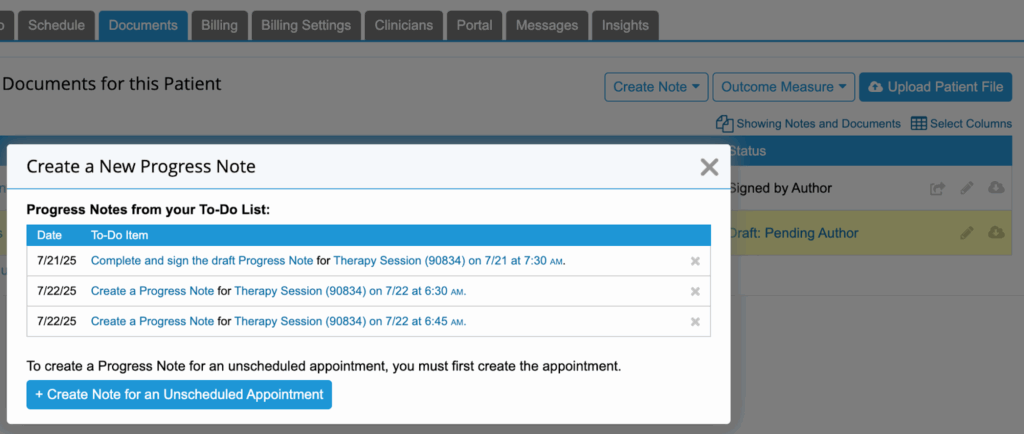
TherapyFuel’s user interface felt clunky and confusing, especially around settings and note generation. There’s no clear explanation of what each option does, leaving users to guess how their choices will impact the final result. The intake sessions aren’t supported, but this critical detail is nowhere to be found until you hit a wall trying to generate one. The UI doesn’t warn or guide you.
Automated emails sent to clients used generic placeholder names like “Joe Doe”, a small detail, but one that could damage trust before the session even starts.
Access to Help
Mentalyc provides a wealth of helpful resources like blogs, articles, FAQs, and in-app tips to guide you every step of the way.
You can easily report any issues through the platform or book a call and speak directly with a real team member: no bots, no waiting, just human support whenever you need it.
TherapyNotes advertises 24/7 phone and email support, and most users appreciate the quick responses and friendly staff. Some users feel frustrated by the limited live support for AI-specific issues and mention that problems are sometimes treated as user errors.
Since the in-app support isn’t very helpful for the AI tool specifically, learning it ends up being mostly trial and error.
Which One Should Therapists Choose?
If you run your whole practice on TherapyNotes and mainly want faster SOAP drafts, TherapyFuel is a reasonable $40/month experiment. That is the honest case for it.
The case against stopping there: while Mentalyc is designed with therapists in mind (built to help them create better notes and take the burden of manual documentation off their shoulders), TherapyFuel is an add-on to an EHR system, for which users pay extra ($40 per user).
In Mentalyc, the entire team effort goes into generating high-quality notes that are tailored to the therapist’s workflow and preferences, audit-proof, and supported by insights that help measure treatment progress and enhance clinical thinking, almost like built-in supervision. This includes access to best SOAP and DAP note templates and more for every session type.
In contrast, TherapyFuel covers progress notes for individual sessions in SOAP format: no options for couples or family sessions, and no tailoring for different modalities. It only works with its built-in telehealth and recording, which means you can’t upload transcripts or use Zoom.
If you want a solution that genuinely supports you in creating insurance-ready and high-quality notes, not a simple Electronic Health Records (EHR) add-on, a therapy-first documentation tool is the stronger choice. The two are not mutually exclusive: many clinicians keep TherapyNotes as their EHR and use a dedicated AI tool for documentation.
How to Add Better AI Notes Without Leaving TherapyNotes
You don’t have to switch EHRs to fix documentation. The practical path most TherapyNotes users take:
1. Keep TherapyNotes for scheduling, billing, telehealth, and claims: it’s good at those.
2. Record or summarize sessions in Mentalyc (how to record and upload): audio, upload, dictation, or typed summary all work.
3. Review and approve the generated note: see real note examples of what output looks like.
4. Send the note into TherapyNotes in one click with the Mentalyc Chrome Extension, fully formatted, no copying or pasting. Learn more about the AI Notetaker.
Many counselors run exactly this setup: EHR for practice management, therapy-first AI for documentation quality. First week of effort: about one session’s worth of setup time.
Frequently Asked Questions
Try a Therapy-First Approach to Your Clinical Notes
If you’re looking for AI that improves the quality of your clinical notes, without switching EHRs, Mentalyc offers a therapy-first alternative. It helps draft insurance-ready notes, treatment plans, and session-based progress insights while keeping clinicians in full control of review and sign-off.
Mentalyc is built specifically for mental health workflows, with a privacy-first design and tools that help you see progress, continuity, and alliance across sessions, not just finish notes faster.
👉 Try Mentalyc free (14 days of full Pro access, 15 notes included, no credit card required) and see how therapy-focused AI can support your clinical work more clearly and consistently.
References
Accessed June 10, 2026 unless noted.
1. TherapyNotes pricing page: therapynotes.com/pricing
2. TherapyFuel feature page: therapynotes.com/features/therapyfuel
3. TherapyNotes reviews on Trustpilot: trustpilot.com/review/therapynotes.com (Soeder quote accessed December 2025; Guresky review June 2026)
4. TherapyNotes reviews on G2: g2.com/products/therapynotes/reviews (quotes accessed December 2025)
Why other mental health professionals love Mentalyc

“Having Mentalyc take away some of the work from me has allowed me to be more present when I’m in session with clients … it took a lot of pressure off.”
LPC

“By the end of the day, usually by the end of the session, I have my documentation done. I have a thorough, comprehensive note … It’s just saving me hours every week.”
CDCII

“A lot of my clients love the functionality where I can send them a summary of what we addressed during the session, and they find it very helpful and enlightening.”
Therapist

“It takes me less than 5 minutes to complete notes … it’s a huge time saver, a huge stress reliever.”
Licensed Marriage and Family Therapist