
The most used mental health ICD-10 codes are F32.9 (major depressive disorder, single episode, unspecified), F41.1 (generalized anxiety disorder), F43.10 (PTSD, unspecified), the adjustment disorder codes F43.20 to F43.29, and the ADHD codes F90.0 and F90.2. These F-codes account for the bulk of claims in U.S. mental health practice. This 2026 guide gives you the full cheat sheet, how each code maps to the DSM-5-TR, how to pair them with CPT codes on a claim, and what changed in the latest annual update.
What are ICD-10 codes and why they matter for therapists
ICD-10 codes are the alphanumeric diagnostic codes therapists use to classify mental and behavioral disorders for documentation and insurance billing. The full name is the International Classification of Diseases, 10th Revision. In the U.S., the version used is ICD-10-CM (Clinical Modification), maintained by the Centers for Medicare & Medicaid Services (CMS) and the National Center for Health Statistics (NCHS).
Therapists are required to include an ICD-10 code on every insurance claim. HIPAA has required standardized ICD diagnosis codes since 2003 (ICD-9-CM then, ICD-10-CM since the 2015 transition), and the U.S. healthcare system switched from ICD-9 to ICD-10 on October 1, 2015. ICD-10 allows far more diagnostic precision and fewer “unspecified” claim rejections than ICD-9 did.
For therapists, ICD-10 codes serve two essential purposes. The first is clinical clarity: consistent, accurate diagnoses across providers. The second is administrative accuracy: proper billing, reimbursement, and compliance. Using the correct code supports high-quality care and protects your practice from claim denials, revenue loss, and compliance issues. Concretely, ICD-10 coding helps therapists communicate diagnostic information to other providers, justify medical necessity for reimbursement, track client outcomes over time, and contribute data for public health and research.
Spend less time writing, more time with clients.

Behavioral health diagnosis codes: ICD-10 and DSM-5-TR
Behavioral health diagnosis codes come from two sources: the ICD-10-CM (used on the insurance claim) and the DSM-5-TR (used for clinical assessment). The two are aligned, not in conflict. The DSM-5-TR lists the corresponding ICD-10-CM code under each disorder.
The International Classification of Diseases (ICD) is published by the World Health Organization (WHO) and used worldwide to report physical and mental illnesses. The U.S. uses ICD-10-CM specifically. International versions of ICD-10 exist but differ in some codes.
The Diagnostic and Statistical Manual of Mental Disorders, Fifth Edition, Text Revision (DSM-5-TR) is published by the American Psychiatric Association and is the standard for diagnosing mental health conditions in U.S. clinical practice. Each DSM-5-TR diagnosis points to the corresponding ICD-10-CM code for billing.
The practical workflow most therapists follow has three steps. First, make the clinical diagnosis using DSM-5-TR criteria during assessment. Second, look up the corresponding ICD-10-CM code, printed beside each DSM-5-TR diagnosis. Third, document that ICD-10-CM code on the insurance claim alongside the CPT service code. Most EHRs handle the crosswalk automatically: selecting the DSM diagnosis populates the right ICD-10 code. You remain responsible for verifying it. If you want a deeper walkthrough of the system itself, see our overview of ICD-10 codes.
This is also where the right tool removes most of the manual lookup. Mentalyc’s AI note taker that drafts intake and progress notes from session audio listens to your intake, surfaces the symptoms that support a diagnosis, and suggests the matching DSM-5-TR-aligned ICD-10-CM code right in the draft note. You read the suggested code, confirm it against your clinical judgment, and it carries through to billing. The code never reaches a claim without you signing off, which keeps you as the clinician of record on every diagnosis.
A brief history of ICD-10
The ICD has been maintained by the WHO since 1948 and is now in its tenth revision; the U.S. adopted ICD-10-CM on October 1, 2015. Before that, U.S. healthcare used ICD-9-CM. ICD-10 was released globally in 1990, but the U.S. delayed adoption by 25 years for system-readiness reasons.
ICD-10 was a major expansion over ICD-9. The full ICD-10-CM diagnosis set now runs to tens of thousands of codes across all chapters, far more than ICD-9 offered, which allows much greater diagnostic specificity. The chapter that matters most to therapists is Chapter 5 (Mental, Behavioral and Neurodevelopmental Disorders, the F-codes), which holds several hundred codes covering nearly every diagnosis you will bill. The next revision, ICD-11, came into effect globally on January 1, 2022, but the U.S. continues to use ICD-10-CM and is not expected to transition to ICD-11 before 2027.
Understanding F, G, and Z code classifications
Therapists use three ICD-10 code families: F-codes for mental and behavioral disorders, G-codes for neurological conditions that overlap with mental health, and Z-codes for psychosocial circumstances and counseling encounters without a diagnosed disorder. F-codes are the workhorse and cover almost all mental health diagnoses you will bill.
ICD-10 codes follow an alphanumeric structure: a letter for the category, two numbers for the disorder family, a decimal point, and up to four more characters for severity, recurrence, or specifier detail. Codes range from three characters (least specific) to seven (most specific).
Here is what each character position means:
- First character (letter): broad category. F = mental/behavioral, G = neurological, Z = psychosocial factors.
- Second and third characters (numbers): the specific disorder family within the category (for example, F32 = single-episode depressive disorder).
- Fourth character: severity, episode type, or anatomical detail (for example, F32.1 = moderate severity).
- Fifth, sixth, seventh characters: specifiers like recurrence, remission, complications, or whether the diagnosis is provisional.
ICD-10 coding categories used in mental health
The three code categories therapists use most often, with their purpose and common examples:
| Code Category | Category Name | Purpose / Common Use | Examples of Common Codes |
|---|---|---|---|
| F Codes | Mental and Behavioral Disorders | The most frequently used codes for documentation, billing, and treatment planning. | F32.0–F33.9 (depressive disorders), F41.1 (GAD), F43.10 (PTSD), F42 (OCD), F10–F19 (substance use disorders) |
| G Codes | Neurological Disorders | Neurological or neurophysiological conditions that may overlap with or influence mental health. | G47.00 (insomnia, unspecified), G43.909 (migraine), G40.909 (epilepsy), G89.29 (chronic pain) |
| Z Codes | Factors Influencing Health Status | Psychosocial factors, life stressors, or preventive encounters where no specific mental disorder is diagnosed. Also documents social determinants of health. | Z63.5 (family disruption), Z65.8 (other psychosocial circumstances), Z71.9 (counseling, unspecified), Z59.861–Z59.869 (financial insecurity) |
Together, these three categories give therapists a fuller diagnostic picture: clinical symptoms (F), medical context (G), and the lived circumstances behind them (Z).
If documentation and code selection eat into your clinical time, Mentalyc’s AI treatment planner that maps diagnoses to billing-ready codes keeps the DSM-5-TR-to-ICD-10 crosswalk in front of you while you write. Mentalyc surfaces the DSM-5-TR-aligned code, but you confirm it before it reaches the claim.
Most frequently used mental health ICD-10 codes in 2026
Depression, anxiety, PTSD, and adjustment disorders remain the most frequently coded mental health diagnoses, and the cheat sheet below is the working reference for everyday clinical practice. It reflects codes valid for FY2026 (the code set effective October 1, 2025).
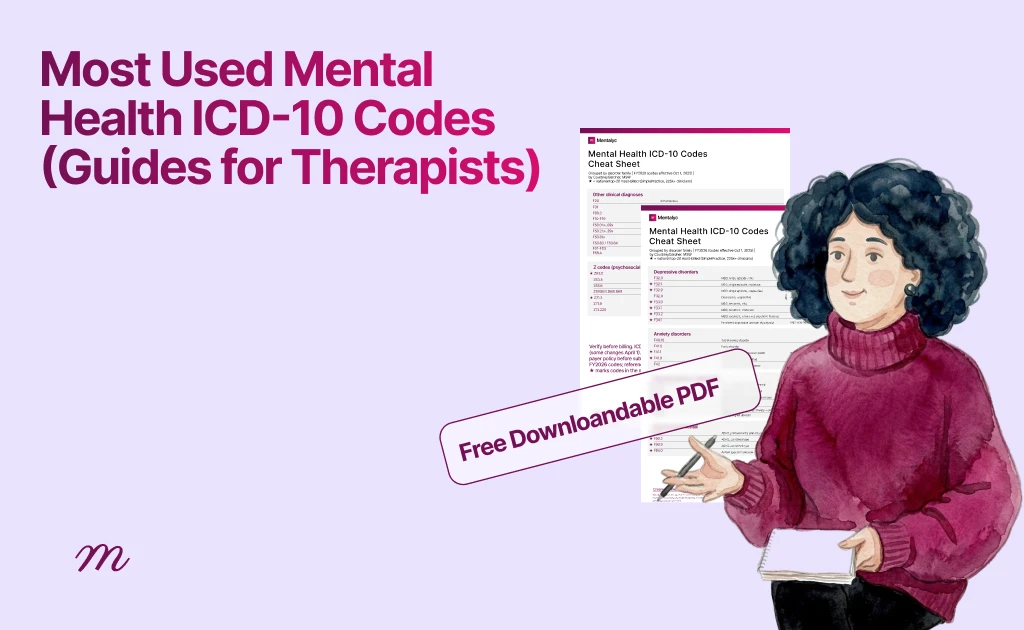
Download the free 1-page ICD-10 cheat sheet (PDF)
Quick reference cheat sheet: common ICD-10 codes by category
This is the printable list. Bookmark this section or print it for everyday reference.
| ICD-10 Code | Condition / Description | Note |
|---|---|---|
| F32.A | Depression, unspecified | Added FY2025 (effective Oct 1, 2024). For depressive symptoms that don’t meet full criteria for MDD. Reduces overuse of F32.9 for “depression NOS.” |
| F32.0 – F33.9 | Major depressive disorder (single / recurrent) | Document episode type, severity, and recurrence. See also the depression coding guide. |
| F32.9 | Major depressive disorder, single episode, unspecified | One of the most-billed codes in U.S. mental health practice. |
| F41.1 | Generalized anxiety disorder (GAD) | Document severity (mild, moderate, severe) where clinically supported. |
| F41.9 | Anxiety disorder, unspecified | Catch-all for anxiety presentations not meeting GAD, panic, or phobia criteria. |
| F40.10 | Social anxiety disorder | |
| F41.0 | Panic disorder | |
| F43.10 / F43.11 / F43.12 | Post-traumatic stress disorder (PTSD), unspecified / acute / chronic | Acute under 3 months; chronic 3 months or more. Document onset and duration. |
| F43.81 | Prolonged grief disorder | Added FY2023 (effective Oct 1, 2022). Use instead of adjustment-disorder or generic stress codes when DSM-5-TR criteria are met. |
| F43.20 – F43.29 | Adjustment disorders | F43.23 (mixed anxiety and depressed mood) is one of the most billed. |
| F50.01x – F50.09x | Anorexia nervosa (subtyped + severity) | Expanded FY2025 (effective Oct 1, 2024). Pick restricting or binge-purge type plus severity. The old single code F50.01 is now a non-billable parent. |
| F50.21x – F50.29x | Bulimia nervosa (severity / remission) | Replaces the retired F50.2. |
| F50.81x | Binge-eating disorder (severity-specific) | Expanded FY2025. |
| F50.83 / F50.84 | Adult pica / adult rumination disorder | Added FY2025. Recognizes adult feeding disorders previously coded under child codes. |
| F10 – F19 series | Substance use, abuse, dependence disorders (alcohol use disorder) | Distinguish abuse vs. dependence, and code remission status carefully. |
| F45.41 / F45.42 | Pain disorder (psychological / mixed factors) | Add a G89 pain code for mixed factors. |
| F01 – F03 series | Dementia / major neurocognitive disorder | Since FY2023, requires a severity specifier (mild, moderate, severe) and any behavioral or psychological symptoms. |
| F68.A | Factitious disorder imposed on another (Munchausen by proxy) | New for FY2026 (effective Oct 1, 2025). Applies to the perpetrator, not the victim. |
| F90.0 / F90.1 / F90.2 / F90.9 | ADHD (inattentive / hyperactive / combined / unspecified) | |
| F84.0 | Autism spectrum disorder | |
| F20 | Schizophrenia | |
| F31 | Bipolar disorder | Document current episode type (manic, depressed, mixed) and severity. |
| F60.3 | Borderline personality disorder | |
| F42 | Obsessive-compulsive disorder | |
| Z63.5 | Family disruption due to separation or divorce | Common psychosocial context Z-code. |
| Z65.8 | Other specified psychosocial circumstances | Document stressors impacting treatment (housing, legal issues). |
| Z59.861 / Z59.868 / Z59.869 | Financial insecurity (difficulty paying for needs / other specified / unspecified) | New for FY2026 (effective Oct 1, 2025). Replaced the older single Z59.86 code, which became a non-billable header. |
| Z71.9 | Counseling, unspecified | For general counseling encounters without a mental-disorder diagnosis. Confirm payer policy. |
| Z13.220 | Encounter for screening for depression | Used for preventive or assessment-only sessions before a diagnosis is established. |
Code-specific guides by diagnosis
When you need the full coding detail for a single diagnosis (every valid sub-code, documentation requirements, and common denial reasons), use the focused guide for that condition:
- Depression: ICD-10 code for depression, major depressive disorder, and recurrent severe depression (F33.2)
- Anxiety: ICD-10 code for anxiety, generalized anxiety disorder, and panic disorder
- Trauma and stress: PTSD ICD-10 coding, adjustment disorder, and adjustment disorder with mixed anxiety and depressed mood (F43.23)
- Other common diagnoses: ADHD, autism spectrum disorder, bipolar disorder, schizophrenia, and alcohol use disorder
- Clinical-status codes: suicidal ideation and altered mental status
Mentalyc reads the diagnosis you settle on in the intake note and pulls the right code from these families automatically, so you spend less time cross-referencing and more time with the client.
Linking ICD-10 codes to CPT codes for billing
Insurance billing requires linking a CPT code (the service you provided) to an ICD-10 code (the diagnosis that justifies medical necessity). Both go on the same claim. Without that pairing, claims get denied.
CPT stands for Current Procedural Terminology: five-digit standardized codes published by the American Medical Association (AMA) that describe the service rendered. ICD-10 codes describe why the service was medically necessary. For the full procedure-side picture, see our guide to psychiatry CPT codes.
Most common CPT codes used by therapists
There are thousands of CPT codes, but only about ten are used regularly in mental health practice:
- 90791 – Psychiatric diagnostic evaluation
- 90792 – Psychiatric diagnostic evaluation with medical services
- 90832 – Psychotherapy, 30 minutes (16–37 minutes)
- 90834 – Psychotherapy, 45 minutes (38–52 minutes)
- 90837 – Psychotherapy, 60 minutes (53+ minutes)
- 90846 – Family/couples psychotherapy, without client present
- 90847 – Family/couples psychotherapy, with client present
- 90853 – Group psychotherapy
- 90839 – Psychotherapy for crisis, first 60 minutes (with 90840 as the add-on for each additional 30 minutes)
Telehealth modifiers
For synchronous audio-video telehealth, append the -95 modifier to the CPT code (for example, 90834-95) and use the appropriate place-of-service code (POS 02 when the client is not at home, POS 10 when the client is at home). For audio-only sessions, modifier -93 applies. Note that Medicare fee-for-service identifies telehealth primarily by the POS code rather than the modifier, so check each payer’s rule. Getting this wrong can result in claim denials or underpayment.
Write less, focus more
- SOAP, DAP, BIRP, EMDR notes and more
- AI Treatment Planner
- AI Progress Tracker
- Alliance signals
- HIPAA & PHIPA compliant

Example claim pairing
| Service provided | CPT code | Diagnosis | ICD-10 code |
|---|---|---|---|
| 45-min individual psychotherapy | 90834 | Moderate MDD | F32.1 |
| 60-min couples therapy | 90847 | Adjustment disorder, mixed | F43.23 |
| Crisis session, 75 min | 90839 + 90840 | Acute PTSD | F43.11 |
From code to care: using the diagnosis to drive treatment and track progress
The ICD-10 code is not just a billing artifact. It is the anchor for the rest of the clinical record, and the same code that justifies the claim should shape the treatment plan and the progress you track against it.
A treatment plan has to map to the diagnosis to survive an insurance audit. The goals, objectives, and interventions all need to tie back to the coded condition and demonstrate medical necessity. Mentalyc’s AI treatment planner that builds insurance-ready plans from the diagnosis starts from the ICD-10 code you confirmed at intake and drafts goals and measurable objectives aligned to that diagnosis and to payer and board requirements. You edit the plan, but the structure and the diagnosis-to-goal link are already in place, which is exactly what auditors look for.
Once treatment is underway, the diagnosis becomes the yardstick for progress. Mentalyc’s AI progress tracker that measures change against the coded diagnosis reads across your session notes, surfaces the symptom themes tied to the original F-code, and shows whether the client is moving toward the plan’s goals over time. That longitudinal view does double duty: it strengthens your clinical reasoning and gives you the documented trajectory payers increasingly ask for at re-authorization. The diagnosis you code carefully at intake, in other words, pays off again at every review.
What changed for FY2026, and recent updates worth knowing
The FY2026 ICD-10-CM code set took effect October 1, 2025, and added new codes relevant to behavioral health, most notably the financial-insecurity Z-codes and factitious disorder imposed on another. ICD-10-CM updates on October 1 each year, with some changes also effective April 1, so a “current” code list is always tied to a fiscal year.
Here is how the recent, frequently-cited changes actually line up by cycle, since dating errors are common in coding guides:
- New for FY2026 (Oct 1, 2025): F68.A (factitious disorder imposed on another) and the expanded financial-insecurity Z-codes Z59.861, Z59.868, and Z59.869, which replaced the older single Z59.86 code.
- From FY2025 (Oct 1, 2024): F32.A (depression, unspecified), plus the expanded eating-disorder severity specifiers for anorexia, bulimia, and binge-eating disorder, and the adult feeding-disorder codes F50.83 (pica) and F50.84 (rumination). Older single codes like F50.01 and F50.2 are no longer billable on their own.
- From FY2023 (Oct 1, 2022): F43.81 (prolonged grief disorder) and the dementia severity overhaul, which requires documenting severity (mild, moderate, severe) and any behavioral or psychological symptoms for F01–F03.
Substance use coding (F10–F19) continues to require careful remission documentation: code the most clinically accurate condition and avoid defaulting to “unspecified.” CMS publishes each year’s update bulletin in summer, so review it before the October effective date and update your EHR templates and reference materials.
ICD-10 to ICD-11: mental health code mapping
The U.S. continues using ICD-10-CM through at least 2027, but ICD-11 has been in effect globally since January 2022. This crosswalk helps therapists in U.S. practices stay aware of the transition. The most significant structural change is that ICD-11 uses an alphanumeric “6A”–”6E” prefix system instead of ICD-10’s “F” codes, and consolidates many personality and substance use categories.
| ICD-10 Code | ICD-10 Condition | ICD-11 Code | ICD-11 Condition |
|---|---|---|---|
| F10.288 | Alcohol dependence with other alcohol-induced disorder | 6C40 | Alcohol use disorder (unspecified) |
| F11.20 | Opioid dependence, uncomplicated | 6C43 | Opioid use disorder (unspecified) |
| F17.210 | Nicotine dependence, cigarettes, uncomplicated | 6C4A | Nicotine use disorder |
| F20.0 | Paranoid schizophrenia | 6A20 | Schizophrenia (unspecified) |
| F23 | Brief psychotic disorder | 6A23 | Acute and transient psychotic disorder |
| F31.31 | Bipolar disorder, current episode depressed, mild | 6A60 | Bipolar and related disorders (specify type) |
| F32.9 | Major depressive disorder, single episode, unspecified | 6A70 | Single episode depressive disorder (specify severity) |
| F33.1 | Major depressive disorder, recurrent, moderate | 6A71 | Recurrent depressive disorder (specify severity) |
| F40.01 | Agoraphobia with panic disorder | 6B02 | Agoraphobia (specify if with panic or other symptoms) |
| F41.1 | Generalized anxiety disorder | 6B00 | Generalized anxiety disorder |
| F42 | Obsessive-compulsive disorder | 6B20 | Obsessive-compulsive disorder |
| F43.10 | Post-traumatic stress disorder, unspecified | 6B40 | Post-traumatic stress disorder |
| F43.21 | Adjustment disorder with depressed mood | 6B43 | Adjustment disorder |
| F45.22 | Body dysmorphic disorder | 6B21 | Body dysmorphic disorder |
| F50.01 | Anorexia nervosa, restricting type | 6B80 | Anorexia nervosa (specify type) |
| F60.3 | Borderline personality disorder | 6D10 | Personality disorder (severity unspecified) |
| F84.0 | Autistic disorder | 6A02 | Autism spectrum disorder |
| F90.2 | ADHD, combined type | 6A05 | ADHD (specify subtype) |
| F95.2 | Tourette’s disorder | 8A05 | Tic disorders (including Tourette’s syndrome) |
| F99 | Mental disorder, not otherwise specified | 6E8Z | Unspecified mental disorder |
Structurally, ICD-11 is built around roughly 17,000 diagnostic categories (with far more codeable terms underneath through combinations) and folds many ICD-10 personality disorders into a single unified diagnosis with severity specifiers.
How to improve your mental health coding skills
The fastest way to improve coding accuracy is to pair ongoing education with a small set of reliable references and an EHR that does the crosswalk for you. Treat coding accuracy as a clinical skill, not just an administrative one.

1. Choose the most specific code. Use the most precise code your documentation supports. Instead of F32 (MDD, single episode), use F32.0 (mild) or F32.1 (moderate) when severity is documented.
2. Cross-reference the Index and Tabular List. The ICD-10-CM Index locates codes by diagnosis or symptom; the Tabular List gives full descriptions and inclusion/exclusion notes. Check both before finalizing.
3. Watch inclusion and exclusion notes. These specify what a code covers and excludes. For example, F41.9 (anxiety, unspecified) excludes anxiety occurring in autism spectrum disorder, where F84.0 applies instead.
4. Use trusted lookup tools. The most reliable are the CMS ICD-10-CM lookup, Find-A-Code, and AAPC Coder (linked in References).
5. Review code changes annually. ICD-10-CM updates October 1. Review the CMS release notes in summer and update your EHR templates before the effective date.
6. Follow proper code sequencing. List the primary diagnosis (the main reason for the visit) first; secondary diagnoses follow in order of clinical significance.
7. Ask when unsure. When a code is ambiguous, check with a colleague, your billing specialist, or the payer before submitting. Verifying takes minutes; correcting denials takes hours.
A good EHR removes most of the manual lookup. Mentalyc’s progress note generator and built-in DSM-5-TR-to-ICD-10 crosswalk keep the right code in front of you as you document.
Tips for memorizing and organizing ICD-10 codes
You don’t memorize the F-code chapter; you master the top 20 and reference the rest. Build a system, not a memory test.
- Top-20 quick-reference sheet. List the 20 codes you use most, with description and any inclusion/exclusion notes. Keep it in your EHR template.
- Mnemonics for weekly codes. For frequent codes, associations help (for example, F32.9 = MDD single episode unspecified, “thirty-two nine, no specifics”).
- Group by clinical similarity. Depression cluster (F32–F33), anxiety cluster (F40–F42), trauma cluster (F43). Groups stick better than isolated facts.
- Weekly chart-review block. Spend 30 minutes weekly reviewing your past week’s coding. You will spot the codes you over-rely on and the ones you should use more.
- Flashcards for new annual codes. When the October update lands, make flashcards for the new codes you will actually see. The FY2026 additions (F68.A and the Z59.86x financial-insecurity codes) are good current examples.
Billing compliance: avoiding upcoding and undercoding
Always code to what the documentation supports, not what reimburses higher (upcoding) or what avoids audits (undercoding). Both are illegal and both create risk.
Upcoding is using a higher-paying code than the documentation justifies. It can trigger payer audits, fraud charges, fines, repayment demands, and in severe cases license loss. It is not always intentional: untrained staff can do it accidentally, but the practice is held responsible either way.
Undercoding is using a lower-paying code than appropriate, often to “save the client money” or avoid scrutiny. It is also illegal, costs you revenue, creates inaccurate records, and can raise audit flags when billing patterns don’t match the services provided.
Mitigate in three steps. First, code to the documentation: if your note doesn’t support the code, change the code, not the note. Second, run periodic self-audits by pulling 10 charts each quarter and comparing diagnoses to documentation. Third, train all clinical and admin staff on annual ICD-10-CM updates and your coding policies. When sharing coded information externally (schools, courts, employers), release only the minimum necessary information, obtain explicit client consent, and keep HIPAA-compliant disclosure logs. For more on documentation that holds up to payers, see writing therapy notes for insurance.
Mentalyc plans and pricing
| Plan | Price | Key Features |
|---|---|---|
| 14-Day Free Trial | \$0 | 14 days of full PRO access, including 15 notes. No credit card required. |
| Mini | USD 14.99 /month | Record in-person sessions, upload audio files, use voice-to-text, or type notes directly. |
| Basic | USD 29.99 /month | Everything in Mini, plus Alliance Genie (limited access) and Smart TP. |
| Pro | USD 59.99 /month | EMDR, Play and Psychiatry modalities, 100+ custom templates (BIRP, PIRP, GIRP, PIE, SIRP), auto-computed CPT codes. |
| Super | USD 99.99 /month | Everything in Pro, plus group therapy notes for each member and priority onboarding and support. |
For current details, visit the Mentalyc pricing page.
Conclusion
Mastering mental health coding is part of becoming a more confident, accurate, and ethical clinician. Staying current with the most common ICD-10 codes and their annual updates ensures proper reimbursement and strengthens the clinical foundation of your care. Each correctly coded diagnosis reflects your commitment to clarity, compliance, and client well-being.
Mentalyc helps therapists bring more precision to documentation. It analyzes session notes to surface symptom patterns, track diagnostic changes over time, and highlight relational dynamics through Alliance Genie insights, helping therapists justify diagnoses clearly and strengthen clinical reasoning.
Frequently asked questions about ICD-10 codes for common mental health conditions
References
1. Centers for Medicare & Medicaid Services. ICD-10. https://www.cms.gov/medicare/coding-billing/icd-10-codes
2. Centers for Disease Control and Prevention, National Center for Health Statistics. ICD-10-CM Files. https://www.cdc.gov/nchs/icd/icd-10-cm/files.html
3. World Health Organization. Classification of Diseases. https://www.who.int/standards/classifications/classification-of-diseases
4. World Health Organization. ICD-11 for Mortality and Morbidity Statistics. https://icd.who.int/browse11
5. World Health Organization. ICD-11 Fact Sheet. https://icd.who.int/en/docs/icd11factsheet_en.pdf
6. American Psychiatric Association. DSM-5-TR. https://www.psychiatry.org/psychiatrists/practice/dsm
7. American Medical Association. CPT (Current Procedural Terminology) Codes. https://www.ama-assn.org/practice-management/cpt
8. ICD10Data.com. F32.A: Depression, unspecified. https://www.icd10data.com/ICD10CM/Codes/F01-F99/F30-F39/F32-/F32.A
9. ICD10Data.com. F43.81: Prolonged grief disorder. https://www.icd10data.com/ICD10CM/Codes/F01-F99/F40-F48/F43-/F43.81
10. ICD10Data.com. F68.A: Factitious disorder imposed on another. https://www.icd10data.com/ICD10CM/Codes/F01-F99/F60-F69/F68-/F68.A
11. American Academy of Professional Coders (AAPC). ICD-10-CM Codes F01-F99. https://www.aapc.com/codes/icd-10-codes-range/F01-F99/
12. Hirsch, J. A., et al. (2016). ICD-10: History and context. https://www.ncbi.nlm.nih.gov/pmc/articles/PMC7960170/
Why other mental health professionals love Mentalyc

“Having Mentalyc take away some of the work from me has allowed me to be more present when I’m in session with clients … it took a lot of pressure off.”
LPC

“A lot of my clients love the functionality where I can send them a summary of what we addressed during the session, and they find it very helpful and enlightening.”
Therapist

“It’s so quick and easy to do notes now … I used to stay late two hours to finish my notes. Now it’s a breeze.”
Licensed Professional Counselor

“By the end of the day, usually by the end of the session, I have my documentation done. I have a thorough, comprehensive note … It’s just saving me hours every week.”
CDCII