

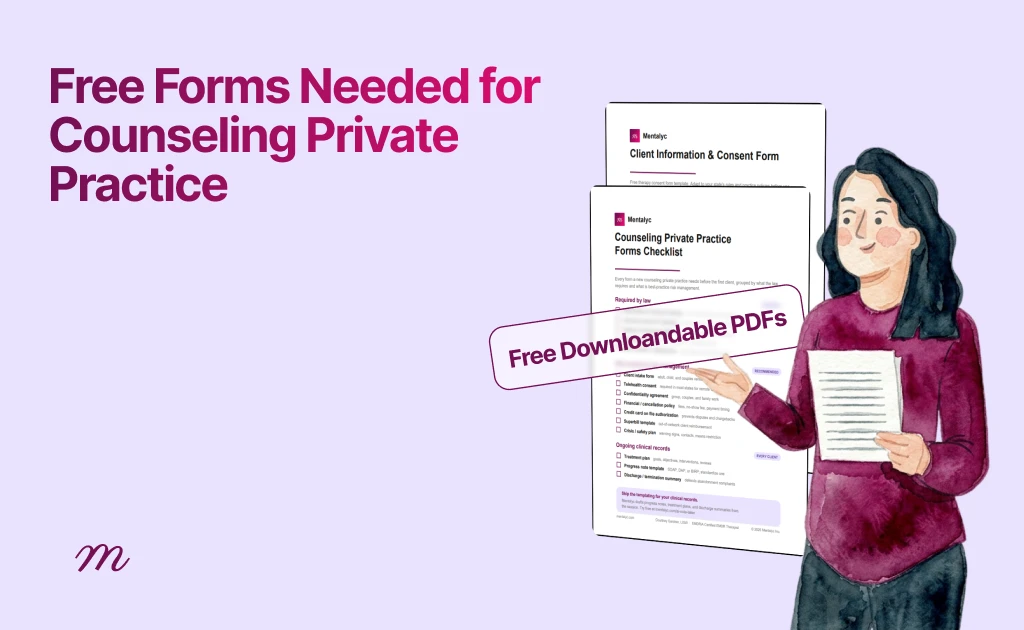
Starting a counseling private practice means assembling a stack of forms before your first client sits down: consent, privacy, intake, and billing documents that keep you compliant and protected. This 2026 guide gives you a checklist of every form you need, plus ready-to-use templates you can copy, adapt to your state’s rules, and put to work the same day. It reflects current federal requirements, including HIPAA and the No Surprises Act.
When I opened Thrive Mind Therapies, my private practice in Cincinnati, the paperwork was the part I underestimated most. Building consent, HIPAA, and intake forms that actually held up took longer than finding my first clients, and the forms I rushed were the ones I had to redo. The checklist below is the version I wish I had started with.
Many clinicians also set up documentation systems early, such as an AI note taker that drafts progress notes from session audio, so notes stay accurate and compliant as the caseload grows. As your intake paperwork starts generating real clinical goals, the AI Treatment Planner that turns intake information into structured, measurable objectives keeps the planning side moving without extra admin time.
The forms every counseling private practice needs
A counseling private practice needs forms in five categories: privacy and consent, client intake, clinical documentation, business and billing, and minor-specific paperwork. Some of these forms are required by federal or state law; others are best practice that protects you in an audit or board complaint. The core set most solo practices open with is:
Spend less time writing, more time with clients.

- HIPAA Notice of Privacy Practices: explains how you store, use, and disclose protected health information. Required by federal law if you bill insurance electronically. Every client signs an acknowledgment.
- Informed consent for treatment: covers your policies, fees, risks, and the limits of confidentiality. Required by state licensing law and every major ethics code (ACA, APA, NASW).
- Intake form: collects contact, health history, insurance, and presenting concerns. Adult, child, and couples versions. Best practice.
- Telehealth consent: required before any remote session in most states.
- Release of information (ROI): required before most disclosures that are not for treatment, payment, or operations.
- Confidentiality agreement: essential for group, couples, and family work. Best practice.
- Financial agreement and cancellation policy: fees, payment timing, and your no-show fee. Best practice and dispute protection.
- Good Faith Estimate: required by the federal No Surprises Act for every uninsured or self-pay client.
- Treatment plan, progress note, and discharge summary templates: your clinical record. Required for insurance, best practice for cash-pay.
- Minor consent and release forms: signed by a parent or legal guardian, with custody documentation, when you see clients under 18.
Laws vary by state, and many practices add policies specific to their setting. Research your local laws and state licensing board requirements before finalizing any form, and confirm anything labeled “required” against your own board and an attorney. The templates below are starting points you adapt to your jurisdiction and your practice.
Forms at a glance
| Form | Purpose | Required or best practice | When it’s used |
|---|---|---|---|
| HIPAA Notice of Privacy Practices | Discloses PHI handling | Required (federal) if you bill electronically | At intake, before treatment |
| Informed consent | Policies, fees, confidentiality limits | Required (state law + ethics codes) | Before first session |
| Intake form | Collects history and presenting concerns | Best practice | At or before intake |
| Telehealth consent | Consent for remote care | Required in most states for remote care | Before first remote session |
| Release of information | Authorizes disclosures outside treatment | Required before most non-TPO disclosures | When info is shared with a third party |
| Confidentiality agreement | Group/couples privacy commitment | Best practice | Before group/couples work |
| Financial agreement | Fees, payment, cancellation policy | Best practice | At intake |
| Good Faith Estimate | Expected charges for self-pay clients | Required (federal No Surprises Act) | At intake for uninsured/self-pay |
| Treatment plan | Goals, objectives, interventions | Required for insurance billing | After intake assessment |
| Discharge summary | Closes the clinical record | Best practice; defends abandonment claims | At end of treatment |
| Minor consent and custody docs | Authorizes treatment of a minor | Required (state-dependent) | At intake for clients under 18 |
Download the free Counseling Private Practice Forms Checklist (PDF)
As you begin seeing clients, tracking outcomes alongside documentation strengthens your workflow. The AI Progress Tracker by Mentalyc helps you visualize symptom changes and goal attainment over time, keeping your paperwork and clinical care aligned.
Protecting privacy with consent, HIPAA, and confidentiality forms
Before your first client walks through the door, you need consent, privacy, and confidentiality forms in place. These forms establish the legal and ethical boundaries of the therapeutic relationship and show that you operate to industry standards.
Compliance and risk management forms
Thorough compliance forms reduce liability. Include HIPAA privacy notices, social media policies, and email consent forms. Conduct risk assessments for self-harm and suicide. Have clients sign agreements acknowledging policies, risks, and their role in treatment.
HIPAA compliance form
A HIPAA form explains how you keep client health information confidential and what rights clients have over their records. The Health Insurance Portability and Accountability Act (HIPAA) sets the privacy rules healthcare providers follow. Your form may also cover:
- How records are stored (for example, encrypted digital files or a locked cabinet)
- Who has access to records (only you and designated staff)
- Clients’ rights to access and amend their records
- How records are disposed of when no longer needed (for example, shredding)
Clients sign to acknowledge they understand your HIPAA policies. The same rules apply to any software you use to write or store notes. Mentalyc is HIPAA-compliant and signs Business Associate Agreements, so client information in your notes is covered under the same standards as your paper files. Read more on the Mentalyc security page.
HIPAA privacy notice template
Dear [Client Name],
This notice describes our privacy policy and how we handle your protected health information. By signing this form, you consent to our privacy policies and procedures.
Use and Disclosure of Health Information
We use and disclose your health information for treatment, payment, and healthcare operations. For example, we may use or disclose your information:
- For treatment purposes, such as sending medical information to other health care providers or specialists involved in your care.
- For payment, such as submitting claims to your insurance company.
- For health care operations, including internal administration and quality assurance.
Client Rights
You have the right to:
- Request restrictions on how your information is used. However, we are not required to agree to all restrictions.
- Request that we communicate with you in a certain way.
- Inspect and copy your medical and billing records.
- Request amendments to your health information.
- Obtain an accounting of disclosures of your health information.
- Revoke your consent for the use and disclosure of your information.
Practice Duty
We are required by law to maintain your information’s privacy and provide you with this notice. We may update our privacy policies and will post changes on our website.
If you have questions or complaints, please contact [name and contact details]. You may also file a complaint with the U.S. Department of Health and Human Services.
I have read, understand, and agree with the following.
Client Signature:________ Date:___
Parent/Guardian Signature (if the client is a minor):_______
Date:_____
Social media policy template
All clients and practitioners are asked to avoid connecting via social media platforms. Practitioners should refrain from connecting with current or former clients on any social media network due to the risks of compromising confidentiality and the client-therapist relationship.
I have read, understand, and agree with the following.
Client Signature:________ Date:___
Parent/Guardian Signature (if the client is a minor):_______
Date:_____
Email consent form template
I authorize [practice name] to email me regarding administrative and clinical matters. I understand that email is not a completely secure or confidential means of communication.
I have read, understand, and agree with the following.
Client Signature:________ Date:___
Parent/Guardian Signature (if the client is a minor):_______
Date:_____
Telehealth consent form template
I consent to engage in Telehealth services with [practice name]. I understand I have the rights, responsibilities, and options related to Telehealth outlined in the practice’s Telehealth policy. I understand Telehealth’s risks and benefits and have discussed them with my practitioner.
I have read, understand, and agree with the following.
Client Signature:________ Date:___
Parent/Guardian Signature (if the client is a minor):_______
Date:_____
Release of information form
A release of information (ROI) authorizes you to share a client’s records with someone outside the treatment relationship, such as a physician, attorney, school, or family member. HIPAA requires a signed ROI before most disclosures that are not for treatment, payment, or operations. If your practice treats substance use disorders and meets the definition of a Part 2 program, 42 CFR Part 2 adds stricter consent rules on top of HIPAA. Most generic checklists skip that detail. A complete ROI names who is releasing, who is receiving, what information, for what purpose, and an expiration date.
Release of information template
I, [client name], authorize [practice name] to release the following information to [name of person or organization]:
Information to be released: [records, treatment summary, dates of service]
Purpose of release:
This authorization expires on: [date or event]
I understand I may revoke this authorization in writing at any time, except where action has already been taken.
Client Signature:________ Date:___
Parent/Guardian Signature (if the client is a minor):_______
Date:_____
Confidentiality agreement
A confidentiality agreement is vital for group therapy and when working with couples and families. It ensures everyone agrees to keep what is discussed private. The agreement should prohibit sharing details about other group members or disclosing private conversations outside therapy. Have all participants sign before starting group sessions.
Write less, focus more
- SOAP, DAP, BIRP, EMDR notes and more
- AI Treatment Planner
- AI Progress Tracker
- Alliance signals
- HIPAA & PHIPA compliant

Confidentiality agreement template
This agreement outlines our expectations regarding confidentiality and privacy in our group therapy setting. All members of the group agree to the following:
- Group members must keep everything shared within the group confidential. This includes details that could identify other members.
- Group members will use first names only during sessions and avoid sharing last names.
- Members will respect the privacy of other members and will not attempt to contact or communicate with them outside of group sessions.
- Members will not share the identities of other group members with anyone outside of the group, including family and friends.
- Members understand that confidentiality outside the group cannot be guaranteed, but all members agree to maintain confidentiality to the best of their abilities.
- Members understand that the group facilitator(s) may disclose information to protect group members or others from harm but will otherwise maintain confidentiality.
All group members must sign below to indicate their agreement to maintain confidentiality within the group as outlined above. Signing indicates each member’s commitment to respecting the privacy of other members.
Client Signature:________ Date:___
Parent/Guardian Signature (if the client is a minor):_______
Date:_____
Client information and consent forms
Client intake starts with forms. Before your first session you want adult, child, and couples templates ready, plus a consent form that establishes client consent for treatment, collects critical information, and meets requirements like HIPAA. Include sections for contact details, health history, insurance details, and a signed consent for treatment. For the full set of questions to ask at intake, see our guide to the mental health intake assessment.
Client consent form
Counseling consent forms inform clients of their rights, your policies, and the limits of confidentiality. A good therapy consent form template also covers:
- Fees, payment, and cancellation policies
- Your credentials, licensing, and areas of expertise
- Potential risks and benefits of therapy
- Limits to confidentiality (for example, harm to self or others, court orders)
- The client’s right to end therapy at any time
Have clients review and sign the form before starting therapy, and keep signed copies in your records. You can also start from a ready-made client consent template.
General client information and consent form template
Download the fillable Client Consent and Intake Form template (PDF)
Client Name:
Date of Birth:
Phone Number:
Address:
Email:
Emergency Contact Name:
Phone Number:
Insurance Information (if applicable)
Insurance Company:
Policy Number:
Group Number:
Medical History and Information:
Current Medications:
Allergies:
Medical Conditions:
History of Hospitalizations:
Have you ever received mental health treatment from a professional such as a psychiatrist, psychologist, or counselor?:
Have you ever made a suicide attempt or thought about it?:
Consent for Treatment
I, [client’s name], consent to outpatient mental health services from [practice name]. I understand that I have the right to refuse treatment at any time and for any reason. I authorize the release of any relevant medical or mental health information necessary to process insurance claims. I authorize payment of benefits to [practice name].
Client Signature:________ Date:___
Parent/Guardian Signature (if the client is a minor):_______
Date:_____
Thank you for taking the time to complete this form. I look forward to supporting you in a safe and confidential environment. Please let me know if you have any other questions.
Adult intake form
For adult clients, a biopsychosocial intake form covers the basics: contact information, family history, medical history, education, relationships, substance use, mental health treatment, and current issues. Ask open-ended questions to understand the context of their life and what brings them to therapy, and leave space for anything else they feel is essential.
Child intake form
With children and teens, gather input from both the child and their guardian. Ask about milestones, behaviors, relationships at home and school, interests, strengths, and difficulties. Include questions specific to the child’s age and development, and note any family history of mental health issues.
Couples intake form
For couples, ask about relationship history, communication patterns, intimacy, values, shared interests, division of household responsibilities, parenting, finances, and current challenges. Ask each partner about their own health and wellness too. Look for similarities, differences, and where compromise may be needed.
Screening and assessment forms
Keep validated screening measures in your intake packet so you have a baseline from session one. The PHQ-9 for depression and the GAD-7 for anxiety are the workhorses, and both are distributed for clinical use at no cost. One trap worth naming: not every well-known scale is free. Several instruments, including the Beck inventories, are copyrighted and require paid per-use licenses, so reproducing them in your packet without a license is a copyright problem rather than a paperwork shortcut. Confirm current licensing terms at the official source before embedding any items.
Crisis and safety plan
A structured safety plan belongs in every practice, not only high-acuity settings. It lists the client’s warning signs, internal coping strategies, supportive contacts, reasons for living, and means-restriction steps. Completing one with a client at risk, and documenting it, is both clinical care and risk management. Keep a blank template ready so you are never building one from memory in a crisis.
Treatment planning, progress notes, and discharge summaries
After an intake assessment, the next step is a personalized treatment plan. Keep pre-designed templates for treatment plans, progress notes, and discharge summaries. A well-built plan outlines therapy goals, the specific interventions you plan to use, and expected outcomes. Review the plan with the client before starting treatment, keep it updated as care progresses, and share progress along the way.

These three documents are the ones you fill out for every client, every session, for as long as they stay in care, which is where the real time cost of documentation lives. A template gets you started, but it still leaves you writing each note by hand. This is the point where many solo therapists move from blank templates to generating the plan, progress notes, and discharge summary from the session itself. The paperwork then keeps pace with the caseload instead of piling up after hours.
Treatment plan template
- Client name and identifier
- Diagnosis
- Problem list
-
Goals:
- Specific, measurable goals the client wants to achieve
-
Objectives:
- Concrete steps to meet each goal
-
Interventions:
- Therapies and techniques you’ll use
- Responsible party:
- Target date for re-evaluation:
Progress notes
Record each client’s progress, challenges, breakthroughs, and next steps after every session. Your progress notes should capture the topics discussed, specific issues the client raised, and your interventions or responses. Document the client’s chief complaint and stated goals at the start of treatment, any referrals to other providers or community resources, and significant life events affecting treatment. Strong progress notes turn a series of sessions into a coherent story of the client’s journey and clearly show the treatment received, the response to therapy, and the outcomes achieved.
Progress note template
- Client name and identifier:
- Date and time of session:
-
Was homework assigned last session?
- Was homework completed?
-
Mental status exam:
- Cover the client’s appearance, behavior, mood and affect, thought processes, thought content, perception, insight, and judgment
-
Subjective:
- Client’s report of symptoms, feelings, progress, or lack of progress toward goals
-
Objective:
- Observable facts about the client’s behavior, mood, engagement, reactions, and any changes in symptoms, functioning, or behavior
-
Assessment:
- Your analysis of the client’s condition and progress
-
Plan:
- Next steps and any changes to the treatment plan
Mentalyc generates progress note drafts from your session audio in SOAP, DAP, BIRP, and other formats; you review, edit, and sign each one, so you stay the clinician of record.
Discharge summaries
When a client’s treatment is complete, a discharge summary formally ends the therapeutic relationship. It reviews the initial reasons for seeking counseling, the goals and outcomes achieved, the tools and techniques used, the client’s mental status at discharge, recommendations for continued care, and any referrals. A discharge summary brings closure for the client, leaves a final clinical note in the record, and is helpful if the client returns to therapy later.
Discharge summary template
- Client name and identifier:
- Reason for discharge:
- Summary of client’s presenting issues:
- Diagnosis and treatment received:
- Client’s progress and response to treatment:
- Discharge recommendations and referrals, if needed:
- Client’s condition at discharge and prognosis:
Clinician Signature:________ Date:___
Business and financial forms
The business side of private practice needs its own paperwork. Keep fee schedules and templates for client estimates of benefits, payment agreements, invoices, and past-due notices. Send welcome letters that introduce your practice, fees, and policies.
Good Faith Estimate
Under the federal No Surprises Act, you must give every uninsured and self-pay client a Good Faith Estimate of expected charges. This is a federal requirement, not a courtesy, and it applies even to a cash-only solo practice. Keep a template estimate on hand so producing one for a new client takes minutes. A Good Faith Estimate lists your name and credentials, the service and diagnosis codes expected, the per-session fee, and an estimate of total cost for the expected course of care.
Credit card on file authorization
A signed credit-card-on-file authorization specifies when you will charge the card, such as for the session balance or a no-show fee. Putting the terms in writing before the first session prevents disputes and chargebacks later.
Superbill template
Out-of-network clients often submit their own insurance claims. A superbill gives them what the payer needs: your NPI, license number, the diagnosis code, the CPT code, the date of service, and the fee paid. Build the template once and reimbursement questions drop sharply.
Estimate of benefits template
[Client name], based on the insurance plan information you provided, we estimate that your insurance company will cover $[estimated amount] of the $[total fee] fee for your initial assessment.
You will be responsible for the remaining $[remaining amount] not covered by insurance.
This is only an estimate, and the actual amount covered and your portion may differ. We will bill your insurance company on your behalf and let you know the final amount due after we receive an explanation of benefits from your insurance.
Payment agreement template
I, [client name], agree to pay $[amount] per session for counseling services provided by [practice name].
I understand that this is my responsibility regardless of any insurance coverage I may have.
I agree to pay in full at the time of service unless other arrangements have been made in advance.
Client Signature:________ Date:___
Parent/Guardian Signature (if the client is a minor):_______
Date:_____
Invoice template
Client name and address:
Date:
Session date:
Session fee: $[session fee]
Total due: $[total due]
Past-due notice template
Dear [Client Name],
This letter informs you that your account is now [X] days past due. According to our records, your previous session was on [date of last session], and a balance of $[amount] remains unpaid.
We value our relationship with you, and your mental health and well-being are paramount to us. We also require timely payments to continue providing you with the highest quality care.
Please contact our office at [phone number] within the next week to discuss payment options. We would be glad to set up a payment plan that works for your situation. If we do not hear from you by [date one week from now], we will need to discuss alternative treatment options that better fit your financial situation.
We hope this is an oversight and look forward to continuing to support you in reaching your treatment goals. Please contact me with any questions.
Warm regards,
[Your name] [Credentials] [Practice name]
Welcome letter template
Dear [client name],
Welcome to [practice name]. I look forward to working with you and providing the counseling and support you need.
My fees are $[amount] per session. Please arrive 10 minutes early for your first appointment to complete new client paperwork.
My practice policies on cancellations, missed appointments, and payment are outlined in the client handbook I will provide at our first session. Please let me know if you have any questions.
We look forward to meeting you.
Warm regards,
[Clinician’s name]
Best practices for billing, insurance, and collections
Billing clients
When billing clients, especially during the first sessions, be transparent about your rates and the insurance you accept. Before the first session, estimate the benefits a client is entitled to so they know what is covered and what they will pay out of pocket. Send invoices promptly, stay open to reasonable payment plans, and consider offering a discount for prepaying a block of sessions.
Insurance
To bill insurance, you need the proper credentials and contracts with insurance companies. You can become an in-network provider by completing the required paperwork, which lets you bill insurers directly. As an out-of-network provider you bill at a lower rate, and clients pay the difference. Confirm each client’s insurance eligibility and coverage before the first visit, and keep your documentation aligned with what payers expect by writing therapy notes for insurance.
Collections
Have a collections policy in place for clients who fall behind or stop paying. Issue late-payment reminders and a final notice before discontinuing services. For past-due invoices, send a collection letter requesting payment within 7 to 14 days. Stay professional but firm, restate your policy, and express your wish to keep working with the client once the balance is resolved.
How often should you update your practice forms?
Review and update your forms at least once a year, and any time legal or regulatory requirements change. Annual review keeps disclosures current, confirms each form still collects what you need, and protects you in an audit or board complaint. Have existing clients re-sign consent and privacy forms when key details change.
Frequently asked questions
Conclusion
Opening a counseling private practice gets far less daunting once the paperwork is built and waiting. Having the right forms before your first client shows professionalism, keeps you compliant, and lets you focus on the work that matters. With solid intake and consent forms, you gather real insight from the start, build the therapeutic alliance faster, and design a treatment plan tailored to each client. From there, automating notes, treatment plans, and progress tracking with Mentalyc gives you back the hours that documentation usually takes.
References
1. HIPAA for Professionals: Privacy. U.S. Department of Health and Human Services. https://www.hhs.gov/hipaa/for-professionals/privacy/index.html
2. No Surprises Act: Good Faith Estimates for Uninsured or Self-Pay Individuals. Centers for Medicare & Medicaid Services. https://www.cms.gov/nosurprises
3. 42 CFR Part 2: Confidentiality of Substance Use Disorder Patient Records. Electronic Code of Federal Regulations (eCFR). https://www.ecfr.gov/current/title-42/chapter-I/subchapter-A/part-2
4. Informed Consent. American Psychological Association, Office of Legal and Regulatory Affairs. https://www.apaservices.org/practice/business/management/informed-consent
5. Private Practice Playbook: Sample Forms. American Medical Association. https://www.ama-assn.org/practice-management/ama-steps-forward/private-practice-playbook-sample-forms
6. Castro-Casbon, J. (2019). Private Practice Clinic Forms: 10 Must-Have Forms to Reduce Your Risk. The Independent Clinician. https://independentclinician.com/private-practice-clinic-forms-10-must-have-forms-to-reduce-your-risk/
Disclaimer: All examples of mental health documentation are fictional and for informational purposes only. Laws and requirements vary by state; confirm your final forms with your licensing board.
Why other mental health professionals love Mentalyc

“Having Mentalyc take away some of the work from me has allowed me to be more present when I’m in session with clients … it took a lot of pressure off.”
LPC

“By the end of the day, usually by the end of the session, I have my documentation done. I have a thorough, comprehensive note … It’s just saving me hours every week.”
CDCII

“It takes me less than 5 minutes to complete notes … it’s a huge time saver, a huge stress reliever.”
Licensed Marriage and Family Therapist

“It’s so quick and easy to do notes now … I used to stay late two hours to finish my notes. Now it’s a breeze.”
Licensed Professional Counselor