


Wiley Treatment Planners are the “PracticePlanners” series of books and EHR add-ons by John Wiley & Sons, authored by Arthur E. Jongsma Jr., that give therapists thousands of pre-written, diagnosis-based treatment goals, objectives, and interventions. They save time and satisfy insurers, but they are static templates that need manual editing and don’t evolve with treatment. The best modern alternative is Mentalyc’s AI Treatment Planner, which generates insurance-ready, SMART-goal plans from your actual session notes, tracks progress automatically, and works with any EHR.
This article explains what the Wiley Treatment Planners are, their benefits, how to use them, where to find them, which EHRs integrate with them, and how Wiley compares to AI-driven alternatives like Mentalyc. Once available only in book format, the planners are now offered as online tools inside several EHR platforms, and they remain one of the most widely used treatment planning resources in mental health.
What are the Wiley Treatment Planners?
The Wiley Treatment Planners (“PracticePlanners”) are a series of books published by John Wiley & Sons, Inc., developed by series editor Arthur E. Jongsma Jr. to help mental health professionals build treatment plans that satisfy third-party payers and state and federal agencies. Because Jongsma founded and edits the series, clinicians often search for “Jongsma treatment planner” and “the Complete Adult Psychotherapy Treatment Planner” interchangeably with “Wiley.” The flagship title, now in its 6th edition, contains over 3,000 prewritten components covering 45 presenting problems.
The series includes thousands of evidence-based, customizable, prewritten treatment goals, objectives, and interventions targeting specific populations and areas of practice. Mental health professionals use them to streamline the process of creating client treatment plans.
Automated treatment plans that reflect your approach

A wide range of psychological issues are covered, such as depression, ADHD, anxiety disorders, substance abuse, and personality disorders. Each planner is organized so users can locate treatment plan components by behavioral problem or diagnosis. Clinicians choose the objectives, goals, interventions, and behaviors associated with a diagnosis, and the plan is built from those selections, all of which can be edited to suit a client’s needs.
The PracticePlanners series includes treatment plans, progress notes, and homework assignment planners. Beyond treatment planning, these tools help therapists with documenting sessions and assigning therapeutic homework. Rather than writing a plan entirely from scratch, PracticePlanners offers customizable templates that simplify the work.
Benefits of using the Wiley Treatment Planners
The main benefit is speed: prewritten, insurer-ready content that saves hours of drafting. The full set of benefits clinicians cite:
Saving time. Prewritten options let therapists focus on direct client interactions instead of researching interventions and drafting plans.
Detailed record keeping. Each plan can be documented and tracked, supporting the clinical reasons for chosen treatments, which matters for regulatory and insurance requirements.
Ease of documentation. Templates keep records organized and streamlined.
Protecting therapists and clients. Proper documentation can help in legal or ethical proceedings by creating a cohesive record of diagnoses, the therapeutic process, and interventions used.
Meeting agency and insurer expectations. Many insurers and some agencies require treatment plans. Wiley uses specific DSM-5-TR diagnostic codes and documentation conventions to satisfy them.
Providing evidence-based care. The recommended interventions are research-backed and appropriate for clients’ diagnoses and goals.
More effective communication. Clear goals and interventions improve communication with clients, who are more likely to engage in treatments they understand, leading to improved therapeutic outcomes.
Customizable and individualized. Therapists can select interventions aligned with orientations such as cognitive-behavioral therapy (CBT) or acceptance and commitment therapy (ACT).
Error-proof documentation. Accuracy is essential in mental health documentation, whether for reimbursement or audits.
Training tool. The planners help train new therapists while standardizing documentation.
Wiley Treatment Planners list for therapists
The most widely used titles cover adults, children, adolescents, couples, families, addictions, and high-acuity populations. The core list:
1. The Complete Adult Psychotherapy Treatment Planner. Guidelines and pre-written objectives for a wide range of adult mental health issues. This is the flagship title, frequently searched on its own.
2. Child Psychotherapy Treatment Planner. Plans for children, covering issues such as attachment disorder, academic problems, and social anxiety.
3. Adolescent Psychotherapy Treatment Planner. Ready-to-use plans for peer conflict, substance abuse, and other adolescent issues.
4. Addiction Treatment Planner. Planning for clients dealing with substance abuse and addiction.
5. Couples Psychotherapy Treatment Planner. Plans for communication difficulties, infidelity, and financial conflicts.
6. Family Therapy Treatment Planner. Pre-written plans for blended-family problems, intergenerational conflicts, and parenting challenges.
7. Severe & Persistent Mental Illness Treatment Planner. Interventions for schizophrenia, personality disorders, bipolar disorder, and more.
8. Suicide & Homicide Risk Assessment & Prevention Treatment Planner. Risk assessment and preventive planning for high-risk patients.
9. Co-Occurring Disorders Treatment Planner. Designed for clients with dual diagnoses.
10. Crisis Intervention Treatment Planner. Plans for acute crisis situations such as suicidal ideation or acute trauma response.
Where can therapists find the Wiley Treatment Planners?
They can be purchased online at Amazon or the official Wiley website. They are also available in many libraries, especially those connected to academic institutions with psychology or counseling programs.
EHRs that integrate with Wiley Treatment Planners
Several EHRs let you use Wiley content directly inside your practice management system, including TheraNest, Valant, and My Clients Plus. These integrations surface pre-written objectives and interventions where you document, so you don’t have to work from the book separately. See our guide to the best Electronic Health Records for private practice for more.
TheraNest. Practice management and therapy notes software that integrates with Wiley, letting therapists add goals, objectives, and interventions to clients’ plans.
Valant. Built for mental health providers and integrates with Wiley to help develop detailed, personalized plans.
My Clients Plus. Known for affordability and ease of use; integrates with Wiley for plans and progress notes.
Because software capabilities change often, confirm Wiley availability directly with the EHR provider.
How to use the Wiley Treatment Planner
You build a plan in four steps, starting from the diagnosis and editing the pre-written content to fit the client. Whether you work from the book or an EHR integration, the pattern is the same:
1. Start from the presenting problem or diagnosis. The planners are organized this way, so you locate the relevant section first.
2. Select behavioral definitions, goals, objectives, and interventions from the pre-written options for that diagnosis.
3. Choose Wiley as the treatment plan template in an EHR, or copy the components from the book.
4. Edit and customize every entry (presenting problem, behavioral definition, goal, objective, intervention) to fit the individual client.
This is what makes Wiley fast for getting a compliant plan on paper. It’s also where its main limitation shows: the plan is only as current as the last time you manually edited it.
Why therapists are looking for alternatives to Wiley Treatment Planner
Clinical practice has changed, and template-based planning is showing its age. Therapists now manage heavier caseloads, tighter insurance requirements, and fully digital workflows, which is driving demand for a Wiley treatment planner alternative built for modern care. Five pressures stand out:
1. Need for personalization. Wiley plans are diagnosis-based, but real therapy is client-specific. Therapists want software that reflects session content, modality, and client language without rewriting generic goals.
2. Too much manual editing. Even with EHR add-ons, Wiley plans often require heavy copy-paste. Clinicians want automated tools that reduce editing while preserving clinical control, especially in busy private and group practices.
3. Lack of progress continuity. Traditional planners don’t evolve with treatment. Goals get written once and rarely updated, making ongoing change hard to demonstrate. Clinicians want a planner that maintains continuity across sessions and links progress notes to goals.
4. Increased insurance scrutiny. Audits and payer reviews are more common. Therapists need insurance-ready plans that show medical necessity, measurable goals, and logical progression of care, without extra time spent “writing for insurance.”
5. Limited cross-EHR flexibility. Many practices use multiple systems or switch EHRs, but Wiley-based tools are often tied to specific platforms. This drives demand for a planner that works with any EHR across SOAP and DAP documentation.
What a modern treatment planner needs to do today
A modern planner has to generate plans from session content, keep them current automatically, stay insurance-ready, track progress, and work across any EHR. The table breaks down why each matters:
| Modern requirement | Why it matters for therapists |
|---|---|
| Session-based personalization | A modern AI treatment plan generator should create goals, objectives, and interventions directly from real session notes, so plans reflect actual client work rather than generic templates. |
| Automatic plan updates | Plans must evolve as therapy progresses. Automated planning keeps goals current without rebuilding plans after every review period. |
| Insurance-ready language | The tool must produce insurance-ready plans with measurable goals and medical-necessity language that holds up during audits and payer reviews. |
| Built-in progress tracking | Effective software links goals to session data, making progress visible over time without extra forms. |
| Interoperability with any EHR | The best EHR treatment planning tool supports SOAP and DAP note integration and works across EHRs, eliminating copy-paste and duplicate documentation. |
Wiley Treatment Planner alternatives
The strongest alternative for most practices is Mentalyc’s AI Treatment Planner; clinicians who specifically want another pre-written template library sometimes consider TheraScribe, Treatment Planner Pro, or the Psychotherapy.net Planner.
Automate Treatment planning with Mentalyc’s AI Treatment Planner
- SMART Goals
- Insurance-ready formatting
- Track goals & outcomes
- HIPAA & PHIPA compliant

Mentalyc AI Treatment Planner, the best modern alternative to Wiley
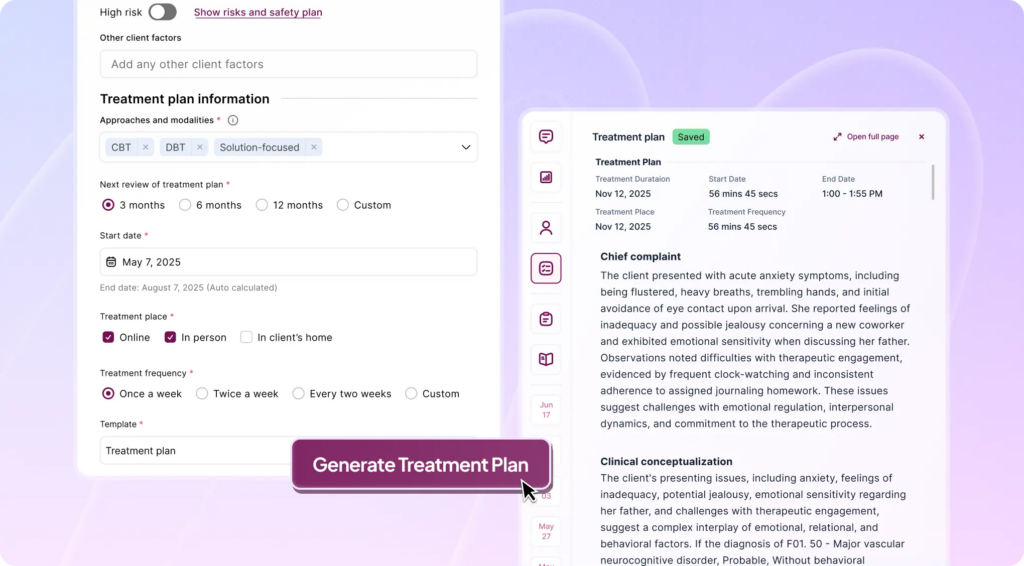
Mentalyc is built for how treatment planning actually works today: dynamic, session-driven, and structured for insurer review. Unlike Wiley’s static templates, Mentalyc’s AI Treatment Planner turns real session notes into clear, goal-focused, insurance-ready plans in minutes.
Automated treatment plans that reflect your approach
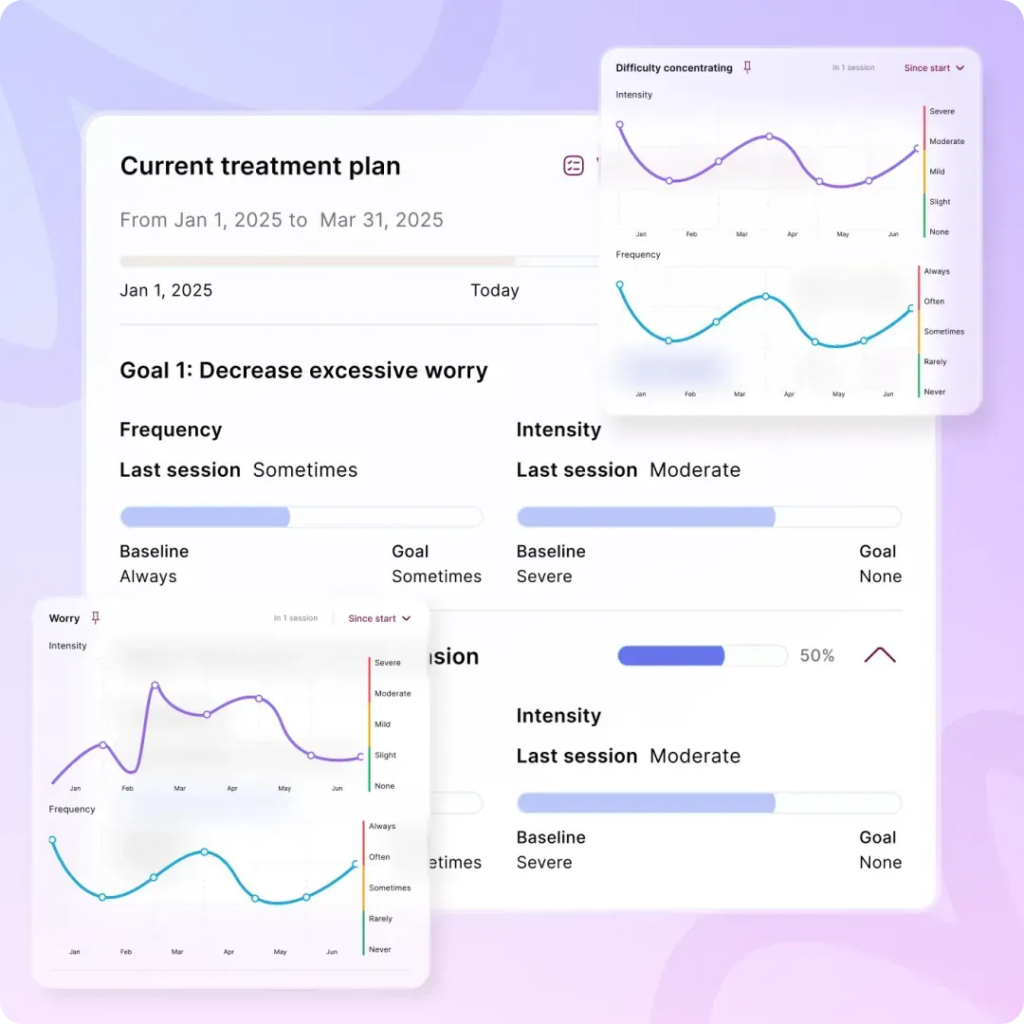
Goal-oriented plans from session notes. Mentalyc generates plans directly from your saved intake or progress notes. Whether you record, dictate, or type a summary, it analyzes session content to create a plan grounded in the client’s symptoms, diagnosis, and clinical context, not a pre-filled content library.
SMART goals with built-in progress tracking. Mentalyc suggests SMART, measurable goals, automatically tracks progress toward them, and updates plans as new sessions are added. By aligning goals and objectives with documented diagnoses, it works as a practical plan generator grounded in real session data, with built-in progress tracking.
Diagnosis-aligned and clinically coherent. Plans align with documented diagnoses and symptoms, preserving the clinical Golden Thread across notes, plans, and progress documentation, which supports medical necessity.
Fully editable, clinician-controlled. Goals, objectives, interventions, and plan structure are fully editable, so therapists customize language, adapt to their modality, and ensure the plan reflects their judgment.
Insurance-ready by design. Plans are structured for payer review with measurable goals, diagnosis-to-goal alignment, and an evidence-based approach, reducing audit stress without over-documentation.
Secure, ethical, and compliant. Mentalyc is fully HIPAA, PHIPA, PIPEDA, and SOC 2 Type II compliant. Transcripts are anonymized, session recordings are automatically deleted within 3 days, client data is never used to train AI models, and a Business Associate Agreement (BAA) is included with every account.
Traditional digital alternatives
For clinicians who want another pre-written template library rather than an AI tool, three options come up most often:
TheraScribe. Created by the same author behind the original Wiley planners; offers a similar structured library with progress tracking and outcome assessment tools.
Treatment Planner Pro. Customizable planning across many conditions, with a library of goals, objectives, and interventions plus EHR integration.
Psychotherapy.net Planner. Pairs planning with video resources and articles, suited to therapists who value multimedia learning.
Wiley Treatment Planner vs Mentalyc AI Treatment Planner
Both aim to support structured, insurance-ready planning; the difference is how plans are created, maintained, and adapted. Wiley is static and manual, Mentalyc is session-driven and automated:
| Feature | Wiley Treatment Planner | Mentalyc AI Treatment Planner |
|---|---|---|
| Planning approach | Static, diagnosis-based templates from books or EHR add-ons | Goal-oriented plans generated from real session notes |
| Source of goals & objectives | Pre-written libraries selected and edited manually | SMART goals auto-suggested from intake and progress notes |
| Personalization level | Requires manual customization | High, plans reflect session content, diagnosis, and modality |
| Automation | Limited (template selection) | Automated planning from notes to goals |
| Progress tracking | Manual review and updates | Automatic goal progress tracking across sessions |
| Golden Thread continuity | Therapist-maintained | Built-in alignment across notes, plans, and progress |
| Insurance readiness | Template-based, widely accepted | Insurance-ready, grounded in session data |
| Adaptability over time | Static unless manually revised | Plans auto-evolve as new sessions are added |
| EHR flexibility | Tied to specific EHR integrations | Works with any EHR |
| Workflow efficiency | Time-intensive editing and updating | One-click generation and updates |
| Clinician control | Full control, but manual | Full control with editable output |
| Best fit for | Therapists preferring traditional, manual planning | Therapists wanting a time-saving, adaptive alternative |
Works with any EHR using one-click autofill
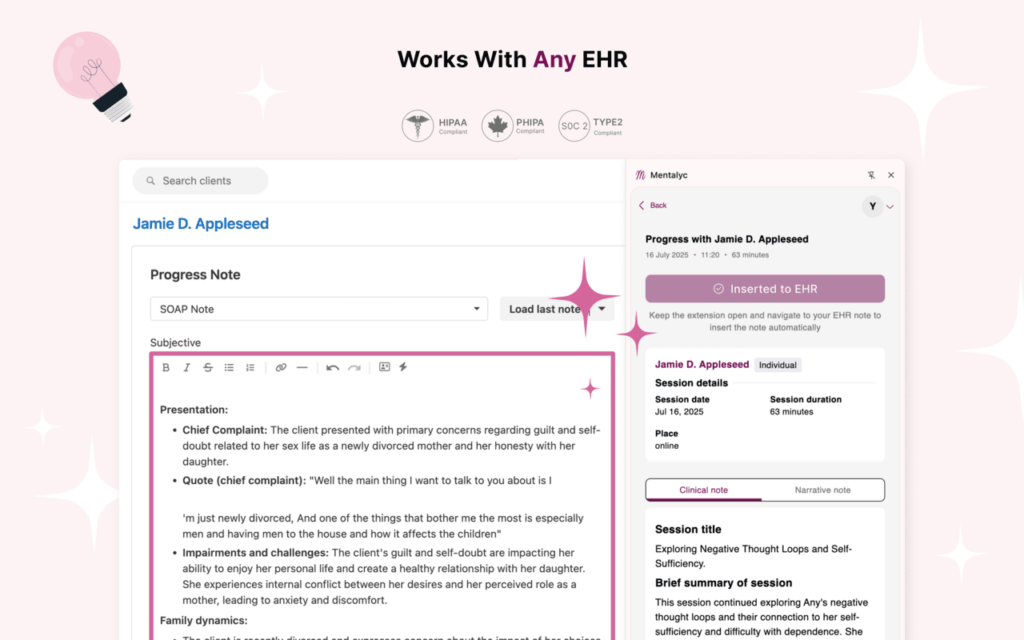
Mentalyc avoids the EHR lock-in and copy-paste that limit traditional planners by sending plans straight into your EHR with a Chrome EHR extension. You keep your existing system and skip the manual transfer.

One-click EHR autofill, no copy-paste. After creating a plan in Mentalyc, clinicians insert it directly into the EHR without reformatting, preserving structure and clinical language.
SOAP and DAP note integration. Plans, goals, and objectives drop into the right sections of the note, maintaining the clinical Golden Thread from session to session.
Works across EHR systems. Unlike tools tied to one platform, the extension is compatible with major mental health EHRs, so clinicians keep their systems while upgrading their workflow.
Your EHR remains the system of record. Your EHR stays the official record while Mentalyc handles documentation automation and planning intelligence behind the scenes.
Who the Mentalyc AI Treatment Planner is best for
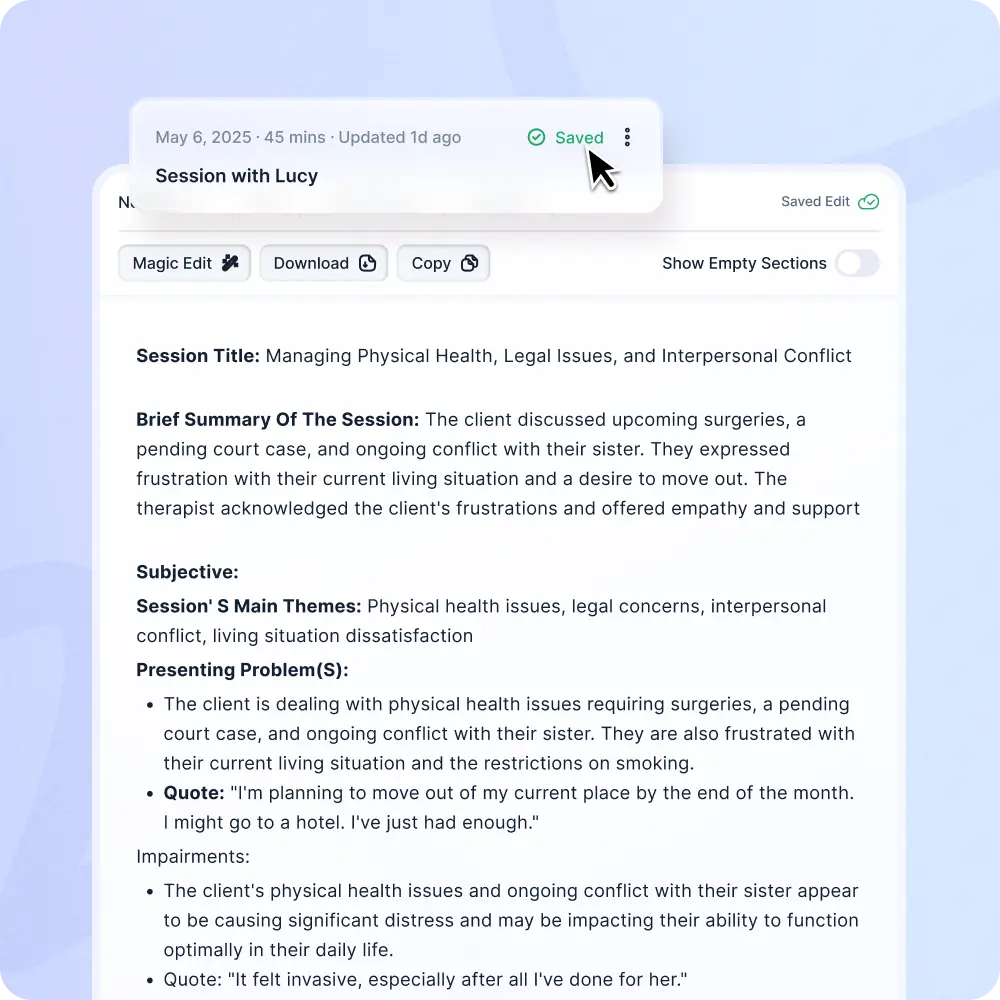
Mentalyc fits clinicians who need efficient, insurance-ready, adaptable planning. It’s best suited for:
- Private practice therapists who want to cut documentation time while keeping clinical quality and audit readiness.
- Insurance-heavy practices that need plans with clear medical necessity, measurable goals, and diagnosis alignment.
- Group practices and multi-clinician teams that need consistent documentation standards and scalable automated planning.
- Therapists managing complex or long-term cases who benefit from built-in progress tracking and evolving plans.
- EHR switchers or multi-EHR users who want a planner that works with any EHR.
- Clinicians seeking an AI alternative to Wiley who value structure and compliance but want AI-driven personalization and flexibility.
Build insurance-ready treatment plans from your session notes
Why other mental health professionals love Mentalyc

“I really like that the treatment plans make sense, and they’re based on the case notes I’ve been entering.”
Therapist

“The treatment plan gives me a place to look with clients and say, here’s where we are and here’s where we’re aiming to go. It’s such a huge help.”
LPC

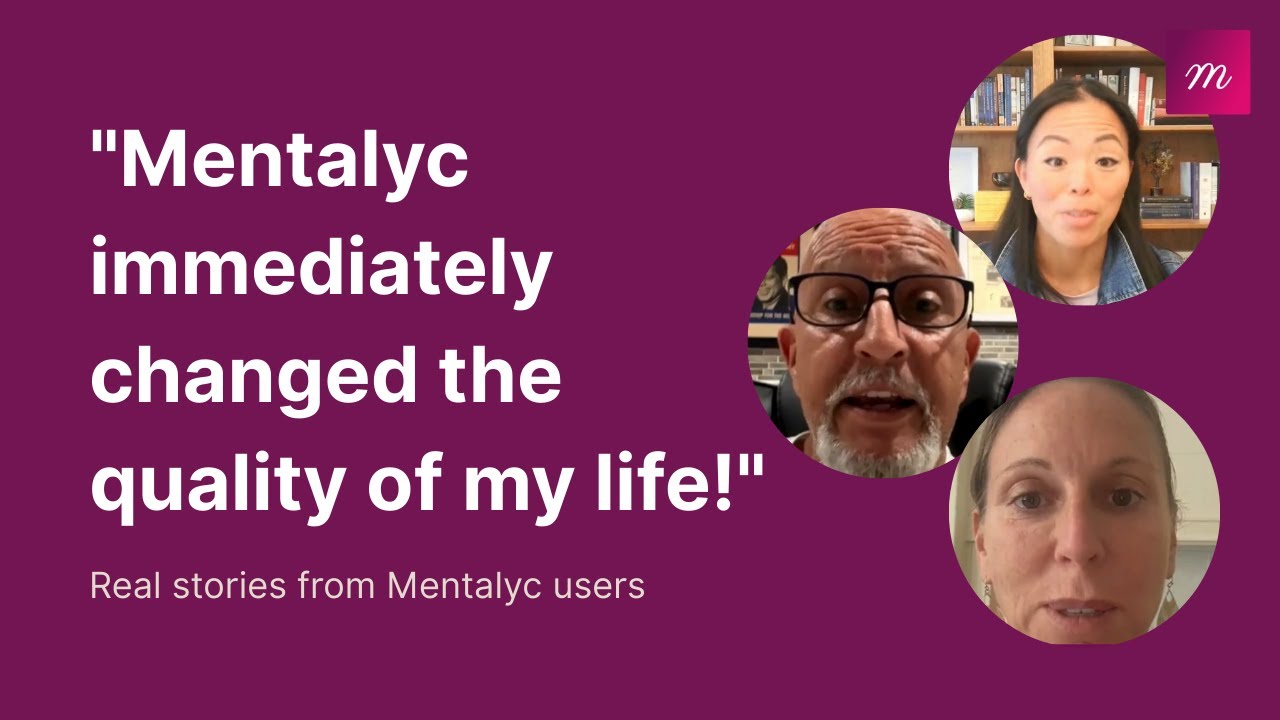
“It immediately changed my quality of life, personally and professionally.”
Owner/Independently Licensed Marriage & Family Therapist (LMFT)

“If I were recommending this software to a colleague, I would tell them that it is the best thing that they could do for their practice.”
Licensed Professional Counselor
Conclusion
Wiley earned its trust by giving therapists a reliable, insurer-recognized framework for documenting goals, objectives, and interventions, and it remains a solid pre-written library for clinicians who prefer manual, template-based planning. Mentalyc takes that foundation into modern practice: it turns real session notes into SMART, measurable goals, tracks progress automatically, and keeps documentation insurance-ready without manual effort. Its EHR-agnostic design and one-click autofill remove copy-paste friction while preserving the clinical Golden Thread. For therapists looking for a Wiley treatment planner alternative with the same clinical credibility and far greater efficiency, Mentalyc is the next step.
Frequently asked questions
References
1. John Wiley & Sons, Inc. PracticePlanners / Treatment Planners. wiley.com
2. Jongsma, A. E. (Series Editor); Berghuis, D. J., Peterson, L. M., & Bruce, T. J. The Complete Adult Psychotherapy Treatment Planner, 6th Edition (PracticePlanners series). John Wiley & Sons, 2021.
3. American Family Physician / RACGP. Acceptance and Commitment Therapy. racgp.org.au
4. Psychotherapy.net. Treatment planning resources. psychotherapy.net