
Obsessive-Compulsive Disorder (OCD) is marked by recurring obsessions and compulsions that can deeply affect daily functioning and well-being (Grayson, 2014). When therapists use the right OCD treatment tools, they can deliver more consistent, evidence-based care and monitor progress over time.
This article highlights some of the best OCD recovery tools and techniques, from ERP and CBT strategies to self-help resources and clinician training programs.
That’s where solutions like **Mentalyc** complement these tools by automatically documenting sessions and tracking client progress — helping therapists see how interventions translate into measurable, real-world improvement.
Evidence-Based Therapeutic Approaches for OCD
| Therapeutic Approach | Core Principle | Best For | Key Techniques | Scientific Support |
| Cognitive Behavioral Therapy (CBT) | Identifying and changing distorted thoughts and maladaptive behaviors. | Individuals with mild to moderate OCD symptoms. | Cognitive restructuring, behavioral experiments. | Strong empirical evidence; first-line treatment. |
| Exposure and Response Prevention (ERP) | Gradual exposure to feared thoughts or triggers while resisting compulsive responses. | Classic OCD presentations (checking, contamination, intrusive thoughts). | Hierarchy building, systematic exposure, response prevention. | Gold-standard evidence-based treatment endorsed by APA and NICE. |
| Acceptance and Commitment Therapy (ACT) | Increasing psychological flexibility by accepting thoughts instead of fighting them. | Clients with high experiential avoidance or shame. | Mindfulness, values-based actions, cognitive defusion. | Supported by randomized controlled trials as adjunct to ERP |
| Mindfulness-Based Cognitive Therapy (MBCT) | Integrates mindfulness practices with CBT to reduce rumination and anxiety. | OCD with comorbid depression or anxiety. | Meditation, body scans, nonjudgmental awareness. | Moderate evidence; effective for relapse prevention. |
| Medication (SSRIs / SNRIs) | Balancing serotonin levels to reduce intrusive thoughts and compulsions. | Moderate to severe OCD or when therapy alone isn’t sufficient. | Pharmacotherapy under psychiatric supervision. | Robust clinical support; effective when combined with CBT/ERP. |
Exposure and Response Prevention (ERP) Therapy
ERP therapy is the gold standard for OCD treatment and involves exposing clients to feared thoughts or situations while preventing compulsive behaviors (Grayson, 2014). ERP therapy for OCD helps clients desensitize anxiety triggers, break the cycle of obsessions and compulsions, and regain control over their lives.
Automated treatment plans that reflect your approach

New! Transfer your notes to EHR with a single click. No more copy-pasting.
ERP Tools and Techniques
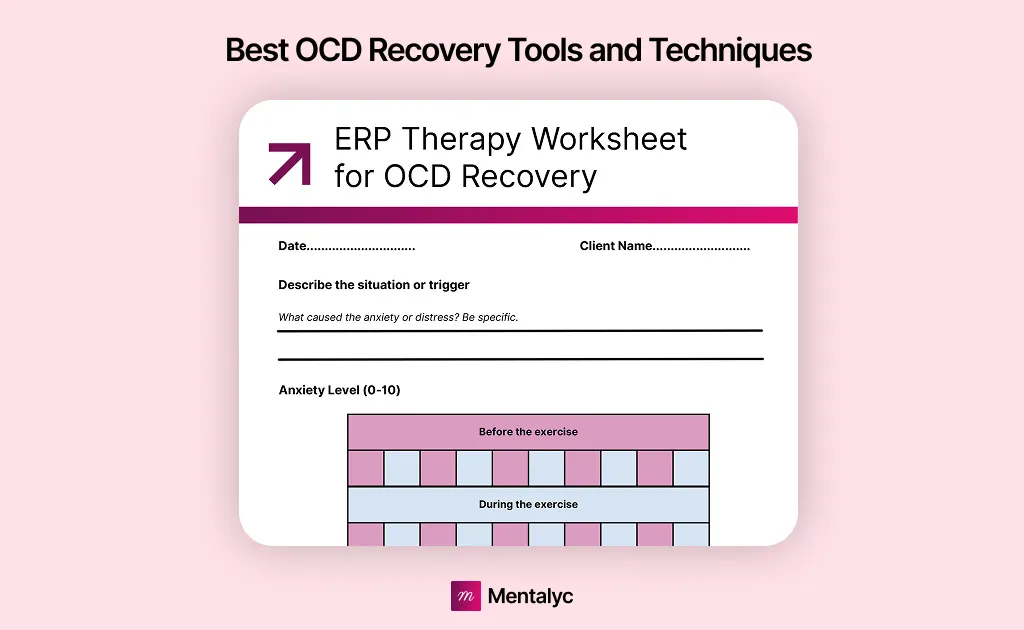
**Exposure Hierarchy Worksheets:** Help clients rank feared situations or thoughts from least to most anxiety-provoking, forming the foundation for ERP. Gradual exposure reduces avoidance behaviors and desensitizes clients to their triggers, helping them break the obsession-compulsion cycle.
Graded Exposure Tracking Sheets: Document each exposure attempt, including anxiety levels and outcomes, allowing clients to track their progress. Provide tangible evidence that anxiety decreases over time without engaging in compulsions, reinforcing the benefits of ERP.
ERP Companion Apps: Apps like NOCD provide guided ERP exercises, reminders, and progress tracking. Ensure clients engage with ERP consistently, even between therapy sessions.
Virtual Reality ERP Exposure Tools: Programs like Limbix use VR to simulate feared scenarios for clients unable to access real-world exposures.
Shared ERP Plans: Use collaborative tools like Google Docs to co-create and monitor ERP exposure hierarchies.
Gamification: Apps like Habitica allow clients to turn exposures into rewarding challenges.
Cognitive Behavioral Therapy (CBT)
Cognitive Behavioral Therapy (CBT) focuses on identifying and challenging distorted thoughts associated with OCD. CBT for OCD recovery helps clients develop healthier thought patterns and reduces the distress caused by intrusive thoughts.
Cognitive Behavioral Therapy (CBT) Tools
Thought Record Templates: These templates help clients document intrusive thoughts, analyze their validity, and reframe them into more balanced, rational alternatives. Thought records challenge distorted beliefs fueling obsessions, such as perfectionism or catastrophic thinking, reducing the emotional intensity of intrusive thoughts.
CBT Thought Diary App: This app provides a mobile platform for clients to track obsessive thoughts, identify triggers, and practice reframing on the go. It encourages real-time engagement with CBT techniques, ensuring clients address obsessive thoughts as they arise and preventing compulsions.
Safety Behavior Identification Tool: The tool assists clients in identifying safety behaviors (e.g., avoidance, reassurance-seeking) that maintain OCD symptoms. Eliminating safety behaviors is critical for breaking the reinforcement loop that sustains obsessions and compulsions.
Intrusive Thought Reframing Worksheets: These worksheets provide step-by-step guidance on how to separate intrusive thoughts from reality and practice accepting uncertainty. They reduce the emotional impact of obsessions by teaching clients to accept intrusive thoughts without engaging with them.
**Behavioral Activation Planner:** This planner encourages clients to schedule pleasurable or meaningful activities to counteract avoidance and withdrawal behaviors. It keeps clients engaged in their values and reduces the time spent obsessing or performing compulsions.
**Cognitive Restructuring Worksheets:** These OCD recovery tools help clients challenge distorted beliefs, such as “If I don’t perform this ritual, something bad will happen.” Targets the cognitive distortions underlying OCD, reducing the urgency and perceived necessity of compulsive behaviors through effective cognitive restructuring for OCD exercises.
Core Beliefs Identification Tools: These tools help clients uncover deep-seated beliefs about control, responsibility, or safety that contribute to obsessive thinking. Addressing these core beliefs helps clients achieve lasting change by targeting the root causes of obsessive thoughts.
Automatic Thought Identification Cards: These portable cards help clients quickly identify and challenge automatic thoughts during OCD flare-ups. Offer immediate support in high-stress situations, helping clients break obsessive cycles in the moment.
Compulsion Reduction Log: The log helps clients track the frequency, duration, and intensity of compulsions over time. Shows measurable progress in reducing compulsive behaviors.
Relapse Prevention Worksheets: Clients identify potential relapse triggers and create actionable management plans. Ensures clients maintain progress and quickly address setbacks, preventing full-blown symptom recurrence.
Mindfulness Training Exercises: With mindfulness for OCD, clients learn to observe intrusive thoughts without judgment or engagement. Encourages acceptance of uncertainty and reduces compulsive responses to obsessions.
Trigger and Response Journal: The journal allows clients to document specific triggers, initial responses, and alternative coping strategies. It builds awareness of patterns and equips clients with tools to respond more effectively to obsessions.
Automate Treatment planning with Mentalyc’s AI Treatment Planner
Generate treatment plans that mirror your approach, satisfy payors, and evolve with your clients.
- SMART Goals
- Insurance-ready formatting
- Track goals & outcomes
- HIPAA & PHIPA compliant
New! Transfer your notes to EHR with a single click. No more copy-pasting.

Values Clarification Worksheets: Help clients identify personal values and align their behaviors with these values rather than their OCD symptoms. Shifts focus away from compulsive rituals and toward meaningful, value-driven activities.
Probability Testing Worksheets: These worksheets help clients analyze the likelihood of feared outcomes based on evidence and past experiences. By introducing realistic perspectives, they reduce the perceived threat of obsessive thoughts.
Habit Reversal Training: Clients identify compulsive behaviors and substitute them with healthier responses. It breaks the automatic nature of compulsions, creating space for alternative coping mechanisms.
Self-Compassion Journaling Prompts: These prompts encourage clients to write about their experiences with kindness and understanding toward themselves. This reduces shame and self-criticism, which are common barriers to progress in OCD treatment.
Imaginal Exposure Scripts: Scripts guide clients through imagining their worst fears without compulsive avoidance. Desensitizes clients to feared scenarios when real-life exposure isn’t feasible.
Acceptance and Commitment Therapy (ACT)
Acceptance and Commitment Therapy (ACT) emphasizes mindfulness and acceptance strategies to reduce the emotional impact of obsessions. ACT for OCD encourages clients to live meaningful lives by accepting intrusive thoughts without engaging in compulsions.
Acceptance and Commitment Therapy (ACT) Resources and Tools
Values Clarification Worksheet: Helps clients identify their core values and align their behaviors with these values rather than being guided by OCD-driven fear or avoidance. Shifts focus away from compulsions and obsessions by encouraging clients to pursue meaningful, value-driven actions, reducing the dominance of OCD over their lives and strengthening their personalized OCD recovery plan.
Mindfulness Practices: Through breathing exercises, body scans, and meditation, clients can observe their intrusive thoughts without judgment or emotional attachment. Mindfulness for OCD allows clients to accept intrusive thoughts as mental events rather than truths that need to be acted upon, reducing the urge to perform compulsions.
Defusion Techniques: Help clients distance themselves from their thoughts by repeating intrusive thoughts in a silly voice or visualizing them as clouds floating by. This technique reduces the power of obsessions by breaking the association between thoughts and emotional distress, allowing clients to see thoughts as transient and non-threatening.
Acceptance Exercises: Encourage clients to sit with discomfort or anxiety triggered by intrusive thoughts without attempting to neutralize it with compulsive behavior. It builds distress tolerance and helps clients move toward accepting uncertainty, a critical step in overcoming OCD.
Committed Action Plans: Help clients set actionable goals that align with their values, breaking OCD-driven avoidance patterns. Encourages clients to focus on achievable, positive actions rather than obsessing over perfection or controlling intrusive thoughts.
“Passengers on the Bus” Metaphor: Clients imagine themselves as bus drivers with their intrusive thoughts (passengers) shouting directions. They are encouraged to keep driving toward their values regardless of the noise. Reinforces the idea that intrusive thoughts don’t have to dictate behavior, empowering clients to stay value-focused despite anxiety.
Willingness Exercises: Teach clients to embrace uncomfortable feelings or thoughts without trying to avoid, fight, or change them. Promotes acceptance of uncertainty and discomfort, key challenges for individuals with OCD.
Thought Labeling: This technique guides clients to categorize their intrusive thoughts as “just a thought” rather than assigning meaning or urgency to them. It reduces the emotional weight of obsessions by normalizing intrusive thoughts as a part of the human experience.
Creative Hopelessness Exercise: This exercise encourages clients to explore the ineffectiveness of their compulsive behaviors in achieving peace or certainty. It helps clients recognize that compulsions are not solving their problems, motivating them to try alternative approaches like acceptance.
Cognitive Fusion Worksheet: Helps clients identify moments when they are “fused” with their thoughts (i.e., treating them as facts) and practice defusing from them. Teaches clients to see their thoughts as separate from themselves, reducing the compulsive urge to act on intrusive ideas, and reinforcing practical OCD management tools for daily life.
ACT Matrix: A visual tool that helps clients identify behaviors that move them closer to or further from their values and categorize actions into four quadrants: helpful/unhelpful and value-aligned/not value-aligned. Simplifies the decision-making process, helping clients focus on behaviors that align with their values rather than those dictated by OCD.
Self-Compassion Exercises: Teach clients to treat themselves kindly and forgive themselves for perceived failures or imperfections in managing OCD. Reduces self-criticism and shame, which are often barriers to progress in treatment.

Metaphors for Acceptance: Simplifies abstract ACT concepts like acceptance and defusion, making them relatable and actionable for clients.
- “Leaves on a Stream” Metaphor: Clients imagine placing their intrusive thoughts on leaves and letting them float down a stream.
- “Tug-of-War with a Monster”: Visualizing OCD as a monster pulling on a rope; clients are encouraged to drop the rope instead of engaging.
Life Compass Tool: This tool helps clients map out what they want their lives to look like in different areas (relationships, career, health) and take small steps toward those goals. It redirects energy away from obsessions and compulsions toward meaningful, value-driven goals.
“Letting Go” Practice: This practice guides clients through exercises where they imagine physically letting go of their need for control over intrusive thoughts. It reinforces the practice of acceptance and reduces the need for compulsions.
Functional Analysis of Compulsions: This approach helps clients examine how compulsions interfere with their values and quality of life. It also builds insight into the cost of compulsions, motivating them to engage in alternative, healthier behaviors.
Anxiety Acceptance Scale: A self-assessment tool that helps clients gauge their willingness to experience anxiety or discomfort without avoidance or compulsive behavior. Tracks progress in building tolerance for uncertainty and distress.
Perspective-Taking Exercises: Encourage clients to view their intrusive thoughts from an external perspective, such as imagining how they’d support a friend with the same thoughts. It helps reduce self-stigma and fosters a more compassionate, accepting attitude toward oneself.
Ritual Prevention Commitment Statements: Clients write statements committing to accept uncertainty and resist engaging in compulsions, aligning with their values. This reinforces their commitment to change and provides a tangible reminder of their goals during difficult moments.
Gratitude Journaling: This practice encourages clients to document things they are grateful for, focusing on the positives in their lives rather than obsessive thoughts. Shifts attention from fear and worry to value-driven experiences.
Medication Management. Selective serotonin reuptake inhibitors (SSRIs) are commonly prescribed for OCD. Medication can reduce the intensity of obsessions and compulsions, making therapy more effective (Pittman, 2021).
Technology and Apps for OCD Recovery
| App Name | Main Features | Best For |
| NOCD | Live video sessions with OCD-trained therapists, 24/7 messaging, in-app ERP tools and community support. | Users seeking structured ERP therapy plus support between sessions. |
| OCD Challenge | Self-guided interactive program based on ERP, customisable modules for OCD symptoms, progress tracking, free globally. | Individuals wanting a free, self-help tool to supplement or replace therapy access. |
| WorryTime | Tool to schedule specific “worry time” each day, allows users to log intrusive thoughts and restrict worry intrusion, CBT-based anxiety/worry management. | Those dealing with intrusive thoughts, rumination or worry needing a simple method to manage them. |
NOCD: A telehealth app providing ERP therapy from licensed clinicians specializing in OCD. NOCD offers on-demand support, ERP exercises, and a community for clients to feel less alone.
OCD Challenge: A digital self-help program based on ERP principles. It allows clients to work through exposures independently with structured guidance.
WorryTime: A mobile app designed to schedule time for worrying, helping clients limit the intrusion of obsessive thoughts. It aligns with CBT principles by teaching clients to contain and manage their worries.
Self-Help Books and Workbooks for OCD
- The OCD Workbook by Bruce M. Hyman and Cherry Pedrick. This workbook provides step-by-step guidance on applying ERP techniques and tracking progress.
- Overcoming Unwanted Intrusive Thoughts by Sally M. Winston and Martin N. Seif. It offers practical advice for normalizing and managing intrusive thoughts.
- Rewire Your OCD Brain by Catherine M. Pittman. Combines neuroscience and CBT to help clients understand and rewire obsessive thought patterns.
OCD Support Groups and Peer Networks
1. International OCD Foundation (IOCDF) Support Groups: Facilitated peer support groups for individuals with OCD and their families. Reduces isolation and fosters community.
2. Reddit OCD Community: An online forum where individuals with OCD share experiences and coping strategies. Provides insight into client struggles and successes.
OCD Professional Development Opportunities for Therapists
1. Behavioral Therapy Training Institute (BTTI): Advanced training in ERP therapy for OCD. Equips therapists with practical tools and techniques.
2. Workshops by ADAA: The Anxiety and Depression Association of America offers workshops and webinars on treating OCD.
3. Supervision Groups for ERP Therapists: Joining a group of ERP-trained clinicians can enhance skills through case consultations and peer feedback.
Tracking and Measurement Tools
- Yale-Brown Obsessive-Compulsive Scale (Y-BOCS): A widely used tool for assessing the severity of OCD symptoms. The Y-BOCS scale helps track client progress over time.
2. OCD Symptom Tracker: Apps like Symple allow clients to log OCD-related symptoms, triggers, and responses for therapist review.
Conclusion: Final Thoughts on OCD Recovery
The best OCD recovery tools in 2025 blend traditional therapeutic approaches, innovative technology, and practical resources that empower clinicians and clients. From ERP and CBT to cutting-edge OCD self-help apps and professional development opportunities, these tools provide therapists with a comprehensive toolkit for treating OCD effectively.
Your goal is to remain adaptable, evidence-based, and compassionate in your treatment approach. Integrating these OCD therapy resources into your practice can help clients recover and live more fulfilling lives.
What tools or techniques have you found most helpful for OCD recovery?
Simplify OCD Documentation and Progress Tracking with Mentalyc
Clients recovering from OCD often benefit from seeing their progress even small wins can reinforce motivation and strengthen commitment to treatment.
Using Mentalyc, therapists can automatically capture key session insights and track changes in symptoms and goals over time. Its Progress Tracking tools make it easy to track improvement, share evidence of growth, and keep clients engaged throughout recovery – all while maintaining HIPAA-compliant, audit-ready documentation.
Register today and have measurable progress a visible part of your clients’ healing journey.
Frequently Asked Questions (FAQs) About OCD Recovery Tools and Techniques
1. What is the best tool for OCD?
The best tool for obsessive-compulsive disorder (OCD) is Exposure and Response Prevention (ERP), an evidence-based OCD treatment recognized as the gold standard in clinical practice. ERP involves gradually confronting feared thoughts or situations while resisting compulsive behaviors, often using an exposure hierarchy to guide the process. This approach helps clients face triggers safely, reduce anxiety, and retrain the brain to tolerate uncertainty.
2. What is the best app for OCD?
Apps like NOCD and OCD Challenge are among the most effective digital tools for obsessive-compulsive disorder management. These platforms provide structured ERP exercises, therapist-guided support, and progress tracking features. Clients can also use digital journals or tracking OCD progress apps to monitor triggers, anxiety levels, and exposure outcomes between therapy sessions, enhancing accountability and treatment consistency.
3. What is the gold standard assessment tool for OCD?
The Yale-Brown Obsessive-Compulsive Scale (Y-BOCS) is the gold standard assessment tool for OCD. It measures the severity of intrusive thoughts and compulsions across time, providing clinicians with a reliable framework for diagnosis and progress evaluation. The Y-BOCS helps tailor treatment interventions like ERP or CBT to the client’s specific symptom profile and monitor therapeutic outcomes effectively.
4. How to stop OCD thoughts naturally?
While OCD cannot be “stopped” overnight, it can be managed using structured anxiety reduction techniques and mindful awareness. Practicing thought defusion and acceptance, as taught in Acceptance and Commitment Therapy (ACT), allows individuals to observe intrusive thoughts without reacting to them. Engaging in behavioral activation, such as exercise, social connection, and engaging in valued activities, can redirect focus and reduce the power of obsessive thinking over time.
5. How can OCD therapy resources aid in relapse prevention?
OCD therapy resources like relapse prevention worksheets, self-monitoring tools, and values clarification exercises are essential for maintaining long-term recovery. These resources reinforce coping strategies learned during therapy, helping clients anticipate and manage triggers before symptoms escalate. Integrating these tools into daily life supports sustainable mental health recovery and empowers clients to maintain progress even after formal treatment ends.
References
Books
Grayson, J. (2014). Freedom from Obsessive-Compulsive Disorder: A Personalized Recovery Program for Living with Uncertainty (2nd ed.). Berkley Trade.
Harris, R. (2008). The Happiness Trap: How to Stop Struggling and Start Living: A Guide to ACT. Trumpeter.
Hyman, B. M., & Pedrick, C. (2010). The OCD Workbook: Your Guide to Breaking Free from Obsessive-Compulsive Disorder (3rd ed.). New Harbinger Publications.
Pittman, C. M. (2021). Rewire Your OCD Brain: Powerful Neuroscience-Based Skills to Break Free from Obsessive Thoughts and Fears. New Harbinger Publications.
Winston, S. M., & Seif, M. N. (2017). Overcoming Unwanted Intrusive Thoughts: A CBT-Based Guide to Getting Over Frightening, Obsessive, or Disturbing Thoughts. New Harbinger Publications.
Websites and Organizations
International OCD Foundation (IOCDF): Provides education, research updates, and resources for clinicians and individuals with OCD. iocdf.org
Anxiety and Depression Association of America (ADAA): Offers webinars, workshops, and articles on treating OCD and related conditions. adaa.org
Mobile Apps
NOCD: A telehealth app specializing in ERP therapy for OCD.
CBT Thought Diary: A popular app for tracking and challenging intrusive thoughts.
Research Articles
Abramowitz, J. S., Taylor, S., & McKay, D. (2009). Obsessive-compulsive disorder. The Lancet, 374(9688), 491-499.
Foa, E. B., & Kozak, M. J. (1997). Mastery of obsessive-compulsive disorder: A cognitive-behavioral approach. Journal of Clinical Psychiatry, 58(suppl 12), 5-10.
Assessment Tools
Yale-Brown Obsessive-Compulsive Scale (Y-BOCS): Widely used for assessing the severity of OCD symptoms.
Psychology Tools: Offers structured assessment worksheets for OCD.
Professional Development
Behavioral Therapy Training Institute (BTTI): Advanced ERP training for clinicians.
IOCDF videos: The International OCD Foundation provides educational videos for therapists and clients on topics like ERP and overcoming stigma.
Why other mental health professionals love Mentalyc

“For anyone hesitant: this is a lifesaver. It will change your life, and you have more time to be present with your patients.”
Licensed Clinical Social Worker

“It immediately changed my quality of life, personally and professionally.”
Owner/Independently Licensed Marriage & Family Therapist (LMFT)

“Do yourself a favor, make your life easier. I found Mentalyc to be one of the best tools that I’ve ever used.”
Licensed Marriage and Family Therapist

“If I were recommending this software to a colleague, I would tell them that it is the best thing that they could do for their practice.”
Licensed Professional Counselor