
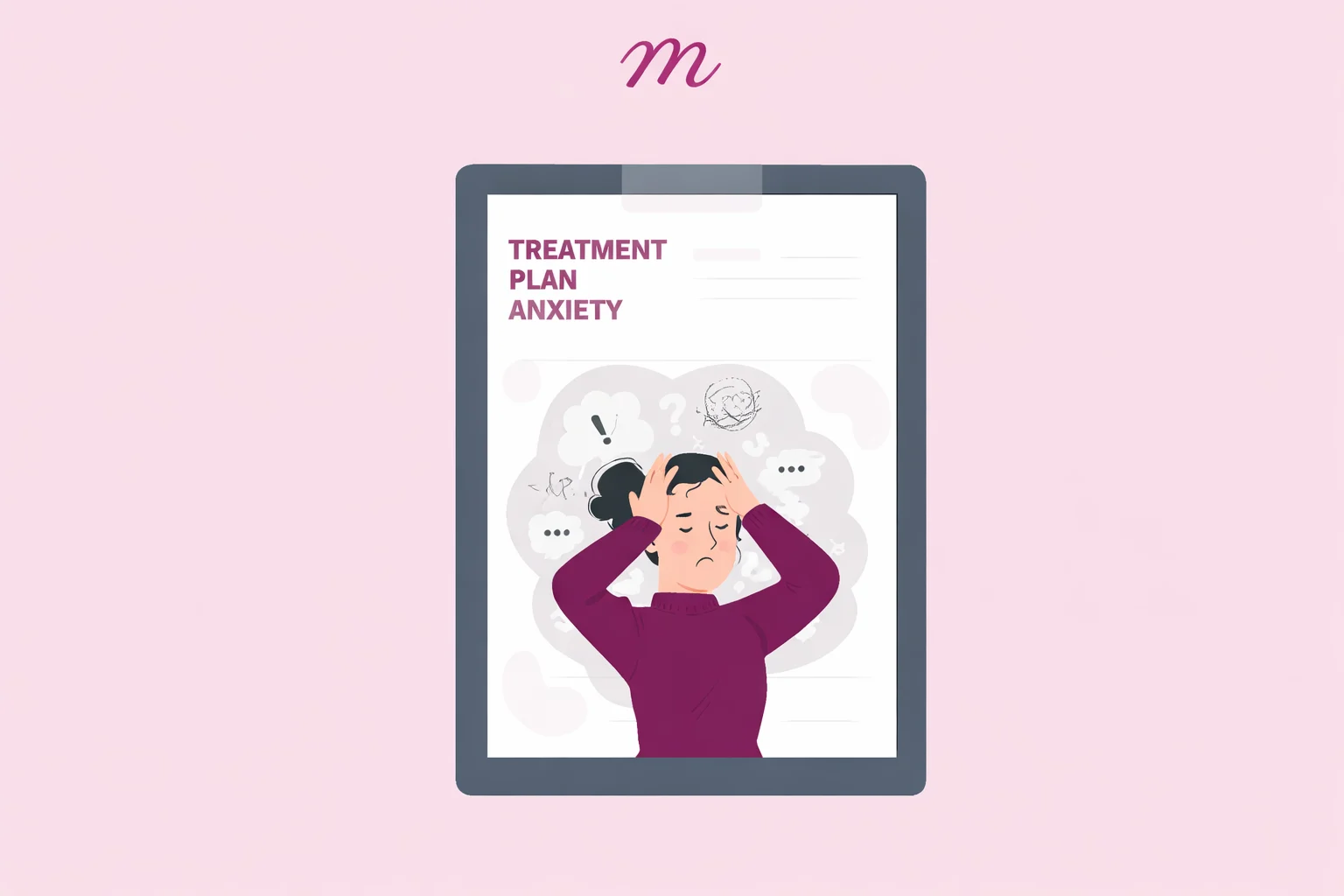
A treatment plan for anxiety gives your client a structured clinical roadmap: diagnosis, measurable goals, evidence-based interventions, and a timeline for reassessment. Without one, sessions can drift. With one, you and your client share a clear picture of what progress looks like, what techniques you will use, and when you will evaluate whether the plan is working. This guide walks through how to build an anxiety treatment plan from scratch, with SMART goal examples, ICD-10 codes, session-by-session outlines, and disorder-specific templates for GAD, social anxiety, comorbid depression, and test anxiety.
What Is an Anxiety Treatment Plan?
An anxiety treatment plan is a written clinical document that connects a client’s anxiety diagnosis to specific, measurable treatment goals and the interventions you will use to reach them. It typically includes the presenting problem, DSM-5-TR or ICD-10 diagnosis, short-term and long-term objectives, chosen modalities (such as CBT or exposure therapy), and criteria for discharge or step-down.
The plan serves three audiences. For the client, it creates transparency about what therapy will address and how long it may take. For the clinician, it functions as a session-by-session guide that keeps treatment focused. For insurance, it demonstrates medical necessity with measurable objectives tied to a recognized diagnosis [1].
A strong treatment plan is not static. You revise it as your client progresses, as new symptoms emerge, or as barriers to treatment surface. The best plans use SMART goals (Specific, Measurable, Achievable, Relevant, Time-bound) so that both you and your client can track change objectively rather than relying on subjective impressions alone.
What Is Anxiety?
Anxiety is a normal human emotion characterized by feelings of worry, unease, and nervousness in response to stress or uncertainty. In moderate amounts, it is adaptive. It sharpens focus before a presentation and motivates preparation for a difficult conversation. The clinical threshold is crossed when anxiety becomes persistent, disproportionate to the situation, and impairing [2].
Everyday anxiety looks like:
- Feeling nervous before a job interview or important presentation
- Worrying about a loved one’s health or safety
- Experiencing butterflies before a first date
- Feeling uneasy when trying something new or unfamiliar
Clinical anxiety looks like:
- Avoiding social situations due to intense fear of judgment or embarrassment
- Experiencing panic attacks that seem to come from nowhere
- Having intrusive thoughts or compulsions that disrupt daily routines
- Feeling constant, excessive worry about various aspects of life that is difficult to control
The difference between everyday worry and an anxiety disorder comes down to intensity, duration, and functional impact. Clinical anxiety is more severe, longer lasting, and interferes with work, relationships, and daily activities. Recognizing where your client falls on this spectrum during the intake assessment is the first step toward building a plan that fits.
How Are Anxiety Disorders Classified?
The DSM-5-TR classifies anxiety disorders into several categories, each with distinct diagnostic criteria, while the ICD-10 provides the billing codes you will use in treatment plans and insurance documentation [2][3]. Below is a reference table matching common anxiety diagnoses to their ICD-10 codes.
| Diagnosis | ICD-10 Code | Key Features |
|---|---|---|
| Generalized Anxiety Disorder (GAD) | F41.1 | Persistent, excessive worry about multiple domains for 6+ months |
| Panic Disorder | F41.0 | Recurrent unexpected panic attacks with persistent concern about future attacks |
| Social Anxiety Disorder | F40.10 | Marked fear or anxiety about social situations involving potential scrutiny |
| Specific Phobia | F40.2xx | Intense, irrational fear of a specific object or situation |
| Agoraphobia | F40.00 | Fear of places or situations where escape might be difficult |
| Separation Anxiety Disorder | F93.0 | Excessive fear about separation from attachment figures |
| Selective Mutism | F94.0 | Consistent failure to speak in specific social situations despite speaking elsewhere |
| Other Specified Anxiety Disorder | F41.8 | Anxiety symptoms that do not meet full criteria for a specific disorder |
| Unspecified Anxiety Disorder | F41.9 | Clinically significant anxiety without sufficient information to assign a specific code |
When writing your treatment plan, include both the DSM-5-TR diagnosis and the corresponding ICD-10 code. Insurance reviewers look for this pairing. If your client presents with comorbid conditions (anxiety plus depression is common), list each diagnosis separately with its own code and treatment objectives.
How Are Anxiety Disorders Treated?
Anxiety disorders respond to several evidence-based modalities, and treatment selection depends on the specific disorder, symptom severity, client preference, and prior treatment history [4]. Here are the primary approaches.
a) Cognitive Behavioral Therapy (CBT): Focuses on identifying and changing negative thought patterns and behaviors associated with anxiety. CBT has the strongest evidence base across anxiety disorders and is typically delivered in 12 to 20 sessions [5]. For a detailed breakdown of CBT techniques for anxiety, see our clinical guide.
b) Exposure Therapy: Gradually exposes clients to anxiety-provoking situations or objects to reduce fear and avoidance. It is the gold-standard treatment for specific phobias and a core component of CBT for social anxiety and panic disorder [6].
c) Acceptance and Commitment Therapy (ACT): Emphasizes accepting uncomfortable thoughts and feelings while committing to valued actions rather than trying to eliminate anxiety.
d) Mindfulness-Based Therapies: Incorporate mindfulness techniques to help clients stay present and manage anxiety symptoms without judgment.
e) Dialectical Behavior Therapy (DBT): Combines cognitive-behavioral techniques with mindfulness and acceptance strategies, particularly useful when anxiety co-occurs with emotion dysregulation.
f) EMDR (Eye Movement Desensitization and Reprocessing): Originally developed for PTSD, now increasingly used for anxiety rooted in traumatic or distressing experiences.
g) Psychodynamic Therapy: Explores unconscious conflicts and past experiences that may contribute to anxiety patterns.
h) Medication: SSRIs (sertraline, escitalopram), SNRIs (venlafaxine, duloxetine), and buspirone are first-line pharmacological options. Benzodiazepines may be used short-term but carry dependence risks [7].
i) Combination Treatments: A combination of psychotherapy and medication often produces the best outcomes for moderate-to-severe anxiety [8].
Your treatment plan should specify which modality or combination you are using, and the rationale for that choice. Document it. A plan that says “CBT for 16 sessions targeting cognitive distortions and avoidance behaviors” is far more useful to a reviewer than “therapy for anxiety.”
How Do You Structure an Anxiety Treatment Plan?
A treatment plan for anxiety should contain seven core sections: identifying information, presenting problem, diagnosis, goals and objectives, interventions, timeline, and discharge criteria [1]. Each section answers a specific clinical and administrative question.
1. Identifying Information
Client name, date of birth, date of plan, treating clinician, and referral source.
2. Presenting Problem
A brief narrative describing the client’s anxiety symptoms in their own words, the duration, and the functional impairment. Example: “Client reports constant worry about work performance and health for the past 8 months. She avoids social gatherings, has difficulty sleeping, and rates her anxiety at 8/10 on most days.”
3. Diagnosis
DSM-5-TR diagnosis with ICD-10 code. Example: Generalized Anxiety Disorder (F41.1).
4. Goals and Objectives
Long-term goals state the desired end-state. Short-term objectives are SMART steps toward the goal. (See the SMART goals section below for detailed examples.)
5. Interventions
The specific techniques you will use in session, tied to each objective. Example: cognitive restructuring, exposure hierarchy, progressive muscle relaxation, psychoeducation about the anxiety cycle.
6. Timeline and Review
Estimated number of sessions, frequency, and the date for plan review. Most anxiety treatment plans are reviewed every 90 days or after 12 sessions.
7. Discharge Criteria
What “done” looks like. Example: “Client reports anxiety at 3/10 or below on most days, GAD-7 score below 5 for two consecutive administrations, and has returned to avoided activities.”
Tools like Mentalyc’s AI Treatment Planner can generate a draft plan that includes SMART goals, suggested interventions, and insurance-ready formatting aligned to your therapy style. Mentalyc generates a draft plan; the therapist reviews, edits, and signs it, remaining the clinician of record. This workflow cuts documentation time while keeping clinical judgment at the center.
What Are SMART Goals for Anxiety Treatment?
SMART goals for anxiety treatment are objectives that are Specific, Measurable, Achievable, Relevant, and Time-bound [9]. They replace vague goals like “reduce anxiety” with concrete targets that you and your client can evaluate at each review. Below are 15 examples organized by clinical category.
Cognitive Restructuring Goals
- Client will identify and challenge at least 3 cognitive distortions per week using a thought record, reducing catastrophic thinking frequency by 50% within 8 weeks.
- Client will replace automatic negative thoughts about social evaluation with balanced alternative thoughts in 4 out of 5 practice situations within 10 weeks.
- Client will demonstrate the ability to independently use the cognitive restructuring worksheet during anxiety-provoking moments, as reported in session, within 6 weeks.
Avoidance Reduction Goals
- Client will complete 3 items on the exposure hierarchy (SUDs rating 40-60) without engaging in safety behaviors within 6 weeks.
- Client will attend at least 2 social events per month without leaving early due to anxiety within 12 weeks.
- Client will reduce avoidance of driving on highways from complete avoidance to completing a 20-minute highway drive independently within 10 weeks.
Physiological Symptom Management Goals
- Client will practice progressive muscle relaxation for 15 minutes daily, reducing self-reported physical tension from 7/10 to 4/10 or below within 4 weeks.
- Client will use diaphragmatic breathing to reduce heart rate during panic-like episodes, self-reporting successful use in 3 out of 4 episodes within 8 weeks.
- Client will reduce frequency of panic attacks from 4 per week to 1 or fewer per week within 12 weeks, as tracked on a daily symptom log.
Functional Improvement Goals
- Client will return to full-time work attendance (5 days per week) without leaving early due to anxiety within 10 weeks.
- Client will initiate and sustain at least one conversation per day with a coworker or acquaintance without significant distress (SUDs below 4) within 8 weeks.
- Client will complete daily responsibilities (meals, hygiene, errands) without requiring reassurance from a partner on more than 2 occasions per week, within 6 weeks.
Sleep and Overall Well-Being Goals
- Client will reduce sleep-onset latency from 90+ minutes to 30 minutes or less on at least 5 nights per week within 8 weeks using sleep hygiene and relaxation protocols.
- Client will reduce GAD-7 score from 16 (severe) to 9 or below (mild) within 16 weeks.
- Client will engage in at least 3 pleasurable activities per week as identified in a values-based activity list, within 6 weeks.
When writing SMART goals, anchor each one to a baseline measurement taken at intake. This makes progress visible to both the client and the insurance reviewer. For more on writing measurable treatment plan objectives that satisfy insurance requirements, see our dedicated guide.
Treatment Plan Examples for Anxiety
The following are two detailed, diagnosis-specific examples. For additional treatment plan examples by diagnosis, see our library of templates across conditions.
Example 1: CBT Treatment Plan for Generalized Anxiety Disorder
Client Profile: 34-year-old female, marketing manager. Presents with excessive worry about work performance, health, and family safety for 14 months. Reports difficulty concentrating, muscle tension, irritability, and disrupted sleep. GAD-7 score: 17 (severe). No prior therapy. No current medication.
Diagnosis: Generalized Anxiety Disorder (F41.1)
Strengths: High motivation for treatment, strong social support from partner, college-educated, no substance use.
Barriers: Demanding work schedule limits session availability, perfectionism may interfere with homework compliance.
Long-Term Goal: Reduce GAD-7 score from 17 to below 8 (mild range) and restore full occupational and social functioning within 16 weeks.
SMART Objectives:
- Client will complete a daily worry log and identify top 3 worry themes within 2 weeks.
- Client will use cognitive restructuring to challenge catastrophic thoughts in 4 out of 5 recorded worry episodes within 6 weeks.
- Client will practice progressive muscle relaxation daily, reducing physical tension rating from 8/10 to 4/10 within 4 weeks.
- Client will attend 2 previously avoided social activities per month without leaving early within 10 weeks.
- Client will report sleeping within 30 minutes of bedtime on 5+ nights per week within 8 weeks.
Interventions:
- Psychoeducation about the GAD cycle (Sessions 1-2)
- Cognitive restructuring using thought records (Sessions 3-8)
- Progressive muscle relaxation and diaphragmatic breathing training (Sessions 3-4, practiced throughout)
- Behavioral experiments to test worry predictions (Sessions 6-10)
- Worry time scheduling (Sessions 5-12)
- Relapse prevention planning (Sessions 14-16)
Session-by-Session Outline:
Assessment and Psychoeducation (Sessions 1-2)
- Conduct thorough assessment of anxiety symptoms and their impact on daily life
- Administer GAD-7, BAI, and PSWQ at baseline
- Educate the client about anxiety and the CBT model
- Introduce the concept of thought records
Cognitive Restructuring (Sessions 3-6)
- Identify and challenge cognitive distortions
- Practice reframing negative thoughts
- Develop and implement positive self-talk strategies
- Introduce worry time scheduling
Behavioral Activation and Relaxation Techniques (Sessions 7-10)
- Introduce and practice progressive muscle relaxation and deep breathing exercises
- Develop a plan for gradually increasing pleasant and meaningful activities
- Implement sleep hygiene techniques
- Begin behavioral experiments
Problem-Solving and Coping Skills (Sessions 11-14)
- Teach and practice problem-solving techniques
- Develop personalized coping strategies for managing anxiety
- Address specific avoidance behaviors with graded exposure
Relapse Prevention and Maintenance (Sessions 15-16)
- Review progress and achievements
- Develop a relapse prevention plan
- Discuss strategies for maintaining gains and handling future challenges
- Readminister GAD-7 and compare to baseline
Review Date: Every 90 days or after Session 8, whichever comes first.
Example 2: Exposure Therapy Treatment Plan for Social Anxiety Disorder
Client Profile: 28-year-old female, marketing professional. Experiences intense anxiety in social and professional situations. Avoids team meetings, declines invitations to social events, and struggles with one-on-one interactions. Reports excessive worry about being judged negatively, making mistakes, or appearing anxious to others. Physical symptoms include rapid heartbeat, sweating, trembling, and difficulty concentrating. Anxiety has started to impact job performance and personal relationships. GAD-7: 14. Liebowitz Social Anxiety Scale: 78 (severe).
Diagnosis: Social Anxiety Disorder (F40.10)
Strengths: Insight into problem, willing to attend weekly sessions, stable housing and employment, no comorbid substance use.
Barriers: High avoidance patterns, limited social support network, entrenched distorted beliefs about others’ perceptions.
Long-Term Goal: Reduce social anxiety symptoms and improve ability to engage in social and professional situations. Target Liebowitz score below 30 within 24 weeks.
SMART Objectives:
- Client will construct a fear hierarchy of 10 social situations ranked by SUDs within 2 weeks.
- Client will complete exposure to 3 low-intensity hierarchy items (SUDs 30-50) without safety behaviors within 6 weeks.
- Client will initiate a conversation with a colleague at least once per day for 5 consecutive workdays within 10 weeks.
- Client will speak up in a team meeting at least once per meeting for 3 consecutive meetings within 16 weeks.
- Client will attend one social event per month without leaving early within 12 weeks.
Interventions:
- Psychoeducation about social anxiety and the exposure model (Sessions 1-2)
- Construction of fear hierarchy (Session 2)
- Deep breathing and progressive muscle relaxation training (Sessions 3-4)
- Cognitive restructuring targeting mind-reading and fortune-telling distortions (Sessions 3-6)
- Imaginal exposure beginning with low-intensity items (Sessions 5-7)
- In vivo exposure, progressing through the hierarchy (Sessions 8-14)
- Social skills training and assertiveness practice via role-play (Sessions 13-16)
- Advanced exposure including public speaking and presentations (Sessions 17-20)
- Relapse prevention and independent exposure planning (Sessions 21-24)
Session-by-Session Outline:
Initial assessment and client education (Sessions 1-2)
- Conduct thorough assessment of social anxiety symptoms and specific fears
- Educate the client about anxiety and the exposure therapy model
- Develop a fear hierarchy (list of feared situations ranked by intensity)
Relaxation Training (Sessions 3-4)
- Teach and practice deep breathing exercises
- Introduce progressive muscle relaxation
- Develop mindfulness skills for managing anxiety during exposures
Imaginal Exposure (Sessions 5-7)
- Begin with low-intensity items on the fear hierarchy
- Guide the client through imagining anxiety-provoking scenarios
- Process thoughts and feelings after each exposure
- Begin cognitive restructuring (e.g., “Everyone will notice I’m anxious” to “Most people are focused on themselves, not on me”)
In Vivo Exposure (Sessions 8-14)
- Gradually progress through the fear hierarchy with real-life exposures
- Start with lower-intensity situations (e.g., small talk with a colleague) and work up to more challenging ones (e.g., speaking up in team meetings)
- Provide support and guidance during exposures
- Process thoughts and feelings after each exposure
Social Skills Training and Assertiveness (Sessions 13-16)
- Teach and practice conversation skills
- Role-play various social scenarios
- Develop assertiveness skills for professional situations
Advanced Exposure and Relapse Prevention (Sessions 17-24)
- Continue exposure to more challenging situations (e.g., giving presentations)
- Develop strategies for handling setbacks
- Create a plan for continuing exposures independently
- Finalize long-term strategies for managing social anxiety
Review Date: After Session 12 and Session 24.
How Do You Write a Treatment Plan for GAD?
A treatment plan for GAD targets the core feature of the disorder: chronic, excessive, difficult-to-control worry across multiple life domains [2]. Start with the GAD-7 at intake to establish a severity baseline and readminister it every 4 to 6 weeks.
Diagnosis: Generalized Anxiety Disorder, F41.1
Presenting Problem Template: “Client reports persistent and excessive worry about [domains: work, health, finances, family] for [duration]. Worry is present on more days than not and is accompanied by [list symptoms: restlessness, fatigue, concentration difficulties, irritability, muscle tension, sleep disturbance]. GAD-7 score: [X].”
Recommended Goal Structure:
- Long-term goal: Client will reduce GAD-7 score from [baseline] to [target, typically below 8] within [timeframe, typically 12-16 weeks].
- Objective 1 (Psychoeducation): Client will demonstrate understanding of the worry cycle (trigger, thought, physical response, avoidance) by explaining it back to the clinician in Session 3.
- Objective 2 (Worry Management): Client will use scheduled worry time (15 minutes daily) and reduce spontaneous worry episodes from [baseline count] to [target] within 6 weeks.
- Objective 3 (Cognitive): Client will identify and reframe 3 catastrophic predictions per week using a thought record within 8 weeks.
- Objective 4 (Behavioral): Client will engage in one previously avoided activity per week for 4 consecutive weeks within 10 weeks.
- Objective 5 (Physiological): Client will practice diaphragmatic breathing or progressive muscle relaxation daily, reducing muscle tension from [baseline] to [target] within 4 weeks.
Key Interventions for GAD:
- CBT with emphasis on cognitive restructuring and behavioral experiments [5]
- Worry time scheduling (stimulus control for worry)
- Relaxation training (progressive muscle relaxation, diaphragmatic breathing)
- Intolerance of uncertainty work (for clients whose worry centers on “what if” thinking)
- ACT-based defusion techniques when worry is ego-dystonic but persistent
- Medication consultation if GAD-7 remains above 14 after 8 weeks of psychotherapy [7]
GAD treatment plans often need to account for comorbid depression or insomnia. If your client’s PHQ-9 score is above 10, add a separate goal addressing depressive symptoms and consider whether a referral for medication evaluation is appropriate. If your client also experiences panic attacks, a separate panic disorder treatment plan may be needed alongside the GAD plan.
What Goes in a Social Anxiety Treatment Plan?
A social anxiety treatment plan prioritizes reducing avoidance of social situations and correcting distorted beliefs about others’ evaluations [6]. The primary diagnosis is Social Anxiety Disorder (F40.10), and the core intervention is exposure combined with cognitive restructuring.
Key Differences from GAD Plans:
- Goals focus on behavioral change in social contexts rather than generalized worry reduction
- Exposure hierarchies are central, not optional
- Social skills training may be needed if avoidance has limited the client’s practice
- Measurement tools include the Liebowitz Social Anxiety Scale or the Social Phobia Inventory (SPIN) alongside the GAD-7
Sample SMART Objectives for Social Anxiety:
- Client will complete 2 exposures per week from the fear hierarchy (starting at SUDs 30-40) without using safety behaviors, within 6 weeks.
- Client will reduce pre-social-event anticipatory anxiety from 9/10 to 5/10 or below by using cognitive restructuring, within 10 weeks.
- Client will attend a group social event (party, team outing, networking event) at least once per month and remain for the full duration, within 12 weeks.
- Client will initiate a conversation with a new person at least twice per week, within 8 weeks.
- Client will deliver a 5-minute presentation to a group of 3+ people without avoidance within 16 weeks.
Interventions:
- Psychoeducation about the social anxiety maintenance cycle (self-focused attention, safety behaviors, post-event rumination)
- Cognitive restructuring targeting mind-reading, fortune-telling, and personalization [10]
- Video feedback to challenge distorted self-perception
- Graded in vivo exposure through the fear hierarchy
- Social skills and assertiveness training via role-play
- Post-event processing to reduce rumination
Document the exposure hierarchy in the treatment plan. Insurance reviewers and supervisors want to see the progression from low-stakes to high-stakes social situations.
How Do You Treat Anxiety and Depression Together?
When anxiety and depression co-occur, the treatment plan must address both conditions with separate diagnostic codes, shared goals where symptoms overlap, and disorder-specific goals where they diverge [8]. Approximately 60% of individuals with an anxiety disorder also meet criteria for major depressive disorder at some point [11].
Dual Diagnosis Example:
- Generalized Anxiety Disorder (F41.1)
- Major Depressive Disorder, single episode, moderate (F32.1)
Shared Goals (symptoms that overlap):
- Client will reduce sleep-onset latency from 90 minutes to 30 minutes or less on 5+ nights per week within 8 weeks, using sleep hygiene and relaxation techniques.
- Client will increase engagement in pleasurable activities from 0-1 per week to 3+ per week using behavioral activation scheduling within 6 weeks.
- Client will reduce GAD-7 from [baseline] to below 8 and PHQ-9 from [baseline] to below 8 within 16 weeks.
Anxiety-Specific Goal:
- Client will use cognitive restructuring to reduce catastrophic worry episodes from [baseline] to [target] within 10 weeks.
Depression-Specific Goal:
- Client will complete a behavioral activation schedule daily, increasing time spent in valued activities from [baseline hours] to [target hours] per day within 8 weeks.
Clinical Considerations:
- Treat the condition causing the most functional impairment first, but begin behavioral activation for depression early because inactivity worsens both conditions
- CBT protocols for comorbid anxiety and depression (such as the Unified Protocol for Transdiagnostic Treatment of Emotional Disorders) can address both simultaneously [12]
- Monitor suicidal ideation at every session when depression is present
- Medication referral is appropriate when either condition is in the severe range
- Track both GAD-7 and PHQ-9 at each review point
For clients with a primary depression presentation and secondary anxiety, a separate depression-focused treatment plan may be more appropriate, with anxiety addressed within that framework. A well-structured CBT treatment plan can serve as a foundation for addressing both conditions when cognitive distortions are the shared mechanism.
How Do You Address Test Anxiety in Treatment?
Test anxiety is a form of performance anxiety triggered by evaluative academic or professional settings, and it activates the body’s fight-or-flight response, releasing cortisol and adrenaline that impair working memory and information retrieval even when the client has prepared thoroughly [13]. The real problem is not lack of knowledge but how stress disrupts cognitive processes [14].
Diagnosis Considerations: Test anxiety is typically coded under Social Anxiety Disorder (F40.10) if the fear centers on being evaluated by others, or Other Specified Anxiety Disorder (F41.8) if it does not meet full social anxiety criteria.
Evidence-Based Interventions for Test Anxiety:
Cognitive Behavioral Therapy: Help the client identify and challenge catastrophic thoughts such as “If I don’t get an A, I’m a failure.” Replace these with balanced alternatives: “I’ve prepared well, and one test does not define my worth.” CBT significantly lowers test anxiety and improves both performance and overall well-being [15].
Systematic Desensitization: Gradually expose the client to test-taking scenarios, starting with low-stakes practice quizzes and progressing to timed mock exams under realistic conditions. Pair each exposure with relaxation techniques.
Biofeedback: Clients monitor their physiological stress responses (heart rate, skin conductance) in real time and learn to control them through deep breathing. Effective but requires specialized equipment.
Mindfulness and Breathing Techniques: The 4-7-8 breathing technique (inhale for 4 seconds, hold for 7, exhale for 8) and box breathing (inhale, hold, exhale, and pause for equal counts of 4) activate the parasympathetic nervous system and reduce physical symptoms of anxiety. These can be practiced immediately before or during an exam.
Priming Competency: Before an exam, have the client recall past academic successes or personal strengths. This brief “mental prime” shifts the mindset from threat to confidence.
Working with Specific Populations:
- High school students often struggle with time management and parental pressure. Focus on study skills, positive affirmations, and relaxation techniques.
- College students face higher academic competition plus balancing jobs and social transitions. Advanced exposure therapy and mock exams are particularly useful.
- Adults and professionals preparing for licensure or certification exams may benefit from progressive muscle relaxation, graduated mock testing, and cognitive restructuring around perfectionism and self-worth.
- Cultural considerations: Family expectations, language barriers, and systemic pressures can intensify test anxiety, particularly for clients from immigrant or minority backgrounds. Tailor treatment to acknowledge these factors.
A mixed-methods approach combining CBT for negative thoughts, relaxation for physiological symptoms, and graduated exposure for avoidance tends to outperform single-method treatments for test anxiety [15].
Sample SMART Objectives:
- Client will reduce Test Anxiety Inventory score from [baseline] to [target] within 10 weeks.
- Client will complete a full-length timed practice exam without leaving or giving up, within 6 weeks.
- Client will use 4-7-8 breathing to self-regulate during 3 out of 4 exam situations within 8 weeks.
How Do You Track Progress in Anxiety Treatment?
Progress tracking in anxiety treatment relies on standardized measures administered at regular intervals, combined with client self-report and clinical observation [1]. Measurement-based care improves outcomes because it catches stalls, reveals sub-threshold improvements, and provides objective data for treatment plan reviews.
Key Measurement Tools:
| Instrument | What It Measures | Items | Scoring | Frequency |
|---|---|---|---|---|
| GAD-7 | Generalized anxiety severity | 7 | 0-21 (5=mild, 10=moderate, 15=severe) | Every 2-4 weeks |
| BAI (Beck Anxiety Inventory) | Somatic and cognitive anxiety | 21 | 0-63 (0-7=minimal, 8-15=mild, 16-25=moderate, 26-63=severe) | Every 4 weeks |
| HAM-A (Hamilton Anxiety Rating Scale) | Clinician-rated anxiety severity | 14 | 0-56 (below 17=mild, 18-24=moderate, 25+=severe) | Every 4-6 weeks |
| PSWQ (Penn State Worry Questionnaire) | Pathological worry (GAD-specific) | 16 | 16-80 (score above 45 suggests pathological worry) | Intake and discharge |
| PHQ-9 | Depression (comorbidity screen) | 9 | 0-27 | Every 2-4 weeks if comorbid |
How to Use These in Your Plan:
Document the baseline score at intake. Set a target score in your SMART objectives. Readminister at each review point. If the score has not improved after 6 to 8 sessions, reassess the treatment approach: consider changing modalities, adding a medication referral, or exploring barriers to engagement [16].
The GAD-7 is the most widely used screening tool for anxiety in outpatient practice due to its brevity and strong psychometric properties [16]. For a deeper clinical picture, pair it with the BAI or HAM-A. Documenting progress in your anxiety-focused session notes alongside these scores creates a complete clinical picture for treatment plan reviews.
Automating score tracking across sessions can flag trends and surface patterns that might not be obvious when reviewing notes manually, freeing you to spend session time on clinical work rather than data management.
Frequently Asked Questions
References
[1] American Psychological Association. (2013). Guidelines for the practice of telepsychology. American Psychologist, 68(9), 791-800. https://doi.org/10.1037/a0035001
[2] American Psychiatric Association. (2022). Diagnostic and Statistical Manual of Mental Disorders (5th ed., text rev.). American Psychiatric Publishing.
[3] World Health Organization. (2019). International Statistical Classification of Diseases and Related Health Problems (10th revision). WHO.
[4] Bandelow, B., Michaelis, S., & Wedekind, D. (2017). Treatment of anxiety disorders. Dialogues in Clinical Neuroscience, 19(2), 93-107. https://doi.org/10.31887/DCNS.2017.19.2/bbandelow
[5] Hofmann, S. G., Asnaani, A., Vonk, I. J., Sawyer, A. T., & Fang, A. (2012). The efficacy of cognitive behavioral therapy: A review of meta-analyses. Cognitive Therapy and Research, 36(5), 427-440. https://doi.org/10.1007/s10608-012-9476-1
[6] Craske, M. G., Treanor, M., Conway, C. C., Zbozinek, T., & Vervliet, B. (2014). Maximizing exposure therapy: An inhibitory learning approach. Behaviour Research and Therapy, 58, 10-23. https://doi.org/10.1016/j.brat.2014.04.006
[7] Strawn, J. R., Geracioti, L., Rajdev, N., Clemenza, K., & Levine, A. (2018). Pharmacotherapy for generalized anxiety disorder in adult and pediatric patients. Expert Opinion on Pharmacotherapy, 19(10), 1057-1070. https://doi.org/10.1080/14656566.2018.1491966
[8] Cuijpers, P., Sijbrandij, M., Koole, S., Huibers, M., Berking, M., & Andersson, G. (2014). Psychological treatment of generalized anxiety disorder: A meta-analysis. Clinical Psychology Review, 34(2), 130-140. https://doi.org/10.1016/j.cpr.2014.01.002
[9] Bovend’Eerdt, T. J., Botell, R. E., & Wade, D. T. (2009). Writing SMART rehabilitation goals and achieving goal attainment scaling. Clinical Rehabilitation, 23(4), 352-361. https://doi.org/10.1177/0269215508101741
[10] Clark, D. M., & Wells, A. (1995). A cognitive model of social phobia. In R. G. Heimberg, M. R. Liebowitz, D. A. Hope, & F. R. Schneier (Eds.), Social Phobia: Diagnosis, Assessment, and Treatment (pp. 69-93). Guilford Press.
[11] Kessler, R. C., Sampson, N. A., Berglund, P., Gruber, M. J., Al-Hamzawi, A., Andrade, L., … & Wilcox, M. A. (2015). Anxious and non-anxious major depressive disorder in the World Mental Health Surveys. Epidemiology and Psychiatric Sciences, 24(3), 210-226. https://doi.org/10.1017/S2045796015000189
[12] Barlow, D. H., Farchione, T. J., Fairholme, C. P., Ellard, K. K., Boisseau, C. L., Allen, L. B., & Ehrenreich-May, J. (2011). Unified Protocol for Transdiagnostic Treatment of Emotional Disorders: Therapist Guide. Oxford University Press.
[13] Hood, A., Pulvers, K., Spady, T., Kliebenstein, A., & Bachand, J. (2015). Anxiety mediates the effect of acute stress on working memory performance when cortisol levels are high. Anxiety, Stress, & Coping, 28(5), 545-562. https://doi.org/10.1080/10615806.2014.1000880
[14] Cassady, J., & Johnson, R. E. (2002). Cognitive test anxiety and academic performance. Contemporary Educational Psychology, 27(2), 270-295. https://doi.org/10.1006/CEPS.2001.1094
[15] Embse, N., Barterian, J., & Segool, N. (2013). Test anxiety interventions for children and adolescents: A systematic review of treatment studies from 2000-2010. Psychology in the Schools, 50, 57-71. https://doi.org/10.1002/PITS.21660
[16] Spitzer, R. L., Kroenke, K., Williams, J. B., & Lowe, B. (2006). A brief measure for assessing generalized anxiety disorder: The GAD-7. Archives of Internal Medicine, 166(10), 1092-1097. https://doi.org/10.1001/archinte.166.10.1092
Disclaimer: All examples of mental health documentation are fictional and for informational purposes only.
Why other mental health professionals love Mentalyc

“It immediately changed my quality of life, personally and professionally.”
Owner/Independently Licensed Marriage & Family Therapist (LMFT)

“If I were recommending this software to a colleague, I would tell them that it is the best thing that they could do for their practice.”
Licensed Professional Counselor

“For anyone hesitant: this is a lifesaver. It will change your life, and you have more time to be present with your patients.”
Licensed Clinical Social Worker

“Do yourself a favor, make your life easier. I found Mentalyc to be one of the best tools that I’ve ever used.”
Licensed Marriage and Family Therapist