Therapists searching for the best AI notetaker want one thing: a tool that genuinely reduces documentation time while staying clinically accurate and privacy-safe.
But not all AI therapy tools deliver the same results. Some miss clinical nuance, some store recordings long term, and others require heavy editing. Choosing the right tool means understanding accuracy, privacy standards, workflow fit for therapy documentation.
This guide breaks down the top AI clinical documentation tools of 2026, ranked using real reviews, hands-on testing, and clinical workflow evaluation, to help you find the best AI notetaker for your practice.
7 Best AI Notetakers for Therapists (2026)
| Tool | Best For | Price | Note Accuracy | Client Types | Key Features | Compliance | Stores Recordings? | Uses Data for Training? |
|---|---|---|---|---|---|---|---|---|
 Mentalyc
|
Best Overall | Free Trial available | A+ | Individuals, couples, children, families, groups |
|
HIPAA + SOC 2 Type II | No | No |
| Eleos Health | Enterprise behavioral health teams | Pricing on request | A | Primarily Individuals |
|
HIPAA + SOC 2 Type II | Yes (stores recordings + transcripts) | Yes (used for model improvement) |
| Upheal | Simple, user-friendly drafting | Free plan available | B | Individuals; Couples (Beta) |
|
HIPAA + SOC 2 Type II | Yes (stores sessions unless manually deleted) | Yes (opt-out available) |
| Blueprint | Outcome tracking + measurement-based care | Charged per session | B+ | Individuals |
|
HIPAA + SOC 2 Type II | Yes | Unclear (likely yes, but undisclosed publicly) |
| TherapyNotes (AI Note Assist) | TherapyNotes users | Included in subscription | C+ | Individuals |
|
HIPAA | Yes | Yes (uses OpenAI; TN states data may improve models indirectly) |
| Heidi | Medical clinics + psychiatry | Free version available | C | Individuals |
|
HIPAA | Yes | Yes |
| SimplePractice (AI Note Assistant) | SimplePractice users | Add-on: ~$17.50/month | C | Individuals |
|
HIPAA | Yes | Yes (via OpenAI; SP discloses model training risk) |
How to Evaluate the Best AI Notetakers for Therapists (2026)
Determining the best AI notetaker for therapists in 2026 depends on specific standards for clinical accuracy, documentation quality, and workflow efficiency. In this section, we outline the clinical performance and workflow evaluation criteria used to rank today’s top AI therapy note taker platforms.

New! Transfer your notes to EHR with a single click. No more copy-pasting.
Clinical Performance Criteria
| Evaluation Criteria | What It Means | Why It Matters for Choosing the Best AI Notetaker 2026 |
|---|---|---|
| Note Accuracy (Clinical & Contextual) | Ability to capture symptoms, themes, interventions, and risk indicators using professional, non-hallucinatory language. | Ensures notes are trustworthy, clinically sound, and ready for insurance or audits. |
| Knowledge of Clinical Frameworks | Recognizes therapeutic models like CBT, DBT, ACT, EMDR, IFS, and trauma-informed care. | Produces modality-aligned notes that reflect real evidence-based practice rather than generic text. |
| Multi-Client & Multi-Modality Support | Performs consistently across adults, teens, children, couples, families, groups, and high-risk sessions. | Reduces errors and maintains accuracy when therapists work with diverse populations and modalities. |
| Support for Structured, Insurance-Proof Notes | Generates clinically structured formats such as SOAP, DAP, GIRP, BIRP, PIRP, SIRP, PIE, plus accurate intake, progress notes, and treatment plans. | Keeps documentation compliant, audit-ready, and aligned with medical-necessity standards. |
Workflow Evaluation Criteria
| Evaluation Criteria | What It Means | Why It Matters for Choosing the Best AI Notetaker 2026 |
|---|---|---|
| Ease of Use, Speed & Workflow Efficiency | Simple capture workflows, fast processing, minimal editing, and documentation completed in under ~5 minutes. | Therapists adopt note-taking automation only if it truly reduces workload and prevents after-hours charting. |
| Security, Privacy & Ethical Standards | HIPAA compliance, SOC 2 Type II infrastructure, encryption, transparency around data use, and whether recordings are stored or used for training. | Protects client confidentiality and ensures the AI tool meets modern 2026 privacy expectations. |
| Fit for Different Practice Types | Works consistently for individual, couples, family, child, and group sessions across solo clinicians, group practices, and agencies. | Ensures the tool supports diverse caseloads and therapy formats without losing accuracy or structure. |
| Integration With EHRs & Clinical Tools | Connects smoothly with systems like TherapyNotes, SimplePractice, Jane, or other workflows. Full details: EHR integrations. | Reduces duplicate work and keeps AI documentation aligned with the therapist’s primary record system. |
| Pricing & Long-Term Value | Fair subscription cost relative to time saved; tools requiring heavy editing often cost more in therapist hours. | Helps clinicians choose solutions that save both time and money across months of documentation. |
| Real Therapist Reviews & Social Proof | Evaluates feedback on accuracy, privacy, workflow fit, and burnout reduction. | Highlights tools that reliably perform in real clinical settings, not just in demos or marketing copy. |
Key Features Therapists Should Look For in an AI Notetaker (2026)
While evaluation criteria help therapists judge quality, the list below highlights the actual features a top-tier AI tool should offer in 2026. These capabilities reflect what clinicians need most — accuracy, compliance, speed, and workflow support — and align with the expectations for the best AI notetaker for therapists.
| Feature | What It Means | Why It Matters for Therapists |
|---|---|---|
| Customization to Match Your Voice & Style | Ability to set tone, phrasing, structure, and preferred formatting. | Produces notes that sound like “your voice,” reducing editing time and improving consistency. |
| Flexible Session Capture Options | Supports session recording, audio upload, dictation, or manual typing. | Ensures compatibility with telehealth, in-person care, and unique workflow setups. |
| Accuracy for Clinical Frameworks | Recognizes interventions, risk indicators, cognitive distortions, themes, and symptoms. | Creates clinically defensible documentation using framework-aligned structure; improves audit readiness. |
| HIPAA & SOC 2 Compliance | Verified security, encryption, and data protection protocols. | Protects client information and reduces clinician liability. |
| Privacy Practices & Data Ethics | Policies for data retention, deletion, training use, and recording storage. | Therapists gain peace of mind knowing client data is never misused. |
| Integration Compatibility | Ability to export to or integrate with any EHR systems. | Reduces duplicate work and keeps documentation consistent across platforms. |
| Treatment Plan & Progress Support | Generates treatment plans, supports goal tracking, and summarizes client progress over time. | Essential for insurance documentation, outcome monitoring, and continuity of care. |
| Speed, Usability & Team Training | Fast processing, intuitive UI, easy onboarding for teams. | Helps practices adopt the tool quickly and maintain consistent documentation standards. |
| Custom Templates for Any Clinical Need | Create your own note templates across all major formats and client types with editable templates. | Ensures documentation matches your workflow and reduces time spent editing generic notes. |
Mentalyc — Best Overall AI Notetaker for Therapists (Rank #1)
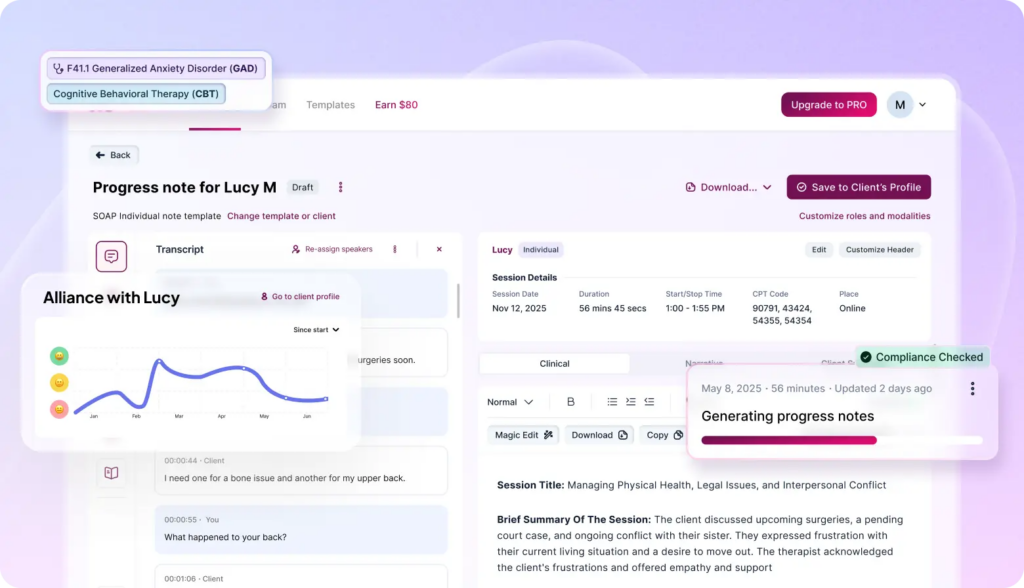
Documentation isn’t the problem, the time it takes is. Therapists must create accurate, clinically meaningful notes for insurance and continuity of care, and many end up finishing them after hours. Mentalyc ranks first because it reduces that burden without reducing quality.
Write less, focus more
Automate notes, treatment plans and progress tracking while keeping your clinical style and the Golden Thread.
- SOAP, DAP, BIRP, EMDR notes and more
- AI Treatment Planner
- AI Progress Tracker
- Alliance signals
- HIPAA & PHIPA compliant
New! Transfer your notes to EHR with a single click. No more copy-pasting.

It addresses this problem at its root: it turns each therapy session into structured, insurance-ready notes and keeps them aligned with treatment goals and overall clinical direction without questionnaires or extra work. Trusted by more than 30,000 clinicians, Mentalyc supports all client types and therapy formats while maintaining a privacy-first approach. It is also the only AI notetaker with Alliance Genie™, which surfaces relational insights that matter for engagement and outcomes.
Combined with streamlined treatment planning, SMART goal suggestions, and clear goal-to-note continuity, Mentalyc helps therapists maintain high-quality clinical documentation with substantially less effort.
Why Mentalyc Ranks First
- Clinical Continuity Built In — Notes, treatment plans, and progress tracking stay connected through the Golden Thread, giving therapists clear visibility of the client history across sessions.
- See What Truly Moves the Work Forward — Alliance Genie™ highlights attunement, collaboration, and potential ruptures so therapists can respond earlier and strengthen therapeutic progress.
- Privacy-First, Zero Storage — Fully HIPAA + PHIPA + BAA + SOC 2 Type II compliant, with no recording storage and no data used for training.
Key Features of Mentalyc
| Category | Features |
|---|---|
| Documentation |
|
| Treatment Planning & Progress Tracking |
|
| Clinical Insight & Reflection |
|
| Workflow & Privacy |
|
Pros
- Most accurate clinical language and highest clinical accuracy in the market
- Fastest workflow – saves hours weekly with true note-taking automation
- Fit different therapy setups, clients, approaches, etc.
- Strongest privacy and security model (HIPAA + PHIPAA + SOC 2 Type II)
- Strengthens clinical insight – helping therapists understand patterns across sessions that inform better care
- Designed to scale as its team plan smoothly into group-practice environments
Cons
- Designed specifically for mental health documentation, so it’s not suited for broader medical use cases.
- No built-in telehealth platform, but works smoothly with whatever tools clinicians already prefer (e.g., Zoom, Doxy).
Best For:
Therapists, counselors, social workers, psychologists, and PMHNPs who want fast, accurate documentation. Works well for solo providers, group practices, supervision teams, and agencies across all therapy formats.

Pricing:
- FREE Trial (USD 0) — 14 days of full PRO access, including 15 notes; no credit card required.
- Mini (USD 14.99/month billed annually) — For small caseloads. Everything you need to get started.
- Basic (USD 29.99/month billed annually) — For part-time work. Core features to save time and stay flexible.
- Pro (USD 59.99/month billed annually) — For full-time therapy. Powerful tools for deeper insights.
- Super (USD 99.99/month billed annually) — For unlimited use. All features unlocked. no limits, full control.
Visit the pricing page for more details.
User Reviews:
Eleos — Best for Enterprise Behavioral Health Teams
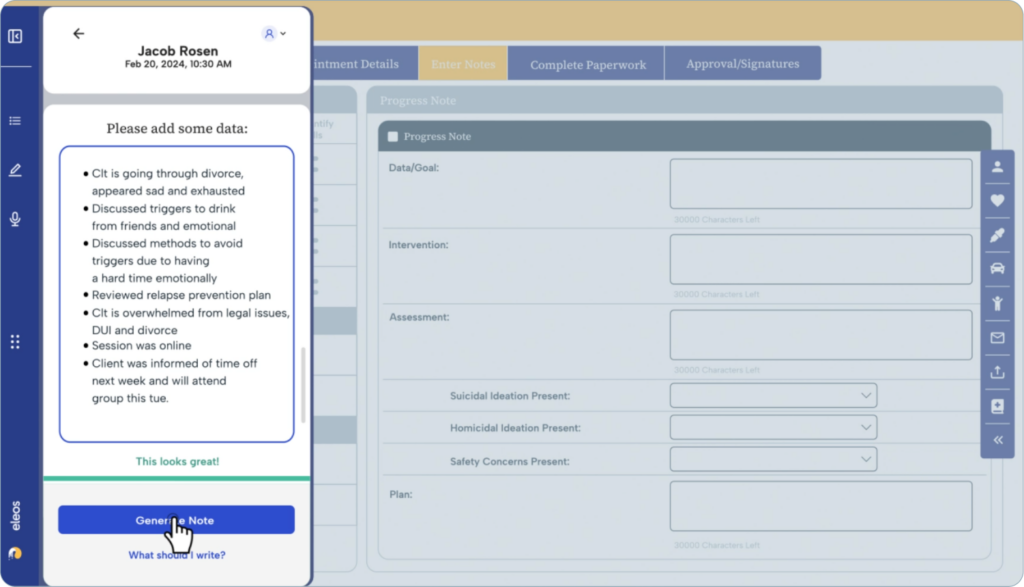
Eleos is built for mid-size and large behavioral health organizations that need standardized workflows, team oversight, and analytics-driven documentation. It generates automated draft notes from session transcription and offers supervision dashboards that help agencies maintain consistency across large teams. User feedback highlights limitations in flexibility and note depth:
“It is an input/output system, which is better when you have the device taking notes from the session directly. However, it is not as comprehensive when you use the note feature. Also, the device can only be used in a clinic. If you are seeing a client in the home or at the school, you can not use the box/ device.” – Abagail B, via **G2
Eleos is a strong fit for structured, in-clinic teams but less ideal for solo clinicians wanting an efficient workflow and high-quality notes.
Key Features
- Automated note drafting from recorded sessions
- Supervisor dashboards with performance insights
- Enterprise analytics and KPI reporting
- Integration with major EHRs
- Coaching, insights, and compliance tools
Pros
- Strong organizational analytics
- Good for multi-provider teams
- Consistent documentation standards across staff
Cons
- Stores recordings (privacy concern for some clinicians)
- More expensive than other AI note-taking tools
- Slower processing times reported by users
- Some reviewers noted “robotic” or repetitive note language
Best For:
Large clinics, agencies, and enterprise behavioral health teams needing analytics and supervision workflows.
Pricing:
- No Free Trial
- Pricing available upon request
Upheal — Best for Simple Note Drafting
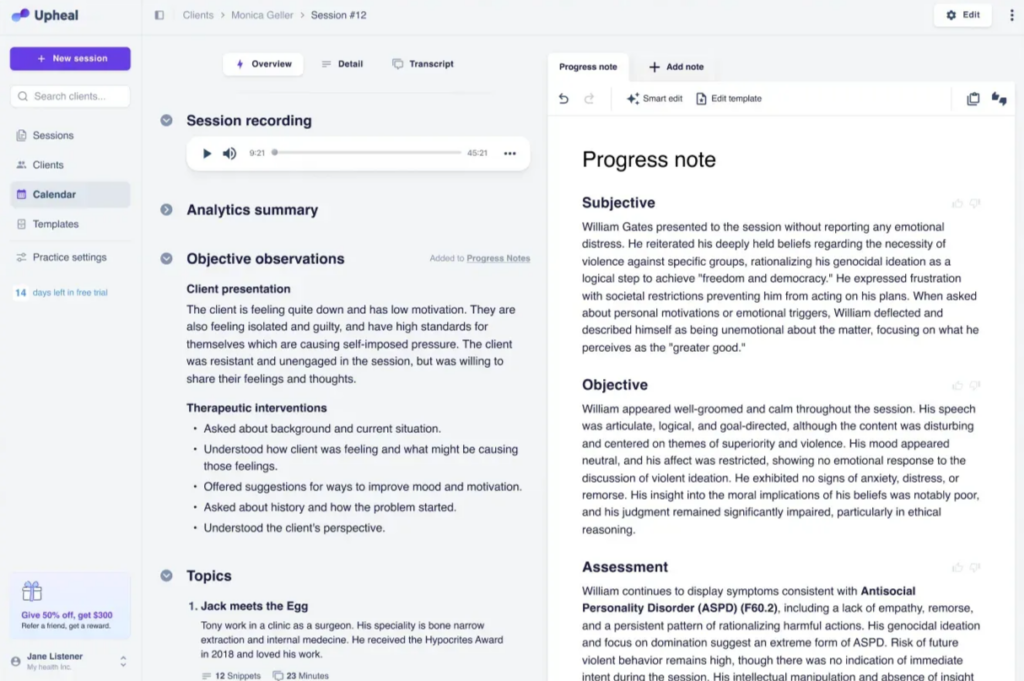
Upheal is a popular entry-level AI note taker, mainly because it offers free notes and a simple workflow. It’s used mostly by solo therapists and small practices who want basic automation from session recordings without deeper clinical insights or complex features. User feedback reflects both ease of use and common accuracy issues.
“Overall, my experience with Upheal is good… but it struggles with identifying speakers, adds dialogue that didn’t happen, repeats interventions, and fixing transcripts can become time-consuming when it’s unclear who said what.” — Letiesha Dunn, via TrustPilot
Upheal works best for straightforward drafting needs, though therapists requiring higher clinical accuracy may find its limitations noticeable.
Key Features
- Session recording + automatic summaries
- Draft notes in standard formats
- Client insights and visual summaries
- Easy-to-use dashboard
- Basic risk flags
Pros
- User-friendly
- Affordable entry price
- Good for simple notes
Cons
- Stores full recordings (privacy concern for some clinicians)
- Limited support for complex modalities
- Not suitable for medical or insurance-heavy documentation
- Inconsistent clinical accuracy
- Some features locked behind paid tiers
Best For:
Solo therapists wanting simple draft notes.
Pricing:
- Free Plan Available
- Starter Plan for Individuals – $19/month billed annually
- Premium Plan for Individuals – $69/month billed annually
- Group Plan – Contact Sales
- Enterprise Plan – Contact Sales
Blueprint — Best for Measurement-Based Care
Blueprint is primarily an outcomes-focused platform that combines measurement tools with basic AI drafting. It’s designed for clinicians who rely on repeated standardized assessments (PHQ-9, GAD-7, etc.) and want those scores reflected directly in progress charts and session documentation.
User feedback commonly mentions that while outcome scores are useful, the AI-generated notes can feel repetitive or overly dependent on scale data:
“Often notes are not accurate, they list of techniques so that is the majority of the note. The assessment section literally is just repeating what was already said, which seems like a waste. Often key content is lost or non-existent but if you run the note with another technique it will give you content that is missing. I have been on the fence as to whether this is actually saving me anytime because I spend so much time editing.” — Apricot cream Meadowlark, via Blueprint Feedback Portal.
Blueprint works best for clinicians working in insurance-heavy or measurement-based environments, but therapists who need flexible, modality-aligned notes may find its limitations noticeable.
Key Features
- Outcome measures (PHQ-9, GAD-7, etc.)
- Progress charts & symptom tracking
- Draft notes based on rating scale data
- EHR integrations
- Client engagement tools
Pros
- Reliable access to standardized assessments
- Supports insurance-driven documentation requirements
Cons
- Notes rely heavily on rating scales, limiting clinical depth
- Not ideal for complex or modality-specific psychotherapy
- Limited customization for different client types
- Some clinicians report confusing dashboards and repeated content
Best For:
Therapists, agencies, and clinics prioritizing outcomes tracking and insurance-mandated measurement-based care.
Pricing:
- Free Trial Available
- Standard – $0.24 per session
- Plus – $0.49 per session
- Pro – $1.49 per session
TherapyNotes — Best for EHR-Integrated AI Drafting
TherapyNotes is a widely used EHR and practice-management system that recently added AI-assisted note drafting (AI Note Assist / TherapyFuel Scribe). Rather than functioning as a standalone AI notetaker for therapists, the feature simply generates draft notes inside the existing EHR workflow. This makes it convenient for clinicians already committed to TherapyNotes, but it also means the AI is limited by the platform’s EHR-first design rather than optimized for advanced clinical insight or multi-modality documentation.
User feedback generally highlights convenience, while also noting limitations in customization—especially for forms and documentation:
“I wanted forms that were more customizable. This was the biggest reason that I changed platforms. I appreciated that the standard forms included necessary information, but they were not customizable enough for my specific niche/client population.” – Ceara, via Capterra.
TherapyNotes works best for clinicians who want basic AI drafting without switching systems, but therapists who need higher note’s quality may find this add-on comparatively limited.
Key Features
- Draft notes from uploaded/recorded transcripts using AI Note Assist
- Fully embedded within TherapyNotes’ scheduling, billing, and documentation workflow
- Built-in consent language and AI settings managed inside the EHR
- Standard note formats (e.g., SOAP, DAP) supported
Pros
- No new workflow — everything happens inside the existing EHR
- Easy setup for clinicians already using TherapyNotes
Cons
- AI capabilities are still early-stage with fewer customization options than specialized AI notetakers
- TherapyNotes retains transcripts/recordings longer than privacy-first tools
- Limited support for specialty formats (group therapy, family therapy, child sessions)
- Not optimized for advanced clinical insight, treatment planning, or alliance analysis
Best For
Clinicians already using TherapyNotes who want light AI drafting within the same EHR environment, without adding a separate documentation tool.
Pricing:
- Free Trial Available
- Solo — $69/month for One User
- Group — $79/month for the first clinician + $50/month per additional clinician
- Enterprise (30+ Users) — $79/month for the first clinician + $50/month per additional clinician
Heidi AI — Best for Mixed-Setting Medical
Heidi (Heidi Health) is positioned as a medical-grade AI scribe used across psychiatry, primary care, and specialist settings. It’s designed for clinicians who want automated transcription and structured medical documentation rather than psychotherapy-specific notes.
User feedback shows that while Heidi can produce detailed medical summaries when working properly, clinicians report significant reliability issues — including lost transcripts, inconsistent audio capture, and device-specific failures:
“I am a clinical psychologist, and I was using Heidi Health (HH) on my Android S24 during my clinical assessment diagnostic interviews, which normally last 2+ hours to aid my report writing. On August 28, 2025, I ran HH as per usual, using my S24 and when I finished the interview, I found that HH only transcribed the first 30 minutes of the interview and the last 5 minutes of the end. All the transcription in between disappeared! I contacted HH’s customer service, and their response was that this caused because HH HAS NOT UPDATED their HH Android app system…” – Les, via Trustpilot.
Heidi is best suited for medically oriented clinics that need broad documentation coverage, but therapists wanting consistent, modality-specific notes may find its instability and medical-first design limiting.
Key Features
- Real-time transcription for psychiatry + general medical visits
- Structured templates for SOAP, assessments, and clinical summaries
- EHR integrations across medical systems
- Claims compliance with HIPAA, SOC 2, and GDPR standards
Pros
- Covers both medical and mental-health documentation
- Useful in multidisciplinary clinics with mixed provider teams
- Can automate long, medically oriented clinical encounters
Cons
- Reliability issues reported: missing transcripts, audio capture failures, device incompatibility
- Not optimized for therapy frameworks (CBT, EMDR, couples, family work)
- Requires customization to fit psychotherapy workflows
- Higher pricing than typical therapist-focused AI tools
Best For
Clinics combining psychiatry + general medicine + therapy, or healthcare systems needing a single scribing solution across multiple provider types.
Pricing:
- Free Version Available
- Pro — $90 per user / month
- Practice — $120 per user / month
- Enterprise — Custom Pricing
SimplePractice AI Note Taker (Add-On) — Best for EHR Users Wanting Minimal Setup
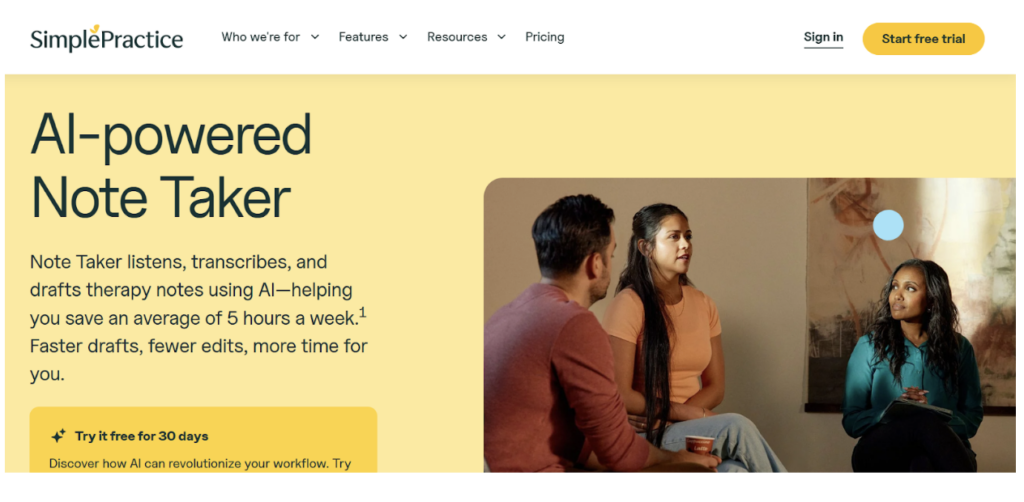
SimplePractice’s AI Note Assistant is an add-on feature intended to help clinicians generate draft notes inside the existing EHR. It supports dictation, audio uploads, or typed summaries and produces basic SOAP/DAP-style drafts.
Because it’s built directly into SimplePractice, the main appeal is convenience rather than clinical sophistication. Public feedback — including from clients whose therapists use the tool — highlights concerns about device limitations and unclear privacy assurances:
“I am a CLIENT of a psychotherapist who uses this. It only works on phones and iPads–not laptops, so the visual is small and unsatisfactory. The terms of service provide NO ASSURANCE of privacy, and the Bot-driven help makes me think it is like every other app that is just mining my data to be able to sell me something. I will quit this provider because this is then only option.” – Teri Bernstein, via Trustpilot.
SimplePractice AI Note Assistant works best only for clinicians already committed to the SimplePractice ecosystem who want lightweight drafting without changing platforms, but therapists needing advanced clinical accuracy or full privacy transparency may find its features limiting.
Key Features
- Built directly into SimplePractice: record, dictate, or upload audio/text
- Generates draft SOAP, DAP, and BIRP notes
- Uses SP’s existing HITRUST-certified infrastructure
- Designed for quick, in-EHR drafting rather than deep clinical insight
Pros
- Convenient for current SimplePractice users
- No need to switch between platforms
- Works for basic documentation workflows
Cons
- User reports of device limitations (mobile/iPad only for some AI features)
- Privacy concerns due to reliance on external AI models and unclear training policies
- Less customization than therapy-focused AI tools
- Limited support for complex sessions (families, couples, groups)
- Not designed for advanced clinical reasoning, treatment planning, or progress tracking
Best For
Clinicians already using SimplePractice who want basic AI drafting built into their existing EHR and do not require deep customization or advanced clinical features.
Pricing:
- Free Trial Available
- Starter — $24.50/month For 3 months, then $49 billed monthly
- Essential — $39.50/month For 3 months, then $79 billed monthly
- Plus — $49.50/month For 3 months, then $99 billed monthly
- AI-powered Note Taker (Add-On) — Add for $17.50/month For 3 months, then $35 billed monthly
Final Recommendation: Which is the Best AI Notetaker for 2026
After evaluating workflow efficiency, clinical accuracy, privacy standards, and real therapist feedback, Mentalyc emerges as the top AI notetaker for 2026. It offers a uniquely comprehensive approach to documentation—transforming each session into clear, structured, insurance-ready notes while maintaining continuity across goals, treatment plans, and progress over time.
Why Mentalyc Ranks #1
- Fast, accurate, fully automated documentation across all client types and modalities
- Goal-to-note continuity that strengthens clinical alignment and supports insurance requirements
- Alliance Genie™, progress insights, and SMART goal support for deeper clinical awareness
- Zero recording storage and SOC 2 Type II security for unmatched privacy and trust
If documentation is taking over your evenings or breaking your clinical flow, Mentalyc offers a way to work more efficiently without sacrificing quality. Its privacy-first design, intelligent workflow, and clinically informed insights make it the most complete and reliable AI notetaker for therapists in 2026.
Frequently Asked Questions (FAQs) on The Best AI Notetaker for Therapists in 2026
1. What is the best AI notetaker for therapists?
There is no single “best” tool for everyone. The right choice depends on your workflow, caseload, and privacy needs. Based on real therapist reviews and feature analysis, the top three options for 2026 are Mentalyc, Eleos, and Upheal.
- Mentalyc ranks highest overall for automation, accuracy, and privacy.
- Eleos is preferred for enterprise and team-based behavioral health settings.
- Upheal is best for budget-friendly note drafting.
These rankings reflect factors such as clinical accuracy, security practices, ease of use, workflow fit, and long-term value.
2. How do AI notetakers improve documentation?
AI notetakers streamline the entire documentation process by generating structured drafts instantly after a session. They help therapists work faster, reduce human error, and produce clearer, more consistent notes. Most importantly, they significantly reduce burnout by eliminating the late-night and weekend paperwork many clinicians face. High-quality AI tools can also create insurance-ready notes, aligning documentation with treatment goals and clinical standards.
3. Are AI notetakers HIPAA compliant?
Many AI tools are designed to follow HIPAA guidelines, but their privacy and security practices vary widely. A fully compliant platform should offer encrypted data handling, access controls, audit logs, and secure session processing. It is also essential to evaluate whether the tool stores recordings, how long data is retained, and whether client information is used for model training. Always review each vendor’s compliance documentation and privacy policy before use.
4. Can AI notetakers replace a therapist’s clinical judgment?
No. AI tools cannot replace professional reasoning, therapeutic decision-making, or clinical expertise. They are designed to support clinicians by improving clarity, consistency, and structure, not to deliver diagnoses or interventions. Therapists must always review and approve every note for accuracy and alignment with clinical care.
5. Is it safe to upload therapy recordings?
Safety depends on the platform’s storage and data-handling practices. Some AI tools store recordings or transcripts in the cloud, which may pose long-term privacy risks. Others use zero-storage models, processing audio without saving it. These tools offer the highest level of privacy and are preferred by clinicians who prioritize client confidentiality. Always look for clear disclosures about storage duration, encryption, and whether data is used to train AI models.
Why other mental health professionals love Mentalyc

“A lot of my clients love the functionality where I can send them a summary of what we addressed during the session, and they find it very helpful and enlightening.”
Therapist

“By the end of the day, usually by the end of the session, I have my documentation done. I have a thorough, comprehensive note … It’s just saving me hours every week.”
CDCII

“It’s so quick and easy to do notes now … I used to stay late two hours to finish my notes. Now it’s a breeze.”
Licensed Professional Counselor

“Having Mentalyc take away some of the work from me has allowed me to be more present when I’m in session with clients … it took a lot of pressure off.”
LPC