
If you are evaluating Eleos Health (often searched as Eleos AI) for your group practice or agency, here is the short version. Eleos is a capable, enterprise-grade behavioral health AI built for large organizations, community mental health, and substance use disorder programs. It does group documentation genuinely well. But it is sold through demos and custom contracts rather than transparent pricing, it is built around organizational oversight of clinicians, and therapists have raised real concerns about client consent. For a group practice that wants the same time savings without the enterprise lift or the top-down feel, there is a more clinician-friendly alternative, covered at the end.
We publish this comparison and we make Mentalyc, one of the alternatives discussed below. We have kept every claim about Eleos sourced to Eleos’s own pages or named third-party reviews, with dates, so you can verify them yourself.
Eleos Health at a glance
| Capability | Eleos Health | A group-practice-friendly alternative (Mentalyc) |
|---|---|---|
| Built for | Large agencies, community behavioral health, SUD programs | Solo clinicians and group practices |
| How you buy it | Demo and custom quote; no public pricing | Transparent monthly plans, free trial |
| Input methods | Ambient audio, text summary, or voice summary | Dictation, uploaded audio, or text |
| Audio/transcript | Analyzed in real time, not saved; only note text stored | No stored audio; AI does not train on client PHI |
| Group therapy notes | Group note + participant summaries, ASAM-aligned | Per-member group therapy notes (higher tiers) |
| Analytics orientation | Supervisor-facing analytics: talk-listen ratios, technique tracking, and clinician activity visibility (per Eleos’s own product pages and named reviewer accounts on Capterra/Software Advice) | The individual clinician’s own clinical insight |
| Best for | Multi-site organizations with supervision needs | Small-to-mid group practices that want to set it up themselves |
What is Eleos Health?
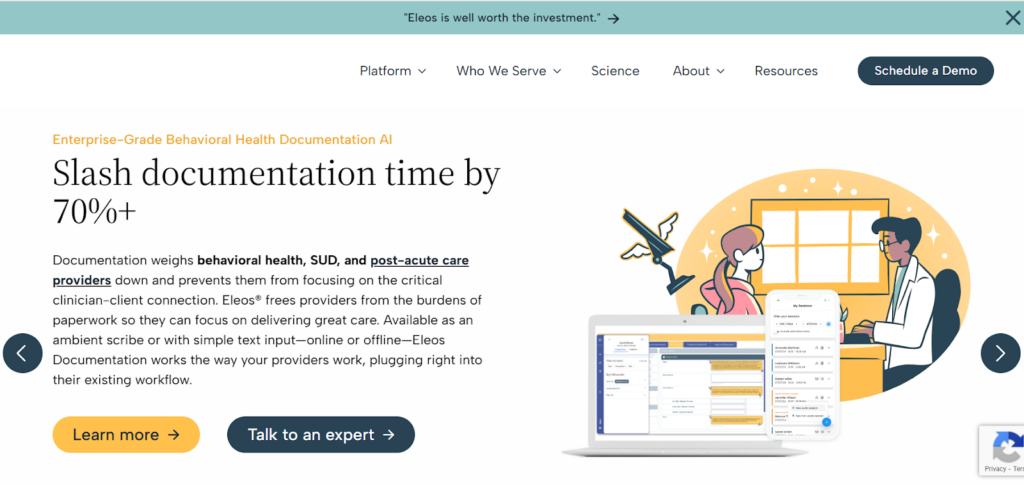
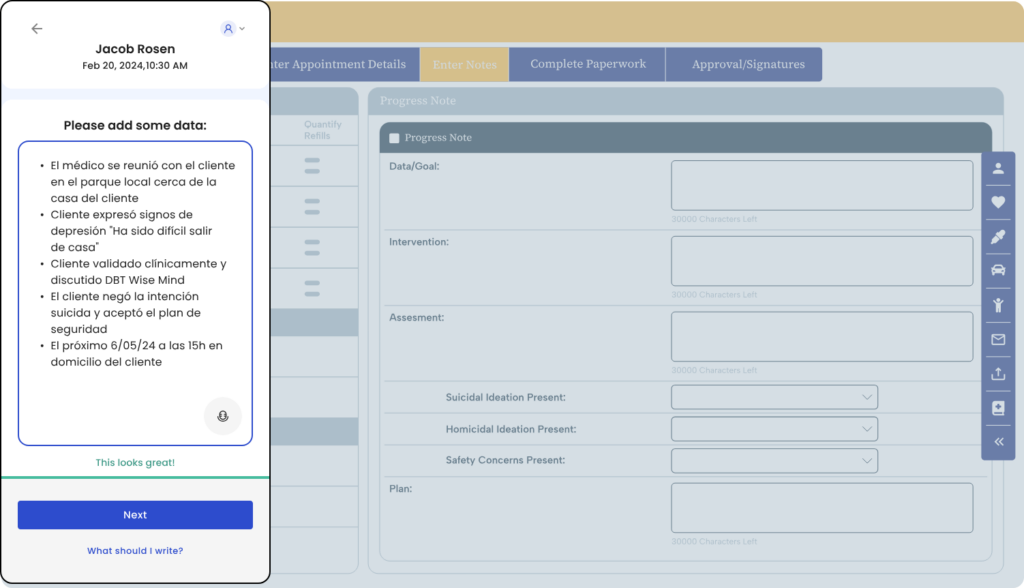
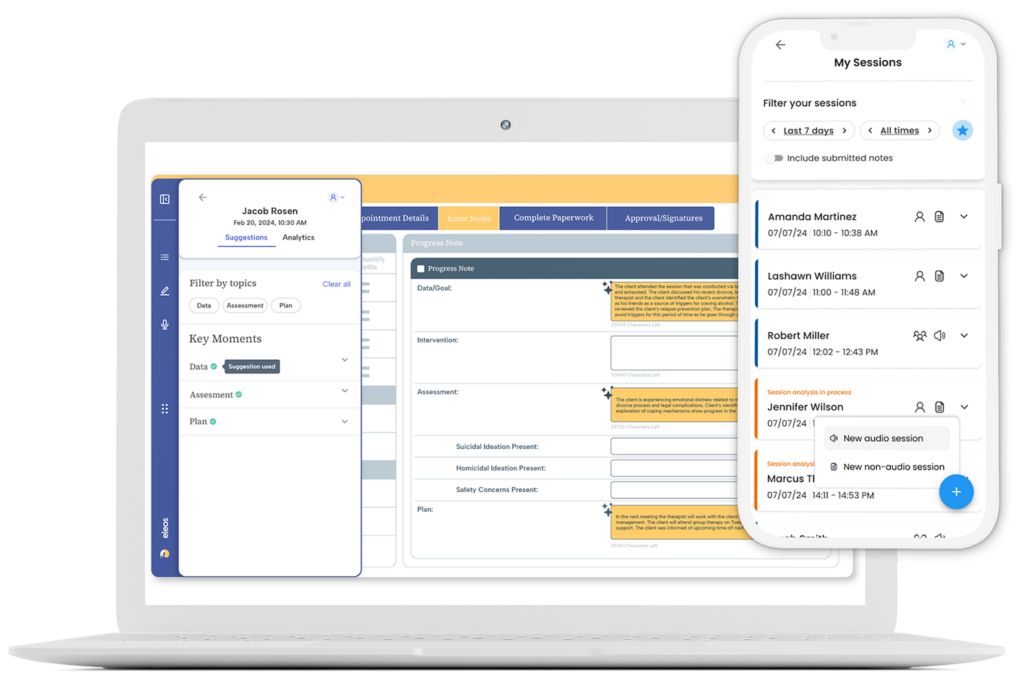
Eleos Health is an AI documentation and clinical-insights platform for behavioral health organizations. It describes itself as the “system of action for community-based care,” and it sells primarily to community mental health agencies, substance use disorder programs, and care-at-home providers rather than to individual therapists buying a subscription. Clinicians capture a session (or type a short summary), and Eleos drafts compliant note content inside a browser extension that overlays the organization’s web-based EHR.
In practice, Eleos is an organization-first product. Its onboarding, its analytics, and its procurement all assume an agency is buying it for a team, which is the root of most of the trade-offs below.
Spend less time writing, more time with clients.

How does Eleos Health work?
Eleos gives clinicians three ways to document, and it does not keep a recording. A clinician can capture live session audio ambiently, type a short text summary (which works offline), or record a quick voice summary, and Eleos expands the input into note suggestions for the chosen note type. Eleos states that it analyzes audio in real time without generating a transcript, that audio is not saved, and that only the text needed for the note is stored.
For group therapy specifically, Eleos captures the full session, separates speakers, and produces one group note plus participant-level summaries aligned to payer and ASAM criteria, a genuinely useful capability for high-volume SUD programs running multiple groups a day. The trade-off is that to access it, you’re in an enterprise contract with organizational oversight of every session. Whether that trade-off is worth it depends entirely on who controls your documentation.
How much does Eleos Health cost? (Eleos Health pricing)
Eleos Health does not publish pricing. There is no public per-seat rate and no self-serve plan; you go through a demo and receive a custom quote. Review platforms list pricing as “available upon request,” and a recurring note in reviews is that the cost requires internal justification. As one IT director put it on Software Advice, “The price tag can initially cause a sticker shock to management. So, you would have to do some leg work to prove ROI.”
For a group practice, the practical takeaway is that you cannot compare Eleos on price without booking a sales call, and you should expect an organization-level contract rather than a month-to-month subscription. If transparent, self-serve pricing matters to you, that is a meaningful difference from clinician-focused tools.
Is Eleos Health worth it? (Eleos Health reviews)
On the major review platforms, Eleos rates highly: roughly 5.0 out of 5 across about 21 reviews on Capterra, Software Advice, and GetApp as of June 2026. The volume is modest, so treat the score as encouraging rather than statistically heavy, but the sentiment from agency buyers is genuinely positive on time savings and customer support.
The recurring criticisms worth knowing before a demo:
- Hardware friction. A reviewer noted the Sensi capture device “would benefit from a higher ghz to minimize interference issues.”
- Inconsistency. Another reported the system “sometimes lacks consistency. It doesn’t always give the prompts and pop-ups it’s supposed to”. For a clinician running back-to-back sessions who depends on the tool to catch what they missed, inconsistent prompting is documentation risk, not just a software nuisance.
- The text path needs more editing. A reviewer observed the audio tool is “very accurate requiring very little correction while the non-audio tool… needs a little more staff correction”. For clinicians who prefer not to record sessions with clients, or work in settings where ambient recording raises consent concerns, the text path is the primary input, and it requires meaningfully more editing time.
- Fit gaps. One reviewer found it “difficult to use for family delivered services.”
Is Eleos Health HIPAA compliant and secure?
Eleos checks the compliance boxes. It offers a BAA and lists SOC 2 Type II, HITRUST, ISO 27001, and ISO/IEC 42001 on its trust center. For large agencies where procurement requires an established compliance stack, those credentials matter. Two caveats are more relevant for a group practice evaluating on their own: First, the full security documentation (BAA, SOC 2 report) sits behind a request gate on Eleos’s trust center rather than being public. Second, Eleos’s own terms place responsibility for obtaining client consent to record on the clinician, and recording laws vary by jurisdiction. That second point connects directly to a concern therapists have raised publicly. Agencies with procurement teams handle this easily; a group practice owner evaluating a tool on a Tuesday afternoon cannot.
The concern therapists raise: client consent and clinician oversight
The concern about recording without clear clinical and ethical frameworks is widespread on r/therapists:
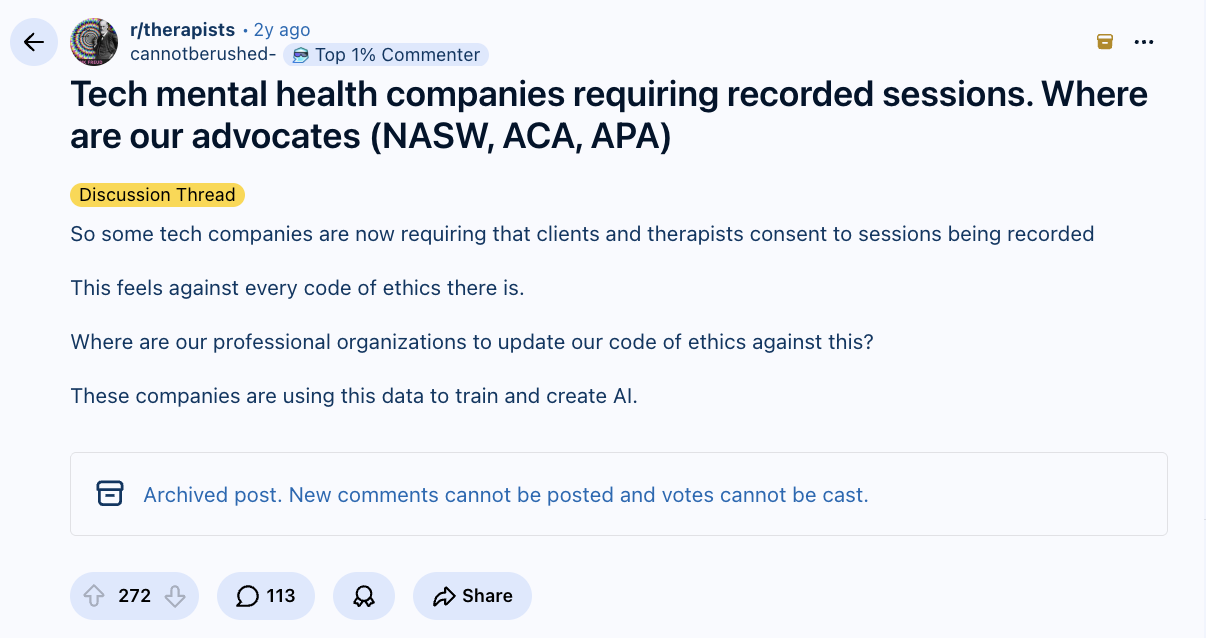
This is the issue that comes up most often in clinician communities, and it is worth taking seriously regardless of which tool you choose.
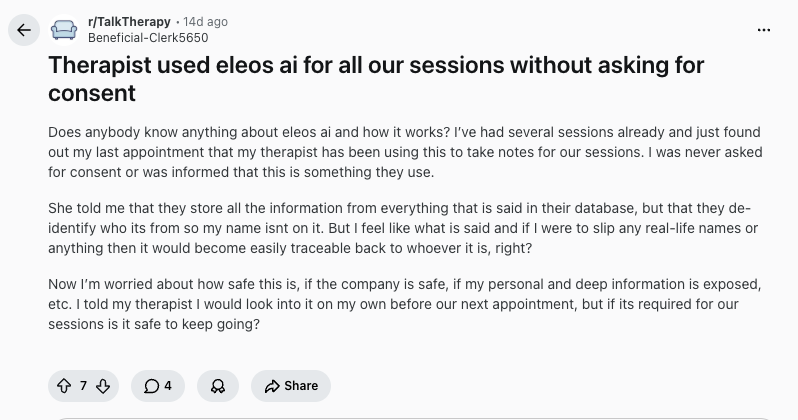
On consent: in a 2026 r/TalkTherapy thread, a client wrote that they only discovered mid-treatment that their therapist had been using Eleos, saying they were “never asked for consent or was informed that this is something they use.” On r/socialwork, a community mental health clinician said they had “made it very clear to my supervisors that I don’t feel comfortable using the ‘listening’ feature until I’m able to understand it enough to explain it to my clients.”
Write less, focus more
- SOAP, DAP, BIRP, EMDR notes and more
- AI Treatment Planner
- AI Progress Tracker
- Alliance signals
- HIPAA & PHIPA compliant

On oversight: because Eleos surfaces analytics like talk-versus-listen ratios and technique use, some clinicians worry these become a supervision tool pointed at them. As one r/therapists commenter put it, the analytics could mean “directors will know if they have unproductive clinicians.” For an agency standardizing documentation across hundreds of clinicians, that oversight is a feature. For a small, collaborative group practice, it can feel like surveillance.
This is the core fit question. Eleos is built for an organization that wants to monitor and standardize. If that is your agency, it fits. If you are a group practice that grows by trusting and developing clinicians rather than monitoring them, the orientation may be wrong for you.
Who Eleos Health is best for
Eleos is a strong, defensible choice if you are a large behavioral health organization, a community mental health center, or a substance use disorder program that needs group-note speaker separation, ASAM-aligned compliance, supervisory analytics, and enterprise security across many clinicians. In that setting, the organizational orientation is exactly what you want.
It tends to fit less well for solo clinicians and small-to-mid group practices that want to buy and set up the tool themselves, see transparent pricing, and keep clinical insight in the clinician’s hands rather than an oversight dashboard.
A better fit for group practices that want collaboration, not control
If you are a group practice drawn to Eleos for the time savings but put off by the enterprise contract and the top-down feel, Mentalyc is built for you. (Disclosure: Mentalyc is our product.) It is a HIPAA-compliant AI notetaker designed for individual clinicians and growing group practices, where the team adopts it together rather than having it pushed down from administration.
Where it fits a collaborative group practice better than an enterprise tool:
- Mentalyc starts at $19.99/month with a 14-day free trial; no sales call, no custom contract.
- Insight serves the clinician, not a monitor. Progress tracking and Alliance Genie give the therapist feedback on their own work and the therapeutic alliance, rather than feeding a supervisor’s productivity dashboard.
- Group practice ready. Per-member group therapy notes, a built-in AI Treatment Planner, and continuity across sessions, scaling from one clinician to a team without an enterprise rollout.
- For clinicians who need a simple, honest answer when a client asks how their session data is handled, Mentalyc’s position is straightforward: no stored audio, and the AI does not train on client PHI.
If your practice grows by developing clinicians rather than monitoring them, that difference in orientation matters more than any single feature.
Try Mentalyc free: https://app.mentalyc.com/register
Switching from Eleos to a clinician-owned tool
Moving is straightforward because Mentalyc does not require an EHR integration project. There is no enterprise onboarding: start a free trial, generate your note types (SOAP, DAP, BIRP, GIRP, EMDR, intake, group), and paste finished notes into whatever EHR you already use. A clinician can run a real session through it the same day, which is the fastest way to compare note quality against Eleos’s output for your own caseload.

Frequently Asked Questions
Disclosure and sources
Mentalyc, recommended above, is our product. Every factual claim about Eleos is sourced and was verified on June 16, 2026. Eleos changes its product and positioning often, so check the live pages for the current state.
Sources
- Eleos Health, Individual Therapy (input methods, no transcript, audio not saved): https://eleos.health/individual-therapy/
- Eleos Health, Group Therapy (group and participant notes, ASAM criteria): https://eleos.health/group-therapy/
- Eleos Health, Security (PHI flow, de-identified audio only, no sell or license, consent is the clinician’s responsibility): https://eleos.health/security/
- Eleos Health, Trust Center (SOC 2 Type II, HITRUST, ISO 27001, ISO 42001, NIST CSF, HIPAA, BAA, documents gated): https://trust.eleos.health/
- Eleos Health, Terms (liability cap, one-year claim window, Delaware jurisdiction, AS-IS): https://eleos.health/terms/
- Eleos Health, Privacy Policy (patient session data governed by the BAA, not this policy): https://eleos.health/privacy/
- Capterra, Eleos Health reviews (5.0 of 5, 21 reviews; Sensi-device interference, Lisa K. Sept 2024; inconsistent prompts, Allison G. Mar 2025): https://www.capterra.com/p/204664/Eleos-Health/reviews/
- Software Advice, Eleos Health (5.0 of 5, 21; pricing sticker-shock, Rony G. Aug 2024; non-audio tool needs more correction, Sharanjit S. Aug 2024): https://www.softwareadvice.com/product/487092-Eleos-Health/
- GetApp, Eleos Health (5.0 of 5, 21; difficult for family delivered services, Kristin K.): https://www.getapp.com/healthcare-pharmaceuticals-software/a/eleos-health/
- G2, Eleos Health (4.9 of 5, 12 reviews): https://www.g2.com/products/eleos-health
- Glassdoor, Eleos Health employer reviews (4.7 of 5, 62; context only, not product evidence): https://www.glassdoor.com/Reviews/Eleos-Health-Reviews-E5008518.htm
- Reddit, r/TalkTherapy, therapist used Eleos AI without asking for consent (2026, patient): https://www.reddit.com/r/TalkTherapy/
- Reddit, r/socialwork, Eleos Health (2025, clinician on the listening feature and consent): https://www.reddit.com/r/socialwork/
- Reddit, r/therapists, Eleos AI (2024, clinician on analytics and oversight): https://www.reddit.com/r/therapists/
- Eleos Health 60M Series C, Jan 2025, 120M+ total funding, privately held: Behavioral Health Business, Fierce Healthcare, BusinessWire
Why other mental health professionals love Mentalyc

“Do yourself a favor, make your life easier. I found Mentalyc to be one of the best tools that I’ve ever used.”
Licensed Marriage and Family Therapist

“For anyone hesitant: this is a lifesaver. It will change your life, and you have more time to be present with your patients.”
Licensed Clinical Social Worker

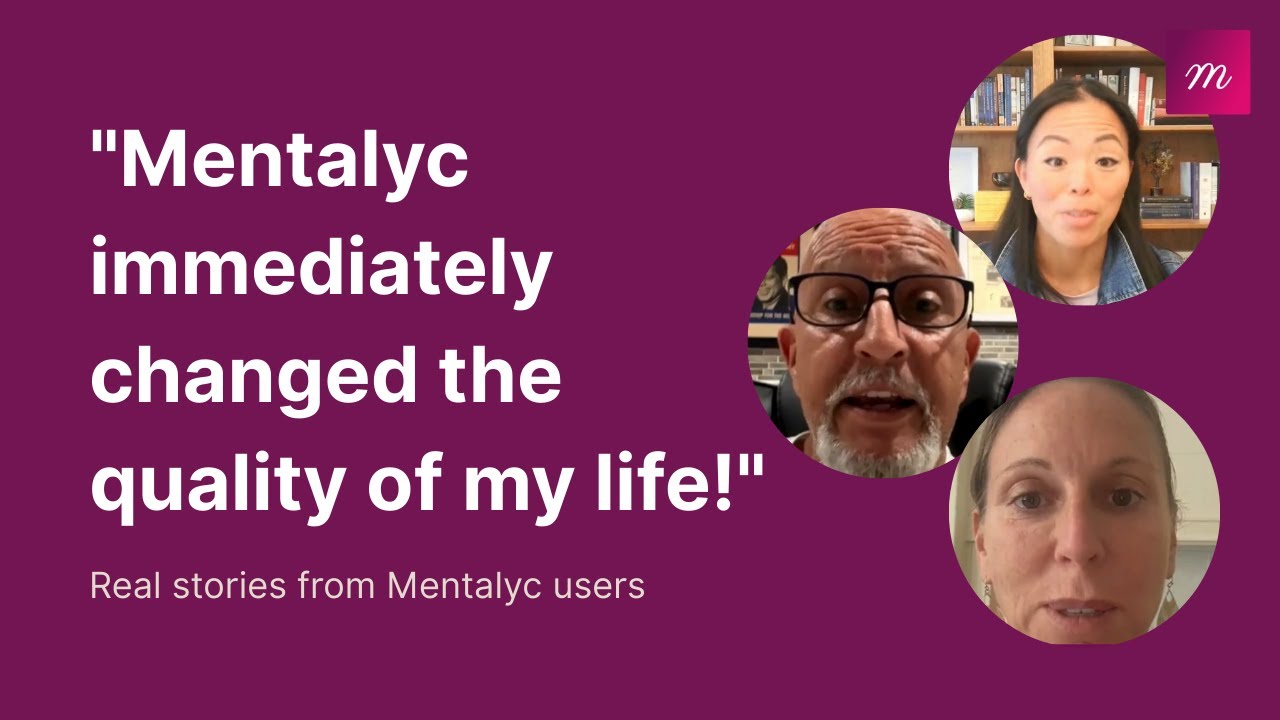
“It immediately changed my quality of life, personally and professionally.”
Owner/Independently Licensed Marriage & Family Therapist (LMFT)

“If I were recommending this software to a colleague, I would tell them that it is the best thing that they could do for their practice.”
Licensed Professional Counselor