
Most therapists want to grow their clinical skills; not just earn CE credits, but actually become more attuned, confident, and effective in session. The problem is finding the time and support to do that while managing full caseloads, heavy documentation, and the emotional demands of the work.
Traditional therapist education often falls short. In-person trainings require time away from clients, supervision can be costly or inconsistent, and many CE courses don’t translate into real-world skill development, especially for therapists in private practice. Without structured feedback, meaningful reflective practice is hard to sustain, and clinical blind spots can go unnoticed.
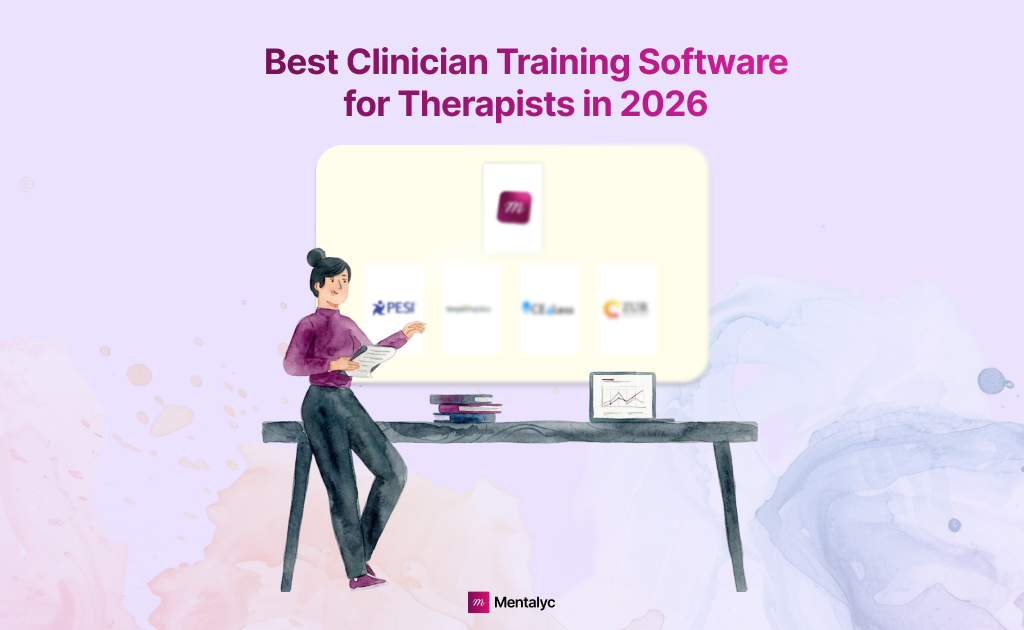
That’s why modern therapist upskilling platforms are evolving. The best clinician training software today supports real-session reflection, strengthens alliance-building and communication skills, and helps therapists grow over time – without adding extra work. This guide reviews the best clinician training software for therapists in 2026, based on real reviews and practical clinical impact.
7 Best Clinician Training Tools in 2026
| Tool | Best For | CEU Accredited | Learning Format | Key Skills Developed | Interactivity Level | Privacy / Data Handling | Pricing | Overall Rating |
|---|---|---|---|---|---|---|---|---|
| Alliance Genie™ (by Mentalyc) | Reflecting on real-session dynamics and therapeutic alliance | No | Session-based analysis with guided clinician insights | Alliance-building, attunement, communication awareness, session flow | High | HIPAA + PHI + SOC 2 Compliant; zero recording storage | 14-Day FREE Trial | A+ |
| PESI | Modality depth & CE variety | Yes | Live + recorded CE | Trauma, EMDR, somatic, specialty modalities | Medium | Standard compliance | Varies by course | A |
| SimplePractice Learning | Structured, self-paced CE | Yes | Video modules + assessments | Ethics, fundamentals, clinical foundations | Medium | Standard compliance | From $24.50/month | A- |
| CE4Less | Budget-friendly CE | Yes | Self-paced courses | Broad CE coverage | Low | Standard compliance | Unlimited Plans and Individual Course pricing available | B+ |
| Zur Institute | Ethics & niche topics | Yes | Courses, articles, webinars | Ethics, boundaries, telehealth competence | Medium | Standard compliance | $19–$199 | B+ |
What Determines a “Best” Clinician Training Software (2026)
The best therapist training tools support real clinical growth—not just content consumption. Strong platforms combine practical skill development, credible therapist education, and formats that translate directly into everyday therapeutic work.
Turn documentation into insights with Mentalyc

New! Transfer your notes to EHR with a single click. No more copy-pasting.
Clinical relevance
Training should reflect what therapists actually do in session. The most effective platforms focus on real client scenarios and modern clinical skills, supporting attunement, decision-making, and therapeutic presence.
Real-world skill improvement
High-quality tools go beyond theory and traditional CE courses. They help therapists improve timing, responsiveness, and in-session communication—so growth is felt in the room, not just on paper.
Learning depth & formats
Case-based learning, simulations, and experiential formats mirror real clinical complexity and help therapists apply skills across different client presentations.
Usability & time efficiency
The best tools fit into a full caseload. Platforms should be intuitive, efficient, and valuable without adding cognitive or administrative burden.
Reflection & long-term growth
Effective platforms support ongoing reflective practice, helping therapists identify blind spots, build on strengths, and refine their therapeutic voice over time.
Fit across experience levels
Strong systems support new, midcareer, and experienced clinicians with learning paths that adapt as clinical responsibility grows.
Overall, platforms that strengthen alliance-building, clinical reasoning, and in-session communication tend to rank highest, as they help therapists better understand how moment-to-moment interactions affect client engagement, trust, and progress over time.
Key Features Therapists Should Look For in Training Platforms (2026)
The best clinician training software for therapists should offer more than information; it should meaningfully strengthen clinical skills, support ongoing therapist education, and enhance everyday therapeutic effectiveness. Below are the core features that matter most in real clinical practice.
| Key Feature | Why It Matters for Therapists |
|---|---|
| Applied skill development | Focuses on real in-session decisions, attunement, and therapeutic presence—so learning shows up directly in clinical work. |
| Feedback loops | Supervision-like insights and communication cues support deeper reflective practice and help identify blind spots over time. |
| CE options (when needed) | Accredited CE courses allow clinicians to meet licensure requirements without sacrificing clinical relevance. |
| Modality depth | Coverage across trauma, somatic work, DBT, EFT, ACT, EMDR, and integrative approaches supports ongoing therapist education. |
| Case-based learning | Realistic scenarios help bridge theory and clinical skills, making concepts easier to apply across client presentations. |
| Roleplays & simulations | Experiential learning allows therapists to practice interventions before using them in live sessions. |
| Growth tracking | Makes therapist development visible over time by tracking improvements in skills, confidence, and clinical patterns. |
| Progress measurement | Helps clinicians see changes in communication, alliance-building, or intervention use with tangible indicators of growth. |
| Ease of use | Fits naturally into a busy schedule—learning should feel supportive, not like another task. |
| Documentation support | Certificates or records help clinicians stay organized for audits, renewals, and insurance requirements. |
Ranked List: Best Clinician Training Software for Therapists in 2026
Alliance Genie™ (Mentalyc) — Best for Real-Session Clinical Skill Growth (Rank #1)
Overview
Automate documentation and session analytics with Mentalyc
From intake to progress and treatment planning — automated, and aligned with your clinical style.
- HIPAA, PHIPA & SOC2 Compliant
- SOAP, DAP, BIRP, EMDR & more formats
- AI Treatment Planner
- AI Progress Tracker for goals & symptoms tracking
- Alliance insights
New! Transfer your notes to EHR with a single click. No more copy-pasting.

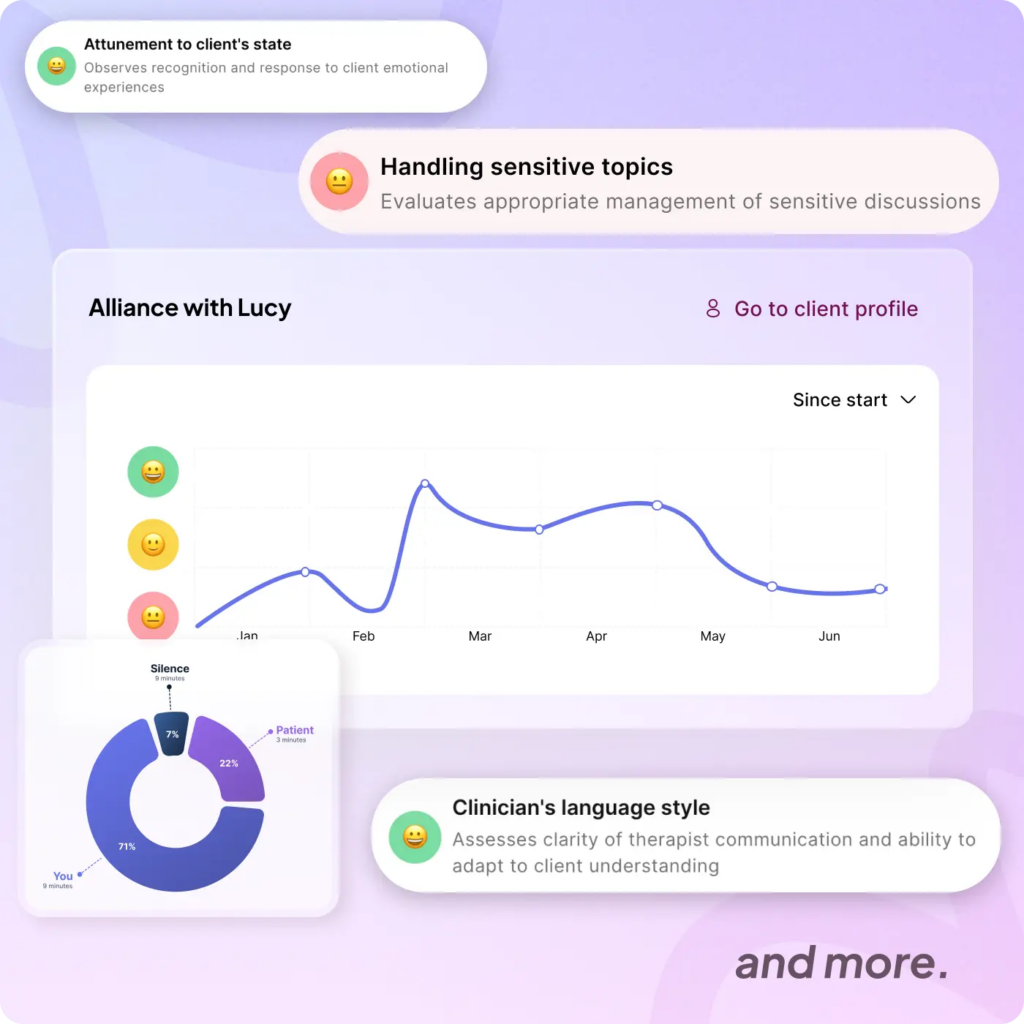
Alliance Genie™ from Mentalyc is a session-informed clinical intelligence tool designed to help therapists grow by analyzing their real sessions, without storing audio or video. It identifies communication patterns, attunement cues, and alliance strengths to provide guidance that feels similar to having a supervisor present. Ideal for private-practice and group-practice clinicians, Alliance Genie™ offers continuous, real-time professional development grounded in actual client work.
User Reviews:
Why other mental health professionals love Mentalyc

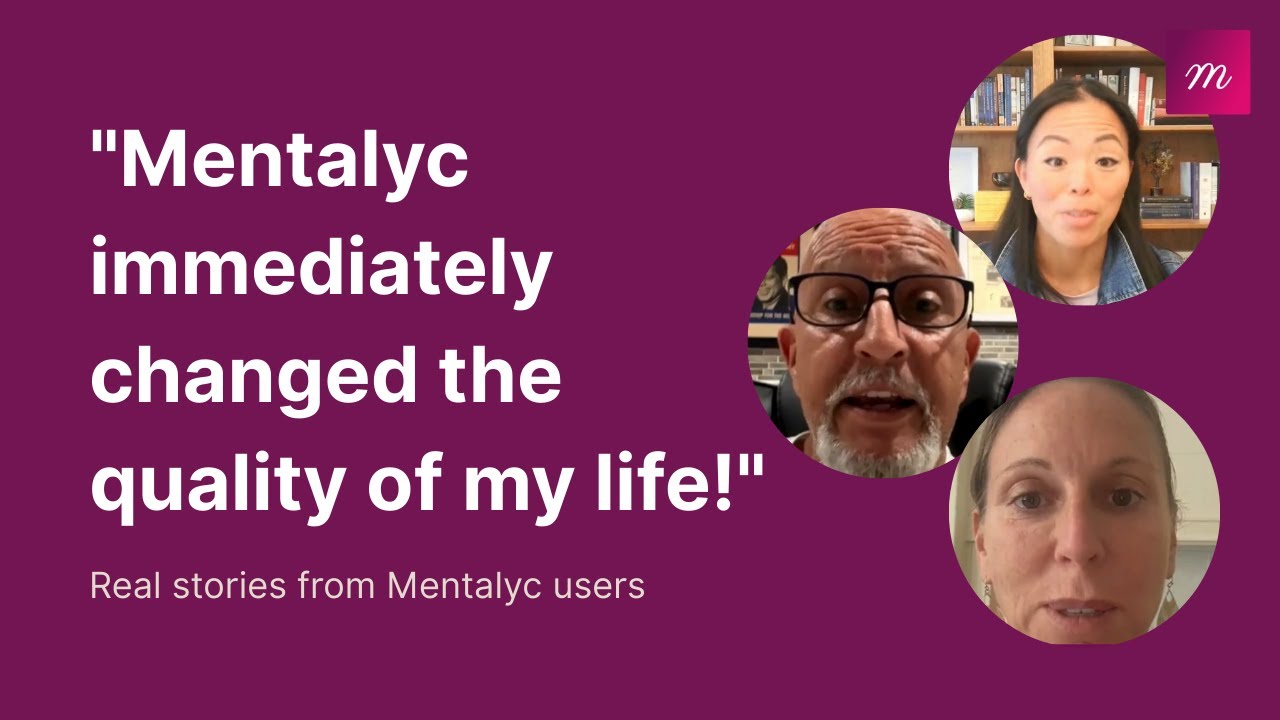
“Reading transcripts helps me tighten up and come across more the way I want to present myself to clients … it’s helped me improve and keep getting better.”
Licensed Marriage and Family Therapist

“It’s really giving me some good confidence … and areas of improvement to see nuances I didn’t see before.”

“There is a lot more feedback and suggestions in it than before … that makes things a little bit easier for me.”

“Using Alliance Genie has really improved my notes … It tells me what I’m doing and gives me an approach of what’s next.”

“It keeps me on a level of assessment about the relationship that has a little bit more objectivity. It helps keep me grounded.”
LPC
Why Alliance Genie™ Ranks First
Alliance Genie™ ranks first because it addresses a gap most traditional training tools miss: helping therapists understand how their real sessions unfold, not just how therapy is taught in theory. Rather than relying on simulations or coursework, Alliance Genie™ supports growth through structured reflection on authentic session dialogue—without storing any recordings.
It’s important to note that Alliance Genie™ is not a CEU platform. Instead, it functions as a session-informed clinical reflection tool that helps therapists see patterns in alliance, communication, and attunement as they emerge in their everyday work. By surfacing supervision-like insights between sessions, it supports ongoing development without the time, cost, or scheduling constraints of traditional supervision.
Built with a privacy-first architecture, Alliance Genie™ is fully HIPAA and SOC 2 Type II compliant. Session audio is not stored, and clinician data is never used for model training – ensuring reflection without compromising client trust.
Key Features of Alliance Genie

- Analyzes real therapy dialogue rather than roleplays or simulations
- Makes alliance, attunement, and communication patterns more visible
- Helps identify blind spots and subtle missed moments between sessions
- Offers supervision-like reflection without scheduling barriers
- Supports ongoing reflective practice grounded in actual client work
- Designed with privacy-first safeguards (HIPAA + SOC 2 Type II, no recording storage)
Pros
- Real-session–based clinical growth
- Develops skills faster and more naturally than CE-only platforms
- Supports both new and experienced clinicians
- Directly strengthens the therapeutic alliance
- No scheduling required — feedback available anytime
Cons
- Does not provide CEU credits
Best For:
Alliance Genie™ is best suited for private-practice clinicians and early-career therapists who want structured guidance without relying on formal supervision. It’s especially helpful for clinicians who don’t have consistent access to supervision, as well as group practices looking for shared growth and benchmarking insights. Overall, it’s ideal for therapists who want to strengthen their in-session communication, therapeutic presence, and attunement over time.
Pricing:
- Free Trial: 14 days of full PRO access
- Basic: USD 29.99/month billed annually (Alliance Genie™ NEW – limited access)
- Pro: USD 59.99/month billed annually (Alliance Genie™ NEW – full access)
- Super: USD 99.99/month billed annually
Visit the pricing page for more details.
Note: Mentalyc also has exclusive discounts for $19.99/month for pre-licensed therapists, therapists in training, and interns. For more info, you can check the discount here.
PESI — Best for CEU Variety & Modality Depth
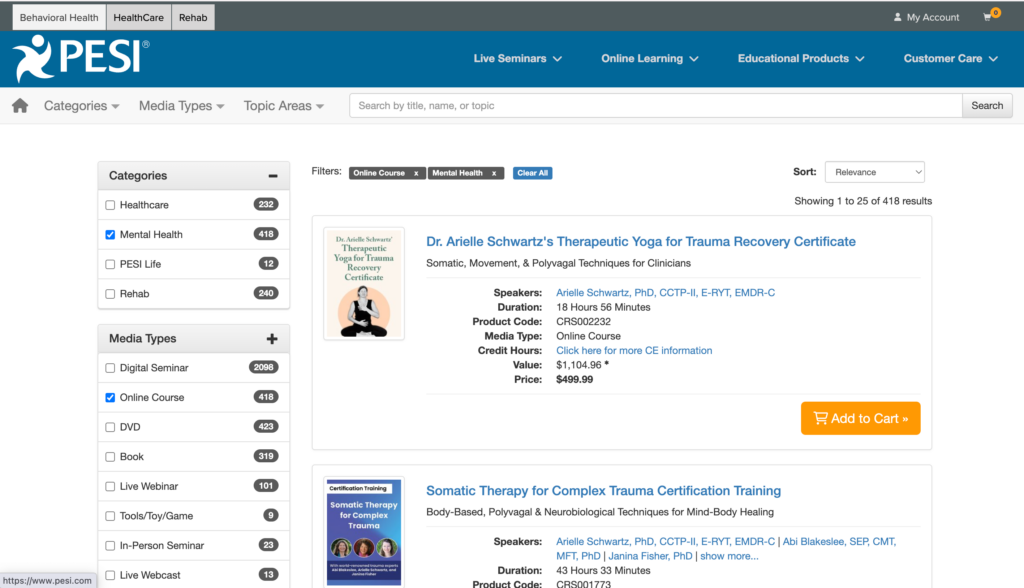
PESI is a widely recognized CE platform offering thousands of courses across specialty areas including trauma, EMDR, somatic therapies, and evidence-based modalities. With live seminars, virtual workshops, and on-demand learning, PESI supports clinicians who want comprehensive modality depth and CEU-accredited continuing education. Its large catalog makes it ideal for therapists who want both foundational and highly specialized training options.
Key Features:
- Extensive CE library across dozens of modalities
- Live and on-demand training options
- Certifications in specialized clinical approaches
- Case demos and practical intervention examples
- Accredited CE across states and professions
Pros
- Largest variety of CE trainings available
- Excellent for modality specialization
- Strong live-event programming
Cons
- Catalog may feel overwhelming for some clinicians
- Not focused on real-session skill measurement
Best For:
- Clinicians needing CEUs for renewal
- Therapists developing specialty expertise
- Providers seeking deep dives into popular modalities
Pricing: Pricing varies per course.
SimplePractice Learning — Best for Structured, Self-Paced CE
SimplePractice Learning offers a curated, well-structured CE experience designed for therapists who value clarity, organization, and ease of use. With a strong catalog of ethics trainings, foundational clinical topics, and self-paced modules, it supports consistent growth without overwhelming clinicians with excessive choices. Its straightforward interface makes it especially helpful for therapists who want simple, reliable CE options.
Key Features:
- Self-paced CE modules
- Clear course structure and learning paths
- Strong ethics offerings
- Evidence-based curriculum
- User-friendly learning environment
Pros
- Clean, intuitive platform
- Ideal for structured learning
- High-quality foundational content
Cons
- Less depth in advanced specialty training
- Smaller course library than major CE providers
Best For:
- Clinicians who prefer self-paced learning
- Therapists needing ethical or foundational CE
- Providers wanting a simple, organized CE experience
Pricing:
- Starter: $24.50/month Billed monthly
- Essential: $39.50/month Billed monthly
- Plus: $49.50/month Billed monthly
CE4Less — Best Budget CE Platform

CE4Less offers one of the most affordable ways for therapists to complete CE requirements, providing unlimited CE courses under a single low-cost subscription. While not as deep or specialized as larger platforms, CE4Less excels in accessibility and value, making it a practical choice for therapists who need economical, accredited CE without sacrificing quality.
Key Features:
- Unlimited CE for one price
- Large library of foundational courses
- Straightforward reading + quiz format
- Accreditation across most states
Pros
- Best price-to-value ratio
- Easy for clinicians who need quick CE completion
- Simple and efficient format
Cons
- Limited advanced or specialty content
- Less interactive and experiential than other platforms
Best For:
- Clinicians wanting affordable CE
- Therapists needing fast completion for renewal
- Providers who prefer text-based CE content
Pricing
Unlimited plans:
- 1-Year Unlimited: $89.99 per year for unlimited access to text-based courses.
- 2-Year Unlimited: $154.99 every 2 years for unlimited access to text-based courses.
- Lifetime: $699.99 for unlimited access to text-based courses.
- Unlimited + Live: $249.99 per year, which includes all text-based courses plus unlimited live and on-demand video courses.
Individual course pricing:
- Price per course: $11.99 per credit hour
Zur Institute — Best for Ethics & Niche Specialty Topics
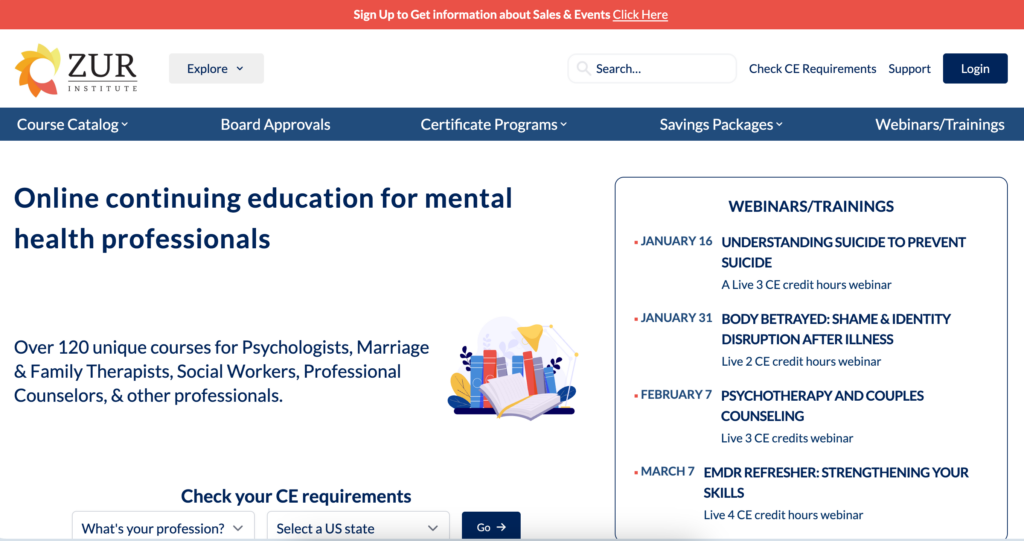
Zur Institute provides rich, in-depth CE content focused on ethics, boundaries, digital practice, and lesser-explored clinical topics. Its trainings help therapists navigate nuanced ethical dilemmas with greater confidence and align their work with best practices across modalities and settings. Ideal for clinicians who value thoughtful, reflective CE that goes beyond foundational ethics.
Key Features:
- Ethics and boundary-focused curriculum
- Courses on telehealth, risk, and digital practice
- Specialty offerings on culturally complex topics
- Accredited CE options
Pros
- Excellent for ethics renewal requirements
- Offers unique, hard-to-find clinical topics
- Thoughtful, principle-based teaching style
Cons
- User interface can feel outdated
- Fewer modality-specific deep dives
Best For:
- Clinicians seeking ethics or boundary training
- Therapists navigating digital therapy or telehealth
- Providers who prefer reflective, nuanced CE
Pricing
Individual online courses at the Zur Institute generally cost between $19 and $199, depending on the number of continuing education (CE) hours offered (which typically range from 1 to 26 CE hours).
Final Recommendation: Best Clinician Training Software in 2026
Choosing the best clinician training software for therapists ultimately depends on what type of growth a clinician is seeking — real-session skill improvement, CE credits, modality depth, or foundational structure. Here is a clear, clinically grounded summary to help therapists decide.
Best for Real Clinical Skill Improvement
Alliance Genie™ is the strongest choice for therapists who want meaningful, session-based growth. By analyzing real clinical conversations (without storing recordings), it strengthens attunement, communication, and alliance in ways traditional CE platforms cannot. This makes it ideal for clinicians who want to deepen their therapeutic presence and improve actual in-room outcomes.
Best for CEU-Rich Education
PESI is the leading option for therapists who want extensive CE options across trauma, somatic work, EMDR, DBT, ACT, and beyond. Its modality depth and access to top clinical educators make it a go-to platform for CE-based professional development.
Best for Structured Training
SimplePractice Learning excels in clarity, structure, and ease of use. Its organized modules, strong ethics courses, and clean user experience make it ideal for clinicians who prefer a predictable, guided path for CE completion.
Best for Specialty or Ethics-Focused Learning
Zur Institute offers deep, nuanced training on ethics, boundaries, digital practice, and niche clinical topics. It’s the best fit for clinicians wanting thoughtful, principle-driven CE that goes beyond foundational coursework.
While each platform has clear strengths, Mentalyc stands out by offering something fundamentally different: real-session–based clinical growth through Alliance Genie™, which complements, rather than replaces, traditional CE training. For therapists seeking deeper relational insight, reflective skill building, and practical in-session improvements, it remains the most direct and impactful tool.
Frequently Asked Questions (FAQs) About The Best Clinician Training Software for Therapists
1. What is the best clinician training software for therapists?
The top three platforms in 2026 are Alliance Genie™, PESI, and SimplePractice Learning. Together, these represent the strongest options across real-session skill development, digital CE tools, and structured therapist learning systems.
2. Is Alliance Genie™ a CEU platform?
No. Alliance Genie™ is not a CEU provider. Instead, it is a real-session–based clinical skill development tool that strengthens communication, attunement, and alliance through reflective insights from actual therapy sessions.
3. How can therapists learn new skills online?
Therapists can grow through live CE courses, self-paced modules, case simulations, specialized digital CE tools, and session-based platforms like Alliance Genie™. Modern therapist learning systems also provide structured pathways for ongoing development.
4. Do online CE courses count for licensure renewal?
Most accredited CE courses offered online do count toward licensure renewal. However, CE requirements vary by state, so clinicians should confirm details with their licensing board.
5. Why is alliance skill-building important?
The therapeutic alliance is the strongest predictor of positive treatment outcomes. Improving attunement, communication, and relational presence directly enhances therapy effectiveness.
6. Are online training tools worth it in 2026?
Yes. Online learning supports flexible therapist education, offers accessible CE completion, and, with tools like Alliance Genie™, provides real-session insights that elevate practical clinical skills in ways traditional courses cannot.