


Therapists know progress doesn’t happen by chance. It’s planned, measured, and refined. A strong TX plan connects the client’s needs, goals, and outcomes, giving structure to intuition and clarity to the therapeutic process.
Whether you’re a new clinician learning how to write a TX plan for therapy or an experienced professional looking to streamline documentation, this guide covers everything you need to know.
You’ll learn what a TX plan is, how to structure it, see examples and templates, and discover HIPAA-compliant AI solutions like Mentalyc can help you write audit-ready TX plans quickly and accurately so you can spend less time on documenting and more time supporting your clients.
What Is a TX Plan in Counseling?
A TX plan (short for treatment plan) is a structured outline therapists use to guide and document the course of therapy. It defines the client’s presenting problems, sets measurable goals, outlines interventions, and tracks progress throughout treatment.
Automated treatment plans that reflect your approach

New! Transfer your notes to EHR with a single click. No more copy-pasting.
In counseling, a TX plan ensures that therapy is intentional and goal-oriented. It keeps both therapist and client focused on measurable change while meeting professional, ethical, and insurance documentation standards.
A well-designed TX plan in therapy typically includes:
- Client information and diagnosis
- Goals and measurable objectives
- Interventions and therapeutic approaches
- Timelines and progress evaluation criteria
To sum it up, a TX plan is your therapy roadmap. It shows where you and your clients are headed, how you’ll get there, and how you’ll measure the client’s progress along the way.
Why a TX Plan Matters in Therapy
For therapists, a TX plan isn’t just helpful documentation: it’s a clinical, legal, and often insurance-required record of the care being delivered.
Insurance companies, managed care organizations, and licensing boards frequently require an up-to-date treatment plan to justify medical necessity and demonstrate progress. A well-maintained TX plan shows that therapy is goal-oriented, evidence-based, and continuously evaluated, which protects both the therapist and the client in case of audits or peer reviews.
It also supports continuity of care, allowing other clinicians, supervisors, or case managers to quickly understand where the client is in treatment and what approaches have been effective so far.
The Importance of TX Plan for Clients
- Builds therapeutic trust and collaboration by making therapy goals transparent
- Helps clients visualize their progress and stay motivated
- Promotes accountability and shared responsibility in their growth
- Ensures their care remains consistent even when transitioning between providers
The Importance of TX Plan for Therapists and Mental Health Professionals
- Keeps sessions focused and aligned with specific treatment goals
- Meeting insurance requirements and ensuring ethical standards
- Demonstrates an evidence-based, outcome-driven approach to care
- Provides structure for clinical supervision, audits, and peer review
- Clearly linking goals, interventions, and progress notes
A quality TX plan can bridge the gap between clinical intuition and professional accountability – ensuring therapy remains goal-directed, measurable, and reimbursable.
Common Challenges in Writing TX Plans
Even experienced therapists can find TX plan writing to be one of the most time-consuming and mentally draining parts of clinical work. The process demands not only clinical reasoning but also consistent updates and measurable outcomes tracking, which can quickly become overwhelming when managing multiple clients.
Many therapists share that treatment planning is one of the most time-consuming parts of documentation. Unlike progress notes, which follow a session’s natural flow, a treatment plan requires stepping back to define the client’s core problems, set measurable goals, choose evidence-based interventions, and ensure everything aligns with payor standards.
For many clinicians, the challenge isn’t just the time involved. It’s the mental load of crafting clear, specific, measurable objectives that meet clinical, ethical, and insurance requirements. When you’re already juggling a full caseload, supervision, and admin tasks, writing or updating a treatment plan becomes yet another demanding piece of documentation added to an already heavy workload.
Here are some of the most common struggles therapists face when creating TX plans:
| Challenge | Impact on Therapists |
| Writing measurable goals | Goals that are too broad or vague can cause treatment plans to be rejected by insurance reviewers or supervisors. |
| Linking interventions to diagnoses | Without clear justification, the plan may appear inconsistent or non-billable. |
| Meeting insurance and compliance requirements | Missed updates or incomplete documentation can lead to denied claims or audit flags. |
| Maintaining updates across clients | With busy caseloads, it’s difficult to revisit every TX plan regularly as clients progress. |
| Balancing detail and conciseness | Overly lengthy or technical plans can slow reviews and reduce readability for clients and team members. |
These challenges don’t just affect productivity. They can also increase stress, contribute to burnout, and reduce the time you have for actual therapy work. In today’s data-driven mental health landscape, documentation is no longer optional; it’s the foundation of clinical accountability and professional integrity.
That’s why most clinicians now rely on AI-powered note taking tools like Mentalyc to make TX plan writing more manageable.
AI-Powered TX Plan Support with Mentalyc
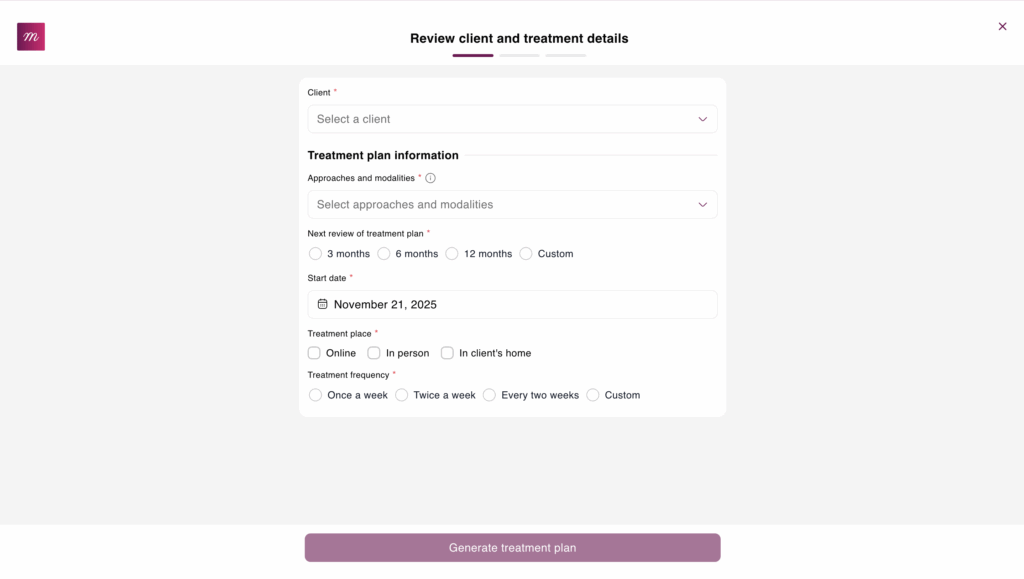
Writing and maintaining TX plans doesn’t have to be stressful. AI-powered note taking tools like Mentalyc are transforming how therapists approach treatment planning. Instead of starting from a blank screen or piecing together all relevant notes, Mentalyc helps you generate structured, professional TX plan mental health with one click.This makes documentation both faster and more clinically precise.
Mentalyc analyzes information from your sessions (including intake) and automatically generates a treatment plan. It suggests SMART goals and interventions, so you don’t have to start from scratch. You can also choose which sections to include in your personalized treatment plan.
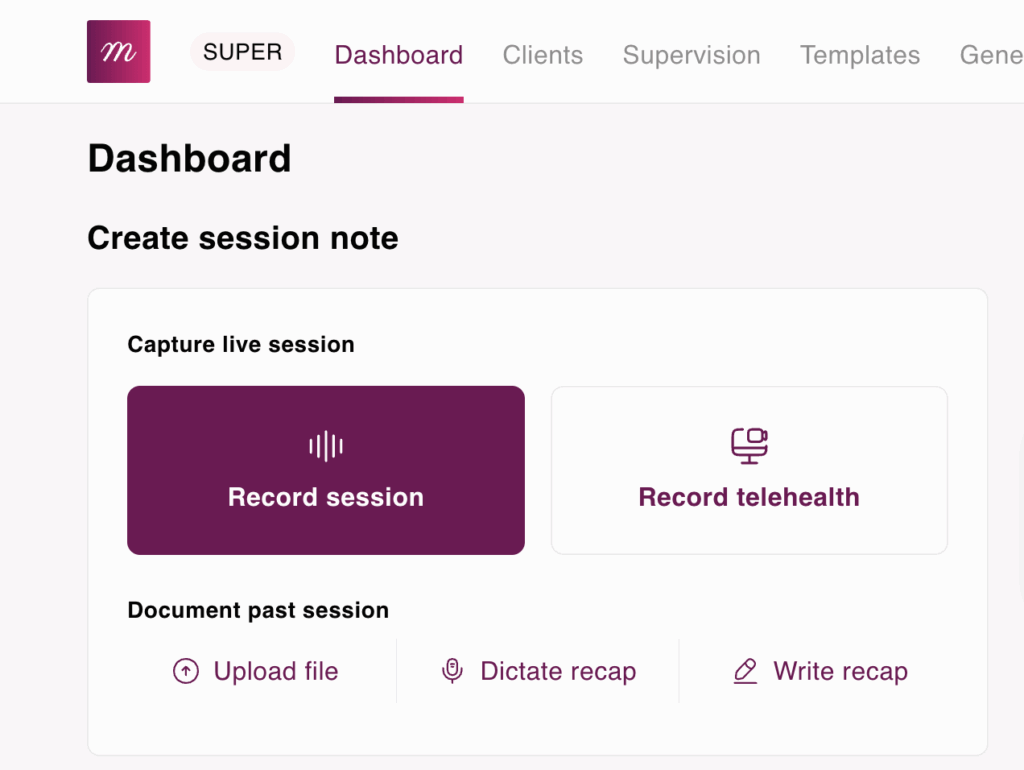
Therapists can record, upload, or dictate session notes in Mentalyc for seamless documentation.
Mentalyc also provides a strong first draft based on the data you already collect, leaving you to refine and personalize the plan with your clinical judgment, intuition, and therapeutic style.
Automate Treatment planning with Mentalyc’s AI Treatment Planner
Generate treatment plans that mirror your approach, satisfy payors, and evolve with your clients.
- SMART Goals
- Insurance-ready formatting
- Track goals & outcomes
- HIPAA & PHIPA compliant
New! Transfer your notes to EHR with a single click. No more copy-pasting.

How Mentalyc simplifies TX plan documentation:
| Feature | How It Helps Therapists |
| AI TX Plan Generator | Automatically drafts measurable goals, objectives, and interventions based on your session summaries or progress notes. You get a clear, structured TX plan outline that reflects the client’s current challenges and treatment focus. |
| Time-Saving Automation | Automatically converts your sessions into well-formatted TX plan templates in minutes – saving hours of repetitive work each week. |
| HIPAA-Compliant & Secure | Designed for mental health professionals, Mentalyc keeps all client information encrypted and compliant with HIPAA, GDPR, and ethical documentation standards. |
| Consistency Across Documentation | Seamlessly aligns your treatment plans with progress notes regardless of format (SOAP, DAP, or BIRP) – ensuring every document contributes to one cohesive narrative. Mentalyc keeps the Golden Thread intact by connecting client needs, goals, interventions, and outcomes across all stages of care. |
| Insight-Driven Summaries | Highlights recurring themes, treatment responses, and progress markers which helps you update the treatment plan with data-driven insights instead of rereading past notes. This continuity strengthens clinical reasoning and demonstrates how each session supports the client’s overall goals and progress. |
TX Plan Examples and Templates
Seeing well-written TX plan examples for therapists can make it much easier to understand what an effective treatment plan looks like in practice. When writing a TX plan therapy, it’s essential to include the same key components across every client: diagnosis, problem statement, goals, measurable objectives, interventions, and progress evaluation.
With our TX plan note example below, we hope to save you time and ensure that each plan meets clinical and insurance documentation standards. Below is a simplified example of TX plan for individual counseling
(Keep in mind that sections may vary depending on your documentation standards or EHR format.)
| Section | Example |
| Client Information | Jane Doe, 29 years old, referred by primary care physician for anxiety and stress management. |
| Diagnosis | Generalized Anxiety Disorder (F41.1) |
| Problem Statement | Client reports excessive worry, muscle tension, and difficulty concentrating, leading to work-related burnout. |
| Long-Term Goal | Reduce anxiety symptoms and improve daily functioning over a 12-week treatment period. |
| Short-Term Objectives | 1. Identify and reframe three recurring negative thought patterns per week. 2. Practice relaxation or breathing exercises at least once daily. |
| Interventions | Cognitive Behavioral Therapy (CBT), psychoeducation on stress response, mindfulness training, and journaling assignments. |
| Progress Evaluation | Weekly self-report check-ins, therapist observation, and GAD-7 scores every four sessions. |
| Timeline | Review TX plan every 6 – 8 sessions or sooner if major progress or setbacks occur. |
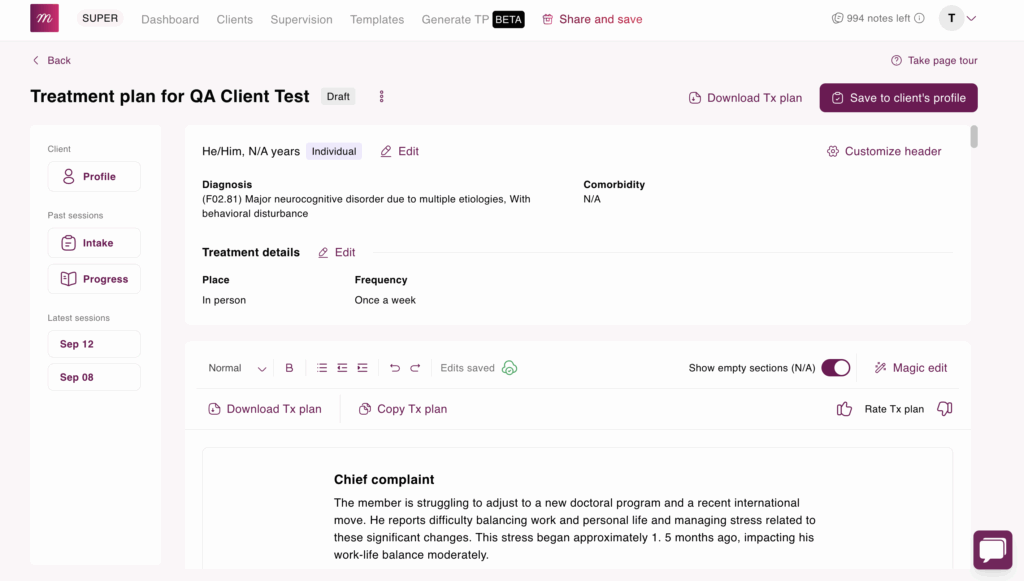
While traditional TX plans provide a clear outline, Mentalyc’s AI Treatment Plan connects each section, from problem to progress, automatically. It ensures your documentation stays cohesive and audit-ready without extra work. Here’s an example of Mentalyc’s TX plan:

| Section | Example |
| Client Information | Name: Alicia (Sample AD) Age: 30 Gender: F Client Type: Individual Treatment Duration: 3 months Start Date: September 15, 2025 End Date: December 15, 2025 |
| Chief Complaint | Client presents with low mood, lack of motivation, and feelings of isolation related to exam stress and parental marital conflict. Symptoms include missing lectures, social withdrawal, and self-critical thoughts. |
| Clinical Conceptualization | The client’s difficulties are shaped by academic pressure and family disruption (Z63.5). Predisposing factors include perfectionism and high expectations; precipitating events include exam stress and family strain. Perpetuating factors involve avoidance behaviors and negative self-talk. Protective factors include insight and motivation for change. |
| Goals and Objectives | Goal 1: Reduce depressive symptoms and build stress-management skills. Objective 1 (Self-critical thoughts): Reduce the frequency of self-critical thoughts from five times per week to once per week, as tracked in a weekly mood journal and reflected in session check-ins. Objective 2 (Social engagement): Increase participation in planned social activities from once per month to once per week, documented through a Social Interaction Log and discussed during therapy sessions. Goal 2: Strengthen emotional resilience and coping strategies related to family dynamics. |
| Interventions | Use IFS Therapy to explore inner parts and reduce internal conflict. Apply Emotionally-Focused Therapy (EFT) to process family-related emotions. Integrate Mindfulness-Based Therapy for emotional regulation and acceptance. |
| Homeworks | • Daily mindfulness meditation (15 min). • Weekly journaling to track negative thought patterns. • Bi-weekly self-reflection using IFS techniques to explore emotional triggers. |
| Metrics & Progress Tracking | Assessment Tools: BDI-II, GAD-7, Resilience Scale, and weekly logs. Mentalyc automatically includes progress toward each goal and links updates to session notes for a clear Golden Thread. |
| Review Date | Auto-suggested every 3–6 sessions or earlier if major progress or setbacks occur. |
In Mentalyc, this entire plan is generated and updated automatically from your session notes while keeping goals, interventions, and progress connected without extra documentation time. Everything stays measurable, compliant, and connected through the Golden Thread so your documentation reflects the real story of your client’s growth without extra work.
TX Plan vs Progress Notes
While TX plan and progress notes are all essential parts of clinical documentation, each serves a distinct purpose in the therapeutic process. Understanding how they fit together helps therapists maintain consistency, meet insurance and ethical standards, and provide a complete record of client care.
| Documentation Type | Purpose | Frequency | Includes | Used For |
| TX Plan (Treatment Plan) | Outlines long-term goals, measurable objectives, and interventions for therapy. | Created in the beginning of therapy and updated periodically (typically every 90 days or after major clinical changes). | Problem statement, goals, objectives, interventions, expected outcomes, review dates. | Establishes direction for therapy, ensures insurance compliance, and communicates treatment intent to clients or other providers. |
| Progress Notes | Summarize what happened in each session and how the client responded to treatment. | Written after every session. | Session summary, interventions used, client participation, progress toward goals. | Tracks short-term progress and provides evidence of ongoing therapeutic work. |
Together, these two documentation types tell the full story of a client’s therapeutic journey:
- The TX plan defines where therapy is headed (the treatment roadmap).
- Progress notes describe what’s happening along the way (each session’s progress and adjustments) – often structured using formats like SOAP, DAP, or BIRP for clarity and compliance.
A complete and well-aligned documentation system ensures that goals set in the TX plan are reflected in the interventions described in progress notes, and that SOAP notes capture measurable progress in a standardized format.
Best software for TX plan writing
Modern therapy documentation tools reduce the administrative load of writing TX plans manually. Mentalyc stands out by integrating AI-generated notes, progress summaries, and TX plan templates – all in one secure, HIPAA-compliant TX plan software. Therapists using Mentalyc report saving up to 90% of their documentation time each week.
- Draft measurable goals automatically
- Sync progress notes and treatment updates
Creating a TX plan for therapy doesn’t need to feel like endless paperwork. A clear, measurable plan not only improves outcomes but also supports ethical, data-driven care.
With Mentalyc, you can streamline TX plan documentation, save time, and focus more on the heart of your work – helping your clients heal.
FAQs About TX Plans
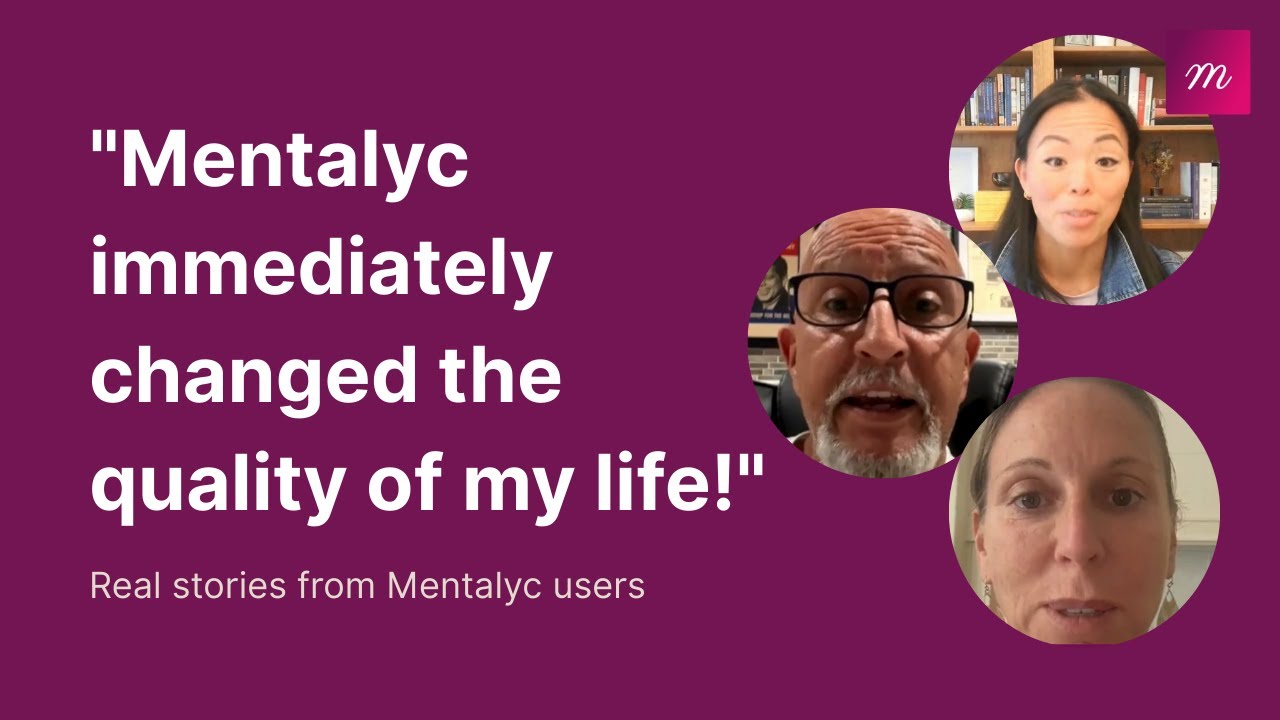
Why other mental health professionals love Mentalyc

“It immediately changed my quality of life, personally and professionally.”
Owner/Independently Licensed Marriage & Family Therapist (LMFT)

“For anyone hesitant: this is a lifesaver. It will change your life, and you have more time to be present with your patients.”
Licensed Clinical Social Worker

“If I were recommending this software to a colleague, I would tell them that it is the best thing that they could do for their practice.”
Licensed Professional Counselor

“Do yourself a favor, make your life easier. I found Mentalyc to be one of the best tools that I’ve ever used.”
Licensed Marriage and Family Therapist