


Therapists exploring a TherapyNotes AI review are often trying to understand whether an AI notetaker inside a traditional EHR can reduce documentation time or simply shift work around existing templates.
In this guide based on real clinicians’ reviews, we examine how well this platform performs in real clinical workflows, where its limitations appear, and when a dedicated AI documentation platform like Mentalyc may be a better fit. It will help answer the most practical question: “Is TherapyNotes AI worth it in 2026?”
Overview: What Is TherapyNotes AI?
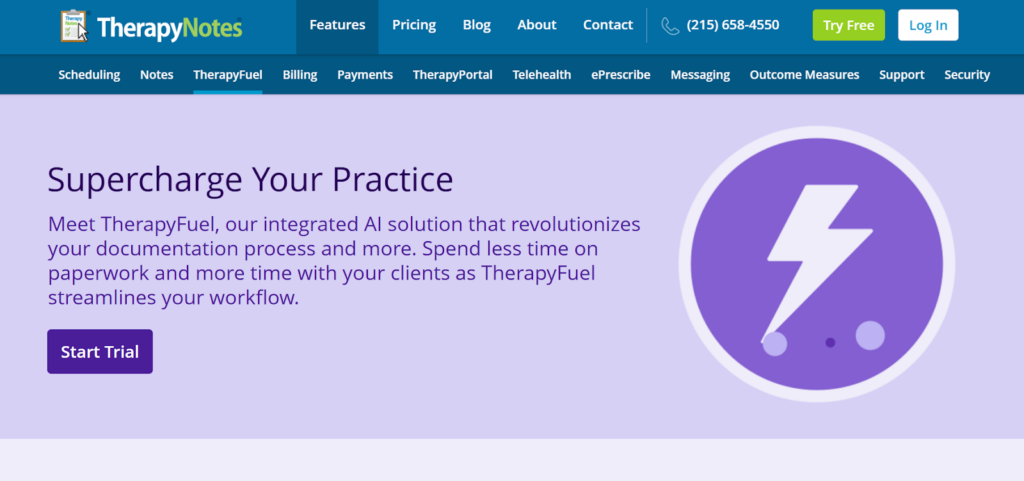
TherapyNotes is a long-established behavioral health EHR. Its AI features are provided through TherapyFuel, an integrated tool designed to help clinicians draft therapy notes within the TherapyNotes platform.
TherapyNotes AI works in two main ways. Clinicians can enter a short session summary that TherapyFuel expands into a draft note, or use TherapyFuel Scribe to transcribe in-person or TherapyNotes telehealth sessions and generate SOAP-style progress notes.
Because it is built directly into TherapyNotes, the AI is best suited for clinicians already using the platform for scheduling, billing, and compliance. It functions as an EHR add-on rather than a standalone AI documentation tool.
TherapyNotes reports HIPAA compliance, provides a Business Associate Agreement (BAA), and applies the same security standards to its AI features as to the rest of the platform.
Key Takeaways — TherapyNotes AI Review 2026
| Area | Summary |
|---|---|
| What it does best | Drafts structured progress notes from summaries or transcripts inside a full EHR |
| Main limitation | AI is assistive, not fully automated; review and editing remain essential |
| Best practice fit | Clinicians, group practices, and agencies already using TherapyNotes |
| Compliance posture | HIPAA compliant, BAA provided, strong access controls and audit logs |
| Pricing model | Base EHR subscription plus per-clinician AI add-on |
| Best value for | Practices that need EHR, billing, and AI notes in one system |
TherapyNotes Scribe Review — Real Therapist Experience
While many clinicians value TherapyNotes for its established EHR functionality, feedback around TherapyFuel Scribe has been more mixed—particularly during rollout and ongoing use in live sessions.
Several users report that the Scribe feature can feel inconsistent and unreliable, making it difficult to depend on during therapy sessions where stability matters. One clinician described challenges with both functionality and follow-up after reporting issues:
“The program is plagued with problems and is inconsistent… using the option in sessions extremely challenging.” — Scott Soeder, via Trustpilot
Beyond technical concerns, customer support responsiveness emerges as a recurring theme in user feedback. Some clinicians report delayed or absent responses to support tickets, even for workflow-blocking issues:
“I’ve requested updates on when this will be fixed and got no response at all.” — Amy M., via G2
Pricing and trust are also points of frustration. Users note dissatisfaction when pricing assurances were later reversed, particularly given the effort required to migrate away from an established EHR:
“A year later they raised prices… it’s hard to switch.” — Amy M., via G2
Taken together, these experiences suggest that while TherapyNotes Scribe may offer value in theory, inconsistency, support delays, and pricing concerns can significantly affect real-world usability.
For clinicians considering AI-assisted transcription inside an EHR, these factors are important to weigh; especially if session-level reliability and responsive support are critical to day-to-day practice.
Who TherapyNotes AI Is Best For
TherapyNotes AI is best suited for clinicians who are already committed to the TherapyNotes EHR and want AI-assisted documentation built directly into their existing workflow.
Because TherapyNotes AI is designed to support documentation efficiency within the EHR, its note drafts emphasize template completeness and standard phrasing. Clinicians often need to refine language to reflect clinical nuance, evolving formulations, or session-specific detail.
For therapists who care most about note quality, clinical depth, and how sessions connect over time, EHR-based AI drafting may feel limiting; especially compared to tools built specifically around therapy documentation rather than administrative workflows.
TherapyNotes AI Features
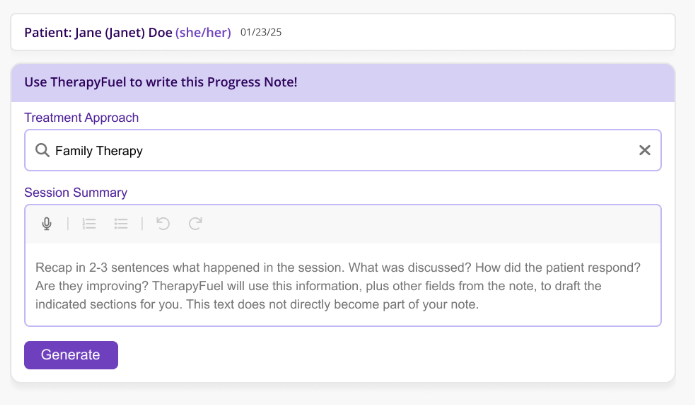
TherapyNotes AI Documentation
TherapyNotes is a template-driven behavioral health EHR. Its AI layer, TherapyFuel, is designed to assist with documentation rather than transform how notes are written.
How AI drafting works
Clinicians either enter a short session summary or enable TherapyFuel Scribe. The AI then drafts SOAP-style progress notes based on existing EHR templates.
Treatment-plan support
TherapyFuel can help populate goals, objectives, and interventions tied to diagnoses already documented in the chart. Ongoing alignment between notes and plans will require clinician review.
Clinical accuracy & review burden
Drafts are structured and compliant, but clinicians still need to review and adjust language for diagnostic nuance, risk documentation, and medical necessity. The AI does not independently assess session content or clinical change.
Customization & control
Clinicians retain full control over tone, content, and length before signing. Notes are never auto-finalized by AI.
Overall, TherapyNotes AI functions as a documentation assistant inside the EHR. It’s not built for note quality or clinical insight.
Recording & Transcription Workflow (TherapyFuel Scribe)
TherapyFuel Scribe supports session capture only within the TherapyNotes ecosystem:
- Works during in-person sessions (when Scribe is enabled) or TherapyNotes Telehealth
- Does not accept external uploads or recordings from other platforms
- For sessions without Scribe, clinicians can still enter summaries for AI drafting
Recording & retention
Session audio is encrypted, transcribed, and deleted after transcription. Transcripts are encrypted and retained until the note is signed or for up to 30 days, whichever comes first. All data handling falls under the TherapyNotes BAA.
Consideration*:* Because capture is limited to TherapyNotes environments, flexibility may be reduced for clinicians who work with other tools.
Analytics & Outcome Tracking
TherapyNotes supports measurement-based care, with outcomes interpreted by the clinician:
- Built-in outcome measures such as PHQ-9 and GAD-7 via the client portal
- Automatic scoring and graphs over time
- Scores can be inserted into progress notes to document baseline and change
However, TherapyNotes AI does not generate automated insights about session quality, patterns across notes, or therapeutic alliance. Progress interpretation remains largely manual.
TherapyNotes AI Integrations & Workflow Support
As a full EHR, TherapyNotes centralizes most workflows:
- Scheduling, billing, telehealth, documentation, outcomes, and AI drafting
- Integrated claims submission and tracking
- Limited reliance on third-party tools
This consolidation simplifies operations, but also means AI functionality is closely tied to the broader EHR system.
Security, Privacy & Compliance
TherapyNotes follows standard EHR security practices and provides a HIPAA Business Associate Agreement (BAA). Session audio used for AI note drafting is deleted after transcription, while written transcripts remain until the note is signed or for up to 30 days. TherapyNotes states that patient data is not sold and that AI features follow the same privacy rules as the rest of the EHR.
However, details about how AI is trained and whether session data is ever used for training are not always clearly explained. Clinicians who want extra certainty may wish to confirm AI training and data-minimization policies directly, in writing, and make sure client consent language reflects this.
TherapyNotes AI Pricing (2026)
| Component | Cost (approx.) |
|---|---|
| Solo EHR plan | ~$69/month |
| Group EHR plan | ~$79/month (first clinician) + ~$50/additional |
| TherapyFuel AI | ~$40/month per clinician |
| Free trial | 30 days (EHR) |
Pricing insight:
TherapyNotes AI offers reasonable value if you need the full EHR. If you only want AI-generated notes, total costs can exceed standalone tools.
TherapyNotes AI Pros and Cons
Pros
- Full EHR + AI in one system
- SOAP-based documentation
- Integrated outcomes (PHQ-9, GAD-7)
Cons
- Scribe reliability can be inconsistent during live sessions
- Notes still need manual editing for accuracy and nuance
- Limited flexibility beyond standard EHR templates
- Support and pricing concerns reported by some clinicians
Final Verdict: Is TherapyNotes AI Worth It for Therapists in 2026?
TherapyNotes AI is primarily an add-on for clinicians already using the TherapyNotes EHR. It can help with basic note drafting, but its value is closely tied to committing to the full EHR ecosystem and its administrative workflows.
For therapists who want more than template-driven documentation, TherapyNotes AI often falls short. Note quality still depends heavily on manual edits, treatment planning remains largely static, and meaningful insight across sessions is limited. Combined with add-on pricing and mixed reports around reliability and support, it may not be the most efficient option for clinicians focused on clinical depth.
Therapists looking for more accurate notes, actionable treatment planning, and session-level insight, without the overhead of a full practice-management system, are likely to find better options.
Best Alternatives to TherapyNotes AI
Mentalyc — The Most Complete Therapy-Focused AI Platform
Mentalyc is designed for therapists who want better clinical documentation without switching EHRs. Instead of focusing on administrative workflows, it supports how therapy progresses from session to session — keeping notes, goals, and progress aligned.

Mentalyc stands out for clinicians who want:
- High-quality, insurance-ready progress notes and treatment plans generated from session audio, uploads, dictation, or brief summaries.
- Session-derived progress tracking, where change is reflected directly from clinical notes rather than relying only on questionnaires or self-report measures
- Clear treatment continuity across sessions, keeping goals, interventions, notes, and progress aligned over time (the “golden thread”).
- Helps therapists stay attuned to the therapeutic relationship and spot potential blind spots early, using insights from Alliance Genie™.
- Built with privacy in mind, meeting HIPAA + PHIPA and SOC 2 Type II standards, with clinicians in control of their data.
Because Mentalyc works alongside your existing EHR, clinicians can keep their current scheduling, billing, and claims workflows while using AI purely for documentation quality, treatment planning, and clinical insight—without EHR lock-in.
Best for: Therapists who want higher-quality, modality-aware clinical notes and clearer continuity across sessions — beyond what EHR add-on AI tools can produce.
SimplePractice AI — EHR-Integrated Note Drafting
SimplePractice AI is primarily designed for clinicians already using the SimplePractice EHR who want basic AI-assisted note drafting without introducing an additional tool.
What to know:
- Generates draft progress notes from dictation or session audio
- Notes require clinician review and manual editing before finalization
- Fully embedded within SimplePractice scheduling, billing, documentation, and telehealth
- Optimized for workflow consolidation rather than clinical analysis
- Limited session-derived progress tracking or deeper insight beyond documentation
Best for: Practices that prioritize having everything inside one EHR and are mainly looking to reduce typing, rather than improve clinical visibility or treatment continuity.
Blueprint — Assessment-Driven Outcome Tracking
Blueprint combines AI documentation with a strong focus on measurement-based care and standardized assessments.
What to know:
- Uses AI to assist with progress notes and treatment plans
- Emphasizes patient-reported outcome measures (PHQ-9, GAD-7, etc.)
- Provides dashboards to track symptom trends over time
- Works alongside existing EHRs through exports or browser extensions
- Focuses on questionnaire-driven outcomes rather than session-derived clinical insight
Best for: Clinicians and practices that rely heavily on PROMs and structured outcomes reporting, particularly in CBT-oriented or measurement-driven care models.
Detailed Comparison: TherapyNotes AI vs Mentalyc
| Feature | TherapyNotes AI (TherapyFuel) | Mentalyc |
|---|---|---|
| What it’s built for | EHR-based note drafting inside TherapyNotes | Therapy-first AI documentation and clinical insight |
| Automation level | Drafts notes from summaries or Scribe transcripts; clinician edits required | Drafts notes and treatment plans from session audio or text |
| Note quality | Structured, template-driven notes (e.g. SOAP); quality depends on manual refinement | Therapy-specific, insurance-ready notes designed for clinical clarity and consistency |
| Note types & flexibility | Core psychotherapy notes and SOAP-style progress notes; limited customization | Wide range of note types (SOAP, DAP, BIRP, GIRP, intake, psychiatry, group, custom formats) |
| Treatment planning | Basic treatment plans maintained manually in the EHR | Automated treatment plans with SMART goal suggestions and ongoing tracking across sessions |
| Progress tracking | No automated progress tracking; relies on questionnaire-based outcomes (PHQ-9, GAD-7) | Progress tracking generated directly from session notes, keeping goals, notes, and outcomes continuously connected (“golden thread”) |
| Alliance insights | Not available | Alliance Genie™ highlights alliance, engagement, and session-quality patterns |
| Recording handling | Audio encrypted and deleted after transcription; transcripts kept up to 30 days | Audio used briefly for processing, then deleted; transcripts de-identified |
| Privacy & compliance | HIPAA-compliant EHR with BAA | HIPAA + PHIPA + BAA & SOC 2 Type II compliant |
| Pricing approach | Full EHR subscription plus separate AI add-on fees | Subscription tiers with solo and team plans |
| Best for | Practices that want everything inside one EHR with limited AI notes | Clinicians who want better notes, treatment plans, and insight—without switching EHRs |
To learn more, check out this more comprehensive comparison between TherapyNotes AI Notetaker vs Mentalyc.
Frequently Asked Questions (FAQs): TherapyNotes AI Review and Best Alternatives
Is TherapyNotes AI HIPAA compliant?
Yes. TherapyNotes markets itself as a HIPAA-compliant behavioral health EHR, and it provides a formal Business Associate Agreement (BAA) that practices must sign and keep on file. The AI features (branded as TherapyFuel / TherapyNotes AI) run inside the same security and compliance framework, so when you have a signed BAA and configure the system appropriately, TherapyNotes AI documentation can be used in a HIPAA-aligned way.
Does TherapyNotes AI store therapy recordings?
When you use TherapyFuel Scribe, TherapyNotes AI does process and temporarily retain data from your sessions, but it doesn’t appear to keep raw audio indefinitely:
- Session audio is encrypted in transit, sent to a transcription processor, and deleted once a transcript is successfully created.
- The transcript is encrypted and stored with restricted access, and TherapyNotes states that it is kept only until the progress note is signed or 30 days have passed, whichever comes first.
Are AI tools safe for clinical documentation?
AI tools like TherapyNotes AI and other note-automation platforms can be used safely when they meet key standards and are used with proper oversight:
- They should be HIPAA-compliant, operate under a signed BAA, and use strong encryption for data in transit and at rest.
- Ideally, they run in SOC 2–audited environments or equivalent, with clear retention limits and policies around data use and model training.
- Ethical guidance from professional bodies and emerging research is consistent on one point: clinicians must never rely on AI alone and should always review and edit AI-generated notes for clinical accuracy and alignment with standards of care.
What note types does TherapyNotes support?
TherapyNotes offers multiple structured progress note formats and lets practices customize them:
- Standard TherapyNotes Progress Note
- SOAP notes, DAP notes, and BIRP progress-note templates, all of which can be tailored in the note library.
In addition, clinicians can create:
- Intake notes
- Treatment plans
- Psychotherapy notes
- Psychiatry/medication-management notes and non-clinical contact notes
What are the best alternatives to TherapyNotes AI?
If you like the idea of AI-assisted documentation but aren’t sure TherapyNotes AI is the best fit, several alternatives are worth comparing:
- Mentalyc – Best if you want fully automated notes, a privacy-first design, and deep clinical intelligence without switching EHRs. Mentalyc focuses on high quality clinical notes, progress tracking, golden thread documentation, and alliance-related insights, and is explicitly HIPAA and SOC 2 compliant.
- Blueprint – An AI assistant for therapists that emphasizes measurement-based care, automating progress notes and treatment plans while tracking outcomes across PHQ-9, GAD-7, and other measures.
Other options include AI note tools integrated with EHRs (e.g., SimplePractice’s AI note taker, Supanote), which may suit practices with different tech stacks or pricing needs.
Try Mentalyc for Faster, Safer, and More Insightful Clinical Notes
If you’re looking for AI that improves the quality of your clinical notes, without switching EHRs, Mentalyc offers a therapy-first alternative. It helps draft insurance-ready notes, treatment plans, and session-based progress insights while keeping clinicians in full control of review and sign-off.
Mentalyc is built specifically for mental health workflows, with a privacy-first design and tools that help you see progress, continuity, and alliance across sessions—not just finish notes faster.
👉 Try Mentalyc free and see how therapy-focused AI can support your clinical work more clearly and consistently.
Why other mental health professionals love Mentalyc

“Do yourself a favor, make your life easier. I found Mentalyc to be one of the best tools that I’ve ever used.”
Licensed Marriage and Family Therapist

“For anyone hesitant: this is a lifesaver. It will change your life, and you have more time to be present with your patients.”
Licensed Clinical Social Worker

“If I were recommending this software to a colleague, I would tell them that it is the best thing that they could do for their practice.”
Licensed Professional Counselor

“It immediately changed my quality of life, personally and professionally.”
Owner/Independently Licensed Marriage & Family Therapist (LMFT)