

Therapy treatment plans by modality are structured care plans that change based on the therapeutic approach used to address a client’s needs. Different modalities focus on different mechanisms of change–CBT targets thought and behavior patterns, psychodynamic therapy explores past experiences and relational themes, humanistic approaches emphasize self-growth, and body-based modalities like EMDR and somatic therapy focus on trauma processing and nervous system regulation. Treatment plans must reflect these differences to remain clinically accurate and effective.
In practice, therapy treatment plans are customized not only by modality, but also by format–individual, group, couples, or family therapy–and by the clinical problem being treated, such as emotion regulation (DBT), trauma recovery (EMDR), or relationship conflict (family or couples therapy). Modality-aligned treatment planning ensures that goals, interventions, and progress measures match the underlying therapeutic framework rather than forcing all approaches into a single, generic structure.
In this guide, we’ll break down how treatment plans differ across major modalities, what modality aligned goals actually look like in documentation, and how to keep plans flexible, measurable, and insurance-ready, without rewriting them every few sessions.
Core Components of Modality-Aligned Treatment Planning
| Core Component | What It Means Clinically | How It Shows Up in a Modality-Aligned Treatment Plan |
|---|---|---|
| Assessment & Case Formulation | The therapist evaluates presenting symptoms, diagnosis, client goals, preferences, and context to determine the most appropriate therapeutic approach. | Goals and interventions are explicitly linked to the client’s primary concern (e.g., trauma → EMDR, anxiety → CBT, relational conflict → couples/family therapy). |
| Modality Selection | The chosen therapeutic framework matches the mechanism of change needed for the client’s problem. | The treatment plan clearly states the modality guiding care and uses modality-specific language (e.g., cognitive restructuring in CBT, trauma reprocessing in EMDR). |
| Modality-Aligned Goals | Treatment goals reflect how change is expected to occur within that modality–not generic symptom reduction alone. | Goals are framed in modality-consistent terms (e.g., increased psychological flexibility in ACT, improved emotion regulation in DBT, increased Self-leadership in IFS). |
| Intervention Strategies | Specific techniques are selected based on the therapeutic framework and client readiness. | Interventions listed are clearly tied to the modality (e.g., exposure exercises for CBT, bilateral stimulation for EMDR, parts mapping for IFS). |
| Therapeutic Alliance | Rapport, collaboration, and shared understanding are essential to treatment effectiveness across all modalities. | Treatment plans reflect collaborative goal setting and ongoing alignment between therapist and client, supporting engagement and continuity of care. |
| Customization to Client Needs | The plan is adapted to the client’s symptoms, preferences, culture, and stage of change rather than following a rigid template. | Goals, objectives, and pacing are individualized–even within the same modality–rather than copied from standardized plans. |
| Integration Across Modalities | Therapists may combine approaches when clinically appropriate to improve outcomes. | The treatment plan documents how multiple modalities are integrated intentionally (e.g., CBT skills for stabilization alongside EMDR trauma processing). |
| Safety & Readiness | The therapist ensures the client has adequate stabilization, coping capacity, and support before advanced interventions. | Plans document preparation phases (e.g., EMDR resourcing, DBT safety planning) before higher-intensity interventions are initiated. |
| Measurable Progress Indicators | Progress is tracked using observable, defensible indicators aligned with the modality. | Outcomes are measurable in modality-appropriate ways (e.g., reduced avoidance, decreased trauma reactivity, increased values-based actions). |
| Ongoing Review & Adaptation | Treatment plans evolve as the client progresses or clinical focus shifts. | Goals and interventions are updated over time to reflect the current phase of treatment, maintaining continuity and clinical accuracy. |
Treatment Plans Across Major Therapy Modalities
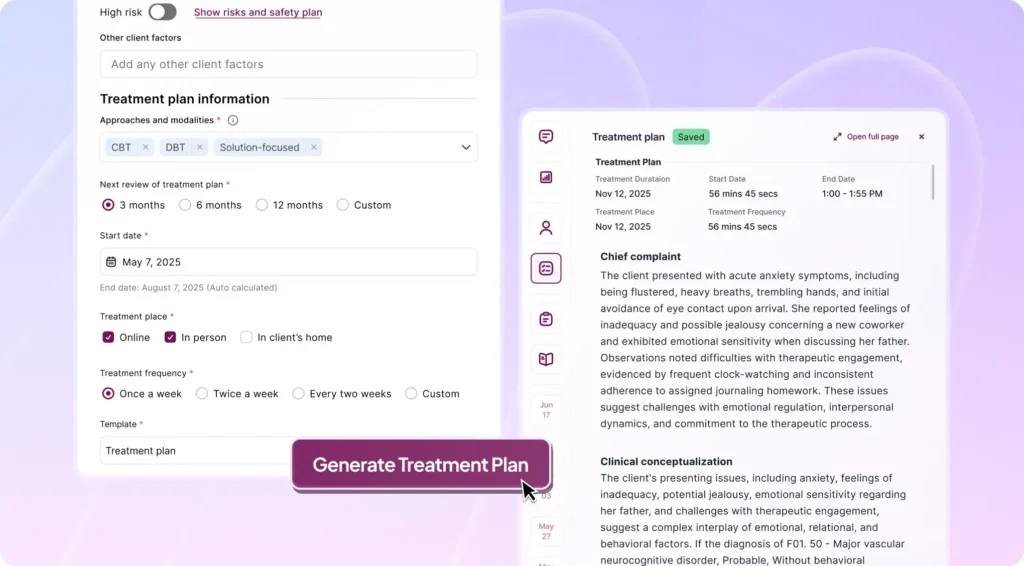
Therapy treatment plans by modality differ because each therapeutic approach is built on a distinct theory of change. What counts as progress, how goals are defined, and which interventions are clinically appropriate all depend on the underlying therapeutic framework. A modality-aligned treatment plan ensures that goals, interventions, and outcomes reflect how change is expected to occur–not just what symptoms are present.
Automated treatment plans that reflect your approach

Cognitive Behavioral Therapy (CBT)
Clinical Focus
CBT targets the interaction between thoughts, emotions, and behaviors. It assumes that maladaptive cognitive patterns and behavioral avoidance maintain psychological distress.
Treatment Planning Implications
A CBT treatment plan is typically structured, time-limited, and skills-oriented. Goals are written in measurable terms and interventions focus on active skill acquisition.
Modality-Aligned Goals
- Reduce frequency and intensity of maladaptive thoughts
- Decrease avoidance behaviors
- Increase use of adaptive coping strategies
Common Intervention Strategies
- Cognitive restructuring
- Behavioral activation
- Exposure exercises
- Thought records and homework assignments
CBT Treatment Plan Example
Long-Term Goal
Reduce anxiety symptoms by modifying maladaptive thought patterns and avoidance behaviors.
Short-Term Objectives
- Client will identify and challenge at least three cognitive distortions per week.
- Client will engage in one avoided situation weekly using exposure strategies.
Interventions
- Cognitive restructuring exercises
- Graduated exposure planning
- Psychoeducation on anxiety cycles
Measurable Outcome
Self-reported anxiety decreases from 7/10 to ≤4/10 over 8 weeks.
Dialectical Behavior Therapy (DBT)
Clinical Focus
DBT is designed for clients with significant emotional dysregulation, impulsivity, and high-risk behaviors. Safety and stabilization are primary.
Treatment Planning Implications
DBT treatment plans follow a hierarchy of targets, prioritizing life-threatening behaviors before skills acquisition or quality-of-life goals.
Modality-Aligned Goals
- Improve emotional regulation
- Reduce self-harm or impulsive behaviors
- Increase effective interpersonal functioning
Common Intervention Strategies
- DBT skills training
- Chain analysis
- Validation strategies
- Crisis and safety planning
DBT Treatment Plan Example
Long-Term Goal
Increase emotional regulation and reduce high-risk behaviors.
Short-Term Objectives
- Client will use distress tolerance skills during emotional crises at least 3 times per week.
- Client will reduce impulsive behaviors as evidenced by session review and self-report.
Interventions
- DBT skills training (mindfulness, distress tolerance, emotion regulation)
- Chain analysis of emotional episodes
- Validation and skills coaching
Measurable Outcomes
- Frequency of impulsive behaviors reduced by 50%
- Increased independent use of DBT skills reported in sessions
Psychodynamic Therapy
Clinical Focus
Psychodynamic therapy explores unconscious processes, early relational experiences, and recurring interpersonal patterns.
Treatment Planning Implications
Psychodynamic treatment plans are often longer-term and process-oriented. Goals emphasize insight, affect tolerance, and relational change rather than immediate symptom elimination.
Automate Treatment planning with Mentalyc’s AI Treatment Planner
- SMART Goals
- Insurance-ready formatting
- Track goals & outcomes
- HIPAA & PHIPA compliant

Modality-Aligned Goals
- Increase awareness of relational patterns
- Improve emotional insight and affect regulation
- Reduce maladaptive defense mechanisms
Common Intervention Strategies
- Interpretation and clarification
- Exploration of transference
- Pattern identification
Psychodynamic Treatment Plan Example
Long-Term Goal
Increase insight into unconscious relational patterns and improve emotional functioning.
Short-Term Objectives
- Client will identify recurring relational themes and emotional triggers.
- Client will increase tolerance for difficult affect during sessions.
Interventions
- Exploration of past experiences and attachment patterns
- Interpretation and clarification
- Examination of transference dynamics
- Reflective exploration
Measurable Outcome
- Increased insight into relational patterns
- Improved emotional regulation and interpersonal functioning
Acceptance and Commitment Therapy (ACT)
Clinical Focus
ACT emphasizes psychological flexibility–helping clients accept internal experiences while committing to values-based action.
Treatment Planning Implications
An ACT therapy treatment plan does not frame success solely as symptom reduction. Instead, goals focus on behavior change aligned with personal values.
Modality-Aligned Goals
- Increase engagement in valued activities
- Reduce experiential avoidance
- Improve willingness to experience distress
Common Intervention Strategies
- Values clarification
- Cognitive defusion
- Mindfulness practices
- Commitment exercises
ACT Therapy Treatment Plan Example
Long-Term Goal
Increase psychological flexibility and values-based living.
Short-Term Objectives
- Client will identify core values in relationships and work.
- Client will engage in one values-driven action weekly despite anxiety.
Interventions
- Values clarification exercises
- Mindfulness and defusion techniques
Measurable Outcome
Increased participation in meaningful activities with reduced avoidance.
Eye Movement Desensitization and Reprocessing (EMDR)
Clinical Focus
EMDR targets trauma-related distress by reprocessing maladaptively stored memories through bilateral stimulation.
Treatment Planning Implications
An EMDR treatment plan is explicitly phase-based, emphasizing stabilization before trauma processing.
Modality Aligned Goals
- Reduce distress associated with traumatic memories
- Improve emotional regulation
- Strengthen adaptive beliefs
Common Intervention Strategies
- Resourcing and stabilization
- Bilateral stimulation
- Trauma memory reprocessing
EMDR Treatment Plan Example
Long-Term Goal
Reduce trauma-related distress and improve daily functioning.
Short-Term Objectives
- Client will develop stabilization skills prior to trauma processing.
- Client will process identified trauma targets using EMDR protocol.
Interventions
- Resourcing techniques
- Bilateral stimulation during reprocessing
Measurable Outcome
SUDs scores decrease from ≥8 to ≤3.
Internal Family Systems (IFS)
Clinical Focus
IFS views symptoms as arising from polarized or burdened internal parts rather than pathology.
Treatment Planning Implications
An IFS therapy treatment plan tracks internal system changes and increased Self-leadership, translating these into functional outcomes.
Modality Aligned Goals
- Increase access to Self energy
- Reduce extreme protective behaviors
- Improve internal emotional regulation
Common Intervention Strategies
- Parts mapping
- Unblending
- Witnessing and unburdening
IFS Therapy Treatment Plan Example
Long-Term Goal

Increase Self-leadership and internal system harmony.
Short-Term Objectives
- Client will identify key protector and exile parts.
- Client will access Self energy during emotional activation.
Interventions
- Parts mapping and direct access
- Unburdening interventions
Measurable Outcome
Reduced emotional reactivity and improved emotional regulation.
Humanistic / Person-Centered Therapy
Clinical Focus
Humanistic therapy emphasizes self-actualization, autonomy, and authentic self-expression.
Treatment Planning Implications
Goals are client-defined and focus on growth rather than symptom correction.
Modality-Aligned Goals
- Increase self-awareness
- Improve self-acceptance
- Strengthen autonomy
Intervention Strategies
- Reflective listening
- Empathic presence
- Experiential exploration
Couples, Family, and Group Therapy (Systemic Modalities)
Clinical Focus
Systemic therapies address relational patterns rather than individual pathology.
Treatment Planning Implications
Goals target interactional dynamics, communication patterns, and role clarity.
Modality-Aligned Goals
- Improve communication
- Reduce relational conflict
- Strengthen family or group functioning
Modality Specific Interventions
- Structural interventions
- Communication skills training
- Boundary and role clarification
Why Therapy Treatment Plans by Modality Break Down Over Time
Even well-written treatment plans often lose effectiveness over time–not because they were poorly designed, but because therapy itself evolves.
Goals are frequently established early in treatment and then revisited only when required for compliance. As clients progress, shift focus, or move into different phases of care, those original goals may no longer reflect the current clinical direction. When goals stay static, the treatment plan stops guiding therapy and becomes a formality rather than a working document.
Interventions can also begin to drift, particularly when clinicians integrate multiple approaches. Without intentional documentation updates, the plan may no longer reflect the modality actually being used in session, weakening alignment between clinical work and written records.
Finally, progress tracking is often manual and inconsistent. Clinicians are left relying on memory or scattered notes to assess change, making it harder to clearly demonstrate outcomes or continuity of care–especially in complex cases or when working across multiple modalities.
How Mentalyc Supports Treatment Plans Across Modalities
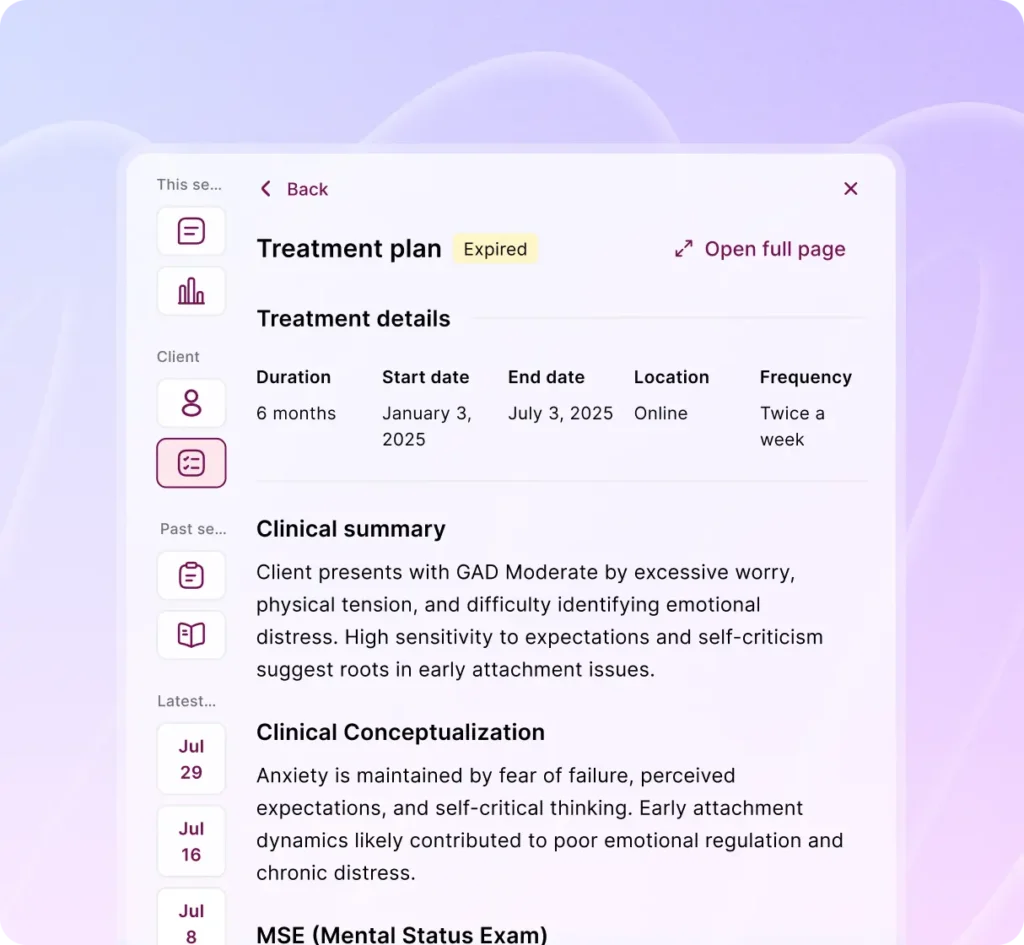
Mentalyc was designed to address these exact breakdown points by keeping treatment plans dynamic, modality-aligned, and continuously connected to session work.
Treatment Plans Built From Real Session Data
Mentalyc’s AI Treatment Planner generates treatment plans directly from your saved session notes–whether you record, dictate, upload, or type them. Instead of starting from a blank template, plans are grounded in the actual clinical material you document, ensuring alignment with your therapeutic framework from the start.
This allows treatment plans to naturally reflect CBT, EMDR, ACT, IFS, psychodynamic, systemic, or integrative approaches–without forcing all modalities into the same structure.
SMART Goals That Stay Clinically Relevant
Mentalyc suggests clear, SMART goals that are tied to diagnosis, symptoms, and modality-specific focus. As new sessions are added, progress toward these goals is tracked automatically–so plans evolve alongside the client rather than remaining fixed at intake.
This removes the need to constantly rewrite objectives while still preserving measurable outcomes that meet insurance expectations.
Golden Thread Alignment Across Documentation
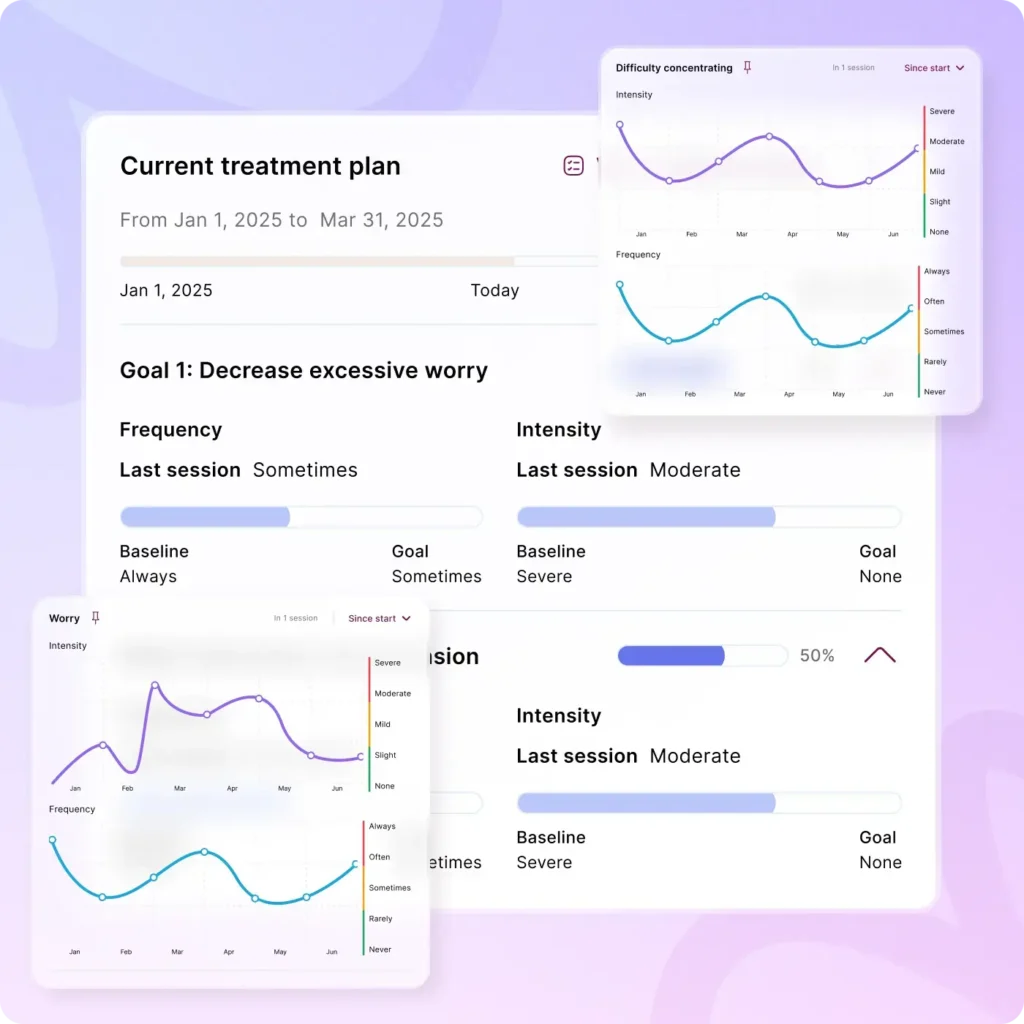
A core strength of Mentalyc is its ability to maintain the Golden Thread across intake notes, treatment plans, and progress notes. Each session builds on prior documentation, creating a continuous and coherent story of care.
This alignment reduces fragmentation, strengthens clinical clarity, and makes it easier to demonstrate continuity and medical necessity during reviews.
Flexible Templates That Match Your Clinical Voice
Mentalyc does not impose rigid formatting. You can customize treatment plan structure and language so documentation reflects your clinical style and modality, not generic AI output. The system supports multiple client types–individual, child, couple, family, and group–without changing how you work.
Less Administrative Load, More Clinical Focus
By drafting plans in minutes and updating them automatically as sessions progress, Mentalyc significantly reduces documentation time and cognitive load. Clinicians no longer need to choose between accurate treatment planning and staying present with clients.
Built for Privacy, Compliance, and Trust
Mentalyc is fully HIPAA, PHIPA, and SOC 2 Type II compliant. Session audio is not stored, client data is never used for model training, and all documentation remains secure and clinician-controlled. This ensures modality-aligned plans are not only clinically sound, but also ethically and legally defensible.
Conclusion
Effective therapy treatment plans by modality do more than satisfy documentation requirements–they reflect the therapeutic framework guiding care, clarify clinical direction, and make progress visible over time. When goals, interventions, and outcomes are aligned with the chosen modality, treatment plans become an active part of therapy rather than static paperwork. This alignment is especially critical in real-world practice, where clinicians often integrate approaches, work with complex presentations, and adapt treatment as clients move through different phases of care.
This is where Mentalyc supports clinicians in a meaningful way. By generating modality-aligned treatment plans directly from session notes, maintaining Golden Thread continuity, and automatically tracking progress toward measurable goals, Mentalyc helps treatment plans stay clinically accurate, current, and defensible–without adding documentation burden. The result is treatment planning that evolves with the therapy and supports both clinical clarity and compliance.
Frequently Asked Questions (FAQs): Therapy Treatment Plans by Modality
Why other mental health professionals love Mentalyc

“It immediately changed my quality of life, personally and professionally.”
Owner/Independently Licensed Marriage & Family Therapist (LMFT)

“Do yourself a favor, make your life easier. I found Mentalyc to be one of the best tools that I’ve ever used.”
Licensed Marriage and Family Therapist

“If I were recommending this software to a colleague, I would tell them that it is the best thing that they could do for their practice.”
Licensed Professional Counselor

“For anyone hesitant: this is a lifesaver. It will change your life, and you have more time to be present with your patients.”
Licensed Clinical Social Worker