

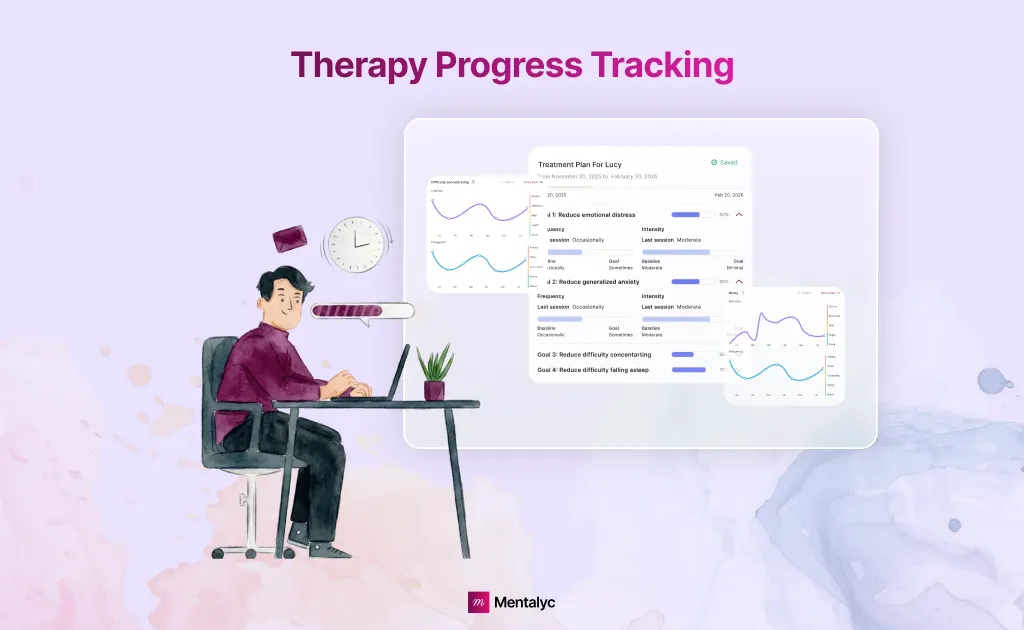
Therapy progress tracking is about noticing how a client is changing over time, not just how a single session went. It helps you see whether symptoms, functioning, or engagement are slowly improving, staying stuck, or shifting in unexpected ways across sessions. Some therapists use questionnaires or rating scales for this (often called progress monitoring or Routine Outcome Monitoring). In day-to-day practice, a lot of the most meaningful progress shows up in session notes and conversations; but, it’s not easy to see the pattern when you’re moving from session to session.
This article breaks down what therapy progress tracking looks like in real clinical work, why common approaches can feel clunky or incomplete, and how Mentalyc’s Progress Tracker helps you see progress clearly using the sessions you already document.
What Is Therapy Progress Tracking?
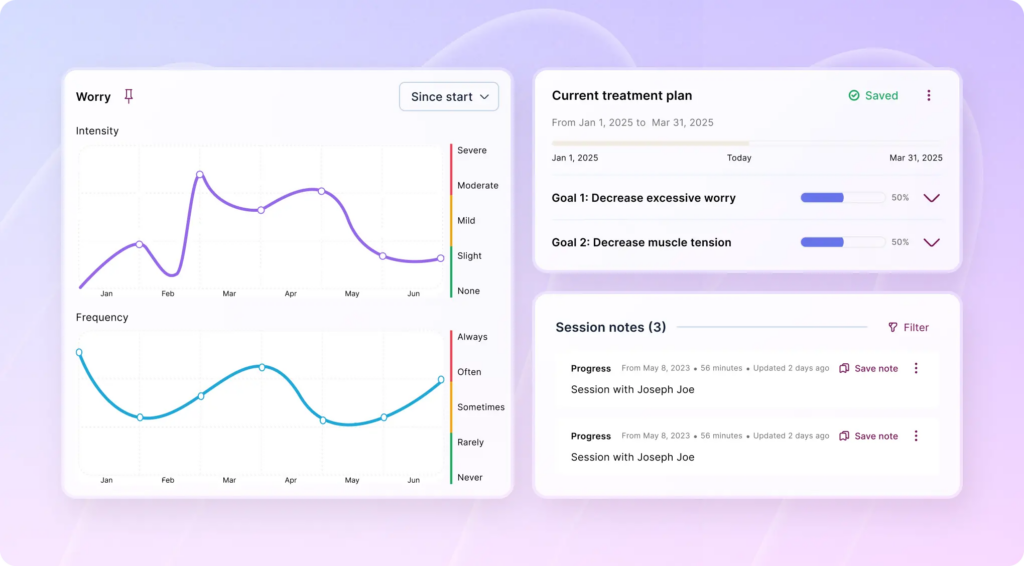
Therapy progress tracking is the systematic observation and interpretation of changes in a client’s clinical presentation across sessions. This includes monitoring:
- Symptom frequency and intensity
- Emotional regulation and coping capacity
- Functional improvement
- Stability, plateaus, or regression
- Response to interventions over time
At its best, therapy progress measurement helps therapists understand progress across therapy sessions, rather than relying on isolated impressions. Importantly, progress tracking is not just about improvement. It is also about:
Track progress automatically from your sessions

New! Transfer your notes to EHR with a single click. No more copy-pasting.
- Identifying when treatment is stalled
- Recognizing when a change in approach is needed
- Noticing subtle improvements that clients may overlook
- Supporting clinical judgment with longitudinal context
Why Tracking Client Progress in Therapy Is Clinically Challenging
Most therapists are already paying close attention to progress. We notice changes in mood, insight, engagement, and behavior. We adjust our approach based on what we see and feel in the room. The challenge isn’t a lack of awareness, it’s holding all of that information together over time.
As cases become longer, more complex, or emotionally demanding, it gets harder to maintain a clear picture of how a client is actually changing. Several common barriers make consistent progress tracking difficult in everyday practice.
1. Reliance on Memory
Therapists often rely on clinical memory to track progress from remembering how a client used to present to comparing it to how they seem now. But memory is shaped by what happened most recently, what felt emotionally intense, or what stood out in a particular session. Over dozens of sessions, small but meaningful shifts can be forgotten or misremembered. Important details blur together, and progress may feel stagnant simply because earlier change is no longer easy to recall.
2. Disconnected Documentation
Progress notes are typically written one session at a time, focused on what happened that day. While each note contains useful information, they are rarely reviewed together in a way that shows change across weeks or months. The story of progress exists in the documentation but it’s scattered. Without synthesis, therapists are left with fragments rather than a clear timeline of how symptoms, functioning, or engagement have evolved.
3. Questionnaire Fatigue
Standardized measures can provide helpful structure, but they are not always easy to use consistently. Clients may forget to complete forms, feel burdened by repeated questionnaires, or disengage from assessments that feel disconnected from the therapeutic conversation. When data is incomplete or inconsistently collected, it becomes harder to trust or interpret. Progress tracking then turns into guesswork rather than a reliable source of insight.
4. Time Constraints
Most therapists don’t have the time to reread months of notes before each session. In busy clinical schedules, decisions are often made quickly, based on the most recent session or a general sense of how things are going. This makes it difficult to step back and notice longer-term patterns—such as gradual improvement, subtle regression, or periods of stability that matter clinically but aren’t obvious session to session.
5. Complex, Non-Linear Progress
Therapeutic change is rarely straightforward. Clients may improve in one area while struggling in another, feel worse during deeper work, or cycle through periods of progress and setback. Without a longitudinal view, these fluctuations can be confusing. It becomes harder to tell whether therapy is truly stalled, unfolding as expected, or moving in a direction that requires adjustment.
Track progress and measure outcomes automatically
Turn your notes into measurable outcomes with built-in progress tracking & impact tools.
- Measure progress over time
- Symptoms tracking
- Goals tracking
- DSM-5 & ICD-10 ready
New! Transfer your notes to EHR with a single click. No more copy-pasting.

What Therapists Actually Need From Progress Tracking in 2026
For progress tracking for therapists to be clinically useful, it must meet several criteria.
Clinically Useful Progress Tracking Must:
- Reflect what actually happened in session
- Show change over time, not just snapshots
- Support session-based progress analysis
- Reduce cognitive load instead of increasing it
- Preserve therapist autonomy and judgment
In other words, therapy progress monitoring should act as therapist decision support, not an administrative burden.
Therapy Progress Tracking as Longitudinal Clinical Insight
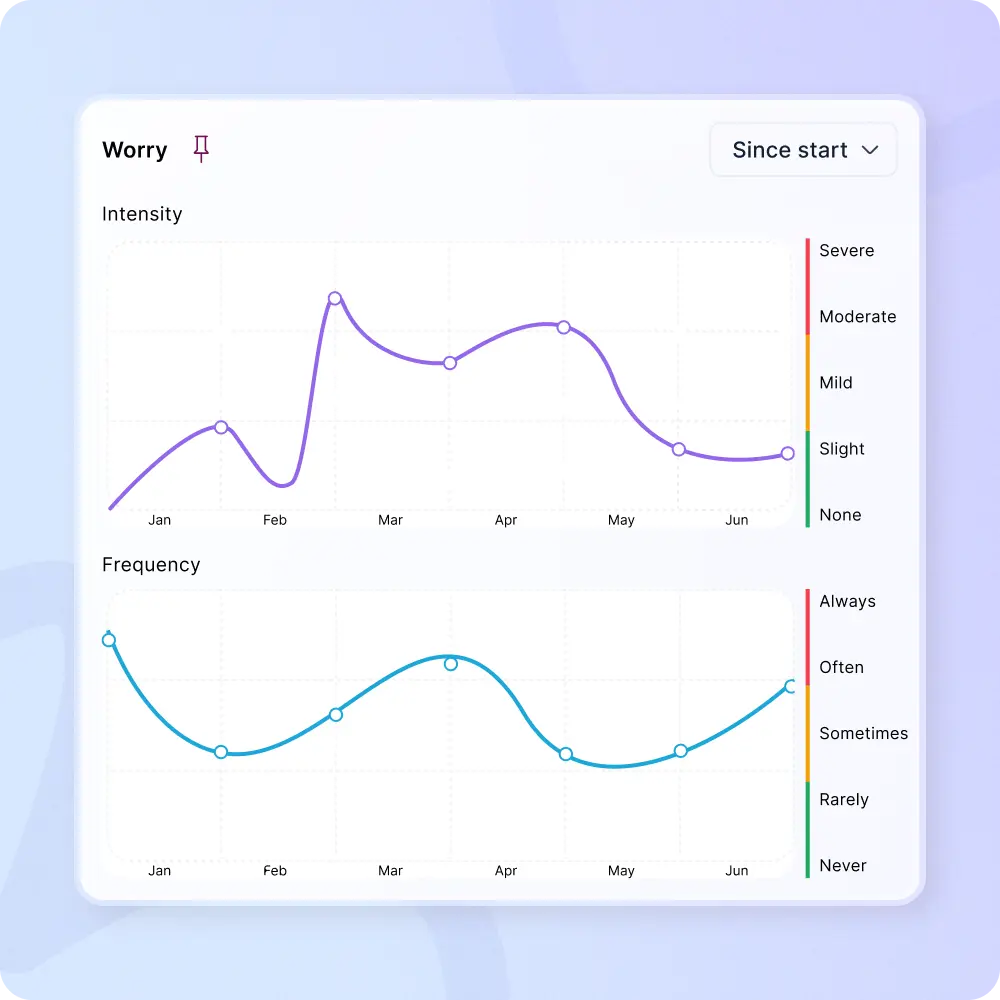
One of the most important shifts in modern therapy progress tracking is moving from session-level documentation to longitudinal client improvement.
Why Longitudinal Tracking Matters
Clinical change rarely happens in straight lines. Progress may include:
- Early symptom relief followed by deeper emotional work
- Temporary symptom increases during trauma processing
- Plateaus that signal the need for treatment adjustment
Without longitudinal visibility, these patterns can be misinterpreted. Longitudinal analysis allows therapists to differentiate between:
- Expected therapeutic fluctuation
- Lack of response to treatment
- Emerging risks or concerns
This is the foundation of meaningful therapy progress measurement.
How Mentalyc Approaches Therapy Progress Tracking
Mentalyc was designed around a simple clinical insight:
Your session notes already contain the full picture of progress. The problem is not lack of data, it is lack of synthesis.
Mentalyc’s AI Progress Tracker transforms session documentation into a clear visual dashboard that shows progress changes, without requiring extra work from therapists or clients.
How Mentalyc’s AI Progress Tracker Works: Session Based Progress Analysis

Step 1: Capture the Session Naturally

Therapists capture sessions the way they already work:
- Recording (telehealth or in-person)
- Dictation
- Typed summaries
- Uploaded audio
This ensures that progress tracking is grounded in real clinical material, not memory recall.
Step 2: Identify Clinically Relevant Signals
Mentalyc analyzes session content to identify:
- Key symptoms
- Recurrent themes
- Goal-related moments
- Shifts in presentation over time
Step 3: Visualize Progress Across Sessions
Progress is displayed through clear visuals that show:
- Symptom trends over time
- Direction of change (improving, stable, worsening)
- Patterns across multiple sessions
This supports therapy progress monitoring without questionnaires or manual scoring.
Tracking Therapy Progress Without Client Questionnaires
One of the most significant differences in Mentalyc’s approach is that clients do not need to fill out forms.
Why This Matters Clinically
- Progress remains embedded in the therapeutic relationship
- Clients are not burdened with extra tasks
- Insights are derived from actual interaction within the session
Mentalyc allows therapists to track client progress in therapy using session-based data, preserving engagement and authenticity.
Therapy Progress Tracking Across Long and Complex Cases
For therapists working with:
- Trauma
- Chronic conditions
- Personality patterns
- Long-term relational work
Progress is often subtle and gradual. Mentalyc supports:
- Longitudinal client improvement across months or years
- Recognition of slow but meaningful change
- Identification of stagnation versus consolidation
This is particularly valuable in cases where improvement is qualitative rather than dramatic.
Therapy Progress Monitoring as Therapist Decision Support
The true value of progress tracking lies in how it informs what happens before you entering the session.
Mentalyc helps therapists:
- Decide when to adjust interventions
- Identify when goals need revision
- Maintain continuity between sessions
- Enter sessions with clarity
This turns progress tracking into clinical guidance, not passive reporting.
Progress Tracking and the Golden Thread of Care
Mentalyc’s progress tracking aligns with the concept of the Golden Thread—the connection between:
- Session content
- Clinical formulation
- Treatment planning
- Documented progress
When progress is visible, documentation becomes a coherent narrative of care, not a collection of isolated notes. As a result, your notes become more defensible when it’s time for an audit.
Ethical and Clinical Integrity in Progress Tracking

Because therapy progress monitoring involves sensitive clinical material, ethical design is essential. Mentalyc is built with:
- Full HIPAA, PHIPA, and SOC 2 compliance
- No storage of session recordings
- No model training on client data
This ensures that therapy progress measurement remains clinically responsible and ethically sound.
The Role of Therapy Progress Tracking in Better Outcomes
Progress tracking doesn’t make change happen on its own. Therapy works because of the relationship, the interventions, and the client’s life outside the room. What progress tracking does is make those elements easier to work with—by bringing clarity to what’s actually unfolding over time.
When progress is tracked consistently and thoughtfully, it supports better care in several important ways:
Reduces blind spots
Without a longitudinal view, it’s easy to miss slow improvement, subtle regression, or patterns that only show up across multiple sessions. Progress tracking helps surface changes that might otherwise go unnoticed—especially in long-term or complex cases.
Supports timely course correction
When therapists can see that progress has stalled, plateaued, or shifted direction, they can respond earlier. This might mean adjusting interventions, revisiting goals, changing pacing, or addressing something that hasn’t yet been named in the work.
Strengthens collaboration with clients
Clear progress signals make it easier to talk openly with clients about how therapy is going. When change is visible, clients often feel more engaged and grounded in the process. When progress is unclear, it opens space for honest reflection rather than assumptions or frustration.
Enhances therapist confidence
Tracking progress over time helps therapists trust their clinical decisions. Instead of relying solely on memory or intuition, you can see patterns that can guide your clinical decision. This clarity is especially valuable in emotionally demanding cases or when progress feels ambiguous. When progress is clear, therapy becomes more intentional. Sessions connect to each other. Decisions feel grounded. And the work feels guided by evidence-based progress.
Conclusion
Therapy progress tracking is not about proving effectiveness or reducing therapy to metrics. It is about understanding change as it unfolds; across sessions, over time, and in context.
When therapists can clearly see how clients are evolving, they are better equipped to respond with care, flexibility, and purpose. Progress tracking helps sessions feel connected, decisions feel supported, and the therapeutic process feel more coherent, for both therapist and client. That’s where Mentalyc’s AI Progress Tracker can helps therapists turn session history into one coherent clinical story – supporting your clinical decisions with defensible documentation for insurance review.
FAQs: Progress Tracking for Therapists
1. Can therapy progress tracking work without treatment plans?
Yes. Mentalyc tracks symptom changes and session patterns even without a formal treatment plan, supporting longitudinal client improvement.
2. Is this therapy progress measurement accurate for complex cases?
Mentalyc supports longitudinal analysis across long-term and complex cases, helping therapists interpret progress patterns over time.
3. Do clients need to complete questionnaires?
No. Progress tracking is derived directly from session material, allowing therapists to track client progress in therapy without surveys.
4. How does progress tracking support therapist decision support?
By visualizing trends across sessions, Mentalyc helps therapists decide what to focus on next, adjust treatment direction, and maintain continuity of care.
5. How does Mentalyc help track client progress in therapy?
Mentalyc analyzes session content to identify symptom trends and meaningful shifts across sessions, supporting therapy progress monitoring without additional assessments.
Why other mental health professionals love Mentalyc

“It helps align the note and the plan for moving forward with sessions … it’s been a really good aid in giving me direction.”
LPC

“It improves the quality of my work as I review my sessions … I bring a sense of continuity from session to session because of the really good summary and progress notes that Mentalyc gives me.”
Licensed Marriage and Family Therapist

“I benefit tremendously every time I wrap up a session and then a few minutes later, I have this AI note. It makes me a better clinician in a variety of ways.”
LPC

“I go back and can read the notes, and it really helps me for the next session. It has made me a much better counselor.”
Licensed Professional Counselor