
The best note-taking app for therapists in 2026 is Mentalyc. It is an AI note-taker built specifically for mental health professionals that turns each session into structured, insurance-ready documentation while keeping client data private (HIPAA + PHIPA + SOC 2 Type II, with zero recording storage). General tools like OneNote or Evernote can hold a quick non-clinical note, but they are not HIPAA-safe for client information and do not produce progress notes, treatment plans, or audit-ready documentation.
This guide ranks the top note-taking and AI documentation tools for therapists in 2026 on what actually matters: HIPAA and SOC 2 compliance, clinical accuracy, treatment-plan alignment, and whether the notes hold up in an insurance audit.
Quick answer – the 3 best note-taking apps for therapists (2026):
- Mentalyc – best overall: purpose-built AI notetaker, zero recording storage, audit-ready notes + treatment plans.
- Eleos – best for large behavioral-health teams needing supervision dashboards.
- Upheal – usable for basic AI drafting, though it has shifted toward being a full EHR rather than a focused notetaker.
How We Ranked These Note-Taking Apps
This ranking is grounded in our ongoing research with therapists, not vendor marketing. At Mentalyc we run continuous surveys on why clinicians choose, switch, or leave documentation tools (hundreds of responses to date), interview therapists actively making buying decisions, and run rolling UX research that compares these tools hands-on. We combined that with published clinician reviews to weigh each tool against the priorities that matter most in day-to-day practice:
| Priority | What we looked at |
|---|---|
| Highest | Clinical accuracy and audit-readiness (correct terminology, treatment-plan alignment, defensible structure) |
| High | HIPAA + SOC 2 safeguards and data handling (BAA, recording storage, training on your data) |
| Medium | Purpose-built for therapy vs. general medical or consumer note-taking |
| Medium | Pricing transparency and value at real documentation volume |
| Supporting | Workflow fit (capture options, EHR compatibility, client-type support) |
Tools built specifically for mental health documentation, with strong privacy and audit-ready output, score highest. General medical scribes, repurposed EHRs, and consumer note apps score lower because they weren’t designed for therapy notes.
Spend less time writing, more time with clients.


Best Note-Taking Apps for Therapists Compared (2026)
| Tool | Best For | Price* | Note Accuracy | Compliance | Stores Recordings? | Trains on Your Data? | Treatment Plans? | Audit-Ready? |
|---|---|---|---|---|---|---|---|---|
| Mentalyc | Best overall | 14-day free trial; from $14.99/mo | A+ | HIPAA + PHIPA + BAA + SOC 2 Type II | No (zero storage) | No | Yes | Yes |
| Eleos | Enterprise teams | Custom / on request | A | HIPAA + SOC 2 + HITRUST | Yes | Yes (model improvement) | Yes | Partial |
| Upheal | Basic drafting (now an EHR) | ~$1/session, cap $69/mo | B | HIPAA + SOC 2 Type II | Yes (unless deleted) | Yes (opt-out) | Partial | Partial |
| Blueprint | Measurement-based care | $0.24-$1.49 / session | B+ | HIPAA + SOC 2 Type II | Yes | Unclear | Partial (scale-driven) | Partial |
| Freed | General ambient scribe (not therapy-specific) | $39 / $79 / $119 mo | B+ | HIPAA; no recording storage | No | No | Limited | Limited |
| TherapyNotes (AI Add-On) | Existing TherapyNotes EHR users | +$40/clinician/mo | C+ | HIPAA | Yes | Yes (via OpenAI) | No | No |
| SimplePractice (AI Add-On) | Existing SimplePractice users | +$35/mo | C | HIPAA (HITRUST infra) | Yes | Yes (via OpenAI) | No | No |
| Theranest (Ensora) | Budget EHR users | from ~$29/therapist/mo | C | HIPAA | n/a (EHR) | n/a | Limited (planner add-on) | No |
| Heidi | Mixed medical / psychiatry | Free tier; $99-$150/user/mo | C | HIPAA, SOC 2, GDPR noted | Yes | Yes | Limited | Limited |
| Evernote / OneNote / Google Keep / Apple Notes / Word | Manual note-taking only | Free-low | n/a | Not HIPAA-safe for PHI | n/a | n/a | No | No |
| ChatGPT / Claude (consumer) | Not recommended for PHI | Free-$20+/mo | n/a | No BAA on consumer plans | Varies | Often yes | No | No |
* Pricing as published by each vendor at time of writing; verify current plans on each provider’s pricing page.
The Best AI Note-Taking Apps for Therapists, Reviewed
Mentalyc – Best Note-Taking App for Therapists (Top Pick)
Mentalyc is the best note-taking app for therapists because it is the only tool that fully meets both layers of safety: HIPAA + PHIPA + SOC 2 Type II security and clinically accurate, audit-ready documentation aligned with treatment goals and insurance requirements. Therapists only need to record (or upload, dictate, or type) the session, and Mentalyc’s AI Note Taker generates structured progress notes, treatment plans, and progress tracking automatically.
Documentation isn’t the problem. The time it takes is. Trusted by more than 30,000 clinicians, Mentalyc turns each session into insurance-ready notes kept aligned with treatment goals and overall clinical direction, without questionnaires or extra work. It is also the only AI notetaker with Alliance Genie™, which surfaces relational insights that matter for engagement and outcomes.
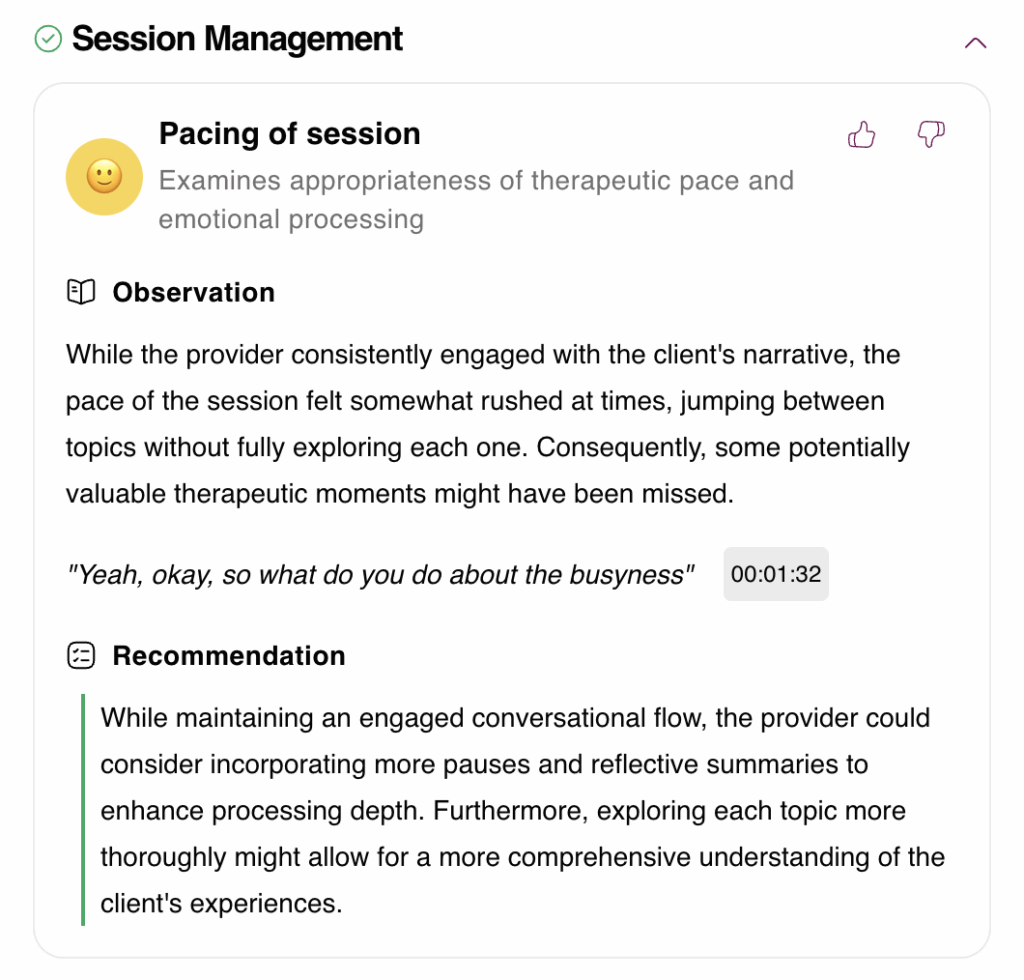
Why Mentalyc ranks first: notes, treatment plans, and progress tracking stay connected through the Golden Thread, giving a clear client history across sessions; Alliance Genie™ surfaces attunement and potential ruptures so therapists can respond earlier; and the privacy model (covered in detail below) is the strongest of any tool here.
| Category | Features |
|---|---|
| Documentation | Automated notes in all standard formats (SOAP, DAP, BIRP, GIRP, PIRP, SIRP, PIE, Intake); supports all client types, including group therapy; auto-computed CPT codes; custom templates; client-shareable summaries |
| Treatment Planning & Progress Tracking | SMART measurable goal suggestions; auto-updating treatment plans; automated progress tracking (no questionnaires); visualizes progress across symptoms and goals |
| Clinical Insight & Reflection | Alliance Genie™ for therapeutic alliance and missed insights; risk detection for high-risk or suicidal clients |
| Workflow & Privacy | Flexible capture (record, upload, dictate, type); works with any EHR via Chrome extension; group-practice and team features; HIPAA + PHIPA + SOC 2 Type II, no recordings stored, no training on user data |
Pros: most accurate clinical language; fastest workflow (saves hours weekly); fits different therapy setups, clients, and approaches; strongest privacy and security model; strengthens clinical insight across sessions; scales into group-practice via the team plan.
Cons: designed specifically for mental-health documentation (not broader medical use); no built-in telehealth platform, but works with whatever tools clinicians already use (Zoom, Doxy).
Best for: therapists, counselors, social workers, psychologists, and PMHNPs. It fits solo, group, supervision teams, and agencies across all therapy formats.
| Plan | Price | Key Features |
|---|---|---|
| Free Trial | $0 | 14 days of full PRO access, 15 notes, no credit card |
| Mini | $14.99/mo (annual) | Record in-person sessions, upload audio, voice-to-text, or type notes |
| Basic | $29.99/mo (annual) | Everything in Mini, plus Alliance Genie™ (limited) and Smart TP™ |
| Pro | $59.99/mo (annual) | EMDR, Play & Psychiatry modalities, 100+ custom templates (BIRP, PIRP, GIRP, PIE, SIRP), auto-computed CPT codes |
| Super | $99.99/mo (annual) | Everything in Pro, plus per-member group therapy notes, priority onboarding & support |
See the pricing page for details. Try Mentalyc for FREE today.
Automate your note-taking securely and focus more on care
Eleos – Best for Enterprise Behavioral Health Teams
Eleos is built for mid-size and large behavioral-health organizations that need standardized workflows, team oversight, and analytics-driven documentation. It generates draft notes from session transcription and offers supervision dashboards for consistency across large teams. User feedback highlights limits in flexibility and note depth:
“It is an input/output system… it is not as comprehensive when you use the note feature. Also, the device can only be used in a clinic. If you are seeing a client in the home or at the school, you can not use the box/device.”
– Abagail B, via G2
Pros: strong organizational analytics; good for multi-provider teams; consistent standards across staff.
Cons: stores recordings; more expensive than most AI note tools; slower processing reported; some “robotic”/repetitive note language.
Best for: large clinics, agencies, and enterprise behavioral-health teams needing analytics and supervision. Pricing: no free trial; on request.
Write less, focus more
- SOAP, DAP, BIRP, EMDR notes and more
- AI Treatment Planner
- AI Progress Tracker
- Alliance signals
- HIPAA & PHIPA compliant

Upheal – Now an EHR, Not a Focused Notetaker
Upheal began as an AI therapy notetaker, but in 2026 it positions itself as “an AI-native EHR for therapists”, bundling AI notes with scheduling, telehealth, client billing (insurance billing slated for summer 2026), and practice management. As it broadens into full practice management, note-taking is no longer its core focus, and clinicians who want a dedicated, privacy-first notetaker may find the EHR-first direction a poor fit. Reviews also flag accuracy issues (see our Upheal vs Mentalyc comparison):
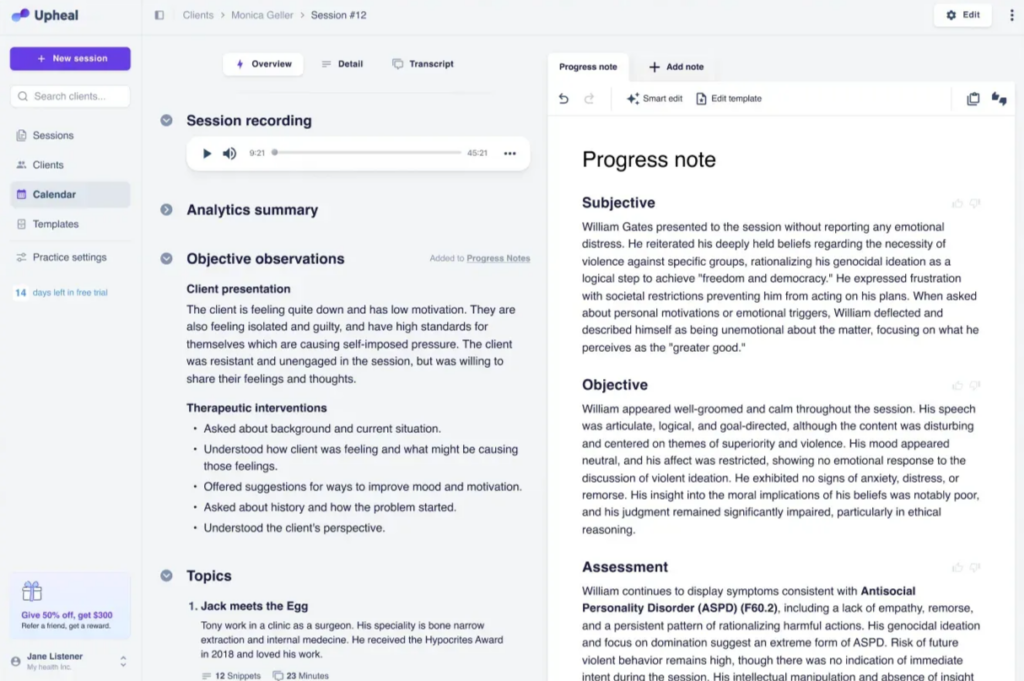
“It struggles with identifying speakers, adds dialogue that didn’t happen, repeats interventions, and fixing transcripts can become time-consuming when it’s unclear who said what.”
– Letiesha Dunn, via Trustpilot
Pros: user-friendly; affordable entry price; basic session analytics.
Cons: now an EHR rather than a focused notetaker; stores full recordings (unless deleted); limited support for complex modalities; inconsistent clinical accuracy; not suited for insurance-heavy documentation.
Best for: solo therapists wanting simple draft notes who are also shopping for an all-in-one EHR. Pricing: $1 per completed session, capped at $69/mo.
Blueprint – Built for Measurement-Based Care, Not Note Depth
Blueprint is primarily an outcomes-and-measurement platform that layers basic AI drafting on top of standardized assessments (PHQ-9, GAD-7). Because its center of gravity is measurement-based care rather than clinical note-taking, the AI notes lean heavily on rating-scale data and can feel repetitive:
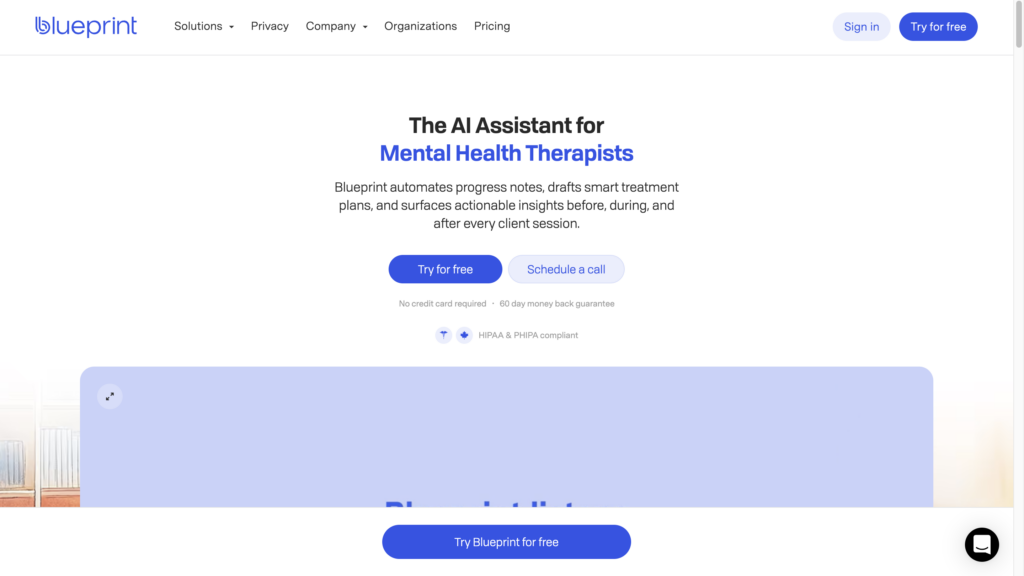
“Often notes are not accurate… The assessment section literally is just repeating what was already said… I have been on the fence as to whether this is actually saving me any time because I spend so much time editing.”
– via Blueprint Feedback Portal
Pros: reliable standardized assessments; supports insurance-driven measurement-based documentation.
Cons: notes rely heavily on rating scales, limiting clinical depth; not ideal for complex or modality-specific psychotherapy; limited customization across client types.
Best for: clinics prioritizing outcomes tracking and measurement-based care. Pricing: $0.24-$1.49 per session.
Freed – General Medical Scribe, Not Tailored to Therapists
Freed is an ambient AI scribe built for general medical use, not psychotherapy. It produces solid transcription-style notes, but lacks the therapy-specific layer clinicians need: no SMART treatment planning, no modality-aligned formats (BIRP, GIRP, PIRP), no therapeutic-alliance insight, and limited audit-ready structure. It’s also expensive at the volume therapists document: unlimited notes start at $79/month (vs Mentalyc’s $59.99 Pro), and EHR push plus ICD-10 coding sit behind the $119/month Premier tier. Therapists who try it report the same fit problem:
“It felt like there wasn’t much flexibility, just a few templates and not much ability to tweak how it works. Output was good for simple visits, but not robust enough for my more complex cases.”
– Freed user, via Reddit
Pros: ambient capture; no recording storage; customizable templates; HIPAA-compliant.
Cons: not therapy-specific; expensive at unlimited/EHR tiers; limited treatment-plan and audit-ready features; no alliance or progress-tracking layer.
Best for: general medical clinicians who want an ambient scribe. Pricing: Starter $39/mo (40 notes); Core $79/mo (unlimited); Premier $119/mo.
TherapyNotes (AI Note Assist) – EHR with Bolt-On AI
TherapyNotes is a widely used behavioral-health EHR that recently added AI-assisted note drafting: HIPAA-aligned drafting inside an EHR, not a purpose-built notetaker:
“Our practice has grown to over 25 users across multiple offices. TN has not kept pace. Complex scheduling remains a pain… clunky at best and error-prone at worst.”
– TherapyNotes user, via Crown Counseling
Pros: no new workflow for existing users; trusted for scheduling, billing, documentation.
Cons: early-stage AI with fewer customization options; retains transcripts/recordings longer than privacy-first tools; limited group/family/child support; not optimized for treatment planning or alliance analysis; add-on costs extra.
Best for: clinicians already on TherapyNotes wanting light AI drafting. Pricing: ~$40/clinician/mo add-on on top of the subscription.
SimplePractice (AI Note Assistant) – EHR Add-On, Minimal Setup
SimplePractice’s AI Note Assistant generates draft SOAP/DAP/BIRP notes inside the existing EHR. Like TherapyNotes, its appeal is convenience for current users, and feedback raises device and privacy concerns:
“The terms of service provide NO ASSURANCE of privacy, and the Bot-driven help makes me think it is like every other app that is just mining my data…”
– Teri Bernstein (client of a SimplePractice user), via Trustpilot
Pros: convenient for current users; no platform switching; fine for basic documentation.
Cons: device limitations (mobile/iPad only for some AI features); privacy concerns and unclear training policies; limited support for complex sessions; not designed for treatment planning or progress tracking.
Best for: clinicians already on SimplePractice wanting basic in-EHR drafting. Pricing: ~$35/mo per enabled clinician (after a 30-day trial), on top of the SimplePractice plan.
Heidi – Medical Scribe, Reliability Issues for Therapy
Heidi (Heidi Health) is a medical-grade AI scribe used across psychiatry, primary care, and specialist settings, and is built for general medical documentation rather than psychotherapy. Therapists report reliability issues:
“I found that HH only transcribed the first 30 minutes of the interview and the last 5 minutes… All the transcription in between disappeared!”
– Les, via Trustpilot
Pros: covers medical + mental-health documentation; useful in multidisciplinary clinics.
Cons: reliability issues (missing transcripts, audio-capture failures, device incompatibility); not optimized for therapy frameworks; requires customization; higher pricing than therapist-focused tools.
Best for: clinics combining psychiatry + general medicine + therapy. Pricing: limited free tier; Clinician $150/user/mo (billed annually); Practice ~$99/user/mo; Enterprise custom.

Tools That Aren’t Built for Therapy Notes (Use With Caution)
General Note-Taking Apps (Evernote, OneNote, Google Keep, Apple Notes, Word)
General note apps are popular for a quick digital notepad: Evernote (versatile, cross-device), OneNote (free, templates, password protection, audio recording), Google Keep (simple, syncs everywhere), Apple Notes (clean and visual on Mac), and Word (quick, track-changes). The catch: none are HIPAA-compliant for protected health information out of the box, and none generate progress notes, treatment plans, CPT codes, or audit-ready documentation. Use them for non-PHI planning and resource libraries, not clinical session notes.
Can You Use ChatGPT or Claude for Therapy Notes?
Not safely with real client information. General-purpose AI chatbots like ChatGPT and Claude can draft text, but the consumer versions therapists typically use do not come with a signed Business Associate Agreement (BAA) and are not designed for protected health information. Pasting session details risks a HIPAA violation, and consumer plans may use your inputs to train models. They also don’t produce audit-ready clinical formats (SOAP, DAP, BIRP), align notes to treatment goals, or track progress across sessions. If you want AI’s speed without the compliance risk, use a purpose-built, HIPAA-compliant tool like Mentalyc that offers a BAA, zero recording storage, and clinically structured notes.
What Makes a Note-Taking App HIPAA-Compliant and Audit-Ready
The tools that win on this page do two things most can’t: keep client data genuinely safe and produce documentation that survives an audit. Think of compliance in two layers, and most tools only meet the first one.
| Compliance Level | What It Covers | What Therapists Should Know |
|---|---|---|
| Level 1: Basic security (minimum) | HIPAA compliance, encryption in transit and at rest, signed BAA | Protects against basic security issues, but does not explain what happens to session recordings or transcripts after use |
| Level 2: Data handling (real risk area) | How session data is stored, retained, deleted, and potentially reused | Therapists should know whether recordings are stored or deleted, how long transcripts are kept, whether deleted data is truly removed, and whether any data trains AI models |
Red flags to avoid: storing session recordings; training AI on client or clinician data; no SOC 2 Type II certification; vague privacy policies. Tools can claim HIPAA compliance yet still store full recordings, keep transcripts indefinitely, or reuse data for training, which increases legal, ethical, and privacy risk.
Legal compliance protects data; clinical compliance protects your license. A truly compliant AI notetaker must also generate audit-ready notes that: reflect what actually happened (no fabrication); use proper clinical terminology; align with treatment goals and plans; support insurance-ready documentation and medical necessity; show continuity of care (the “golden thread”); support SMART treatment planning; and avoid misrepresenting symptoms, risks, or interventions.
This is where many tools fall short: notes that sound clinical but lack goal alignment and defensible structure are vulnerable at audit. Mentalyc was built for both layers: fully HIPAA + PHIPA + SOC 2 Type II with a signed BAA and zero recording storage (security details; more on HIPAA and mental health), and it transforms sessions into structured notes, compliant treatment plans, and progress charts that meet insurance and audit requirements, cutting documentation time by up to 70%. (More on why documentation matters.)
Quick Comparison Recap
- Best overall / privacy-first: Mentalyc, purpose-built, zero storage, audit-ready notes + treatment plans.
- Best for enterprise teams: Eleos, supervision dashboards and org analytics (stores recordings).
- Best if you also want a full EHR: Upheal, note focus diluted by its EHR pivot.
- Best for measurement-based care: Blueprint, strong on assessments, thin on note depth.
- General medical scribe (not therapy-specific): Freed, capable but pricey and not therapy-tailored.
- If you already use that EHR: TherapyNotes / SimplePractice, convenient bolt-on AI, limited clinical depth.
- Avoid for client notes: consumer ChatGPT/Claude and general note apps, no BAA, not audit-ready.
How to Choose the Best Note-Taking App for Your Practice
After weighing workflow efficiency, clinical accuracy, privacy, and real therapist feedback, Mentalyc is the best note-taking app for therapists in 2026. It is the only platform meeting both layers of safety (HIPAA + PHIPA + SOC 2 Type II) and clinically accurate, audit-ready documentation aligned with treatment goals and insurance requirements. If you need billing and telehealth in one system, pair a full EHR (SimplePractice or TherapyNotes) with Mentalyc for the notes layer. If documentation is taking over your evenings, register for Mentalyc for FREE today.
Automate your notes and gain insights with Mentalyc
- SOAP, DAP, BIRP & more
- SMART treatment plans
- Therapeutic alliance insights
- HIPAA, PHIPA & SOC2 compliant
Why other mental health professionals love Mentalyc

“For anyone hesitant: this is a lifesaver. It will change your life, and you have more time to be present with your patients.”
Licensed Clinical Social Worker

“It’s so quick and easy to do notes now … I used to stay late two hours to finish my notes. Now it’s a breeze.”
Licensed Professional Counselor

“If I were recommending this software to a colleague, I would tell them that it is the best thing that they could do for their practice.”
Licensed Professional Counselor

“I’m able to move in and out of doing my notes within that small five-minute gap between sessions. I’m able to keep compliance and rest assured everything is covered.”
Licensed Clinical Social Worker

“My notes get finished after every single session now because Mentalyc makes it so easy. I’m not stressed out about notes and I feel like my notes are of much higher quality.”
Licensed Clinical Social Worker

“It improves the quality of my work as I review my sessions … I bring a sense of continuity from session to session because of the really good summary and progress notes that Mentalyc gives me.”
Licensed Marriage and Family Therapist

“The treatment planning has been a huge support as well. I really appreciate the amount of guidance the program has given me.”
Frequently Asked Questions (FAQs)
References
- U.S. Department of Health & Human Services, HIPAA
- Health Insurance Portability and Accountability Act (HIPAA), Wikipedia
- Eleos Health user review (G2)
- Upheal user review (Trustpilot)
- Heidi Health user review (Trustpilot)
- TherapyNotes user review (Crown Counseling)
- Related Mentalyc reading: Upheal vs Mentalyc · Progress Notes · Mental Health Treatment Plan · SMART Goals in Therapy · HIPAA and Mental Health · Importance of Documentation