
Documentation audits are increasing, insurers are rejecting vague or inconsistent notes, and concerns about AI-generated therapy notes, from fabricated details to unclear data storage, are making clinicians more cautious.
Many tools claim to be HIPAA compliant, but stop at basic security. They encrypt data yet fall short on clinical accuracy, audit-ready documentation, and treatment-plan alignment—the areas insurers and supervisors care about most. Others raise concerns around recording storage, opaque data-use policies, or reliance on generic GPT-based models.
This guide compares the top AI note-taking tools for therapists in 2026, focusing on what actually matters: HIPAA and SOC 2 compliance, ethical data handling, zero recording storage, and documentation that holds up in audits and payer review.
Ranked List of Top HIPAA-Compliant AI Notetakers & Treatment Plan Generators
Tool |
Best For |
HIPAA + SOC2 |
Recording Storage |
Uses Data for Training? |
Clinical Accuracy |
Treatment Plans? |
Audit-Ready? |
Price* |
Overall Rating |
|---|---|---|---|---|---|---|---|---|---|
Mentalyc |
Best overall for therapists wanting full compliance + audit-safe notes + advanced session analytics |
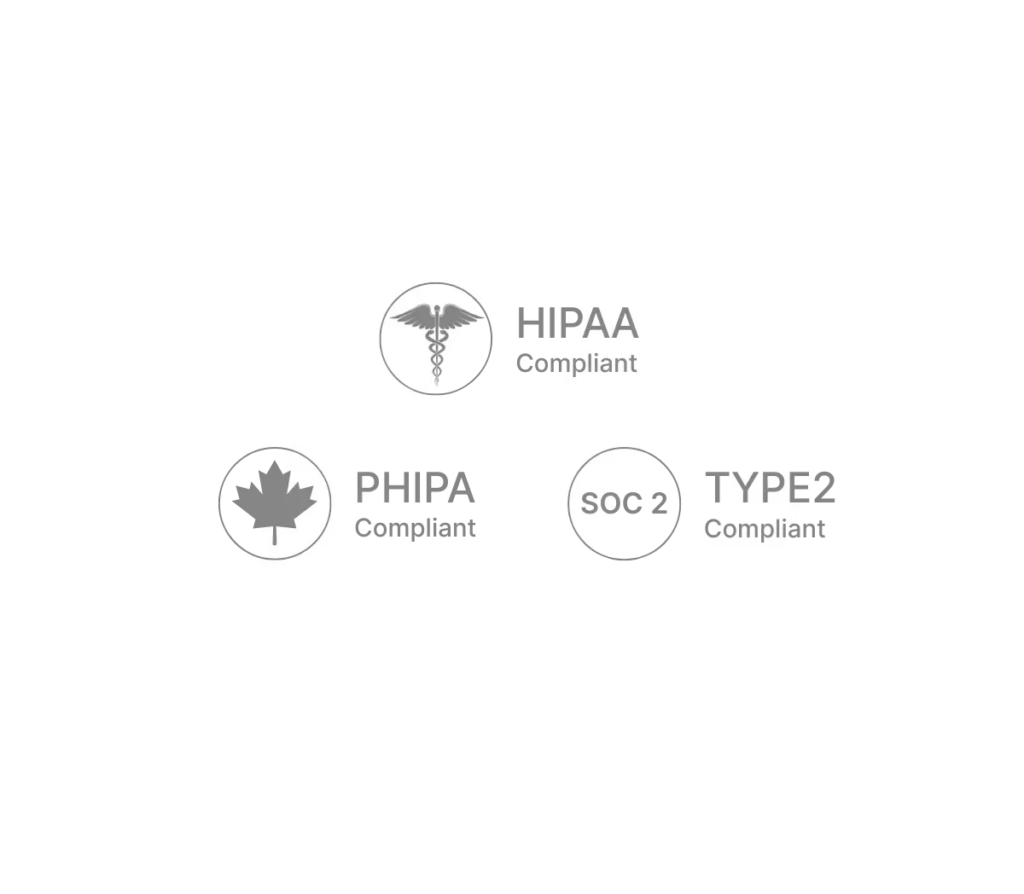
Yes – HIPAA + PHIPA + BAA and SOC2 Type II |
Zero recording storage (rare) |
No training on clinician data |
Excellent (designed for audit-ready, clinical accuracy) |
Yes – creates measurable goals from sessions and links them to ongoing progress. |
Yes – notes are designed to support audits, supervision, and insurance review. |
14-Day Free Trial with Full Pro and Paid Plan Access |
A+ |
Upheal |
Clinicians looking for basic AI notes with simple analytics |
HIPAA compliant, SOC2 status less clearly detailed |
Not Clear |
Not Clear |
Good – but less focused on audit-ready structure |
Partial – note generation but treatment-plan support less emphasized |
Partial |
Free and paid plans available |
A |
Eleos |
Large organizations focused on compliance oversight and operational analytics. |
Yes – HIPAA + SOC2 + HITRUST |
Not Clear |
Not Clear |
Good – enterprise grade documentation |
Yes – treatment plan support offered |
Partial – audit-ready features available |
Contact for custom quotes |
B+ |
Heidi |
Entry-level / simple AI scribe for therapy and allied health |
SOC2 compliant, HIPAA/GDPR noted |
Not Clear |
Not Clear |
Moderate – more general, less therapy-specialized |
Limited – treatment-plan depth less emphasised |
Limited audit-ready focus |
Free and paid plans available |
B+ |
TherapyNotes AI Add-On |
Best if you already use TherapyNotes EHR and just need AI drafting |
HIPAA compliant core product |
Not Clear |
Data-use terms unclear |
Good – in EHR context but AI note depth less documented |
No strong treatment plan generator noted |
No full audit-readiness clearly marketed |
Add-on fee billed separately from the base subscription |
B |
What Makes An AI Notetaker “HIPAA-Compliant”?
When therapists evaluate a HIPAA-compliant AI note-taker, it’s easy to assume compliance is just a technical checkbox. In practice, there are two levels of compliance and most tools only meet the first.
What HIPAA Compliance Really Means for AI Note-Takers
Compliance Level |
What It Covers |
What Therapists Should Know |
|---|---|---|
Level 1: Basic security (minimum) |
HIPAA compliance, encryption for data in transit and at rest, and a signed Business Associate Agreement (BAA) |
Protects against basic security issues, but does not explain what happens to session recordings or transcripts after use. |
Level 2: Data handling (real risk area) |
How session data is stored, retained, deleted, and potentially reused |
Therapists should know whether recordings are stored or deleted, how long transcripts are kept, whether deleted data is truly removed, and whether any data is used to train AI models. |
⚠️ Why this matters:
Tools can still store full recordings, keep transcripts indefinitely, or reuse data for training increase legal, ethical, and privacy risk—even if they claim HIPAA compliance.
Red flags to avoid
- Storing session recordings
- Training AI on client or clinician data
- No SOC 2 Type II certification
- Unclear or vague privacy policies
Many GPT-based tools raise one or more of these concerns. By contrast, Mentalyc clearly states that it does not train on clinician or client data and does not retain session recordings—addressing both security and real-world clinical risk.
Clinical & Documentation Compliance for Audit-Ready AI Therapy Notes
Legal compliance protects data. Clinical compliance protects your license.
A tool can be HIPAA-compliant and still produce unsafe documentation. A truly compliant AI notetaker for therapists must generate audit-ready AI therapy notes that meet insurance, ethical, and clinical standards. That means the AI must:
- Accurately reflect what happened in session (no guessing or fabrication)
- Use proper clinical terminology, not generic AI language
- Align notes with treatment goals and plans
- Support insurance-ready documentation and medical necessity
- Show continuity of care across sessions (the “golden thread” auditors expect)
- Support SMART treatment planning and measurable progress
- Avoid ethical misrepresentation of symptoms, risks, or interventions
This is where many AI note tools fall short. They generate notes that sound clinical but lack clear goal alignment, progress logic, and defensible structure – making them vulnerable during audits or payer review.
Key Features Therapists Should Look For in a HIPAA-Safe AI Notetaker (2026)
Feature |
Why It Matters for Therapists |
|---|---|
No recording storage |
Session audio is never kept, reducing risk around subpoenas, breaches, and client consent concerns. |
Encrypted data handling |
Keeps PHI protected from the moment data is captured to the final signed note. |
Clinically accurate note drafting |
Avoids made-up symptoms, risks, or interventions that could cause problems in audits or supervision. |
Evidence-based framework support |
Helps notes align with recognized approaches like CBT, DBT, ACT, EMDR, and trauma-informed care. |
SMART goal support |
Produces clear, measurable goals that insurers and auditors expect to see. |
Treatment plan alignment (“golden thread”) |
Connects session notes, goals, and progress so care clearly builds over time. |
Group, couples, and child therapy support |
Accurately reflects relational work, family dynamics, and developmental context. |
Clear continuity of care |
Shows how each session follows from the last—important for audits, supervision, and payer review. |
No AI training on client data |
Protects client confidentiality and avoids ethical concerns around data reuse. |
Consistent notes across sessions |
Keeps structure and language stable, reducing red flags during review. |
Clinician-controlled style |
Preserves your clinical voice, preferred language, and documentation approach. |

Mentalyc — Best Overall HIPAA-Compliant & Audit-Ready AI Notetaker (Rank #1)
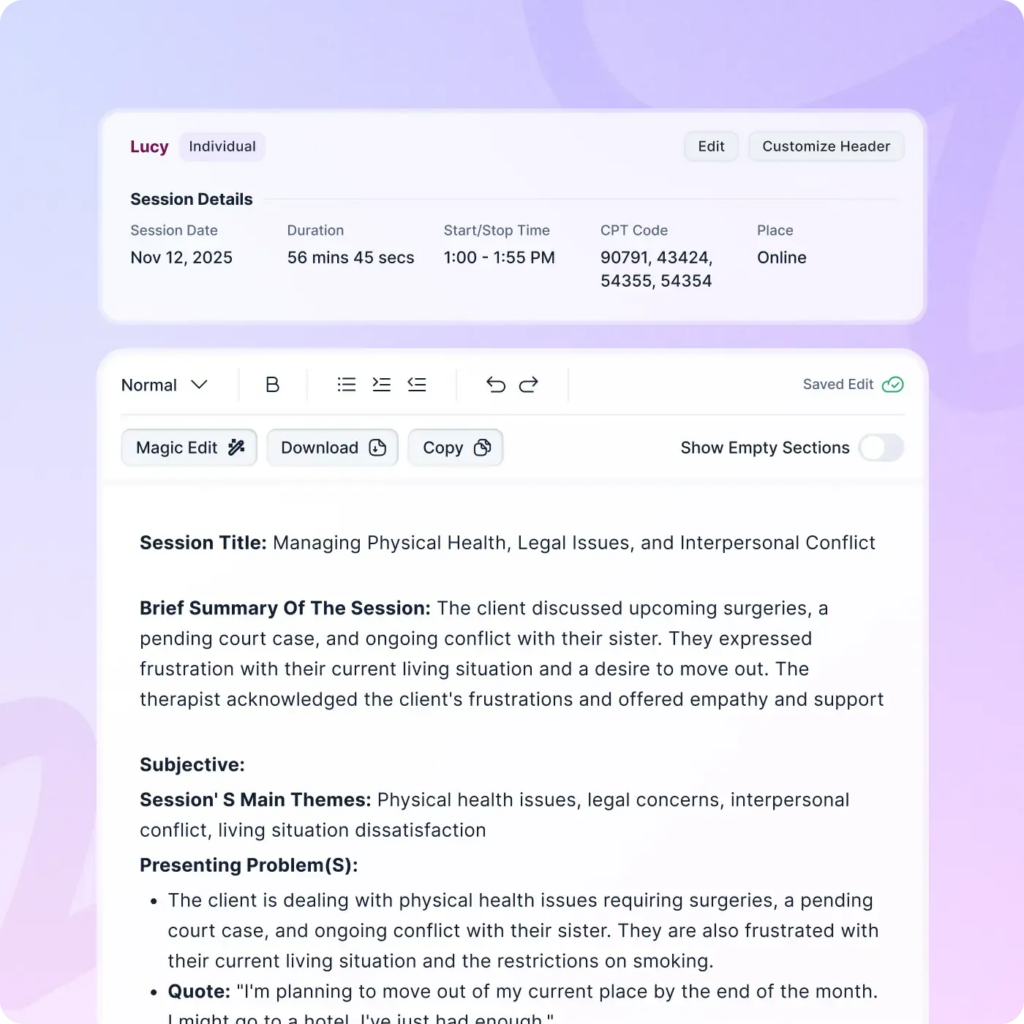
Mentalyc stands out in 2026 as the top HIPAA-compliant AI note taker and AI treatment plan generator built specifically for mental health professionals. It focuses on two things most AI tools fail to balance: strong data protection and clinically accurate, audit-ready documentation.
Unlike generic AI software, Mentalyc is designed for real clinical use – producing clinically accurate documentation that reflects actual session content while maintaining strong privacy protections.
What Makes Mentalyc Different
1. Privacy & Compliance
Mentalyc is built to meet real-world compliance expectations, not just marketing claims.
- HIPAA & PHIPA compliant with BAA support
- SOC 2 Type II compliant
- No recording storage (session audio is not retained)
- Does not train on clinician or client data
- Encrypted workflows end to end
2. Clinical Accuracy & Audit Safety
Mentalyc produces documentation designed to hold up in audits, supervision, and payer review.
- Clinically aligned, insurance-ready notes
- Clear continuity of care across sessions (“golden thread”)
- Structured documentation that supports medical necessity
- Built-in guardrails to prevent hallucinations or speculative content
3. Therapy-Focused Functionality
Mentalyc supports how therapy actually unfolds across sessions.
- Automated progress notes, intake, and treatment plans from real sessions
- AI progress tracking with measurable goals and symptoms changes linked across notes
- Notes adapt to clinician style, voice, and modality
- Supports individual, couples, group, and child therapy
- Includes **Alliance Genie™** (therapeutic alliance insights) for supervision-level reflection and skill development
Pricing
- Free Trial: 14 days of full PRO access, including 15 notes—no credit card required.
- Mini: USD 14.99/month billed annually
- Basic: USD 29.99/month billed annually
- Pro: USD 59.99/month billed annually
- Super: USD 99.99/month billed annually
Visit the pricing page for more details.
Therapists Reviews on Mentalyc’s AI Note-taker
Why other mental health professionals love Mentalyc

“I’m able to move in and out of doing my notes within that small five-minute gap between sessions. I’m able to keep compliance and rest assured everything is covered.”
Licensed Clinical Social Worker

“My notes get finished after every single session now because Mentalyc makes it so easy. I’m not stressed out about notes and I feel like my notes are of much higher quality.”
Licensed Clinical Social Worker

“It improves the quality of my work as I review my sessions … I bring a sense of continuity from session to session because of the really good summary and progress notes that Mentalyc gives me.”
Licensed Marriage and Family Therapist

“The treatment planning has been a huge support as well. I really appreciate the amount of guidance the program has given me.”
Upheal — Best Known for Analytics-Rich AI Therapy Notes
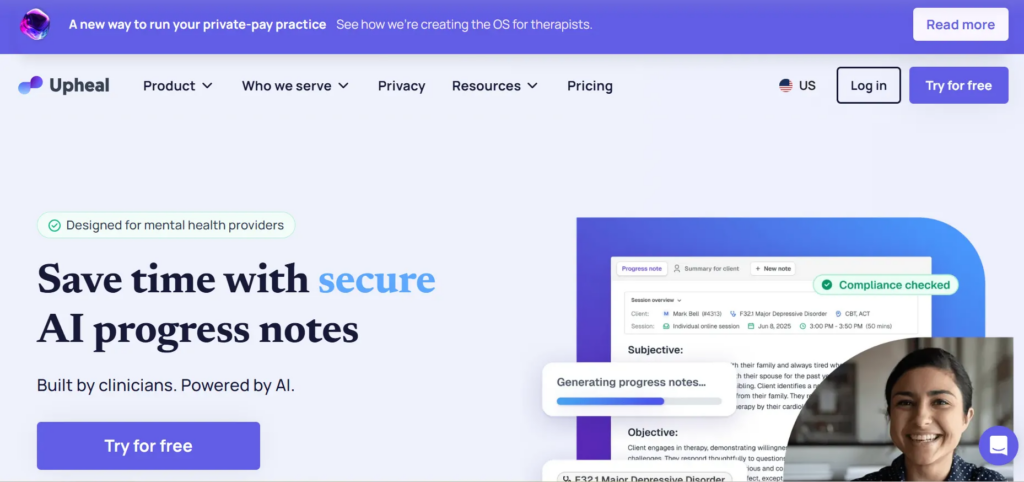
Upheal is often evaluated by therapists looking for a HIPAA-compliant AI notetaker that combines documentation with session analytics. Clinicians generally value its insights into engagement and talk-time patterns, but reviews consistently note that accuracy checks and transcript cleanup remain necessary, which can affect audit readiness. One therapist described the trade-off this way:
“Incorrectly identifying male and female voice, even if the transcript speakers have been adjusted…Some interventions mention dialogue that happened that wasn’t correct” — Upheal user… via Trustpilot
Key Features
- AI-generated therapy notes (SOAP, DAP, BIRP formats)
- Session analytics (talk-time ratios, engagement trends)
- SMART goal support and treatment-plan concepts
- Works with telehealth and integrates with several EHRs
Pros
- Basic analytics for session review
- Free plan available
Cons
- Session audio and transcripts may be stored, increasing data-privacy exposure
- Data-training policies are less explicit than privacy-first tools
- Notes often require manual correction for clinical accuracy
Best For
Therapists who want AI therapy notes plus analytics and are comfortable reviewing/editing notes for clinical and insurance accuracy.
Pricing
- Free plan (limited)
- Starter: $19/month (billed annually)
- Premium: $69/month (billed annually)
Eleos — Best for Large Practices Requiring Enterprise-Level Compliance Oversight
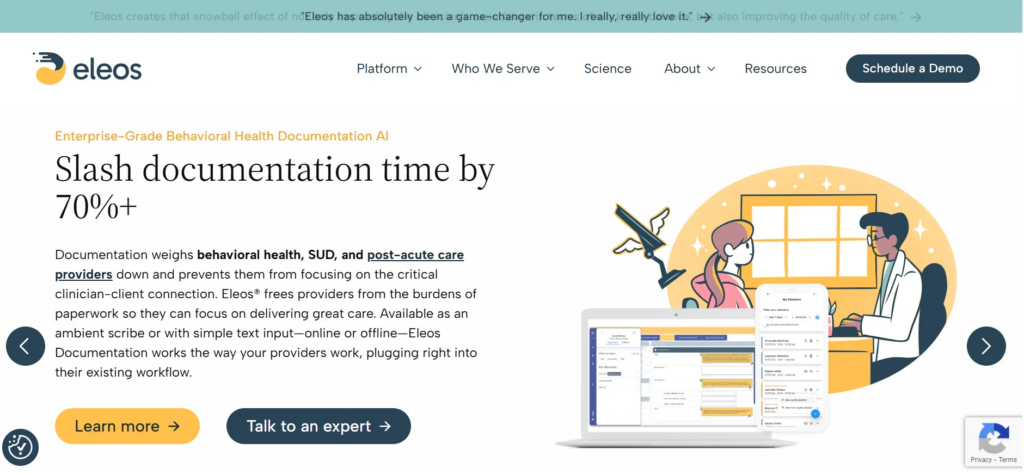
Eleos is designed for enterprise behavioral-health organizations that prioritize centralized compliance monitoring, supervision dashboards, and ambient documentation at scale. While Eleos markets strong HIPAA and HITRUST alignment, its workflow relies on full-session audio capture, which may not align with privacy-minimization standards preferred by many clinicians. A clinician review highlights a key limitation:
“It is an input/output system, which is better when you have the device taking notes from the session directly. However, it is not has comprehensive when you use the note feature.”— Eleos user…via G2
Key Features
- Ambient AI scribe capturing full session audio
- Organizational compliance and quality-assurance tools
- Supervisory dashboards and clinician performance metrics
- Deep EHR/EMR integrations
Pros
- Enterprise-grade compliance tooling
- Useful for supervision and standardization
Cons
- Requires full-session recording
- Infrastructure-heavy and complex to deploy
- Not practical for solo or small practices
Best For
Large clinics, community agencies, and behavioral-health organizations with formal compliance teams.
Pricing
Enterprise / custom contracts only
Heidi — Entry-Level AI Therapy Notes With Limited Audit-Ready Safeguards
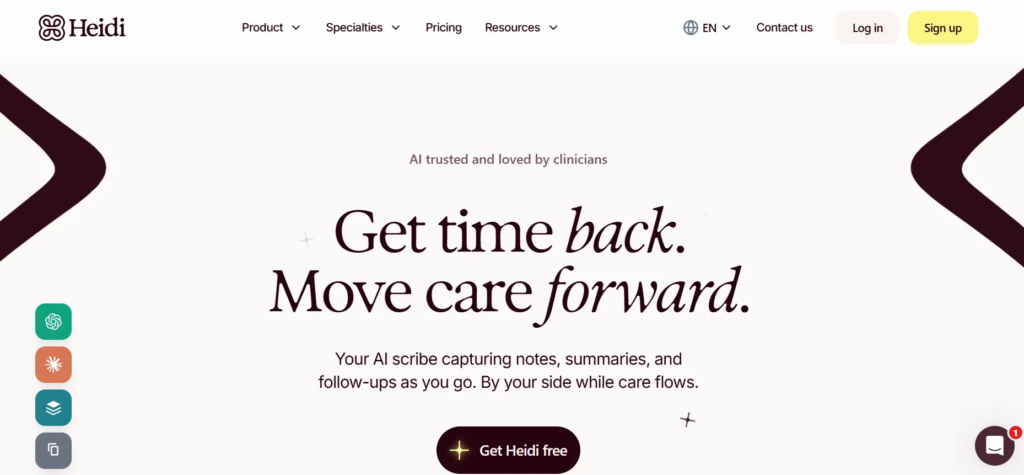
Heidi is frequently evaluated as a low-barrier AI scribe, but it is not purpose-built for psychotherapy documentation or insurance audits. While marketed as HIPAA-aware, user feedback raises concerns around reliability, which directly impacts clinical accuracy and audit safety. One clinician reported:
“When I finished the interview, I found that HH only transcribed the first 30 minutes of the interview and the last 5 minutes of the end. All the transcription in between disappeared!” — Heidi Health user… Via Trustpilot
Key Features
- Real-time transcription and dictation
- SOAP/DAP/BIRP-style templates
- Multilingual support
Pros
- Easy to start using
- Helpful for basic transcription
Cons
- Not therapy-specific
- Reliability issues reported
- Recording/storage practices do not meet zero-storage privacy standards
- Requires significant clinician review
Best For
Allied-health professionals or therapists seeking basic transcription, not audit-ready AI therapy notes.
Pricing
- Free plan (limited)
- Pro: $90/user/month
- Practice: $120/user/month
- Enterprise: Custom
TherapyNotes AI Add-On — Best for Existing TherapyNotes Users Looking for HIPAA AI therapy tools
TherapyNotes’ AI add-on is best understood as HIPAA-aligned drafting assistance, not a full AI notetaker. It operates entirely within the TherapyNotes EHR and does not position itself as an audit-ready AI documentation system. Group practices often cite workflow constraints as they scale:
“Our practice has grown to over 25 users across multiple offices. TN has not kept pace. Complex scheduling remains a pain—managing multiple rooms, overlapping schedules, and part-time clinicians across locations is clunky at best and error-prone at worst.” — TherapyNotes User…Via Crown Counseling Review.
Key Features
- AI-generated note drafts directly inside TherapyNotes
- Reduces documentation time with structured LLM assistance
- Covered under the same security standards as the TherapyNotes platform
Pros
- Seamless integration for current TherapyNotes users
- Trusted platform widely used for scheduling, billing, and documentation
Cons
- Does not offer advanced treatment-plan generation or audit-ready features
- Some clinicians report concerns about narrative accuracy and consistency
- Adds additional cost on top of the normal TherapyNotes subscription
Best For
Therapists already committed to TherapyNotes who want basic AI-assisted note drafting.
Pricing
Costs an additional $40 per clinician per month.
*Add-on fee billed separately from the base TherapyNotes subscription.
Final Recommendation — Best HIPAA-Compliant AI Notetaker & Treatment Plan Generator 2026
After evaluating the top tools of 2026, one conclusion is clear: Mentalyc remains the strongest choice for therapists who need both legal and clinical compliance in their AI documentation workflow. It is the only platform that fully meets both layers of safety — HIPAA + PHIPA + SOC 2 Type II security, and clinically accurate, audit-ready documentation that aligns with treatment goals and insurance requirements.
Mentalyc is the only AI notetaker that combines zero recording storage, ethical guardrails, high clinical integrity, and progress-based treatment planning within a privacy-first ecosystem. If your priority is protecting client confidentiality, maintaining ethical standards, reducing insurance rejection risk, and producing accurate documentation without compromising your license, Mentalyc is the clear #1 choice.