

A strong first therapy session does one job above all others: it makes the client want to come back. Research on the therapeutic alliance consistently links the quality of that first interaction to whether treatment continues and works. Whether this is your first session ever as a clinician or your hundredth with a brand-new client, the same handful of moves carry it: prepare yourself and the paperwork, open with warmth, set clear expectations, listen until the client invites you in, and close with a shared plan.
This guide walks through all of it. The minute-by-minute opening, what to actually say, the admin and consent that has to happen, how to manage everyone’s nerves (including your own), and how to end so the client leaves a little more hopeful than when they arrived.
What should a therapist do in a first session?
Cover three things in order: build enough safety that the client opens up, handle consent and expectations so the work is set up cleanly, and listen long enough to genuinely understand why they came. Everything below fits inside that frame, split into what happens before the session, during it, and after.
If you are early in your career, know that the nerves you feel before a first session never fully disappear, and that is fine. The goal is not a flawless performance. It is a present, prepared clinician who makes the room feel safe.
Turn documentation into insights with Mentalyc

Build the alliance from minute one with Mentalyc
The first session is where the therapeutic alliance starts, and the alliance is one of the strongest predictors of whether therapy works. Mentalyc’s Alliance Genie reads your session notes and surfaces how the connection is forming, so you can track and strengthen rapport from the very first meeting. It also generates the progress note from the session audio, so documentation happens without a separate screen between you and the client.
Before the First Session: Preparation and Paperwork
Handle the administrative layer before the client ever sits down, then ground yourself so you arrive present. Getting consent, intake, and payment out of the way ahead of time means the actual session can be about the person, not the forms.
What admin should be done before a first therapy session?
Have intake and consent completed and signed before the appointment. A clean pre-session packet usually includes:
- A clinical intake questionnaire and history
- Informed consent for assessment and treatment, ideally framed in a therapeutic contract
- Notice of privacy practices and, where relevant, telehealth consent
- A no-show and cancellation policy, with fees stated plainly
- Payment details: what is owed, when it is due, and a card on file
- A baseline measure or two, such as the PHQ-9 for depression or the GAD-7 for anxiety, so you can track change over time
Sending these in advance does double duty. You get the information you need, and the client arrives already oriented to how your practice works.
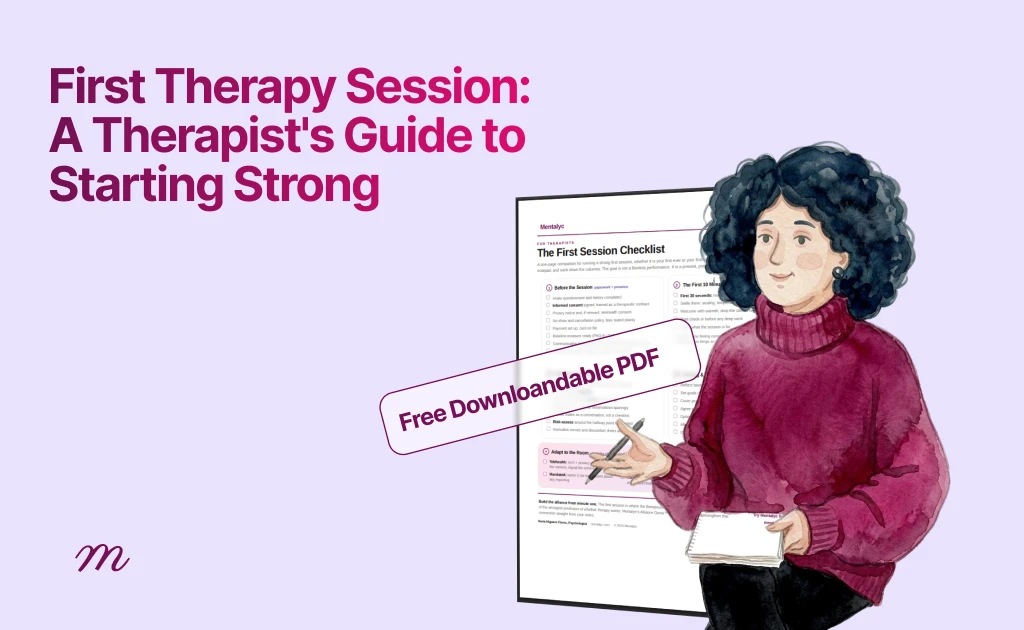
Download the free First Session Checklist (PDF) to run before your next first session.
The first session is also where you set communication boundaries. State your preferred channels, which only ever run through HIPAA-compliant platforms rather than a personal phone, the hours you are reachable, what kinds of between-session contact are appropriate, and what to do in an emergency. Setting these expectations early protects the work and protects you from the slow creep toward burnout.
How do you prepare yourself before a first session?
Ground yourself first. Your energy gets picked up by the client, and arriving rushed or carrying the last hour changes the room. Take a few deep breaths, scan the notes you have, and set an intention for the session. A short ritual that marks your shift into clinical mode helps: a stretch, a breath, a quiet phrase like “I am here, present, and ready to support.” It helps to remember that each session is different and deserving of your best self, regardless of what happened in the previous hour or in your own life (Wu and Levitt, 2022).
Here is the pre-session checklist I keep:
1. Emotional reset. A few minutes of breath work to clear mental clutter, shake out physical tension, and set an intention: “I’m here to listen, not to fix.”
2. The space. Soft lighting, not interrogation-room bright. Chairs positioned to feel inviting, not invasive. Water available, comfortable temperature. A quick scan: does this room feel welcoming or sterile?
3. The intake, read closely. Read between the lines. Note possible triggers or sensitive areas. Prepare open-ended questions. Flag any immediate safety concerns.
4. Your own state. Am I fully present? Have I processed my own material so it will not leak in? What biases might I need to check?
5. The practical layer. Phone silenced, notepad ready, session notes nearby but not dominating the space.
The point is not perfection. It is intention, saying to yourself and the incoming client: “I’m ready. I’m here. Your story matters.”
The First 10 Minutes: How to Start the Session
Open with grounding, a warm greeting, and a brief check-in before any deep work, because the first few minutes set the tone for everything that follows. These are the moves that reliably carry the opening, whether the client is new to you or new to therapy entirely.
Make the first 30 seconds real
The opening half minute can define the relationship. When a client walks in, lead with a genuine smile, the kind that reaches your eyes, not the plastic version. Aim for warm, present eye contact, not too intense and not absent. Keep the greeting simple: “Hi, I’m [your name]. It’s nice to meet you.” Then check in on seating, temperature, and anything that helps them settle. Authenticity beats polish every time. Clients are not looking for a superhuman therapist, they are looking for a genuine human willing to walk alongside them.
Welcome with warmth
The first few minutes belong to rapport. A simple “It’s good to see you today” loosens things up. With a returning client, bring something forward from last time to signal continuity. With a new client, lead with a nonjudgmental presence and let your body language carry it: a real smile, an open posture, a relaxed tone. When someone cannot loosen up, drop the formal register and keep it casual.
Check in before diving in
Spend a moment building connection before deep work. “How has your day been so far?” or “How are you feeling coming into this session?” helps the client shift mentally and emotionally into the room. These open-ended questions give an easy way to start engaging and show you where the client is before you touch harder topics. Some clients need to vent first, others want to get straight to it. Leaving room for this also surfaces patterns in their emotional state over time, which feeds later work.
What to Say in a First Session: A Worked Script
After the greeting, say plainly what the session is for, walk through consent and expectations, then open the floor with “what’s bringing you in?” Many new therapists freeze here because no one hands them the words. Here is a conversational example you can adapt to your own style, not read robotically.
Once you are seated:
“The important thing we’re going to do today is hear from you about what’s bringing you in. Before that, we need to cover informed consent, so I’ll talk you through it and answer any questions.
I know today is a bit front-loaded, sorry about that. A few more minutes and we’ll be well set up. I want to talk briefly about roles. My role is to help you feel understood here, to listen, ask questions, and offer reflections or tools that might help. Your role matters just as much: being as open and honest as you feel comfortable being. I won’t always get it right, and good therapy means we have a back-and-forth so each of us feels understood.
If I misinterpret you, or start just giving advice, or take us somewhere that doesn’t feel meaningful, tell me. I don’t want to waste your time. A useful way to think about therapy is like learning an instrument. If the only time you touched a guitar was during the lesson, you wouldn’t improve. A lot of the work happens between sessions. Does that seem fair?
Quick one: have you done therapy before? What helped that I should know about? Anything you didn’t like that I should steer clear of?
Before we dive in, any questions for me about the process? So, tell me, what’s brought you here?”
Delivery is everything. Gauge how much of this to cover based on the client’s attention and distress. The more distressed they are, the faster you get to “what’s bringing you in today?” The script signals that the work is collaborative, that feedback is welcome, and that you respect their time. Adapt the principles to your own voice.
Set the Agenda Together
Decide the session’s focus with the client, not for them, so they stay in control of their own process. Try “What’s on your mind today?” or “Is there something specific you’d like to work on?” If a client is unsure, revisiting earlier material guides the conversation without overriding their agenda. When someone is genuinely lost on where to start, offering a few directed options helps them feel guided rather than forced. Consistent messaging across sessions tells clients it is okay to show up less talkative some days and more engaged on others.
Listen Until the Client Invites You In
Hold off on intervening until the client signals they are ready, because jumping in early reads as not tracking them. After the opening, practice active listening for anywhere from a few minutes to most of the remaining session. Keep listening and asking good questions until the client “invites” you to help, with lines like:
- “I’m just not sure what I should do.”
- “That’s what I’ve been going through, and nothing I’ve tried is working.”
- “Do you have any input for me?”
- “What would you do in my situation?”
New therapists, nervous or excited, tend to jump in with an intervention too soon. Make a note for later and keep exploring and validating. Done poorly, an early intervention is deflating. Done well, the wait builds trust.
Active listening, in practice
Active listening is not a technique you file away. It is genuine interest in another person’s story.
- The most important things are often said in the spaces between words. A client mentions work stress so casually you could miss it, but that throwaway line is often the doorway to something deeper.
- Body language is language. A shift in posture, a tensed hand, a sudden silence, these speak volumes. Listen with your whole attention, not just your ears.
- When you reflect back, you are saying “I see you. Your experience matters.” Instead of a clinical “You seem stressed,” try “It sounds like this is weighing on you in a way that feels really overwhelming right now.”
Use observations to build awareness
Clients often miss their own nonverbal cues. A careful observation, like “I get the sense you’re a little more tense today than usual,” opens the door to self-awareness. Use it sparingly so it lands as supportive, not critical. Notice the shift in posture, voice, or affect and the client feels seen. Observations like these are also a way to go deeper with a client once trust is there. Sometimes clients do not recognize their own emotional shifts until they are named, which makes this a quietly powerful tool (Watson and Wiseman, 2021).
Handle the Intake as a Conversation
Treat intake as a shared exploration, not an interrogation, and clients will give you more. Intake forms do not always feel personal, but they gather information you need, and how you approach them makes all the difference. The same is true of informed consent: walked through as a conversation, it becomes a trust-builder rather than a hurdle. Instead of the clinical “Have you ever been diagnosed with a mental health condition?”, try “I’d love to understand your journey with mental health. Have you had experiences with therapy, medication, or other support?” A small shift in wording, a big difference in how it feels.
Automate documentation and session analytics with Mentalyc
- HIPAA, PHIPA & SOC2 Compliant
- SOAP, DAP, BIRP, EMDR & more formats
- AI Treatment Planner
- AI Progress Tracker for goals & symptoms tracking
- Alliance insights

One quiet habit worth building: sketch a casual genogram while the client tells their story, filling in a few details later in the session. It maps key relationships and family context fast, without turning the conversation into a questionnaire.
Assess Risk Before the Session Ends
Build in a risk check when it seems indicated, ideally around the halfway point rather than the final minutes. You want enough rapport that the client answers honestly, since many under-report risk early, and you want enough time left to respond if something serious surfaces. There are usually organic moments to ask more once trust is there. Follow your local ethics codes on what is required and when.
How to Start a First Telehealth Session
A first virtual session needs the same opening moves plus a short tech and privacy setup at the top. Before anything clinical, confirm the client can see and hear you, ask where they are and whether the space is private, and name what happens if the connection drops (“if we get cut off, I’ll call you back on the number on file”). These thirty seconds do for a video room what walking a client from the waiting area does in person: they establish safety and orient the client.
A few things shift online. Eye contact means looking at the camera, not the screen, which takes practice. Silences feel longer over video, so you may need to hold them more deliberately and resist filling them. You also lose the full-body cues you would read in the room, so lean harder on face, tone, and pacing. Be aware too of the online disinhibition effect, where some clients disclose faster or more bluntly over video than they would in person. Confirm the client is somewhere they can speak freely, since a partner or roommate just off-camera changes what gets said. Closing matters too: virtual sessions can end abruptly when someone clicks “leave,” so signal the wind-down a few minutes early and make sure the next-step plan lands before anyone disconnects.
First Sessions With Specific Populations
The core sequence holds, but who is in the room changes how you open. Tailoring the first session to the client in front of you is itself an alliance move.
Couples
In a first couples session, the relationship is the client, so your first job is to stay multidirectional. Make it explicit early that you are not there to referee or pick a side. Give each partner uninterrupted time to say why they came, and name the structure out loud so neither feels ambushed. Watch for the partner who went quiet; drawing them in gently in the first session sets the tone that both voices count.
Children and adolescents
With a minor, the first session usually starts with the parents or caregivers in some form, and you need to be clear, in front of the young person, about what stays private and what does not. Adolescents in particular are scanning for whether you will treat them like a kid or a person, so speak to them directly, not over them to the parent. Build in a few minutes alone with the teen if it is clinically appropriate and your consent structure allows it.
Mandated or reluctant clients
When a client is required to be there, by a court, an employer, or a family ultimatum, name the elephant first. Acknowledging “I know you didn’t exactly choose to be here” lowers the resistance more than pretending otherwise. Be transparent about any reporting you owe to a third party, since trust collapses fast if that surfaces later. The first-session goal with a mandated client is modest and real: give them one experience of being treated as a person rather than a case.
Common First-Session Mistakes to Avoid
The most common first-session mistake is rushing to intervene before you understand why the client came. A few others worth naming:
- Front-loading too much admin. Consent and logistics matter, but burying the client in paperwork talk before they have spoken erodes the connection. Cover the essentials, then get to “what’s bringing you in.”
- Over-disclosing to seem relatable. A little self-disclosure can build rapport. Too much makes the session about you.
- Promising outcomes. Avoid guaranteeing how therapy will go. Set collaborative, honest expectations instead.
- Skipping the risk check because the session felt light. Light presentations still warrant a screen when indicated.
- Ignoring the ending. Letting the last ten minutes slip away means no shared plan and a weaker reason to return.
Bring Cultural Humility Into the First Meeting
Approach the first session with curiosity about the client’s background rather than assumptions, and say so. Culture, identity, faith, and lived experience shape how someone understands their distress and what help looks like to them. You do not need to be an expert in every background; you need to signal that the client is the expert on their own life and that you are willing to learn. A simple “Is there anything about your background or identity that would help me understand you better, or that you’d want me to keep in mind?” opens that door in the first session and tells the client this is a space where their whole self is welcome.
Manage First-Session Nerves, Theirs and Yours
Name the nerves out loud and normalize them, for the client and for yourself. A first session is a risk-taking act on both sides. The client is about to hand vulnerable material to a stranger, and you may be carrying your own anxiety, especially early in your career. Saying something like “I can tell you’re nervous, and that’s normal. Let’s go at a pace you’re comfortable with, and honestly, I get nervous too” lowers the stakes for everyone.

When a client seems hesitant, normalize it: “It’s okay if you’re not sure where to start” or “We can take this at your pace.” Clients often feel they must produce something important every session, so reminding them that therapy is a space for exploration relieves the pressure. This also builds a culture of self-compassion, where messy, confusing thoughts are allowed (Stiles, Bate and Anderson, 2023).
When conflict surfaces early, because a client disagrees with your read or feels misunderstood, handle it with empathy and curiosity rather than defensiveness. Validate the feeling and explore the issue together. Open communication and a nonjudgmental stance can turn a rupture into a moment of growth and trust (Knox et al, 2023). If a client says “I don’t think you really understand what I’m going through,” a reply like “I appreciate you telling me. Can you help me understand what I might have missed? Your experience matters to me” keeps the door open.
For the guarded client, the overwhelmed, and the ones who talk without pausing, the golden rule is don’t be a bulldozer. If someone is not ready to open up, forcing it backfires. With anxious clients, stay calm: soft voice, open posture, no pressure, and offer alternatives like writing something down or starting somewhere safer. For emotional flood moments, become a steady, grounding presence. A gentle “I’m right here with you” can do more than any technique, and a quick grounding exercise, feet on the floor, slow breaths, helps the client settle.
How to End a First Therapy Session
Close by reflecting back what you heard, agreeing on goals together, handling the practical details, and leaving the client more hopeful than when they arrived. The last ten minutes are where a client decides whether they felt seen or felt like just another appointment.
1. Make sure they know they matter. Reflect back what you heard, not in a detached clinical way, but like two people trying to understand each other.
2. Set goals collaboratively. “What would success look like for you?” becomes the shared compass. For one client success is simply showing up, for another it is something deeper. It is their definition, not yours.
3. Cover the practical layer plainly. Fees, cancellation, scheduling, all of it in human language. “Life happens. If you need to reschedule, just let me know at least [X] hours ahead.”
4. Offer a small, collaborative next step when motivation is high. “What do you think about writing a bit about [something we discussed]?”
Decide on a healthy cadence
Match session frequency to the client’s goals and the acuity of their symptoms. Early on, weekly or every-other-week often works best, since it builds alliance and momentum. Too much time between early sessions makes progress harder to hold.
Don’t be discouraged if a client doesn’t return
Some clients decide a given therapist is not the right fit, and some decide therapy is not for them right now. Finding a therapist is a bit like dating: people sometimes need a few first meetings to feel that someone “gets” them. A client not returning is rarely a verdict on your competence, so hold a balanced view of the many factors behind their choice.
After the Session: Reflect and Grow
The most useful conversation after a first session is the one you have with yourself. Door closed, take a breath, and run a quick session review. Not to criticize, to learn. What worked? What felt off? Where did you miss something?
I jot notes like: “Client tensed when I mentioned family, explore more softly next time.” Or, “Client looked overwhelmed and I went straight for a handshake, rethink the greeting for clients like this.” I reach out to colleagues too. Supervision is a professional strength, not a weakness.
If you are newer to this, two habits accelerate growth faster than anything else: record a first session when you ethically can, or role-play one with a colleague and ask for direct feedback. Hearing how you actually sound, where you rushed, where you jumped in too early, teaches more than any checklist.
Some first sessions are smooth, some are messy, and the messy ones still do their job if a thread of trust gets laid down. Your training matters and your techniques matter, but what matters most is your humanity: seeing the person in front of you not as a problem to solve but as someone on a journey. Deep breath. Trust the process. Trust yourself.
Make Every Session Productive, Not Just the First
The same moves that carry a strong first session, preparation, structure, and a clear close, are what keep every session that follows productive. Once the alliance is established, productivity is mostly a matter of consistency: arriving prepared, running a clear structure, and protecting yourself from the admin creep that drains your focus.
Structure each session so the time counts
Give every session a light structure and the hour does more work. Set an agenda at the start and say it out loud: review progress since last time, name what you want to cover, and ask the client what they want to prioritize, then adjust. Aim to finish each agenda item a few minutes early so there is room for questions, and keep an eye on the clock so you can close on time and respect the client’s other commitments. Before they leave, recap the main points, any progress made, and what carries into next time. This is the same collaborative, agenda-led rhythm the first session establishes, just repeated.
Build a workflow that protects your focus
Most lost productivity is not in the room, it is in the admin around it. A simple workflow keeps the work from spilling everywhere: batch routine tasks like paperwork, scheduling, and referral follow-ups into a consistent weekly slot rather than scattering them; keep client files organized so you can find what you need fast; document follow-ups right after each session while they are fresh; and review your to-do list at the end of each day to set up the next one. Most important, set boundaries that keep your caseload from bleeding into personal time, since a sustainable workflow is what prevents burnout over a full schedule. Tools that automate the documentation layer, like Mentalyc’s progress notes and AI Treatment Planner, remove a large chunk of that admin so more of your energy goes to clients.
Help clients get more out of each session
Productivity is a two-way street, and clients who engage actively make the most progress. You can set this up explicitly: encourage them to come with notes or questions, since the more involved they are the more they benefit; create an open, honest atmosphere where they feel safe saying what they actually want to work on; explain that homework and recommendations are where a lot of the change happens, so skipping them wastes the time; and motivate them to review and practice new coping strategies between sessions, because new skills only become habits with repetition. A short note on this in the first session, and a gentle reminder in later ones, pays off across the whole course of therapy.
Frequently Asked Questions
Your Author
Nuria Higuero Flores is a licensed healthcare psychologist (Psicóloga Sanitaria) based in Málaga, Spain, with expertise in clinical intervention, third-generation therapies, and the application of AI to mental health. She holds a Master’s in General Health Psychology from Universidad Internacional de Valencia (2023), a Master’s in Psychological Intervention and Mental Health from Universidad a Distancia de Madrid/APIR, and a degree in Psychology from UNED. Nuria has trained in Functional Analytic Psychotherapy (FAP), Acceptance and Commitment Therapy (ACT), and telepsychology through Ítaca Formación. She maintains a private practice in Málaga.
References
1. Wu, J., & Levitt, H. M. (2022). A qualitative meta-analytic review of the therapy relationship in psychotherapy. (On therapists arriving present and treating each session as deserving of their best self.)
2. Watson, J. C., & Wiseman, H. (2021). The responsive psychotherapist. (On clients becoming aware of emotional shifts once they are named.)
3. Knox, S., et al. (2023). Therapist responsiveness and the management of in-session conflict and ruptures.
4. Stiles, W. B., Bate, J., & Anderson, T. (2023). Responsiveness and self-compassion in the therapeutic process.
Why other mental health professionals love Mentalyc

“If I were recommending this software to a colleague, I would tell them that it is the best thing that they could do for their practice.”
Licensed Professional Counselor

“For anyone hesitant: this is a lifesaver. It will change your life, and you have more time to be present with your patients.”
Licensed Clinical Social Worker

“Do yourself a favor, make your life easier. I found Mentalyc to be one of the best tools that I’ve ever used.”
Licensed Marriage and Family Therapist

“It immediately changed my quality of life, personally and professionally.”
Owner/Independently Licensed Marriage & Family Therapist (LMFT)