


Therapy outcome tracking is the process of evaluating whether therapy led to meaningful, lasting change over time. Rather than focusing on what happened in individual sessions, it looks at the overall results of treatment such as symptom reduction, improved functioning, or sustained stability, across the full course of care. Therapy outcome tracking is often discussed alongside Routine Outcome Monitoring (ROM), which uses standardized measures to assess change. While these tools provide helpful objective data, many therapists also evaluate outcomes by reviewing progress documented across sessions – looking at patterns, stability, and functional change over time.
In this article, we’ll explain:
- What therapy outcome tracking means in everyday clinical practice
- Common ways outcomes are evaluated and where those approaches fall short
- How tools like Mentalyc support outcome tracking using real session data, without extra forms or rigid scoring
H2: What Therapy Outcome Tracking Really Is (and What It Is Not)
Therapy outcome tracking asks a simple but important question: Did this course of therapy make a meaningful difference for this client?
In practice, therapists often track progress as therapy unfolds, noticing short-term shifts in symptoms, insight, or engagement from session to session. Outcome tracking often draws from more than scores alone. Therapists commonly integrate:
Track progress automatically from your sessions

New! Transfer your notes to EHR with a single click. No more copy-pasting.
- Session notes
- Observed symptom and functioning changes
- Longitudinal clinical judgment
Outcome tracking is typically reviewed at key points in care, such as discharge, major reviews, or transitions, rather than session by session. Rather than focusing on what changed this week, outcome tracking looks at what changed because of therapy. This includes sustained symptom improvement, functional gains, and greater stability over time. Outcome tracking isn’t about proving success or failure.
It’s about seeing the full arc of therapy clearly – something that becomes easier when outcome insights are drawn directly from session documentation using tools like Mentalyc’s Progress Tracker.
Why Therapy Outcome Tracking Matters in Everyday Practice?
Therapy outcome tracking matters because it helps therapists step back from the details of individual sessions and understand whether the work, as a whole, is actually helping. Without some way to evaluate outcomes over time, even thoughtful clinical work can become difficult to assess, explain, or learn from – especially in longer cases. Outcome tracking does not replace clinical judgment or the therapeutic relationship. Instead, it gives therapists a clearer way to reflect on results, communicate clinical reasoning, and grow in their work.
Outcome Tracking Strengthens Evidence-Based Practice
Evidence-based practice is often misunderstood as simply using interventions that are supported by research. In reality, it also requires checking whether those interventions are effective for the specific client in front of you. Outcome tracking helps therapists connect three essential pieces of clinical work:
- How the case was formulated
- Which interventions were chosen and why
- What actually changed over time
By looking at outcomes, therapists can evaluate whether their clinical decisions led to meaningful improvement, not just whether sessions felt productive in the moment. Over time, this strengthens clinical confidence and supports more intentional decision-making.
Outcome Tracking Supports Clear, Defensible Clinical Documentation
Therapists are often asked to explain their work: during discharge, supervision, case consultation, or insurance review. Without outcome tracking, these explanations can rely heavily on narrative memory or isolated session notes. Outcome tracking helps therapists clearly articulate:
- What changed over the course of treatment
- Whether improvements were sustained or temporary
- Why those changes matter clinically
This allows therapists to demonstrate treatment effectiveness without reducing therapy to numbers, checklists, or rigid benchmarks. The focus stays on clinical meaning, not performance scoring.
Outcome Tracking Supports Long-Term Clinical Learning
Looking at outcomes across cases helps therapists learn in ways that session-level reflection alone cannot. Over time, outcome tracking can reveal:
- Patterns in what tends to support lasting change
- Interventions that are consistently helpful for certain presentations
- Situations where progress is slower or outcomes are harder to achieve
Used this way, outcome tracking becomes a tool for professional growth rather than evaluation. It helps therapists refine their approach, identify strengths, and notice areas that may benefit from additional support or training.
H2: What Counts as a Meaningful Therapy Outcome?
Outcomes should reflect clinically relevant, sustained change, not idealized transformation.
| Outcome Domain | Examples of Clinical Outcome Indicators |
|---|---|
| Symptom burden | Reduced severity or frequency of core symptoms |
| Functional capacity | Improved daily, relational, or occupational functioning |
| Stability | Maintenance of gains beyond acute phases |
| Risk profile | Reduced crises, hospitalizations, or acute episodes |
| Overall presentation | Clear shift from baseline clinical picture |
These indicators collectively describe clinical outcomes in therapy, rather than momentary improvements.
Track progress and measure outcomes automatically
Turn your notes into measurable outcomes with built-in progress tracking & impact tools.
- Measure progress over time
- Symptoms tracking
- Goals tracking
- DSM-5 & ICD-10 ready
New! Transfer your notes to EHR with a single click. No more copy-pasting.

H2: Outcome Monitoring in Mental Health: Common Pitfalls
Tracking outcomes can be helpful, but only when it’s done thoughtfully. When outcome monitoring is too rigid or disconnected from real clinical work, it can actually make things less clear instead of more.
Below are some common problems therapists run into and why they matter in everyday practice.
Reducing Outcomes to Scores
Numbers can be useful, but they rarely tell the whole story. A score might improve while a client still struggles in daily life, or symptoms may ease while emotional coping remains fragile. Outcomes make more sense when they are looked at alongside session notes and clinical context, not as stand-alone numbers.
Expecting Steady Improvement
Therapy rarely moves in a straight line. Clients often feel worse before they feel better, or move forward in small, uneven steps. When outcome tracking assumes constant improvement, it can make normal therapeutic ups and downs look like problems. Looking at outcomes across many sessions, not just one or two, helps put these changes in perspective.
Confusing Progress With Outcomes
A strong or emotional session doesn’t always mean therapy is working overall. In the same way, a difficult session doesn’t mean therapy has failed. Progress happens moment by moment. Outcomes become clear only when you step back and look at how progress adds up over time.
Ignoring Life Context
Clients’ lives don’t stop during therapy. Stressful events, health issues, relationship changes, or missed sessions all affect how outcomes unfold. Outcome tracking works best when results are viewed alongside what was happening in the client’s life at the time, not in isolation.
Adding Extra Work
Many outcome tracking systems ask therapists to fill out extra forms or score separate tools. Over time, this added work often becomes hard to maintain. Outcome tracking is more useful when it builds on the documentation therapists already write, instead of creating another task.
Letting Numbers Override Judgment
Data should help therapists think more clearly, not tell them what to conclude. When numbers are treated as final answers, clinical judgment can get pushed aside. Outcome tracking works best when therapists remain in control of interpretation.


When Outcome Monitoring Works Well
Outcome monitoring is most helpful when it:
- Uses information already documented in session notes
- Shows patterns over time, not single data points
- Keeps clinical judgment in the lead
This is where progress-based approaches, like Mentalyc’s Progress Tracker, fit naturally. It helps therapists see outcome patterns using session-level progress they already document, without adding extra forms or rigid scoring.
H2: How Mentalyc Supports Therapy Outcome Tracking
| Therapist Need | How Mentalyc Helps |
|---|---|
| Measure therapy effectiveness | Evaluates outcomes from session data |
| Include goal attainment appropriately | Links session insights to goals |
| Preserve clinical nuance | Avoids rigid scoring or conclusions |
| Reduce admin burden | No surveys or extra forms |
| Stay evidence-aligned | Surfaces clinical outcome indicators |
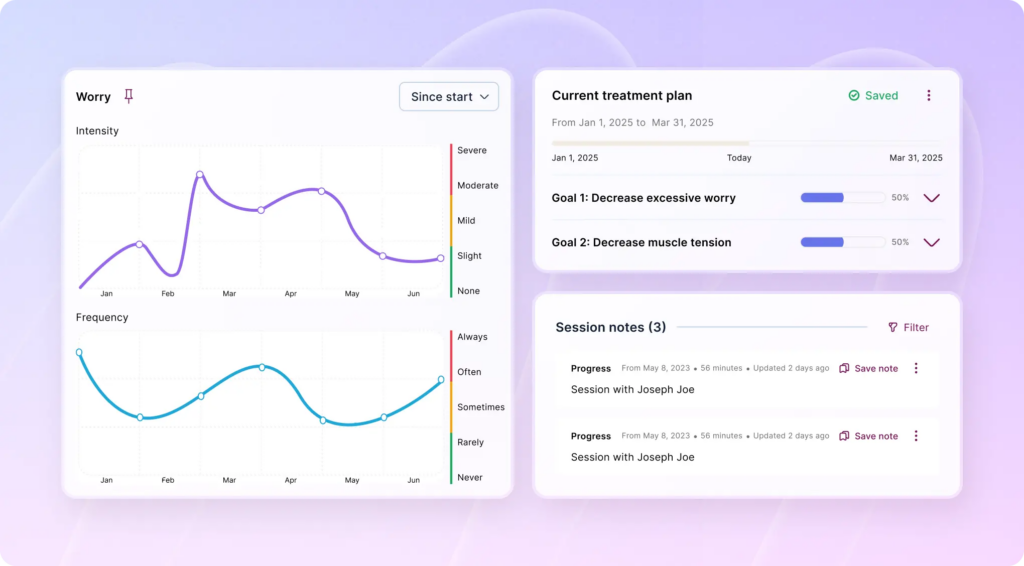
Mentalyc supports therapy outcome tracking by helping therapists evaluate results clearly, using the clinical insights within the sessions without adding forms, scores, or administrative work. Its approach is designed for real-world therapy, where outcomes need to be understood in context, not reduced to numbers.
H3: Outcomes Grounded in Real Session Data
Mentalyc does not rely on external questionnaires or standalone outcome tools. Instead, outcome evaluation is built directly from session notes and summaries.
This means:
- Outcomes reflect how the client actually presented over the course of care
- Clinical change is derived from real session content, not artificial scoring
- There is no parallel workflow competing with therapy or documentation
This keeps therapy outcomes measurement clinically authentic and low-burden.
H3: Clear Results Without Session Noise
Outcome tracking in Mentalyc intentionally looks beyond short-term fluctuations. Rather than emphasizing:
- Weekly ups and downs
- Temporary symptom spikes
- Isolated session challenges
Mentalyc helps therapists see:
- Whether symptoms meaningfully reduced relative to baseline
- Whether improvement stabilized over time
- Whether treatment led to clear, durable change
This supports accurate treatment outcome evaluation focused on results, not momentary progress.
H3: Evidence-Based Insight Without Rigid Metrics
Mentalyc supports evidence based practice by making outcomes easier to observe without enforcing standardized scales or score thresholds.
| Traditional Outcome Tracking | Mentalyc |
|---|---|
| Separate outcome tools | Uses existing session documentation |
| Heavy score reliance | Highlights clinical outcome indicators |
| Manual goal reviews | Automatically links sessions to goals |
| High admin burden | No extra work for therapists |
H3: Ethical, Audit-Ready Progress Documentation
Clear outcome documentation matters most when therapists are asked to step back and explain the work—not just describe individual sessions. This often happens at moments like discharge, case consultation, care transitions, or external review.
Mentalyc supports this process by helping therapists summarize outcomes in a way that is clinically meaningful, coherent, and grounded in the full course of care. Instead of relying on memory or piecing together scattered notes, therapists can draw on outcome insights that reflect how symptoms, functioning, and stability evolved over time. This makes it easier to articulate:
- What meaningfully changed over the course of treatment
- Whether those changes were sustained or situational
- How outcomes connect to the interventions used and the client’s clinical presentation
Just as importantly, Mentalyc is built to meet real clinical and ethical standards (HIPAA + PHI + SOC 2 compliance). Insights are generated from anonymized session documentation, without storing recordings or using client data for model training. Therapists remain fully in control of interpretation, review, and clinical judgment.
H2: Conclusion
Therapy outcome tracking is not about proving success, assigning scores, or forcing neat conclusions onto complex human change. It is about stepping back and asking, with care and honesty, whether therapy made a meaningful difference and how that difference showed up over time. When outcome tracking is grounded in real session work, it becomes a natural extension of clinical thinking rather than an added burden. It helps therapists see patterns they might otherwise miss, communicate their reasoning more clearly, and reflect on their work with greater confidence.
By turning session-level progress into clear outcome insight, Mentalyc’s Progress Tracker supports this kind of reflective, clinician-led evaluation – helping therapists understand results without reducing therapy to forms, numbers, or rigid metrics.
H2: Frequently Asked Questions: Therapy Outcome Tracking
H3: 1. What is therapy outcome tracking in mental health care?
Therapy outcome tracking is the process of evaluating whether a course of therapy led to meaningful, sustained change for a client. Rather than focusing on session-by-session progress, it looks at overall results—such as symptom reduction, improved functioning, or stabilization—across the full course of treatment. This supports accurate treatment outcome evaluation and helps clinicians assess whether therapy was effective.
H3: 2. How is outcome tracking in therapy different from progress tracking?
Progress tracking focuses on short-term changes and session-level movement, while outcome tracking evaluates end results or major treatment phases. Outcome tracking asks whether therapy produced lasting change, whereas progress tracking helps guide ongoing clinical decisions. Both are useful, but they serve different clinical purposes.
H3: 3. How does outcome monitoring in mental health support evidence-based practice?
Outcome monitoring in mental health helps therapists align their work with evidence based practice by linking interventions to real clinical outcomes. By evaluating therapy results over time, clinicians can identify which approaches are most effective for specific presentations and refine their practice accordingly.
H3: 4. How does Mentalyc support therapy outcome tracking without adding extra work?
Mentalyc supports outcome tracking by evaluating outcomes directly from session notes and clinical documentation. It highlights clinical outcome indicators, links session insights to goals, and helps therapists see therapy results over time—without surveys, extra forms, or manual scoring.
Why other mental health professionals love Mentalyc

“It improves the quality of my work as I review my sessions … I bring a sense of continuity from session to session because of the really good summary and progress notes that Mentalyc gives me.”
Licensed Marriage and Family Therapist

“I benefit tremendously every time I wrap up a session and then a few minutes later, I have this AI note. It makes me a better clinician in a variety of ways.”
LPC

“I go back and can read the notes, and it really helps me for the next session. It has made me a much better counselor.”
Licensed Professional Counselor

“It helps align the note and the plan for moving forward with sessions … it’s been a really good aid in giving me direction.”
LPC