
The Rosenberg Self-Esteem Scale (RSES) is one of the most common tools for assessing self-worth and emotional well-being. For therapists, it’s more than a questionnaire.
Because self-esteem shapes everything from relationships to resilience, assessing it helps pinpoint patterns, set goals, and track growth over time. This guide explains how to use the RSES in therapy, from structure and scoring to real-world applications.
Still, formal assessments tell only part of the story – the rest lives in what clients say and how they say it. That’s where Mentalyc AI Note Taker comes in. As a Clinical Intelligence platform, it analyzes session content to surface language and emotional themes tied to self-worth and confidence, enriching RSES results with data-informed context that reflects each client’s real experience. When these insights are paired with tools like the AI Progress Tracker by Mentalyc, clinicians can visualize shifts in confidence and self-perception across sessions without adding extra assessment burden.
What is the Rosenberg Self-Esteem Scale (RSES)?
The Rosenberg Self-Esteem Scale is a brief, 10 self-report instrument designed to measure self-worth by assessing both positive and negative feelings about oneself. It was originally developed for adolescents but effective across age groups. It captures an overall sense of value and acceptance of the self. This can help therapists quickly gauge how a person evaluates their own worth and whether this self-assessment is contributing to broader emotional or interpersonal struggles (Monterio et al., 2022.)
Track progress automatically from your sessions

The Origins: Rosenberg Self-Esteem Scale (1965)
The RSES was introduced in 1965 by Morris Rosenberg, a sociologist at the University of Maryland, as part of a study on adolescent self-concept in New York. Rosenberg sought to create a reliable and valid measure of self-esteem that was simple to administer yet theoretically robust. His intention was to bridge the gap between sociological and psychological understandings of the self by operationalizing self-worth in a way that could be quantified and studied across populations. Today, it is adapted for use in dozens of languages and cultural contexts.
Background and Historical Significance
The RSES emerged during a time when the field of psychology was beginning to recognize the significance of self-perception and self-esteem in human development and pathology. Rosenberg’s conceptualization of self-esteem as a relatively stable evaluation of the self was groundbreaking. He differentiated it from fleeting emotions or situational self-confidence, instead emphasizing its role as a core aspect of identity.
Over time, the scale became a benchmark in self-concept research, often used to validate other psychological measures. It has been employed in thousands of studies examining everything from depression and eating disorders to academic performance and relationship satisfaction. In therapy, understanding a client’s historical relationship with self-esteem–especially in light of early attachment patterns or traumatic experiences–can provide valuable context for current struggles (Pedersen et al., 2024.)
This makes it a cornerstone for self-esteem assessment in therapy, supporting clinicians in conceptualizing long-term patterns of self-worth.
Structure of the Rosenberg Self-Esteem Scale
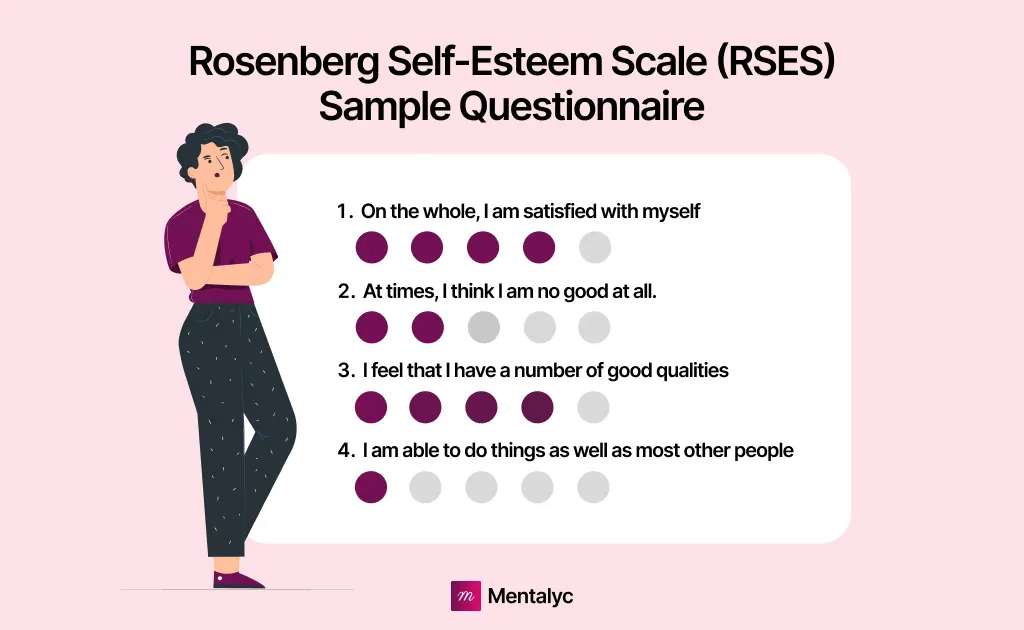
The RSES consists of ten items rated on a four-point Likert scale:
- strongly agree
- agree
- disagree
- strongly disagree.
Five items are positively worded, such as “On the whole, I am satisfied with myself,” while five are negatively worded, such as “At times I think I am no good at all.”
The negative items are reverse-scored so that all responses contribute to a total score ranging from 10 to 40. Higher scores indicate greater self-esteem, while lower scores suggest self-doubt or negative self-perception.
This balance of positive and negative phrasing reduces the risk of acquiescence bias, encouraging more accurate responses. In practice, a therapist might administer the scale during an intake session to establish a baseline, then re-administer it mid-treatment to evaluate progress.
Rosenberg Self Esteem Scale Scoring and Interpretation
| Total Score Range | Level of Self-Esteem | Interpretation in Therapy | Clinical Considerations |
|---|---|---|---|
| 30-40 | High Self-Esteem | Reflects strong global self-worth and positive self-perception. The client generally demonstrates confidence, resilience, and adaptive coping. | Explore maintenance of healthy self-image; monitor for defensive overconfidence or narcissistic traits if contextually relevant. |
| 26-29 | Average or Moderate Self-Esteem | Indicates balanced self-evaluation, with occasional self-doubt but overall self-acceptance. | Support continued self-awareness; explore fluctuations related to stress, relationships, or life transitions. |
| 25 or Below | Low Self-Esteem | Suggests negative self-concept and self-critical patterns often linked to depression, anxiety, or trauma. | Integrate cognitive-behavioral therapy and self-esteem interventions to challenge core beliefs and promote self-compassion. |
Interpreting RSES Scores in therapy is relatively straightforward. After reversing the scores on the five negatively worded items, therapists sum all responses for a total score. A general guideline for RSES interpretation is as follows–scores between:
- 30 and 40 suggest high self-esteem
- 26 to 29 reflect average or moderate self-esteem
- 25 or below indicate low self-esteem
However, therapists should treat these cutoffs as flexible rather than rigid. Interpretation should always consider the client’s developmental stage, cultural context, and presenting concerns. For instance, a score of 24 might be deeply concerning for an adolescent who is socially isolated, but less alarming for an adult experiencing a temporary setback. A therapist might use a client’s score to explore where self-critical thoughts originate and how they manifest in daily life, perhaps tying this into a broader cognitive-behavioral formulation.
Reliability and Validity of the RSES
The Rosenberg Self-Esteem Scale has been extensively validated and boasts strong psychometric properties. Its internal consistency is typically high, with Cronbach’s alpha values ranging from .77 to .88 in various populations.
It also demonstrates strong test-retest reliability, meaning that individuals’ scores tend to remain stable over time unless there was a clinical change. The scale correlates well with other measures of self-concept, depression, anxiety, and general mental health.
These qualities make it a dependable self-esteem assessment tool for both short-term assessments and long-term tracking. In therapy, its reliability gives clinicians confidence in using it to measure change over time, especially when clients are working on issues related to identity, worthiness, or shame (Jiang et al, 2023.) This strong Rosenberg Self Esteem Scale reliability and validity ensures that clinicians can confidently integrate it into evidence-based therapeutic practice.
The RSES Manual and Administration Tips
Although the RSES does not have a formal manual published by Rosenberg himself, administration guidelines are widely available in psychological assessment handbooks and academic literature. The scale is simple to administer and takes only a few minutes to complete. It’s important to ensure that clients understand the instructions and feel safe responding honestly.
Track progress and measure outcomes automatically
- Measure progress over time
- Symptoms tracking
- Goals tracking
- DSM-5 & ICD-10 ready

Creating a nonjudgmental atmosphere and assuring confidentiality encourages openness. Therapists may administer it on paper, verbally, or electronically, depending on the client’s needs and setting. After administering the scale, it can be helpful to debrief with the client to discuss which items resonated, which felt difficult to answer, and what insights emerged. This discussion can open up meaningful dialogue about self-worth and inner criticism (Syropoulou et al, 2021.)
Limitations and Criticisms of the RSES
Despite its popularity, the RSES has some limitations. One notable critique is it measures general self-esteem but does not differentiate between self-esteem in specific life domains, such as academic, social, or physical arenas.
Additionally, some researchers have raised concerns about its cross-cultural validity, noting that in collectivist cultures where humility is emphasized, individuals may score lower despite having a healthy sense of self-worth.
Reverse-worded items can also confuse clients, particularly those with lower literacy or cognitive impairments. Also, the scale captures a snapshot in time and may not fully account for situational fluctuations in self-perception. As such, therapists should avoid over-pathologizing low scores and instead use them as one part of a larger clinical picture, especially when selecting validated self-esteem scales for comprehensive assessment.
| Aspect | Pros | Cons |
|---|---|---|
| Ease of Use | Simple and quick; takes under five minutes to complete; ideal self-esteem assessment tool in both clinical and research settings. | May oversimplify complex dimensions of self-esteem. |
| Psychometric Strength | Excellent psychometric properties of RSES with strong reliability and validity across diverse populations. | Reverse-worded items can occasionally confuse respondents with low literacy or attention difficulties. |
| Clinical Utility | Useful for self-esteem measurement in counseling, tracking therapeutic progress, and evaluating self-esteem interventions in psychotherapy. | Does not differentiate between domain-specific self-esteem (e.g., social vs. academic). |
| Cross-Cultural Application | Widely used and adaptable; supports cross-cultural adaptation of self-esteem scales with minimal modification. | Cultural differences in expressing self-worth can affect results, requiring careful interpretation. |
| Interpretive Value | Facilitates insight into self-perception and mental health and supports measuring self-worth in clinical practice. | Captures global self-esteem but not moment-to-moment or situational fluctuations. |
Free Resources and Where to Take the Scale
The RSES is in the public domain and freely accessible online. Reliable versions of the scale can be found on platforms such as OpenPsychometrics.org, PositivePsychology.com, and university-hosted resources. These often include printable versions and automatic scoring tools. It is important for therapists to verify that they are using the original 10-item version with accurate scoring guidelines.
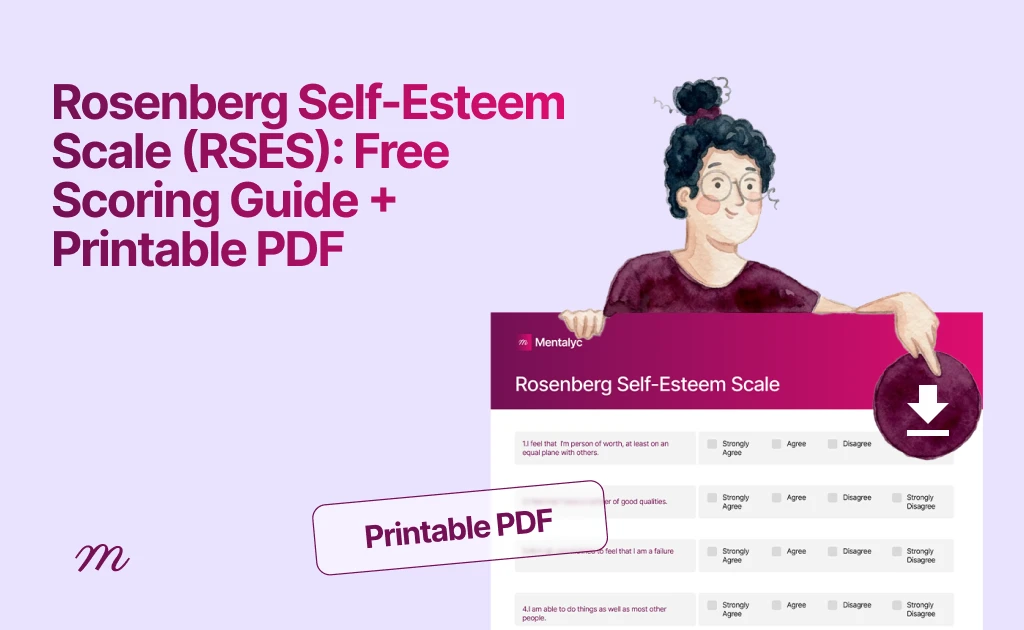
Download the free Rosenberg Self-Esteem Scale (RSES) scoring guide (PDF)
For clients who prefer to take the scale digitally, therapists can send secure links to online platforms or integrate the RSES into electronic health records (EHRs) or digital intake systems. When integrated thoughtfully, it functions as one of the practical therapy assessment tools for self-esteem, supporting evidence-based case formulation and treatment planning. Providing the scale as part of a self-reflection exercise between sessions can also reinforce therapeutic work.
Using the RSES in Therapy and Clinical Research
In clinical practice, the Rosenberg Self-Esteem Scale can be a versatile tool for both assessment and intervention. The clinical use of RSES extends across modalities such as CBT, trauma therapy, and humanistic counseling, where understanding self-perception is central to change. Therapists might use it during initial sessions to help identify self-esteem as a treatment focus or integrate it into regular outcome monitoring.

It’s particularly helpful in cognitive-behavioral therapy, where identifying and restructuring negative core beliefs is central. For example, a therapist working with a client experiencing persistent feelings of unworthiness might use the RSES score to track progress and challenge distorted beliefs like “I’m a failure” or “I’m not lovable.”
Additionally, it can be used in trauma-focused therapy to explore how past abuse has impacted a client’s self-perception. In research, the RSES remains a trusted instrument for studying self-esteem’s relationship with mental health, social functioning, academic achievement, and more (Muslih and Chung, 2024.)
Case Example: Applying the RSES in Practice
Jessica, a 29-year-old nursing practitioner, sought therapy due to self-doubt, people-pleasing, and feelings of unworthiness after a breakup. In her first session, her therapist, Elaina, administered the Rosenberg Self-Esteem Scale (RSES), revealing a low self-esteem score of 18. This helped frame self-worth as a central focus for therapy. Over several sessions, Elaina used the RSES results to guide cognitive-behavioral work, targeting Jessica’s negative self-beliefs, building assertiveness, and fostering self-compassion. After 8 weeks, Jessica retook the RSES and scored 27, reflecting meaningful progress. The tool not only tracked change but deepened therapeutic dialogue and validated her growth.
Conclusion: Why Every Therapist Should Know the RSES
The Rosenberg Self-Esteem Scale (RSES) is a reliable, accessible, and clinically valuable tool that allows therapists to efficiently measure an individual’s global self-worth. Its broad applicability, ease of use, and solid psychometric foundation make it an excellent addition to any clinician’s toolbox. When paired with thoughtful interpretation and clinical insight, the RSES can illuminate patterns of self-perception, catalyze therapeutic conversations, and support clients on their journey toward a healthier self-concept.
Enhance Clinical Documentation and Insight with Mentalyc
Mentalyc is a Clinical Intelligence platform that helps therapists go beyond documentation by turning session dialogue into data-backed insight on client growth, self-perception, and emotional themes.
Whether you’re interpreting results from the Rosenberg Self-Esteem Scale (RSES) or tracking changes in confidence over time, Mentalyc enriches your clinical perspective with patterns drawn directly from your sessions. It’s designed to complement your therapeutic intuition, helping you capture progress with clarity, compliance, and care.
Therapists who want ongoing education on assessment tools like the RSES and practical documentation strategies can also follow Mentalyc on Facebook and Instagram for updates and walkthroughs.
Frequently Asked Questions (FAQs) About the Rosenberg Self-Esteem Scale (RSES)
Why other mental health professionals love Mentalyc

“It helps align the note and the plan for moving forward with sessions … it’s been a really good aid in giving me direction.”
LPC

“It improves the quality of my work as I review my sessions … I bring a sense of continuity from session to session because of the really good summary and progress notes that Mentalyc gives me.”
Licensed Marriage and Family Therapist

“I benefit tremendously every time I wrap up a session and then a few minutes later, I have this AI note. It makes me a better clinician in a variety of ways.”
LPC

“I go back and can read the notes, and it really helps me for the next session. It has made me a much better counselor.”
Licensed Professional Counselor