
Therapists searching for an art therapy note taker in 2026 are looking for one thing: a way to document symbolic expression, creative process documentation, and intervention outcomes clearly without flattening the clinical meaning of art-based work or risking insurance denials.
Art therapy documentation is uniquely complex. Many sessions include quiet stretches, movement, play, imagery, symbolic expression, and process-based interventions that don’t fit neatly into standard templates. Yet notes still need to support HIPAA requirements, diagnostic clarity (DSM-5, ICD-10), and payer expectations—especially when you’re proving medical necessity and treatment progress.
This guide breaks down the best art therapy notes apps, what actually matters for art therapists, and why Mentalyc leads the category for clinicians who want compliant, clinically meaningful documentation.
Ranked List: Best Art Therapy Note Taker Tools (2026)
| Rank | Tool | Best For | Art-Specific Documentation | Insurance-Ready Notes | Privacy & Compliance | Overall Rating |
|---|---|---|---|---|---|---|
| 1 | Mentalyc | Full art therapy workflow | ✅ Strong | ✅ Strong | HIPAA + BAA and SOC 2 Type II | A+ |
| 2 | Upheal | Basic analytics | ⚠️ Limited | ⚠️ Partial | HIPAA | B |
| 3 | Carepatron | Templates + practice mgmt | ⚠️ Basic | ⚠️ Template-dependent | HIPAA | B+ |
| 4 | SimplePractice AI | Existing SP users | ❌ Minimal | ⚠️ Basic | HIPAA | B |
| 5 | TheraNest | EHR-centric practices | ❌ Generic | ⚠️ Standard | HIPAA | B |
What Makes a Good Art Therapy Note Taker
A true art therapy progress note tool must do more than summarize what was said. In real expressive arts work, the therapist is often documenting:
- The process (how the intervention was introduced and guided)
- The client’s engagement and themes (including play themes and non-verbal cues)
- The reflection (how the client makes meaning after the creative work)
- The clinical “translation” (how creative interventions map to goals/objectives and progress)
Generic therapy tools often fail because they prioritize speed over clinical nuance and assume therapy is mostly verbal. Art therapy often isn’t.
Features to Look For in Digital Art Therapy Note System
| Feature | Why It Matters in Art Therapy |
|---|---|
| Flexible templates | Art therapy SOAP notes + narrative/process sections often need a hybrid format |
| Process-friendly documentation | Supports quiet/non-verbal segments (art-making, movement, play) |
| Progress tracking | Tracks change through themes/skills/practice—without relying on questionnaires |
| Treatment plan linkage | Helps map creative interventions to goals/objectives for payer alignment |
| After-visit summaries | Helps clients carry themes and commitments into real life |
| Multi-setting support | In-person, telehealth, phone, and community/mobile sessions |
| Strong privacy + consent support | Art therapy often includes sensitive material; privacy boundaries must be clear |
| Group/family support | Art therapy is often used in families/groups; multi-speaker structure matters |
Mentalyc — Best Art Therapy Note Taker for Clinicians (2026)
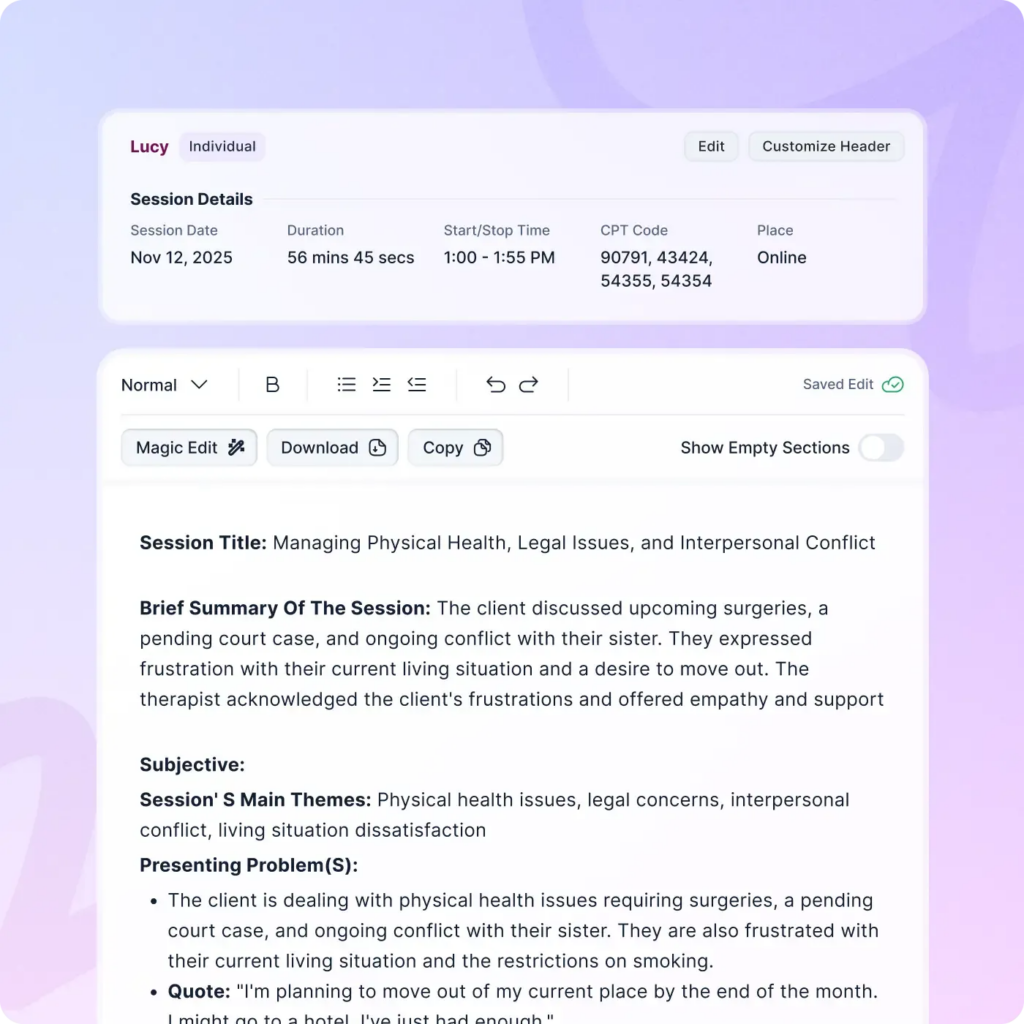
Mentalyc is a therapy-focused documentation platform that works well for art therapists who want structured, clinically aligned notes without forcing creative or expressive work into rigid or overly medicalized language.
Rather than treating documentation as a checkbox, Mentalyc supports how therapists track client progress over time while preserving clinical judgment and interpretation. Mentalyc supports the clinical reality art therapists live in: two worlds that must connect.
- Creative / expressive work in-session
- Clinical documentation requirements outside-session
Why Mentalyc Works for Art Therapy
- Captures the creative process (instructions, pacing, transitions, reflections)—even when sessions are quiet or non-verbal
- Helps translate expressive interventions into clinical language that payers understand
- Preserves therapist judgment and avoids speculative “AI interpretation” of artwork
- Maintains the Golden Thread across notes, treatment plans, and progress over time
- Makes it easier to provide client-friendly after-visit summaries (key takeaways + what they’re trying between sessions)
Core Capabilities for Art Therapists
- AI Note Taker to draft structured notes from session content (audio upload, dictation, typed notes)
- Flexible note formats (SOAP, narrative, custom templates suitable for art therapy)
- AI Treatment Planner to create measurable goals linked to therapeutic work
- AI Progress Tracker that reflects treatment progression directly from session notes—without requiring questionnaires
- Alliance Genie™ for supervision-style insights into key alliance dimensions, such as engagement, pacing, talk-time balance, and missed opportunities
- EHR note transfer within 1 click – no copy pasting for a seamless integration
- Clinician-controlled note review and editing (you decide what stays)
Trust and Boundaries That Matter in Art Therapy
Art therapists often draw a clear line: documentation should support clinical work without interpreting or analyzing the art itself. Mentalyc is designed to respect that boundary by helping structure session notes and track progress, while leaving all clinical interpretation in the therapist’s hands.
At the same time, it meets the practical requirements of clinical practice by handling client data responsibly and compliantly.
Clinical boundaries
- Supports documentation of therapeutic process and progress without automated interpretation of creative expression
- Preserves clinician judgment and language for expressive and symbolic work
Privacy & compliance
- HIPAA compliant with BAA support
- SOC 2 Type II compliant
- Session audio is not stored; transcripts are anonymized and secured
Best for: Art therapists who want documentation that respects creative modalities and meets clinical, audit, and insurance expectations without compromising professional boundaries.
User Feedback:
“Mentalyc is a huge help in capturing what I do without having to translate my brain into the clinical speak that insurance companies require.” by Suzi Humbert, MHRS certificate art therapist.
Mentalyc Art Therapy Documentation Software Plans & Pricing
| Plan | Price | Key Features |
|---|---|---|
| 14-Day Free Trial | $0 | 14 days of full PRO |
| access, including 15 | ||
| notes—no credit card | ||
| required. | ||
| Mini | USD 14.99 /month | Record in-person |
| sessions, upload | ||
| audio files, use voice- | ||
| to-text, or type notes | ||
| directly, etc | ||
| Basic | USD 29.99 /month | Everything in Mini, |
| plus: Alliance | ||
| Genie™NEW! (limited | ||
| access), Smart TP™ | ||
| Pro | USD 59.99 /month | EMDR, Play and |
| Psychiatry modalities, | ||
| 100+ custom | ||
| templates | ||
| incld. BIRP, PIRP, GIRP, PIE, and SIRP, | ||
| Auto-computed CPT | ||
| codes | ||
| Super | USD 99.99 /month | Everything in Pro, |
| plus: Group therapy | ||
| notes for each group | ||
| member, Priority | ||
| onboarding and | ||
| support |
For more information, visit the pricing page on our website.
Upheal — Session Analytics AI Notes (Limited for Art Therapy)
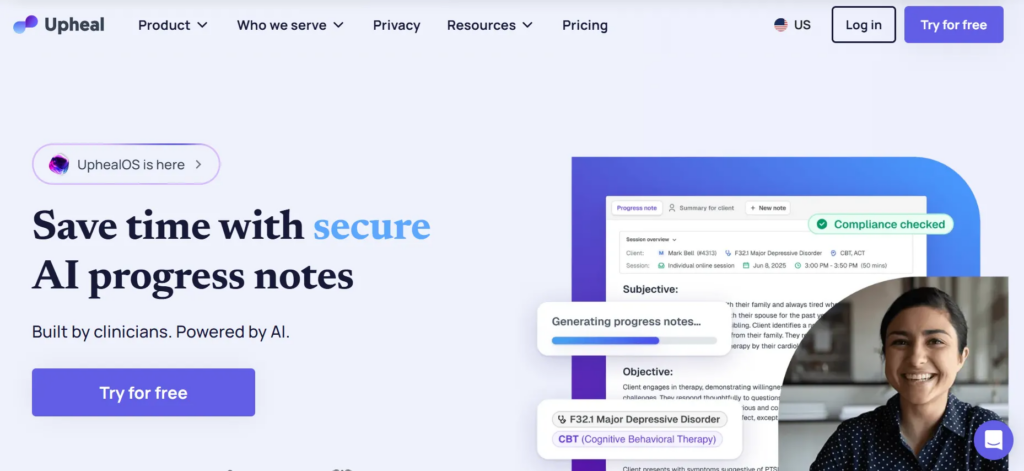
Upheal positions itself as an AI documentation tool with session analytics. While some clinicians appreciate the time savings, the platform tends to work better for highly verbal modalities than creative, process-based sessions. Also, UpHeal doesn’t support family therapy (a common setup for art therapy) like they claim according to this user:
“This software oversells and underdelivers. I signed up for the highest tier because I do family therapy and they claim to support this modality…Upheal is not set up to capture family sessions” — Danielle Drake…via Trustpilot.
For art therapy documentation, the limitation is predictable: analytics often center on speech, while expressive work centers on process, themes, and non-verbal engagement.
Key Features
- AI-generated progress notes (SOAP, DAP, BIRP)
- Session analytics (talk-time ratios, engagement metrics)
- Treatment plan generation with structured goals
- Telehealth recording and transcript analysis
- EHR integrations
Pros
- Clean interface and fast note generation
- Helpful for clinicians focused on verbal session analysis
Cons
- Limited support for documenting non-verbal process
- Weaker fit for play/movement/creative interventions
- Not ideal if you rely heavily on symbolism and quiet segments
- Long-term transcript storage raises privacy concerns for some clinicians
Best For
Talk-therapy clinicians who want analytics-heavy insights and are less focused on expressive arts or non-verbal modalities.
Pricing
- Free plan available
- Paid plans typically start in the mid-range compared to other AI note tools (pricing varies by feature tier)
Carepatron — Template-Driven Documentation Platform
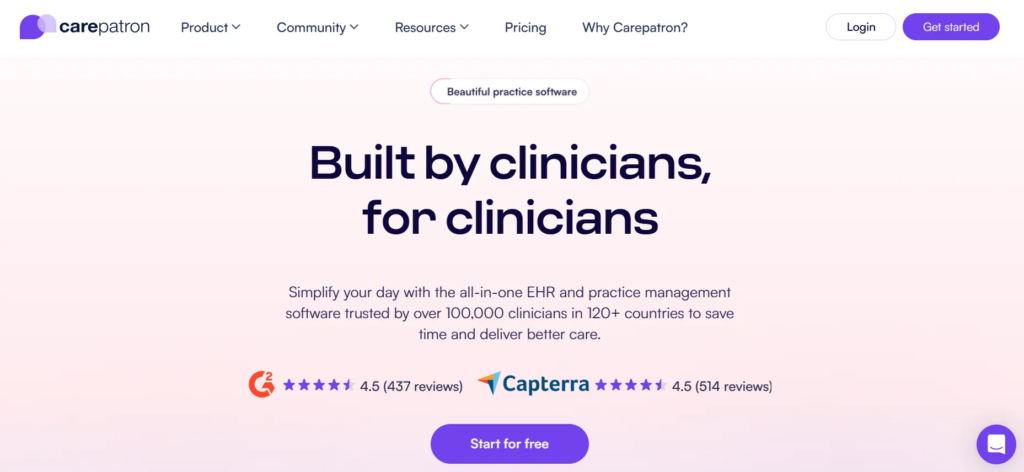
Carepatron is an all-in-one documentation platform combining scheduling, notes, and templates. Users often describe it as flexible but more manual.
“Carepatron’s AI seems to have a more surface level knowledge of what I do as a SLP instead of the other AI software that tailored its output…” — Ryan P…. Via G2.
For art therapists, Carepatron can work if you like templates—but you may need to do more of the clinical translation work yourself.
Key Features
- Customizable note templates
- Practice management and scheduling
- Progress notes and treatment plans
- Client portal and file storage
- HIPAA-compliant infrastructure
Pros

- Good all-in-one practice management coverage
- Works for group and individual sessions
Cons
- Minimal AI assistance for clinical interpretation
- No native support for treatment progression visualization
- Progress tracking requires manual review
- Limited automation for art therapy progress note tool needs
Best For
Art therapists who prefer structured templates and are comfortable handling creative process documentation manually.
Pricing
- Free tier with limited features
- Paid plans scale based on practice size and features
SimplePractice AI Note Taker — Convenient but Basic

SimplePractice’s AI note-taking add-on is designed for therapists who want automation without leaving their existing EHR. However, users frequently report that the AI output lacks clinical depth.
“The rating scale trackers are good but there is no way to include in the note. So if you are audited by insurance, you will have to hand enter every thing…” — Marianne Webb Marianne Webb AP…Via Trustpilot.
For art therapy, “basic automation” is often not enough—because you need process documentation, theme tracking, and goal linkage. This can be a challenge for art therapy SOAP notes, where nuance matters.
Key Features
- AI-generated progress notes inside SimplePractice
- Supports SOAP, DAP, and BIRP formats
- Dictation and text-based input
- Uses SimplePractice’s security framework
Pros
- Good for basic documentation
- Familiar workflow for existing users
Cons
- Limited support for art therapy documentation
- Weak handling of symbolic expression
- No advanced progress tracking
- Not ideal for art therapy notes for insurance reimbursement
Best For
Therapists already using SimplePractice who want light automation for standard, verbal sessions.
Pricing
- Add-on pricing layered on top of SimplePractice subscription
- Cost increases with practice size
TheraNest — Compliance-Focused, Modality-Agnostic
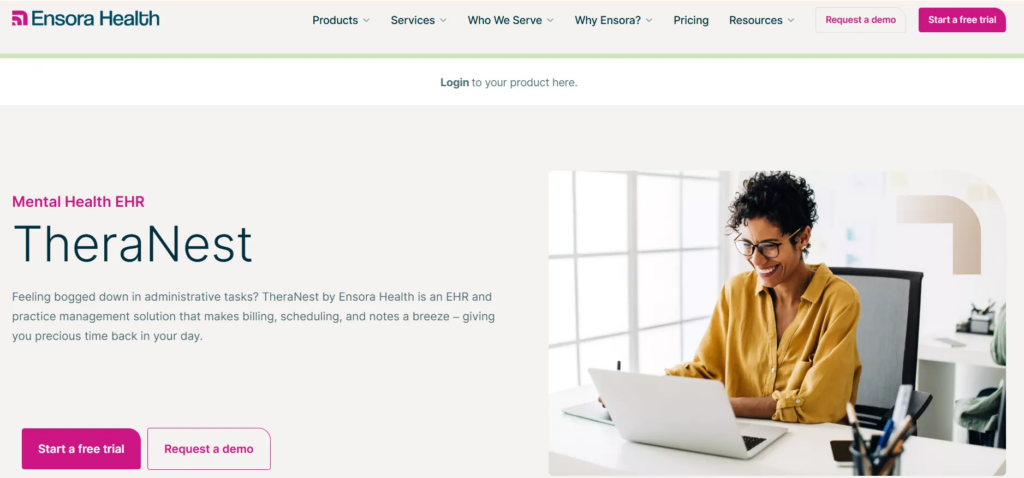
TheraNest is primarily an EHR and billing platform. It’s reliable for standard documentation, but may feel rigid for expressive work.
“Great when it works, horrible when it doesn’t…However, custom forms started not working (for example – our custom intake note which is required for our billing model)…” — SK…via Trustpilot.
Key Features
- Progress notes and treatment plans
- Billing and insurance workflows
- Client scheduling and reminders
- Standard note templates
Pros
- Strong billing and claims support
- Reliable for insurance workflow
Cons
- Generic templates for art therapy notes
- Limited flexibility for creative interventions
- Manual effort required to document process and outcomes
Best For
Practices where billing efficiency matters more than modality-specific documentation.
Pricing
- Monthly subscription per clinician
- Pricing varies by feature bundle
Final Recommendation — Best Art Therapy Note Taker in 2026
Choosing the right art therapy note taker comes down to one core question: Does the tool respect the complexity of art therapy while still meeting clinical, ethical, and insurance requirements?
Art therapists don’t just document what was said. They document symbolic expression, creative process documentation, shifts in affect, relational cues, and intervention outcomes that often unfold visually or non-verbally. Most documentation tools struggle here because they’re built for talk therapy first and creative modalities second.
After comparing leading options, Mentalyc stands out as the best art therapy documentation software for clinicians in 2026.
Why Mentalyc Is the Clear Winner for Art Therapists
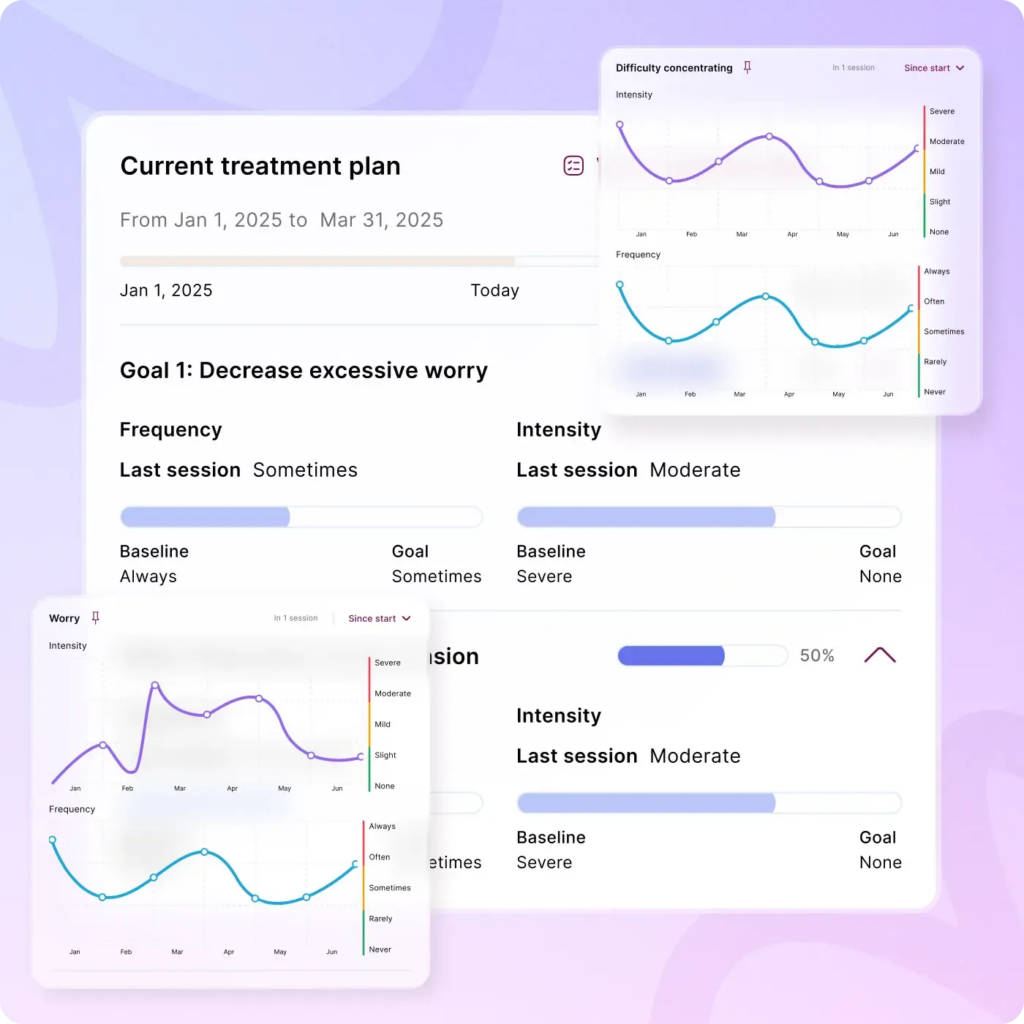
Mentalyc is the only platform in this category that supports the full art therapy clinical documentation workflow, from session capture to progress tracking. What sets Mentalyc apart:
Built for clinical translation (without flattening the creative work)
Mentalyc helps turn expressive interventions into structured clinical documentation that supports treatment planning and payer expectations—without pretending to interpret the artwork for you.
Handles quiet, non-verbal segments
Art therapy often includes silence, movement, and making. Mentalyc supports documenting the guided process, transitions, and reflections so the clinical work doesn’t disappear due to the lack of words.
Progress tracking that fits creative modalities
With AI Progress Tracker, you can track progress through goals, skills practiced, and themes—without forcing clients into constant questionnaires.
Clear treatment plan alignment
Mentalyc links notes to goals/objectives using measurable language, supporting art therapy treatment plan goals and documentation and reducing audit stress.
Designed for real-world practice
Art therapists often work across settings (in-person, telehealth, phone). Mentalyc supports flexible workflows while keeping documentation consistent.
FAQs About Art Therapy Notes App
Why other mental health professionals love Mentalyc
“For anyone hesitant: this is a lifesaver. It will change your life, and you have more time to be present with your patients.”
Licensed Clinical Social Worker

“It immediately changed my quality of life, personally and professionally.”
Owner/Independently Licensed Marriage & Family Therapist (LMFT)

“If I were recommending this software to a colleague, I would tell them that it is the best thing that they could do for their practice.”
Licensed Professional Counselor

“Do yourself a favor, make your life easier. I found Mentalyc to be one of the best tools that I’ve ever used.”
Licensed Marriage and Family Therapist