

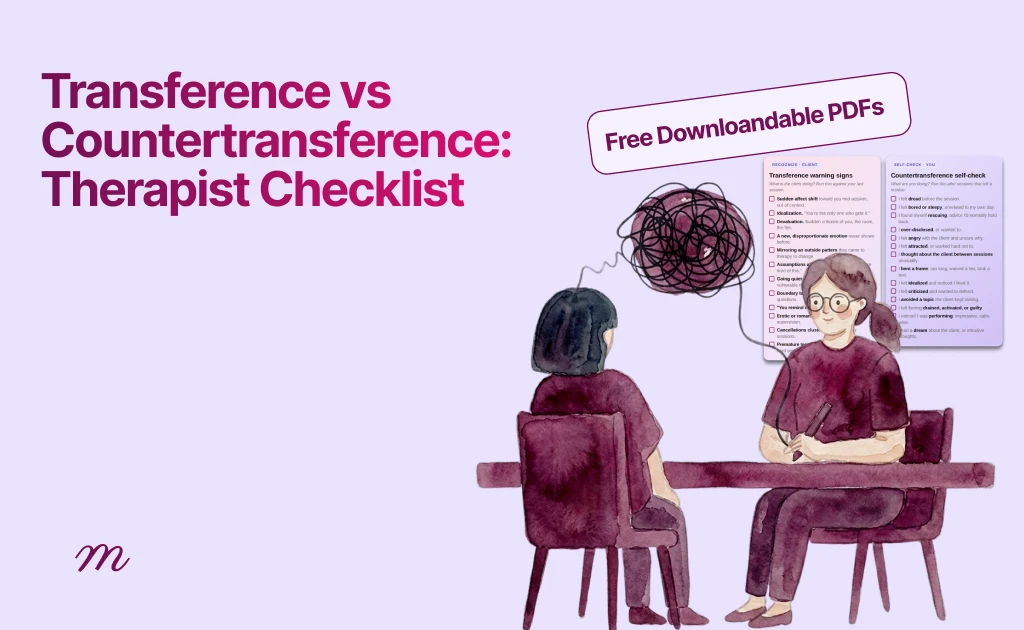
Most transference and countertransference goes unnamed in the moment. You feel the shift, the session ends, and you only piece it together later, if at all. This guide is built to be used: two clinical checklists you can run after a session (the warning signs of client transference, and a countertransference self-check), plus the standard steps for handling each. Definitions are here too, but the working tools come first.
Transference is the client’s unconscious redirection of feelings from past relationships onto you. Countertransference is your emotional reaction to the client that goes beyond a neutral professional response. One flows from client to therapist. The other flows back. Both are clinical information. What matters is whether you catch them.
The transference warning-signs checklist
Download: the free transference & countertransference recognition checklist (PDF) to run after your next session.
The most common warning signs of transference are a sudden shift in the client’s affect toward you, idealization or devaluation, assumptions about your inner state, boundary testing, and disproportionate reactions to small in-session cues. Run this list against your last session. A single item is human. A cluster, or the same item recurring across clients, is the signal.
Strengthen your therapeutic relationships

1. Sudden shift in affect toward you mid-session. Frustration, withdrawal, flattery, or flirtation appearing out of context.
2. Idealization. “You’re the only one who gets it.” Often surfaces self-worth or unmet caregiver needs.
3. Devaluation (negative transference). Sudden criticism of you, the room, your fee. Often a defense against vulnerability that just opened up.
4. A new, disproportionate emotion the client has never shown. Usually a sign the relationship has become safe enough to surface buried material.
5. Mirroring an outside relational pattern. The client whose partner says he “snaps under pressure” snaps at you.
6. Assumptions about your inner state. “You’re tired of hearing about this.” The client is reading their own internal narrative into your neutral cues.
7. Going quiet in a way that is unlike them. Especially after a vulnerable moment. The withdrawal is protective.
8. Boundary testing. Gifts, between-session contact, scheduling gymnastics, personal questions about you.
9. “You remind me of…” statements. The most overt form. Take it seriously.
10. Erotic or romantic feelings. Normal in incidence, requires careful handling and almost always supervision (Celenza, 2024). See therapeutic boundaries.
11. Cancellations clustered around emotionally heavy sessions. One of the clearest early warning signs of dropout.
12. Premature termination language right after a hard session. Rarely about getting better.
Example. Joanie enters therapy to address volatile relationships with men. Her male therapist Peter learns that her father was abusive and absent. Joanie initially describes her relationships in unrealistically positive terms, smoothing over real trauma, and works hard in session to seem agreeable, mirroring her childhood people-pleasing. Rather than interpret early, Peter reflects what he observes: “You tend to soften the rough parts when you tell me about Maxwell. What’s that like, telling me?” Over time, Joanie connects her in-session need to please Peter with the same need that drove her relationship with her father and her current one. The transference becomes the laboratory.
Common projection categories beyond in-session signals (Yeomans, Caligor, & Diamond, 2023): parental projections (experiencing you the way they experienced a parent), sibling projections (rivalry, fairness), sexual or erotic projections (intimacy needs surfacing through the therapy relationship), idealizing projections (you are perfect, the rescuer, reveals self-worth gaps), persecutory or negative projections (you are unsafe, judging, common in trauma histories), and mirror projections (the client mirrors the very pattern they came to therapy to change).
The countertransference self-check
Common signs of countertransference include dread before a session, boredom or sleepiness in session, rescuing impulses, over-disclosure urges, thinking about the client between sessions, and bending the frame around fees, time, or contact. Run this after the sessions that left a residue.
- I felt dread before the session.
- I felt bored or sleepy in a way unrelated to my own day.
- I found myself rescuing, offering advice or reassurance I’d normally hold back.
- I over-disclosed, or wanted to.
- I felt angry with the client and unsure why.
- I felt attracted to the client, or worked hard not to.
- I thought about the client between sessions more than is typical for me.
- I bent a frame: ran long, waived a fee, took a between-session text.
- I felt idealized and noticed I liked it.
- I felt criticized and noticed I wanted to defend.
- I avoided a topic the client kept bringing up.
- I left the session feeling drained, activated, or guilty.
- I noticed I was performing, trying to be impressive, calm, or wise.
- I had a dream about the client, or intrusive thoughts.
A single item is human. A cluster, or the same item recurring across clients, is data worth taking to supervision.
Here is the hard part the checklist exposes: most of us cannot catch our own patterns in real time, and we definitely cannot see them stacking up across clients session after session. The dread you felt on Tuesday and the rescuing on Friday and the frame you bent last month may be one pattern, and you would never connect them from memory. This is the gap a second set of eyes is supposed to fill. When supervision is available, that is where it goes. When it is too expensive, hard to schedule, or not part of your stage of licensure, a structured reflection layer can stand in.
Mentalyc’s Alliance Genie reviews your session transcript the way a supervisor would and flags the exact moments countertransference shows up: ruptures, missed bids, engagement drops, how you handled a sensitive topic, then tracks those patterns across clients so the recurring ones surface instead of slipping past. It analyzes each session across 27 areas grounded in Bordin’s working alliance framework, and it is the only AI tool dedicated specifically to measuring and improving the therapeutic alliance. It is built to sharpen your own read of the room, not replace it. If supervision is not currently accessible to you, it can serve as a reflective-practice substitute on your own schedule.
If you supervise or run a group practice, the same analysis works across a roster. When a supervisee uses Mentalyc, you can connect accounts and review their analyzed sessions together, so supervision time goes to the flagged transference and countertransference moments instead of reconstructing the session from memory. Try Mentalyc free.
Transference vs countertransference: how they differ
Transference flows from client to therapist. Countertransference flows from therapist to client. Both involve emotional material from outside the therapy room leaking into it. The expectation is asymmetric: clients are supposed to project; therapists are expected to contain, reflect, and intervene.
| Transference | Countertransference | |
|---|---|---|
| Who is projecting | The client | The therapist |
| Direction | Past relational material to therapist | Therapist’s reactions to client |
| Frequency | Common in any modality with relational depth | Common but should be the exception |
| Clinical value | High, reveals unconscious patterns | High when managed, harmful when acted out |
| Risk if missed | Rupture, premature termination | Boundary violation, ethical breach |
| Primary management tool | In-session naming and exploration | Supervision, personal therapy, structured reflection |
Positive vs negative transference. Positive transference is when a client projects loving, admiring, or trusting feelings onto the therapist. Negative transference is when they project anger, suspicion, or hostility. Both are clinically informative. Extreme idealization signals unmet caregiver needs or self-worth gaps. Negative transference is almost always displaced material being relocated into the therapy room (Scott, 2021).
Transference vs projection. Transference is a specific form of projection, but not all projection is transference. Projection is the broader defense mechanism (attributing your feelings or traits to another). Transference is the specific projection of relational patterns from past important figures onto the therapist. All transference is projection; not all projection rises to transference.
What is transference?
Transference is the unconscious redirection of feelings, expectations, and relational patterns from a client’s earlier important relationships onto the therapist. The client is not aware they are doing it. The feelings are real to them in the moment, but their source is somewhere else, usually a parent, sibling, or former partner.
Sigmund Freud first described transference in his 1912 paper The Dynamics of Transference. Contemporary research confirms it occurs across every therapeutic modality, well beyond psychodynamic work (Kline, Hill, Lu, & Gelso, 2023). The APA Dictionary of Psychology defines it as “the displacement or projection onto the analyst of feelings, attitudes, and behaviors that originated in the patient’s earlier experiences with parents, siblings, and other significant figures.”
Attachment theory is the contemporary framework most therapists use to make sense of transference. Securely attached clients tend to bring fewer extreme transference reactions. Clients with anxious, avoidant, or disorganized styles bring more, in patterned and predictable ways (Roddy & Eccleston, 2023). Knowing a client’s attachment history is one of the strongest predictors of which projections will show up.
What is countertransference?
Countertransference is the therapist’s emotional reaction to the client that goes beyond a neutral, professional response. It can be a reaction to the client’s transference, or it can come from your own unresolved material that the client unknowingly activates.
The clinical stakes are clear. Unmanaged countertransference correlates with worse outcomes (r = -.16, d = -0.33). Well-managed countertransference correlates with significantly better outcomes (r = .39, d = 0.84) (Hayes, Gelso, Goldberg, & Kivlighan, 2018, meta-analysis, n = 973). Countertransference is information. What matters is what you do with it.
The 3 types of countertransference
The three most widely recognized types are subjective, objective, and concordant/complementary.
1. Subjective countertransference. Reactions from your own unresolved material. The client is the trigger, not the cause. This is what personal therapy and self-reflection are designed to manage.
2. Objective countertransference. Reactions most therapists would have to this client. Diagnostically useful: if you feel pushed away, others probably do too.
3. Concordant or complementary countertransference. Concordant: you feel what the client feels (their helplessness, their rage). Complementary: you feel what someone in the client’s life feels toward them (impatient like their parent).
Some frameworks add a fourth, erotic countertransference, which is normal in incidence, requires immediate supervision, and is never acted on (Celenza, 2024).
Cultural and identity-based countertransference deserves its own attention. Reactions tied to a client’s race, ethnicity, gender, religion, immigration status, or sexuality, or to the activation of your own identity, are a distinct and often unspoken form. It shows up as over-identification, unexamined assumptions, avoidance of a charged topic, or working harder to be liked across a difference. The management is the same as any other countertransference: notice it, do not act on it, and take it to supervision or consultation, where naming the identity dynamic directly is the work, not a detour from it.
Rupture types. Tishby and Wiseman (2022) distinguish withdrawal-type ruptures (the alliance quietly disengages: compliance, silence, “everything is fine”; the client moves away) from confrontation-type ruptures (the alliance is openly attacked: criticism, complaint, anger; the client moves against). Repair looks different in each. Withdrawal calls for slowing down and naming the felt distance. Confrontation calls for absorbing without defending and taking genuine responsibility. For deeper rupture-and-repair guidance, see Mentalyc’s rupture and repair in therapeutic alliance.
Deepen your therapeutic alliance through insight and reflection
- Evidence-based tools
- Auto-captured areas for growth
- Alliance signals
- Supervision-like insights

How to deal with transference: a 5-step approach
The standard clinical approach is: notice and contain, name what is observable, explore the here-and-now feeling, link to historical pattern only when the alliance can hold it, and repair if there is rupture. It works in psychodynamic, integrative, schema-focused, and, with adjustments, CBT modalities (Prasko et al., 2022).
1. Notice and contain. Do not interpret in the moment. Pause. Track your own reaction. Premature interpretation is usually countertransference acting out.
2. Name what is observable, not what is unconscious. “I notice something shifted just now,” not “You’re projecting your father onto me.”
3. Explore the feeling in the room first. “What’s it like to bring this up with me right now?”
4. Link to pattern only when the alliance can hold it. “Some of what just happened here echoes what you described with your father.”
5. Repair if there is rupture. “I think I missed what you were trying to say. Can we go back?” Repaired ruptures are associated with better outcomes than uninterrupted alliances (Eubanks et al., 2018).
Maintain professional boundaries throughout. See self-disclosure in therapy for the frame that holds this together.
Transference with the clients who are actually hard
The clients who generate the strongest transference are usually trauma survivors, clients with personality disorders, and mandated or involuntary clients, and each pulls for a predictable countertransference you can prepare for.
- Trauma and complex PTSD. Expect rapid idealization followed by testing, and watch for trauma-specific transference where you are unconsciously cast as the perpetrator, the rescuer, or the bystander who failed to protect. The pull is to over-function and rescue. Slow the pacing, keep the frame visible, and name the test as safety-seeking rather than rejection.
- Borderline and other personality structures. Splitting puts you in the idealized seat one week and the devalued seat the next, often within a single session. The complementary countertransference (feeling controlled, drained, or “walking on eggshells”) is diagnostic data, not a personal failing. TFP was built precisely for this, but the same containment-then-naming sequence applies in general practice.
- Mandated and involuntary clients. Transference here is colored by the client’s relationship to authority and the “system.” You are read as the court, the agency, or the parent before you have said anything. Acknowledging the imposed frame openly (“you did not choose to be here”) usually does more to build alliance than any interpretation.
When the same difficult dynamic recurs across several clients, that is rarely about the clients. It is a pattern in you worth bringing to supervision or structured reflection.
How to manage countertransference: 4 practices
The four core practices are structured self-reflection between sessions, regular clinical supervision, your own personal therapy, and mindfulness in-session. All four are evidence-supported components of effective management (Hayes et al., 2018).
1. Self-reflection between sessions. Brief and structured. What pulled my attention? What did I avoid? What did I want to fix? (The self-check above is built for exactly this.)
2. Clinical supervision. Bring specific moments, not summaries. Transcript excerpts, the exact thing that landed differently than expected. If your supervisor uses the Mentalyc AI Note Taker, supervisees get supervision and consultation notes free, so the countertransference and transference themes from each session are documented for your learning log, portfolio, and accreditation hours without extra writing.
3. Your own therapy. Not optional for clinicians doing relational-depth work.
4. Mindfulness in-session. The same grounding skills you teach clients work for you when the room gets activated.
How to respond on the ASWB, NCE, and licensure exams
On the exam, the decision rule is simple: transference is about the client, so you can use it therapeutically; countertransference is about you, so you take it to supervision and do not process it with the client. This single distinction accounts for most transference and countertransference items on the ASWB (social work), NCE/CPCE (counseling), and NCLEX/PMHNP (nursing) exams.
When a vignette shows the client reacting to you as they would to a parent, partner, or authority figure, that is transference, and the keyed answer is usually to explore it in session. When the vignette shows you having a strong emotional reaction to the client, that is countertransference, and the keyed first action is almost always to seek supervision or consultation, not to disclose it to the client and not to refer out. Referral is a last resort that appears only after supervision and personal therapy have failed to contain the reaction.
Transference in social work, counseling, and nursing
Transference and countertransference are clinically identical across professions. What differs is the supervision structure and licensure-exam framing.
- Social work. Case-management roles see transference around dependency, authority, and “system” relationships.
- Counseling. Person-centered and integrative modalities work with transference through the relational frame even when it is not named.
- Psychiatric nursing. Inpatient and crisis contexts produce particularly strong objective countertransference because of patient acuity.
What is transference-focused psychotherapy (TFP)?
Transference-focused psychotherapy (TFP) is a manualized, evidence-based psychodynamic treatment developed by Otto Kernberg, primarily for borderline personality disorder. It uses the therapy relationship itself as the primary change mechanism.
Key features (Yeomans, Caligor, & Diamond, 2023): twice-weekly sessions over a year or more, a clearly defined treatment contract, active interpretation of transference in the here-and-now, and a focus on integrating split internal representations. It has strong empirical support for BPD outcomes, including reduced suicidality and hospitalization. TFP is one of three first-line evidence-based BPD treatments alongside DBT and Mentalization-Based Treatment. Where DBT emphasizes skills training, TFP rewires the underlying personality structure through the therapy relationship.


Why this matters clinically
The therapeutic alliance is one of the most robust predictors of therapy outcome across modalities, and unaddressed transference plus unmanaged countertransference are two of the most common reasons the alliance frays (Flückiger, Del Re, Wampold, & Horvath, 2018). For the broader alliance framework, the measurement instruments, and the rupture-repair evidence, see Mentalyc’s pillar guide on the therapeutic alliance.
The practical point for transference work: when a rupture goes unrepaired, clients quietly stop booking, and weak alliance is a well-documented driver of premature termination (Sharf, Primavera, & Diener, 2010). Ruptures that are repaired in session are associated with better outcomes than relationships with no apparent ruptures at all (Eubanks, Muran, & Safran, 2018). Working with transference well helps clients gain insight into unconscious patterns, differentiate triggers from true threats, and build healthier relationships outside therapy, because they have a different experience of an old pattern with someone who notices it, names it gently, and does not respond the way the original figure did (Kline et al., 2023). It backfires when therapists interpret prematurely, when countertransference is unmanaged, when shame is in the room and the therapist does not slow down for it, or when professional boundaries soften (Prasko, Ociskova, Vanek, et al., 2022).
Supervision prompts
Bring two specific, somatic, relational prompts into your next supervision hour, not all eight.
1. Where in this session did my emotional reaction go beyond what the content called for? What did that reaction feel like in my body?
2. Is there a client I’m thinking about between sessions in a way that’s unusual for me?
3. Was there a moment of rupture I noticed but did not name? What stopped me?
4. Am I working harder for this client than they are for themselves? When did that start?
5. Is there a feeling I keep having across multiple clients right now? What in my own life might be feeding that?
6. Did I bend a frame this week? Whose comfort was that serving?
7. Is there a topic this client keeps approaching that I keep redirecting away from? Why?
8. If a colleague described this case back to me, what would I notice that I’m not letting myself see?
Frequently Asked Questions
References
American Psychological Association. (2024). APA Dictionary of Psychology: Transference / Countertransference. https://dictionary.apa.org/
Bordin, E. S. (1979). The generalizability of the psychoanalytic concept of the working alliance. Psychotherapy: Theory, Research & Practice, 16(3), 252-260.
Celenza, A. (2024). Erotic transference: A contemporary introduction. Routledge.
Eubanks, C. F., Muran, J. C., & Safran, J. D. (2018). Alliance rupture repair: A meta-analysis. Psychotherapy, 55(4), 508-519.
Flückiger, C., Del Re, A. C., Wampold, B. E., & Horvath, A. O. (2018). The alliance in adult psychotherapy: A meta-analytic synthesis. Psychotherapy, 55(4), 316-340.
Freud, S. (1912). The dynamics of transference. In The Standard Edition of the Complete Psychological Works of Sigmund Freud, Volume XII (pp. 97-108). Hogarth Press.
Hayes, J. A., Gelso, C. J., Goldberg, S., & Kivlighan, D. M. (2018). Countertransference management and effective psychotherapy: Meta-analytic findings. Psychotherapy, 55(4), 496-507.
Kline, K. V., Hill, C. E., Lu, Y., & Gelso, C. J. (2023). Transference and client attachment to therapist in psychodynamic psychotherapy. Psychotherapy.
Prasko, J., Ociskova, M., Vanek, J., Burkauskas, J., Slepecky, M., Bite, I., … Juskiene, A. (2022). Managing transference and countertransference in cognitive behavioral supervision: Theoretical framework and clinical application. Psychology Research and Behavior Management, 15, 2129-2155.
Roddy, J., & Eccleston, S. (2023). Understanding attachment and transference. In Working with client experiences of domestic abuse (pp. 60-72). Routledge.
Scott, S. K. (2021). Psychodynamic theories: Approaches and applications. In Foundations of couples, marriage, and family counseling (2nd ed., pp. 103-124).
Sharf, J., Primavera, L. H., & Diener, M. J. (2010). Dropout and therapeutic alliance: A meta-analysis of adult individual psychotherapy. Psychotherapy: Theory, Research, Practice, Training, 47(4), 637-645.
Tishby, O., & Wiseman, H. (2022). Countertransference types and their relation to rupture and repair in the alliance. Psychotherapy Research, 32(1), 16-31.
Yeomans, F., Caligor, E., & Diamond, D. (2023). The development of transference-focused psychotherapy and its model of supervision. American Journal of Psychotherapy, 76(1), 46-50.
Why other mental health professionals love Mentalyc

“Reading transcripts helps me tighten up and come across more the way I want to present myself to clients … it’s helped me improve and keep getting better.”
Licensed Marriage and Family Therapist

“It keeps me on a level of assessment about the relationship that has a little bit more objectivity. It helps keep me grounded.”
LPC

“Using Alliance Genie has really improved my notes … It tells me what I’m doing and gives me an approach of what’s next.”

“It’s really giving me some good confidence … and areas of improvement to see nuances I didn’t see before.”