

Running a therapy practice means juggling clinical work, documentation, and the financial realities of being a small business owner. Knowing what counts as a therapy business expense is essential not only for staying compliant but also for building a financially sustainable private practice. From office rent to CE credits, these costs are more than necessities; they’re strategic investments in your growth and the quality of care you provide.
In this guide, we’ll walk through which expenses qualify, how to document them for taxes, and examples every therapist should know.
And if you’re investing in professional development, tools like Mentalyc is the only solution in the market that designed to help therapists strengthen clinical insight through features like Alliance Genie™. It can offers supervisor-like feedback on client connection and progress so you can keep growing your skills.
What Is a Business Expense?
For mental health professionals, understanding what qualifies as private practice business expenses is essential for managing finances and ensuring compliance with tax regulations. According to the IRS, a business expense is any ordinary cost (common and accepted in your field) and necessary (helpful and appropriate for your practice). For the expense to be deductible, it must directly relate to your therapy practice or mental health services.
Turn documentation into insights with Mentalyc

New! Transfer your notes to EHR with a single click. No more copy-pasting.
Components of a Business Expense:
Ordinary: The expense should be typical within the mental health industry. For example, office rent, liability insurance, and continuing education courses are all considered ordinary because they are customary for therapists.
Necessary: The expense must contribute to your business’s operations or success. It’s not essential, but it aids professional work. For instance, membership in professional organizations such as the American Psychological Association (APA) is considered necessary because it provides resources, networking opportunities, and credibility to your practice.
Directly Related to Your Practice: The expense must have a clear business purpose. Personal expenses or costs not closely tied to your clinical work are not deductible. For example, purchasing therapeutic tools, such as play therapy supplies, for client sessions would qualify, but buying the same supplies for personal use at home would not.
Common Therapy Business Expenses
| Expense Category | Examples | Tax Deduction Notes |
| Office Space | Office rent, co-working space, or home office area | Rent is fully deductible; a home office qualifies if used exclusively for business. |
| Utilities & Internet | Electricity, phone, Wi-Fi | Deduct only the business-use percentage if shared with personal use. |
| Therapy Equipment & Supplies | Furniture, therapy tools, stationery | Depreciation rules apply for high-cost equipment. |
| Technology & Software | EHR systems, telehealth platforms, billing software | Must be used primarily for business and comply with data protection standards. |
| Professional Development | CEUs, certifications, training workshops | Fully deductible as continuing education necessary for maintaining licensure. |
| Professional Memberships | APA, ACA, or state board dues | Deductible if directly related to professional practice. |
| Marketing & Advertising | Website hosting, Google Ads, logo design | Deductible as long as the costs are for promoting your professional services. |
| Insurance & Licensing | Liability insurance, license renewals | Fully deductible as essential professional expenses. |
| Travel & Mileage | Conferences, supervision meetings, and client visits | Keep detailed records including dates, destinations, and purposes. |
| Administrative Costs | Accountant fees, billing services, banking fees | Deductible as part of managing and maintaining business operations. |
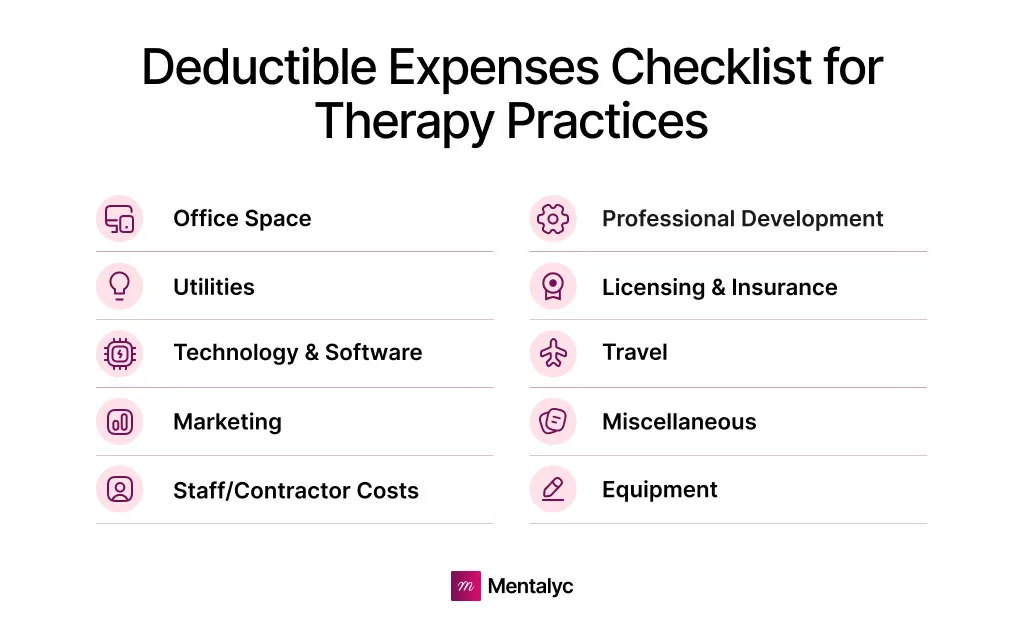
This is a list of common business expenses for therapists, categorized for clarity:
1. Office Space
What’s Deductible: If you rent an office for your practice, the cost of rent is fully deductible. Therapists who work from home may be eligible for a home office deduction.
- Examples: Monthly office lease payments, co-working space fees.
- Note: A home office must be used exclusively for business to qualify for deductions.
2. Utilities and Office Maintenance
What’s Deductible: Utilities (electricity, internet, phone service) and office space maintenance costs.
- Examples: Electric bills, water bills, cleaning services, and office repair costs.
- Special Notes: You can only deduct the business portion if you share utilities between personal and business use.
3. Technology and Software
What’s Deductible: Any technology or software you use for scheduling, teletherapy, billing, or maintaining client records.
- Examples: Practice management platforms like SimplePractice, telehealth software subscriptions, website hosting, and video conferencing tools like Zoom.
- Note: Ensure the software is HIPAA-compliant if handling sensitive client information.
4. Marketing and Advertising
What’s Deductible: Expenses incurred in promoting your practice or services.
- Examples: creating and maintaining a professional website, directory listings, business cards, Google Ads, social media advertising, and promotional items such as branded pens or notepads.
5. Professional Development
What’s Deductible: Costs associated with maintaining or improving your skills as a therapist.
- Examples: CEU (continuing education units) courses, professional certifications, training programs, and membership fees for professional organizations like the American Counseling Association (ACA) are deductible.
6. Licensing and Insurance
What’s Deductible: The expenses needed to remain licensed and insured.
- Examples: state licensing fees, liability insurance, professional indemnity insurance, license renewal fees, and insurance premiums.
7. Equipment and Supplies
What’s Deductible: Any physical items purchased to support your practice.
- Examples: office furniture, therapy tools (e.g., art supplies for art therapy), printers, and filing cabinets.
- Note: Depreciation rules may apply to high-cost equipment.
8. Travel Expenses
What’s Deductible: Travel costs for attending conferences, meeting clients offsite, or other business-related trips.
Automate documentation and session analytics with Mentalyc
From intake to progress and treatment planning — automated, and aligned with your clinical style.
- HIPAA, PHIPA & SOC2 Compliant
- SOAP, DAP, BIRP, EMDR & more formats
- AI Treatment Planner
- AI Progress Tracker for goals & symptoms tracking
- Alliance insights
New! Transfer your notes to EHR with a single click. No more copy-pasting.

- Examples: Mileage, airfare, hotel stays, and meals (subject to IRS limits).
- Note: Keep detailed records, including dates, purposes of travel, and receipts.
9. Employee and Contractor Costs
What’s Deductible: Wages, benefits, and fees paid to anyone you employ or contract to help run your practice.
- Examples: Salaries for administrative staff, payments to outsourced billers, or freelance graphic designers.
- Note: Don’t forget payroll taxes if you have employees.
10. Miscellaneous Expenses
What’s Deductible: Additional costs that don’t fit neatly into the above categories but are essential to your practice.
- Examples: Professional liability lawsuits, business bank account fees, and professional headshots for marketing materials.
- Note: Keep documentation to justify these deductions in case of an audit.
How to Determine If an Expense Qualifies
Here’s a quick checklist to evaluate whether an expense can be considered a therapy business expense:
1. Is it Ordinary? Is the expense typical and accepted in the therapy field? Understanding deductible expenses for therapists requires knowing what’s considered standard and accepted across the mental health industry.
2. Is it Necessary? Does the expense directly support the operation or growth of your practice? Most therapy practice tax deductions apply only when an expense is essential to your services and helps sustain or expand your work.
3. Is it Documented? Do you have receipts, invoices, or bank statements to support the expense? Proper documentation ensures your therapist tax write-offs are legitimate and easily defensible if reviewed by tax authorities.
Example: Setting Up a Tele therapy Practice
Let’s consider an example of a therapist, Uma, who is setting up a tele therapy practice. Here’s a breakdown of her qualifying expenses:
1. Office Setup. Uma decides to work from home and designates a room exclusively for tele therapy. She buys a desk ($300), an ergonomic chair ($200), and soundproofing panels ($150).
- Deduction: $650 for equipment. This qualifies under home office deduction for therapists, as long as the space is used solely for professional work.
2. Technology. Uma purchases a laptop ($1,200) and subscribes to a HIPAA-compliant tele health platform ($49/month).
- Deduction: $1,788 ($1,200 for the laptop + $588 annual subscription fee). These are part of her therapy equipment and supplies deduction, which includes items directly related to providing client services.
3. Internet and Phone. Uma upgraded her internet speed ($50/month increase) and used a separate phone line for client calls ($30/month).
- Deduction: $960 ($600 for internet + $360 for phone).
4. Professional Development. Uma enrolls in a CEU course on tele therapy techniques ($300) and joins the ACA ($200 annual fee).
- Deduction: $500.
5. Marketing. Uma hires a graphic designer to create a logo ($150) and pays for Facebook Ads ($500).
- Deduction: $650.
6. Insurance. She obtains professional liability insurance ($500/year).
- Deduction: $500.
Uma incurred $5,048 in deductible therapy expenses in her first year.
Best Practices for Managing Business Expenses
Effective business expense management is crucial for your therapy practice’s financial health and growth. Here are some best practices to guarantee accurate records, streamline finances, and prepare for tax season.
1. Separate Business and Personal Finances: Mixing personal and business finances complicates tracking expenses, increases the risk of missed deductions, and can create issues during tax audits.


Action Steps:
- Open a dedicated business bank account to manage income and expenses for your practice.
- Use a business credit card for all work-related purchases to maintain a clear record and earn rewards.
- Avoid using personal accounts for business-related expenses to keep finances clean and organized.
2. Use Software for Therapy Accounting: Manual record-keeping is time-consuming and prone to errors. Accounting software automates financial tracking and simplifies therapist bookkeeping. Explore platforms tailored for therapy practices that integrate appointment scheduling and billing.
Platforms like QuickBooks, Xero, or Wave can help you:
- Categorize expenses (e.g., rent, insurance, supplies).
- Track income and expenditures in real time.
- Generate profit and loss statements and tax-ready reports.
| Tool Name | Best For | Key Features | Ideal For |
| QuickBooks Online | Comprehensive accounting and payroll | Expense tracking, invoicing, and integration with tax forms | Solo and group practices |
| Xero | Real-time financial management | Multi-device syncing, project tracking, and reporting | Growing private practices |
| Wave | Free accounting and invoicing | Tracks income and expenses, connects to bank accounts | Solo practitioners or startups |
3. Keep Detailed Records: Proper documentation is essential to substantiate deductions in case of an IRS audit and to maintain an accurate financial history of your practice.
Action Steps:
- Save all receipts, invoices, bank statements, and proof of payments related to your business.
- Use tools like CamScanner or Expensify to digitize and store records.
- Retain documentation for at least seven years, as required for tax purposes.
- To avoid confusion, categorize expenses clearly (e.g., travel, office supplies, professional development).
4. Consult a Tax Professional: A tax advisor with experience in therapy practices can ensure you:
- Maximize deductions (e.g., home office, professional memberships, teletherapy software).
- Remain compliant with ever-changing IRS rules for therapists.
Action Steps:
- You should meet with a tax professional at least once a year, ideally before tax season, to plan and strategize.
- Ask for guidance on complex expenses, such as depreciation of equipment or retirement contributions.
- Consider a CPA or tax advisor who understands the unique needs of mental health professionals.
5. Conduct Regular Reviews: Reviews help you monitor spending, make informed financial decisions, and adjust your budget or tax planning as your practice grows.
Action Steps:
- Schedule quarterly reviews to evaluate your income and expenses.
- Look for trends or areas where you can cut unnecessary costs or invest in growth opportunities.
- Adjust your tax estimates and contributions based on income fluctuations.
- Use the review as an opportunity to reassess subscription services or software you no longer use.
Tips:
- Use autopay for recurring expenses like rent or utilities to avoid late fees.
- Use your accounting software or bank app to set spending limits or notifications for unusual transactions.
- Allocate a percentage of each payment received into a savings account for estimated taxes.
- If you travel for work, use a mileage-tracking app like MileIQ to document and maximize vehicle-related deductions.
By implementing these best practices, you can maintain a clear financial picture, minimize stress during tax season, and position your practice for success.
Common Pitfalls to Avoid
Managing business expenses effectively involves avoiding common mistakes that can lead to financial inefficiencies or tax issues. Here are some pitfalls therapy professionals should watch for:
Overlooking Documentation Compliance and Audit Readiness.
Incomplete or inconsistent therapy notes can create serious problems during audits or insurance reviews – leading to denied claims or financial penalties. Solution like **Mentalyc’s AI therapy note** help therapists stay compliant by automatically generating accurate, audit-ready notes and treatment plans, ensuring your records meet both ethical and insurance standards.
Overestimating the Home Office Deduction. Claiming an incorrect deduction can trigger audits or penalties. Make sure you use the space exclusively for work and accurately calculate the deduction using either the simplified method or the actual expenses method based on square footage and associated costs.
Failing to Track Small Expenses. Over time, small purchases like pens, printer paper, or snacks for clients can add up, and failing to track them means losing out on legitimate deductions. Use expense tracking apps or software to capture every receipt—no matter how small.
Misclassifying Personal Expenses. Blurring the line between personal and business expenses can result in disallowed deductions and potential fines during an audit. Always keep personal and business accounts separate and use dedicated cards for business expenses.
Failing to Account for Depreciation. Large purchases such as computers, office furniture, or therapy equipment often require depreciation over time, and incorrect handling can result in compliance issues. Work with a tax professional to record depreciation properly using IRS guidelines.
Forgetting Quarterly Estimated Tax Payments. As a self-employed professional, neglecting to make quarterly estimated payments can result in significant penalties at tax time. Use accounting software to calculate estimated taxes and set reminders for the four quarterly payment deadlines (April, June, September, and January).
Neglecting to Reevaluate Subscriptions and Services. Review recurring expenses like software subscriptions or memberships to avoid unnecessary spending. Conduct quarterly or annual audits of all subscriptions and cancel those that are no longer necessary or underused.
Missing Out on Mileage Deductions. Failing to document mileage for work-related travel means losing out on a significant deduction. Use a mileage-tracking app like MileIQ or keep a detailed log of all business-related trips, including dates, purposes, and distances.
Overlooking Health Insurance Premiums. If you’re self-employed, you can deduct health insurance premiums for yourself and your family, but many professionals overlook this. Consult with a tax professional to ensure you claim this deduction appropriately.
Failing to Plan for Tax Rate Changes. Tax rates or deduction rules can change yearly, leaving you unprepared for higher liabilities. Stay updated on tax law changes, especially those affecting small businesses, and adjust your strategies accordingly.
Underestimating the Importance of Emergency Funds. Unexpected expenses, such as equipment repairs or tax surprises, can disrupt your business if you lack a financial buffer. Build an emergency fund to cover at least 3–6 months of business expenses.
Ignoring Client-Related Expenses. Therapists often overlook deductible expenses like client tools or refreshments. Keep receipts for these items and ensure they fall within IRS guidelines (e.g., keep client expenses under $25 per client per year).
Not Reviewing IRS Updates for Your Industry. The IRS may issue updates or new guidelines for specific industries, including therapy practices. Regularly check the IRS website or consult with a tax advisor who is familiar with therapy professionals.
By staying vigilant and avoiding these pitfalls, you can better manage your business finances, maximize your deductions, and ensure long-term success for your practice.
Conclusion
Understanding what counts as a therapy business expense is essential for running a successful and financially healthy practice. Therapists can reduce their tax burden by categorizing expenses correctly, keeping accurate records, and consulting with financial professionals. From office rent to professional development, every deductible expense helps support the growth and sustainability of their practice.
Managing your expenses is only one part of running a financially healthy practice. Keeping your documentation audit-ready is just as important. Mentalyc’s AI note taker automatically creates accurate, compliant notes and treatment plans, helping therapists stay organized, protected, and financially secure. By following these guidelines, you can ensure your practice operates efficiently and remains financially sound, setting you up for long-term success.
Frequently Asked Questions (FAQs) About Therapy Business Expenses
1. What Qualifies as a Therapy Business Expense?
A therapy business expense is any ordinary and necessary cost directly related to running your private practice or providing client care. To qualify, an expense must be common in the profession (ordinary) and helpful or appropriate for your work (necessary).
Examples include office rent, therapy supplies, professional liability insurance, and continuing education courses. Keeping your mental health private practice finances organized ensures these expenses are properly classified and maximized for tax benefits.
2. What Are Common Deductible Expenses for Therapists?
Common deductible expenses include office rent, furniture, therapy software, internet, and professional insurance. Therapists can also deduct costs for continuing education, advertising, and telehealth equipment.
In addition, deductible professional memberships for therapists, such as joining the American Psychological Association (APA) or state licensing boards, are valid tax deductions. Properly identifying business expense categories for therapists helps ensure accurate reporting and maximizes potential tax savings.
3. What Are the Best Practices for Managing Therapy Business Expenses?
Effective management starts with separating personal and business accounts, using reliable therapy accounting software, and maintaining detailed records. Regular reviews of your expenses allow you to stay compliant and financially organized.
For accurate therapy income and expense tracking, therapists should use bookkeeping platforms like QuickBooks or Xero, which can generate profit-and-loss statements and tax-ready reports. These systems also support therapy business tax compliance, making it easier to prepare for audits and deductions.
4. What Are Common Tax Mistakes Therapists Should Avoid?
Therapists often make avoidable mistakes, such as mixing personal and business expenses, overclaiming home office deductions, or failing to track small purchases. Another common oversight is not accounting for large purchases through depreciation or forgetting to make quarterly estimated tax payments.
Many clinicians also overlook therapist marketing expense deductions, such as website costs, logo design, or paid online advertising. These expenses are legitimate write-offs and can significantly reduce tax liability when properly documented.
5. How Do You Track Business Expenses as a Therapist?
Tracking business expenses accurately is essential for smooth operations and audit readiness. Therapists should use a dedicated business bank account and software tools designed for therapy income and expense tracking. Save digital copies of receipts, invoices, and bank statements for at least seven years.
Maintaining detailed records helps ensure all self-employed therapist deductions are correctly reported, including office expenses, travel mileage, and professional training costs. Consistent tracking also improves overall financial awareness and planning.
6. How Can Therapists Save on Taxes?
Therapists can save on taxes by strategically claiming all eligible deductions, such as office rent, technology costs, insurance, and continuing education. Utilizing the IRS Schedule C therapy practice form allows self-employed professionals to list and categorize all income and deductions.
Implementing psychotherapy business tax tips, such as meeting quarterly with a tax advisor and setting aside money for estimated payments, helps reduce errors and last-minute stress. Planning ahead ensures full compliance with IRS guidelines while optimizing tax savings for the year.
References
Internal Revenue Service (IRS). Publication 535: Business Expenses. Retrieved from: https://www.irs.gov/forms-pubs/about-publication-535
QuickBooks. Essential Tax Deductions for Small Businesses. Retrieved from: https://quickbooks.intuit.com/blog
Small Business Administration (SBA). Small Business Tax Deductions. Retrieved from: https://www.sba.gov/
Why other mental health professionals love Mentalyc

“It immediately changed my quality of life, personally and professionally.”
Owner/Independently Licensed Marriage & Family Therapist (LMFT)

“If I were recommending this software to a colleague, I would tell them that it is the best thing that they could do for their practice.”
Licensed Professional Counselor

“Do yourself a favor, make your life easier. I found Mentalyc to be one of the best tools that I’ve ever used.”
Licensed Marriage and Family Therapist

“For anyone hesitant: this is a lifesaver. It will change your life, and you have more time to be present with your patients.”
Licensed Clinical Social Worker