
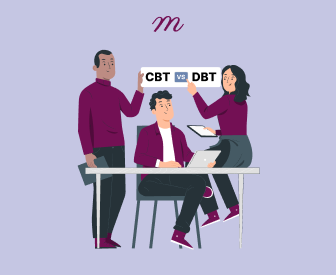
Cognitive Behavioral Therapy (CBT) and Dialectical Behavior Therapy (DBT) are two of the most widely used evidence-based modalities in mental health practice. While both are structured and skills-oriented, they serve different clinical purposes and require distinct documentation approaches.
For therapists, the real challenge is not defining CBT or DBT—but deciding when to use each modality, how to structure goals and interventions accordingly, and how to document treatment in a way that remains clinically coherent, measurable, and insurance-ready.
This guide focuses on:
- When CBT vs DBT is clinically appropriate
- How to document goals, objectives, and interventions for each modality
- How tools like Mentalyc’s AI Treatment Planner support modality-specific documentation and continuity of care
What Is Cognitive Behavioral Therapy (CBT) and When to Use It?
Cognitive Behavioral Therapy (CBT) is a structured, evidence-based psychotherapy used when a client’s symptoms are primarily maintained by maladaptive thought patterns and learned behavioral responses. From a clinical standpoint, CBT is most effective when clients can reflect on their internal experiences, tolerate structured homework, and engage in collaborative problem-solving.
Turn documentation into insights with Mentalyc

New! Transfer your notes to EHR with a single click. No more copy-pasting.
CBT targets the interaction between cognitions, emotions, and behaviors, helping therapists identify how distorted or unhelpful thinking patterns contribute to symptom persistence. Treatment focuses on modifying these patterns through clearly defined, measurable interventions.
Clinically, CBT is well suited for conditions such as anxiety disorders, depressive disorders, obsessive-compulsive disorder (OCD), PTSD (particularly cognitive-processing–oriented presentations), insomnia, chronic pain, and substance use disorders where insight and behavioral change are feasible.
Core CBT Techniques and How They Are Documented
CBT documentation is strongest when interventions are clearly linked to identified cognitive patterns and measurable behavioral outcomes. Below are commonly used CBT techniques, framed from a clinical and documentation perspective.
Cognitive Restructuring
Used to identify and challenge cognitive distortions that maintain symptoms.
Documentation focus: distorted thought → alternative balanced thought → symptom response.
Behavioral Activation
Introduced when low mood or avoidance reduces engagement in reinforcing activities.
Documentation focus: activity scheduling → behavioral follow-through → mood change.
Exposure Techniques
Applied to anxiety and trauma-related conditions using graded, imaginal, or interoceptive exposure.
Documentation focus: fear hierarchy → exposure task → anxiety reduction over time.
Cognitive Reframing
Helps shift rigid interpretations into more flexible, adaptive perspectives.
Documentation focus: original appraisal → reframed interpretation → behavioral impact.
Thought Records
Used to track automatic thoughts, emotional responses, and evidence evaluation.
Documentation focus: recurring themes → cognitive insight → change in belief strength.
Relaxation Techniques
Implemented to reduce physiological arousal that interferes with cognitive work. For example, your client can practice the 4-7-8 deep breathing exercise to help calm the mind and body.
Documentation focus: technique used → physiological response → symptom modulation.
Additional CBT Interventions Used in Treatment Planning
CBT often incorporates complementary techniques that support cognitive and behavioral change:
Mindfulness-Based CBT – increases present-moment awareness when rumination or anxiety interferes with progress
Cognitive Behavioral Rehearsal – prepares clients for real-world situations through structured practice
Role Playing – supports social skills development and anticipatory coping
Problem-Solving Therapy – addresses practical stressors contributing to symptom maintenance
Successive Approximation – breaks complex goals into achievable steps to support behavioral momentum
Socratic Questioning – deepens cognitive insight through guided clinical inquiry
These techniques are best documented as interventions linked to specific objectives, rather than as standalone activities.
CBT is indicated when therapists observe that:
- Symptoms are reinforced by identifiable cognitive distortions or avoidance behaviors
- The client can engage in reflective dialogue about thoughts and beliefs
- Change-oriented interventions are clinically appropriate
- Progress can be operationalized and tracked over time
CBT treatment applies to individuals with the following mental health conditions:
- Depression
- Anxiety
- Obsessive-Compulsive Disorder
- Post-traumatic Stress Disorder
- Attention Deficit Hyperactivity Disorder (ADHD)
- Bipolar Disorder
CBT sessions typically involve active therapist direction, collaborative agenda-setting, and between-session assignments. These assignments—such as thought monitoring, behavioral experiments, or exposure tasks—serve both therapeutic and documentation purposes by providing observable markers of progress.
CBT Treatment Planning: Goals, Objectives, and Interventions
From a documentation standpoint, CBT treatment plans typically emphasize:
Long-Term Goals
- Reduce symptom severity through cognitive and behavioral change
- Improve functional coping and adaptive thinking patterns
Short-Term Objectives
- Identify and modify specific cognitive distortions
- Reduce avoidance behaviors
- Increase engagement in adaptive behaviors
Interventions
- Cognitive restructuring
- Behavioral activation
- Exposure-based exercises
- Skills rehearsal and homework review
Documentation Considerations and Limitations of CBT
CBT may be less effective when:
Automate documentation and session analytics with Mentalyc
From intake to progress and treatment planning — automated, and aligned with your clinical style.
- HIPAA, PHIPA & SOC2 Compliant
- SOAP, DAP, BIRP, EMDR & more formats
- AI Treatment Planner
- AI Progress Tracker for goals & symptoms tracking
- Alliance insights
New! Transfer your notes to EHR with a single click. No more copy-pasting.

- Clients lack insight or memory capacity to engage in cognitive work
- Emotional dysregulation overwhelms reflective processing (e.g., some personality disorders)
- Severe cognitive impairment or amnestic conditions are present
In cases such as antisocial personality disorder or significant memory impairment, CBT documentation may fail to demonstrate progress because the core mechanisms of change are inaccessible. These presentations often require medical or alternative therapeutic approaches.
For severe depressive presentations, CBT is frequently documented alongside pharmacotherapy, as combined treatment improves outcomes and supports medical necessity.
Using Mentalyc to Support CBT Documentation
CBT’s structured nature aligns well with Mentalyc’s AI Treatment Planner, which helps therapists with:
- SMART CBT goals generated from session notes – Treatment goals and objectives are suggested directly from recorded, dictated, or typed CBT sessions, not generic templates.
- Golden Thread preserved automatically – Session notes, treatment plans, and progress stay connected in one continuous story of care.
- Auto-updated treatment plans – CBT goals evolve as therapy progresses, without manual rewrites.
- Progress tracked without extra forms – CBT outcomes are monitored directly from session content, with no questionnaires or duplicate work.
- Insurance-ready by design – Plans are structured with measurable goals and objectives aligned with insurance expectations.
What Is Dialectical Behavior Therapy (DBT) and When to Use It?
Dialectical Behavior Therapy (DBT) is an evidence-based psychotherapy used when clients struggle with emotion regulation, impulsivity, or chronic relational instability, and when change-focused approaches alone are insufficient or destabilizing.
DBT was developed by Marsha Linehan in the 1970s, originally for borderline personality disorder (BPD). Clinically, it is now applied across presentations where emotional intensity interferes with cognitive processing, safety, or behavioral control, including mental health conditions like PTSD, mood disorders, and eating disorders.
DBT is particularly indicated when therapists observe:
- Recurrent emotional dysregulation or crisis behaviors
- Self-harm, suicidal ideation, or high-risk impulsivity
- Strong affective responses that overwhelm insight-based work
- A need to balance acceptance and change to maintain therapeutic engagement
Common clinical presentations include BPD, chronic suicidality, trauma-related affect dysregulation, eating disorders, mood disorders, and some ADHD presentations where emotional reactivity is prominent.
Core Components of DBT Treatment
DBT is typically structured as a multi-component treatment, which may include:
- Individual therapy focused on case formulation and skill application
- Skills training (often group-based)
- Crisis planning and between-session support
From a documentation standpoint, DBT emphasizes skill acquisition, stabilization, and risk management over symptom elimination alone.
Core DBT Skills and How They Are Documented
DBT documentation is strongest when it clearly links emotional states, skill use, and behavioral outcomes over time.

Mindfulness
Used to increase present-moment awareness and reduce emotional reactivity.
Documentation focus: awareness → emotional response → behavioral choice.
Emotion Regulation
Targets identification, acceptance, and modulation of emotional intensity.
Documentation focus: emotion triggers → regulation strategy → outcome.
Distress Tolerance
Applied when immediate change is not possible and safety must be maintained.
Documentation focus: crisis trigger → skill used → avoidance of harmful behavior.
Interpersonal Effectiveness
Addresses boundary-setting, assertive communication, and relational stability.
Documentation focus: interaction pattern → skill application → relational impact.
DBT Treatment Planning: Goals, Objectives, and Interventions
Long-Term Goals
- Increase emotional regulation and stability
- Reduce high-risk or self-harming behaviors
- Improve interpersonal functioning and safety
Short-Term Objectives
- Practice and generalize DBT skills across contexts
- Reduce frequency or intensity of crisis behaviors
- Improve awareness of emotional triggers
Interventions
- Skills coaching (mindfulness, emotion regulation, distress tolerance)
- Validation strategies
- Crisis planning and safety monitoring
- Skills rehearsal and review
CBT vs DBT: Clinical Decision Framework
| Clinical Dimension | CBT | DBT |
|---|---|---|
| Primary Treatment Focus | Targets maladaptive thought patterns and learned behaviors that maintain symptoms | Targets emotion dysregulation and balances acceptance with change |
| Clinical Use Case | Best when symptoms are insight-accessible and cognitively driven | Best when emotional intensity or impulsivity interferes with cognitive work |
| Core Techniques | Cognitive restructuring, behavioral activation, exposure, thought records | Mindfulness, distress tolerance, emotion regulation, interpersonal effectiveness |
| Therapeutic Orientation | Problem-focused and change-oriented; typically short- to mid-term (≈ 8–20 sessions) | Validation-based with acceptance and change; often longer-term |
| Therapist Role | Directive and collaborative; guides cognitive and behavioral change | Supportive and validating; provides skills coaching and stabilization |
| Treatment Structure | Primarily individual therapy; group format optional | Combines individual therapy with structured skills training (often group-based) |
| Documentation Emphasis | Thought patterns, behaviors, interventions, and measurable symptom change | Skill acquisition, emotional regulation, safety, and behavioral stabilization |
| Best-Fit Client Presentations | Anxiety disorders, depression, OCD, PTSD, insomnia, substance use (with insight capacity) | Borderline personality disorder, chronic suicidality, self-harm, trauma with affect dysregulation |
| Typical Goal Orientation | Symptom reduction through cognitive and behavioral modification | Emotional stability, reduced risk behaviors, improved relational functioning |
Similarities Between CBT and DBT
Despite their differences, CBT and DBT share several foundational characteristics that make both modalities compatible with structured treatment planning and outcome-focused documentation.
Both approaches are goal-driven and structured, relying on clearly defined treatment plans with specific objectives and interventions. Each modality requires therapists to articulate clinical targets and demonstrate progress over time.
Both CBT and DBT address the interaction between thoughts, emotions, and behaviors, though they emphasize different change mechanisms. CBT prioritizes cognitive and behavioral modification, while DBT incorporates emotion regulation and acceptance strategies alongside behavioral change.
Active participation is essential in both modalities. Therapists routinely assign between-session tasks—such as thought monitoring, skills practice, or mindfulness exercises—to reinforce learning and support generalization. These assignments also provide concrete data points for progress documentation.
Both CBT and DBT can be delivered in individual and group formats. Group work is optional but effective in CBT, while skills groups are a core component of standard DBT models. In both cases, therapists must document how group-based interventions support individual treatment goals.
Finally, both modalities are strongly supported by clinical outcome research and have demonstrated effectiveness across a range of mental health conditions when applied appropriately.
Conclusion
Cognitive Behavioral Therapy and Dialectical Behavior Therapy are not interchangeable techniques but distinct, evidence-based modalities designed for different clinical presentations and stages of treatment.
CBT is most effective when symptoms are driven by maladaptive thinking and behavioral patterns that can be addressed through insight and structured change strategies. DBT is indicated when emotional dysregulation, impulsivity, or safety concerns require stabilization through skills training, validation, and acceptance-based work.
For therapists, the key is not choosing one modality over the other—but selecting, sequencing, and documenting each approach based on clinical need. Both CBT and DBT require clear treatment goals, defined interventions, and consistent progress tracking to remain clinically coherent and insurance-ready.
Tools like Mentalyc support this process by helping therapists maintain alignment between session notes, treatment plans, and ongoing progress—allowing clinicians to focus on clinical judgment and client care rather than administrative overhead.
Frequently Asked Questions: CBT vs DBT
What Is the Difference Between Cognitive Therapy (CT) and Cognitive Behavioral Therapy (CBT)?
Cognitive Therapy (CT) focuses primarily on identifying and modifying distorted or maladaptive thought patterns to improve emotional functioning. Cognitive Behavioral Therapy (CBT) builds on CT by explicitly integrating behavioral interventions—such as exposure, behavioral activation, and skills practice—to reinforce cognitive change. In clinical practice, CBT is more commonly used because it allows therapists to target both cognitive processes and observable behaviors within a structured treatment plan.
Is CBT or DBT More Appropriate for Anxiety Disorders?
CBT is generally the first-line modality for anxiety disorders, as it directly targets cognitive distortions, avoidance behaviors, and fear-based conditioning through structured interventions such as exposure and cognitive restructuring. DBT may be clinically appropriate when anxiety is accompanied by significant emotional dysregulation, impulsivity, or safety concerns, and when stabilization and distress tolerance are required before cognitive work can be effective.
Can DBT Be Practiced Without a Trained Therapist?
No. DBT is a comprehensive, skills-based treatment that requires therapist guidance, accountability, and clinical judgment, particularly when working with high-risk behaviors such as self-harm or suicidality. Core components of DBT—such as skills coaching, validation strategies, and crisis management—cannot be safely or effectively implemented without professional oversight.
Can CBT Be Used Without Ongoing Therapist Involvement?
While CBT techniques are often adapted into self-help formats, formal CBT treatment—especially for moderate to severe presentations—requires therapist involvement to ensure accurate case formulation, appropriate intervention selection, and ongoing outcome monitoring. Without clinical guidance, cognitive and behavioral techniques may be misapplied or insufficient for complex cases.
Can CBT and DBT Be Integrated Within the Same Treatment Plan?
Yes. Many therapists integrate CBT and DBT techniques across different phases of treatment. DBT skills are often introduced first to stabilize emotional dysregulation and reduce risk, followed by CBT interventions once clients can engage in cognitive and behavioral change work. Clear documentation is essential when integrating modalities to demonstrate clinical rationale and treatment progression.
Is DBT Limited to Borderline Personality Disorder?
No. Although DBT was originally developed for borderline personality disorder, it is now widely used for other clinical presentations involving emotion dysregulation, including chronic suicidality, self-harm, eating disorders, substance use disorders, trauma-related conditions, and mood disorders. The modality is best selected based on functional needs and emotional regulation capacity, not diagnosis alone.
References:
- Allen Press. (n.d.). Dialectical behavior therapy as treatment for borderline personality disorder. Mental Health and Substance Use, 9(1). https://meridian.allenpress.com/mhc/article/6/2/62/127854/Dialectical-behavior-therapy-as-treatment-for
- American Psychological Association. (2017). What is cognitive behavioral therapy? https://www.apa.org/ptsd-guideline/patients-and-families/cognitive-behavioral
- Butler, A. C., Chapman, J. E., Forman, E. M., & Beck, A. T. (2006). The empirical status of cognitive-behavioral therapy: A review of meta-analyses. Clinical Psychology Review, 26(1), 17-31. https://doi.org/10.1016/j.cpr.2005.07.003
- May, J. M., et al. (2016). Dialectical behavior therapy as a treatment for borderline personality disorder. Mental Health and Substance Use, 9(1), 51-65. https://doi.org/10.1080/17523281.2016.1146110
- National Institute for Health Research. (2020). Combined drug and psychological therapies may be most effective for depression. https://evidence.nihr.ac.uk/alert/combined-drug-and-psychological-therapies-may-be-most-effective-for-depression/
Disclaimer
All examples of mental health documentation are fictional and for informational purposes only.
Why other mental health professionals love Mentalyc

“It immediately changed my quality of life, personally and professionally.”
Owner/Independently Licensed Marriage & Family Therapist (LMFT)

“For anyone hesitant: this is a lifesaver. It will change your life, and you have more time to be present with your patients.”
Licensed Clinical Social Worker

“If I were recommending this software to a colleague, I would tell them that it is the best thing that they could do for their practice.”
Licensed Professional Counselor

“Do yourself a favor, make your life easier. I found Mentalyc to be one of the best tools that I’ve ever used.”
Licensed Marriage and Family Therapist