

The therapeutic alliance is one of the strongest predictors of engagement and effectiveness in therapy. Research consistently shows that how therapists and clients work together plays a major role in treatment outcomes. Traditionally, the alliance has been measured using tools like the Working Alliance Inventory (WAI) and other alliance questionnaires. While these measures are useful in research and training, they are often used infrequently and outside the session. In everyday practice, alliance is usually felt rather than formally tracked—noticed when something shifts or breaks down.
Therapeutic alliance tracking builds on this foundation by looking at how the therapist–client relationship changes over time. Instead of relying only on surveys, it focuses on patterns of attunement, collaboration, and repair as they appear across sessions. In this article, we’ll explain what alliance tracking means in real clinical work, where traditional measurement tools fall short, and how Mentalyc’s Alliance Genie™ supports ongoing reflection on the therapeutic relationship—without adding forms, disrupting sessions, or replacing clinical judgment.
What Therapeutic Alliance Tracking Actually is
Therapeutic alliance tracking is the structured, longitudinal reflection on how the therapist–client relationship unfolds over time. It focuses on:
- Working alliance measurement (shared goals, shared tasks, emotional bond)
- Alliance strength in therapy across sessions
- Alliance shifts across sessions, including rupture and repair
- Ongoing therapy relationship monitoring grounded in real session interaction
What it is not:
Strengthen your therapeutic relationships

New! Transfer your notes to EHR with a single click. No more copy-pasting.
- A symptom scale
- A satisfaction survey
- A proxy for outcome or progress tracking
- A replacement for supervision
Alliance tracking answers a distinct clinical question: “How are we working together and how is that relationship changing?”
What Clinically Meaningful Alliance Tracking looks at
Effective therapy relationship monitoring focuses on how therapy is happening, not just what is discussed.
1. Attunement
- Were responses emotionally aligned with the client’s experience?
- Did pacing and tone match the client’s needs?
- Were misattunements noticed and addressed?
Attunement is dynamic, not static. Tracking helps surface fluctuations that are hard to notice in real time.
2. Collaboration
- Were goals and tasks genuinely co-created?
- Did the client demonstrate ownership or quiet compliance?
- Were expectations revisited as therapy evolved?
This is the lived reality of working alliance measurement, beyond checklists.
3. Therapeutic engagement
- How actively did the client participate?
- Were there shifts in initiation, reflection, or resistance?
- Did engagement deepen, plateau, or fluctuate?
Tracking engagement clarifies whether resistance reflects avoidance, overwhelm, or misalignment.
4. Rupture and repair
- Where did tension, withdrawal, or mismatch appear?
- Was it acknowledged explicitly or implicitly?
- Did repair restore safety—or leave residue?
Ruptures are expected. Repair determines direction.
5. Alliance shifts across sessions
- Is the relationship strengthening, flattening, or weakening?
- Are changes tied to transitions, stressors, or clinical moves?
- Do recurring relational themes appear?
Seeing alliance as a trajectory—not a moment—supports earlier, more intentional intervention.
Traditional Therapeutic Alliance Tracking Methods (and Their Limits)
Therapeutic alliance tracking has traditionally meant measuring the quality of the therapist–client relationship using standardized questionnaires and observational tools. It usually involves:
1. Regular questionnaire administration
Clients (and sometimes therapists) complete alliance scales at set intervals—early, mid-treatment, or session by session.
2. Score review and interpretation
Clinicians review total scores and individual items to identify potential concerns (e.g., disagreement on goals or reduced trust).
3. Discussion and adjustment
Feedback is discussed explicitly or implicitly in therapy, informing changes to pacing, focus, or intervention style.
Deepen your therapeutic alliance through insight and reflection
Use Alliance Genie™ to track, reflect, and strengthen your therapeutic connections.
- Evidence-based tools
- Auto-captured areas for growth
- Alliance signals
- Supervision-like insights
New! Transfer your notes to EHR with a single click. No more copy-pasting.
The most common alliance measurement tools include:
- Working Alliance Inventory (WAI) — a widely used self-report questionnaire that measures the quality of the therapeutic relationship (alliance) in psychotherapy by assessing three key components: agreement on Goals, agreement on the Tasks, and the emotional Bond between therapist and client, with shorter versions like the WAI-SR (Short Revised) providing quick assessments for routine monitoring.
- Session Rating Scale (SRS) — a short, session-by-session measure of alliance quality and client perception
- Agnew Relationship Measure (ARM) — Another common questionnaire, often used in digital or blended therapy contexts to assess collaboration and partnership
- California Psychotherapy Alliance Scales (CALPAS) — a clinician-rated alliance assessment tool
- External observation methods — structured ratings of recorded therapy sessions by supervisors or trained observers
These tools allow clinicians to monitor relationship quality, compare scores over time, and examine correlations with engagement, retention, and outcomes.
Where Traditional Alliance Measurement Falls Short in Practice
Despite their research value, traditional therapeutic alliance measurement tools have practical limitations in everyday clinical work:
- They rely on periodic self-report questionnaires, often completed outside the session
- They capture snapshots rather than continuous relational patterns
- They increase administrative burden when added to routine documentation
- They may miss in-session relational nuance, such as subtle misattunements or repair attempts
As a result, alliance measurement often becomes intermittent and abstract, rather than a living reflection of how the relationship is unfolding session by session.
This is where newer approaches to therapeutic alliance tracking like Mentalyc’s Alliance Genie™ aim to evolve the field—by building on established measurement models while reducing burden and increasing clinical relevance.
How Mentalyc’s Alliance Genie™ supports therapeutic alliance tracking
Alliance Genie™ was designed specifically to support alliance and relationship tracking without changing how therapists practice. It functions as an AI-enabled supervision support tool that analyzes therapy sessions after they occur—so therapists remain fully present in session.
How Alliance Genie works in practice?
1. Capture your session

Upload or record a session, and Alliance Genie™ will start gathering insights based on the actual interaction with your client.
2. Get a deeper look at the relationship
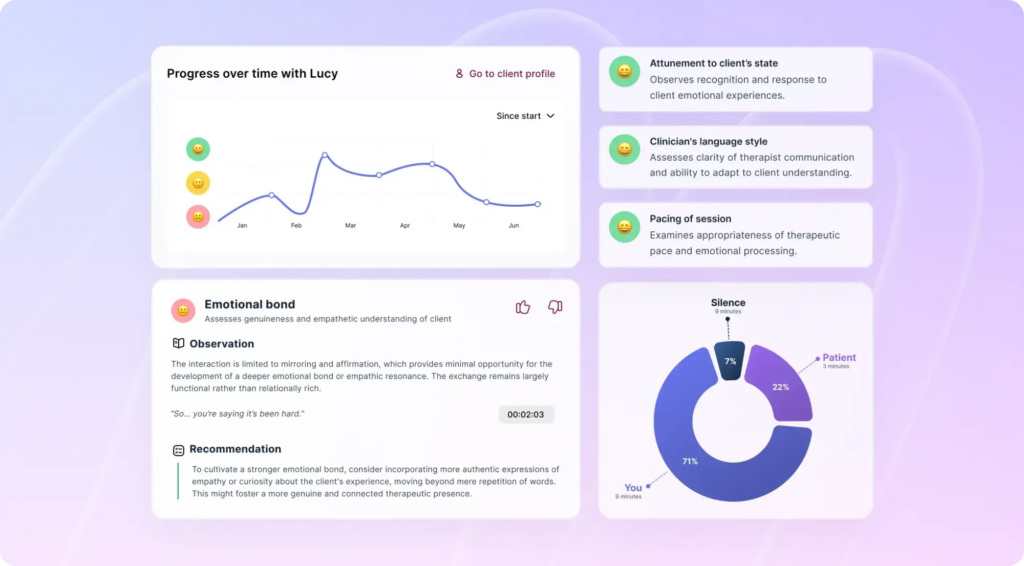
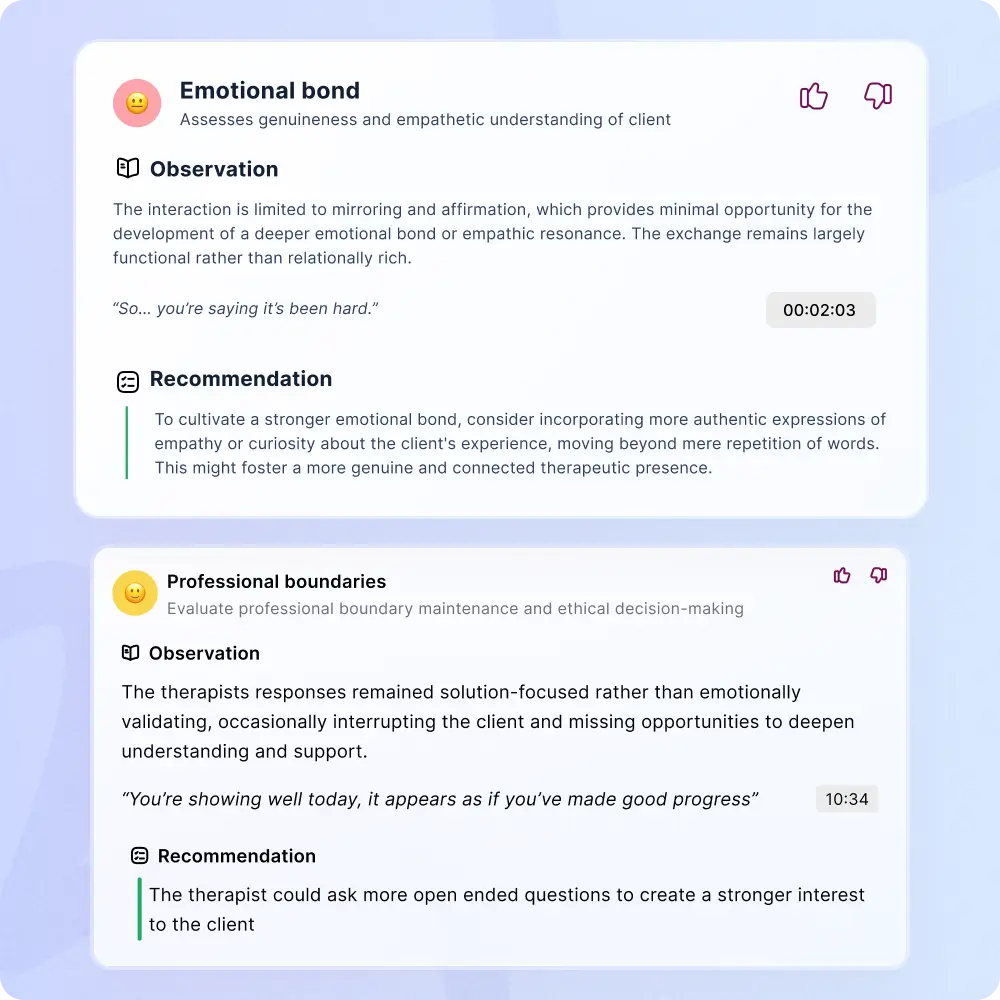
Alliance Genie™ works as a therapeutic alliance assessment and session quality analysis tool — highlighting moments that shaped attunement, collaboration, and engagement.
3. Receive clear and actionable insights
See what supported the connection, where it shifted, and what you can focus on next to strengthen the therapeutic relationship.
The biggest difference compared to traditional alliance measurement is that there are no forms, no scoring, and no interruption to care. Alliance reflection happens after the session, using the clinical material that already exists, rather than asking clients or therapists to pause therapy to complete questionnaires. This keeps the focus on the therapeutic relationship itself, not on managing measurement tools, and allows alliance patterns to be observed over time without changing how therapy is conducted in the room.
What Alliance Genie™ actually looks at
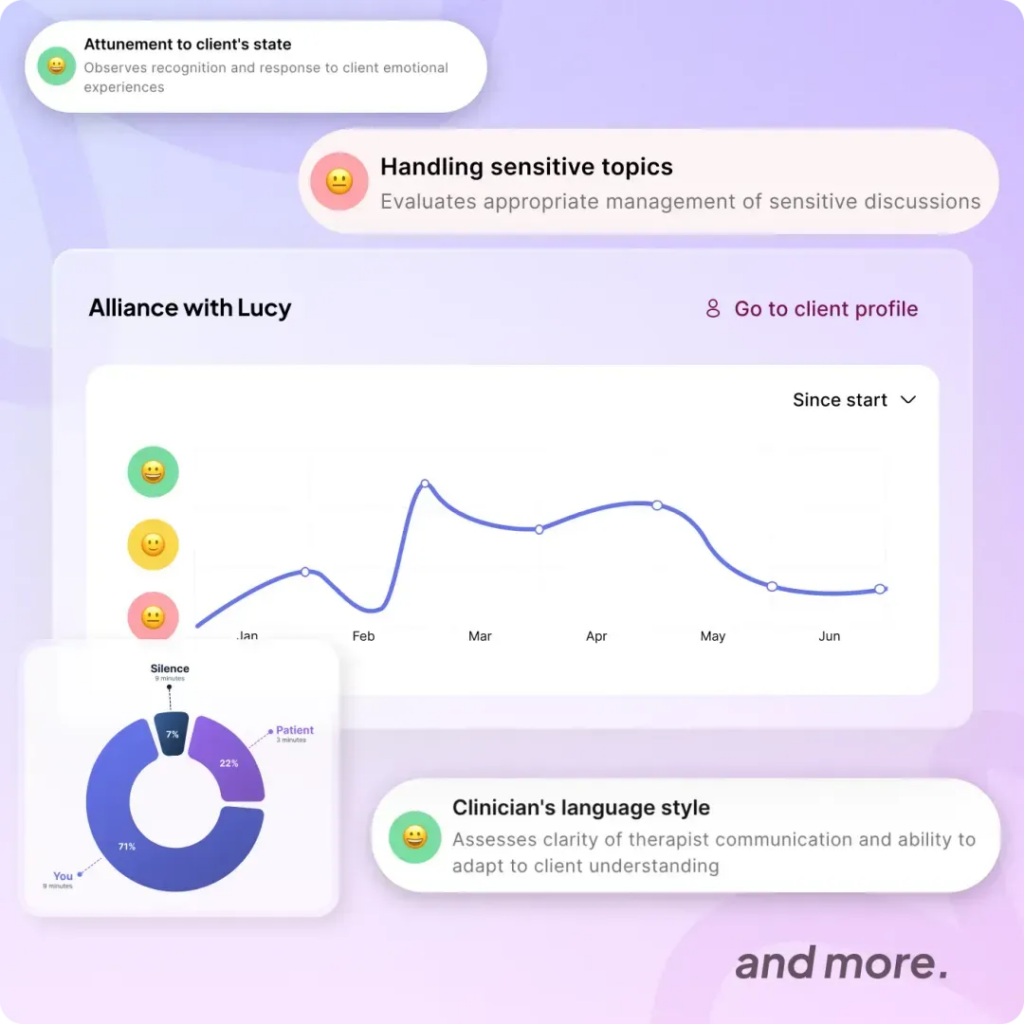
Alliance Genie™ groups alliance intelligence into five clinically recognized areas:
- Therapeutic Foundation: Emotional regulation, boundaries, cultural responsiveness, psychoeducation, language style.
- Session Flow & Pacing: Structure, pacing, expectations, transitions, and closure.
- Quality of the Relationship: Empathy, attunement, trust, handling sensitive topics, repairing misalignment, family or parent collaboration when relevant.
- Therapeutic Process in Action: Adaptability, resistance, engagement patterns, attachment considerations.
- Collaboration & Shared Goals: Goal agreement, task alignment, autonomy, progress check-ins, acknowledgment of effort.
This structure supports therapy relationship monitoring that is clinically grounded—not abstract.
Alliance Genie™ as supervision-informed reflection
Alliance Genie™ is not meant to replace supervision, consultation, or a therapist’s clinical intuition. Instead, it supports the kind of reflection therapists already do—by making relationship patterns easier to see over time. In practice, this often means becoming aware of blind spots that weren’t obvious in the moment, subtle misattunements that shaped engagement, or relational strengths that show up consistently but tend to go unnoticed. Over multiple cases, therapists may also begin to see familiar relational patterns repeating in different forms.
By surfacing these themes across sessions, Alliance Genie™ creates a supervision-like layer of reflection between sessions. This supports gradual skill development and deeper relational awareness—without turning alliance work into a separate task, score, or evaluation.
Privacy, ethics, and clinical control
Alliance Genie™ is designed for real clinical environments, where privacy, ethics, and clinician control are non-negotiable.
Session audio is used only long enough to generate an anonymized transcript. No recordings are stored, and client data is never used to train models. The system is fully HIPAA, PHIPA, and SOC 2 Type II compliant, and therapists retain full authority over review and interpretation of any insights generated.
Most importantly, alliance tracking remains clinician-led. The tool is designed to support ethical review, professional standards, and informed clinical judgment—not to automate or override them. For alliance work to be meaningful, it must feel safe for both therapists and clients.
Why Alliance Tracking Strengthens Therapy Itself
When the quality of the therapist–client relationship becomes more visible over time, it directly supports better clinical care. Therapists are able to notice shifts in engagement earlier, respond to emerging ruptures with greater clarity, and intervene more intentionally rather than reactively. Over time, this visibility also strengthens confidence in relational decisions, because intuition is supported by pattern recognition rather than isolated impressions. Alliance tracking does not replace judgment. It sharpens it by giving therapists a clearer view of how the relationship itself is evolving across the course of therapy.
Final Reflection: Making Relational Work Visible with Therapeutic Alliance Tracking
The therapeutic alliance has always been central to effective therapy. What’s changed is that therapists now have better ways to reflect on it systematically without interrupting sessions or adding extra work. Therapeutic alliance tracking makes the relationship itself easier to observe over time, so therapists can respond with greater attunement, collaboration, and care. Mentalyc built Alliance Genie™ to support exactly this kind of work: clearer reflection, stronger engagement, and more intentional relational care—without pulling therapists out of presence.
FAQs: Alliance and Relationship Tracking
Is therapeutic alliance tracking evidence-based?
Yes. Decades of psychotherapy research show that the quality of the therapeutic alliance—especially agreement on goals, collaboration on tasks, and emotional bond—is one of the strongest predictors of engagement and retention across modalities. Alliance tracking does not replace clinical judgment or supervision; it provides a structured way to reflect on relational processes that are already known to matter.
How is alliance tracking different from client satisfaction surveys or alliance questionnaires?
Traditional alliance measures rely on brief self-report snapshots, usually collected intermittently and outside the session. Therapeutic alliance tracking, as supported by Mentalyc, focuses on session-level interaction patterns—such as attunement, pacing, collaboration, and rupture/repair—observed longitudinally across sessions. This allows therapists to notice alliance shifts over time rather than relying on isolated scores.
Does Alliance Genie™ tell me whether my alliance is “good” or “bad”?
No. Alliance Genie™ does not score, rank, or judge the therapeutic relationship. Instead, it highlights relational signals—what supported connection, where alignment shifted, and what may deserve reflection. The goal is insight, not evaluation. Clinical interpretation and decision-making always remain with the therapist.
Can alliance tracking help identify rupture and repair moments?
Yes. Alliance Genie™ is designed to surface moments where emotional alignment, pacing, or collaboration shifted—often the early signs of rupture. It also highlights how those moments were handled, helping therapists reflect on whether repair occurred and how it might be strengthened in future sessions.
Will alliance tracking change how I run my sessions?
No. Alliance Genie™ works after the session using the same session capture therapists already use for documentation. There are no in-session prompts, forms, or disruptions. Therapists stay fully present, then reflect afterward with greater clarity.
Is alliance tracking appropriate for all therapy modalities?
Yes. Alliance Genie™ adapts to different therapeutic orientations, including CBT, psychodynamic, humanistic, relational, integrative, and trauma-informed approaches. It focuses on universal relational dimensions—attunement, collaboration, engagement, and repair—while respecting modality-specific language and style.
How does alliance tracking fit alongside supervision?
Alliance tracking is not a replacement for supervision. It functions as a between-session reflective layer, offering supervision-like insights that help therapists notice patterns, blind spots, and strengths in real time. Many clinicians use it to deepen supervision conversations or support reflective practice when supervision access is limited.
Why other mental health professionals love Mentalyc

“There is a lot more feedback and suggestions in it than before … that makes things a little bit easier for me.”

“It keeps me on a level of assessment about the relationship that has a little bit more objectivity. It helps keep me grounded.”
LPC

“Reading transcripts helps me tighten up and come across more the way I want to present myself to clients … it’s helped me improve and keep getting better.”
Licensed Marriage and Family Therapist

“Using Alliance Genie has really improved my notes … It tells me what I’m doing and gives me an approach of what’s next.”