
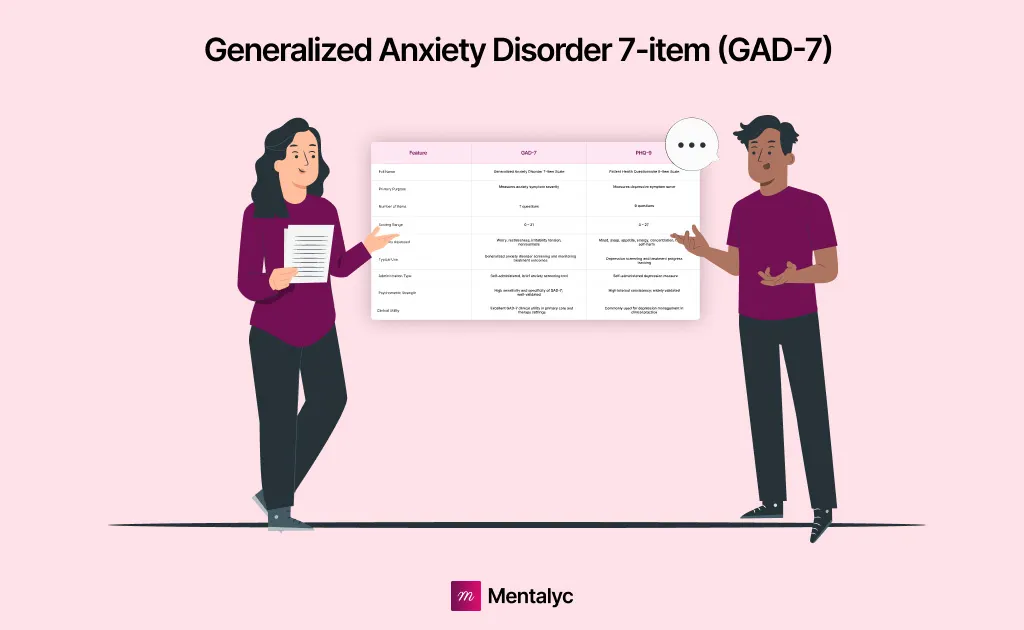
Simple and quick to complete, GAD-7 is famous for giving both clinicians and clients a clearer picture of how anxiety shows up day-to-day.
In this article, we’ll walk through how to score the GAD-7, interpret the results, and use it to guide treatment and track progress over time. Because using the GAD-7 effectively requires periodic assessments and active client participation, tracking anxiety trends between formal evaluations can be challenging.
That’s where Mentalyc supports you. It distills insights about symptom changes directly from your session data, without relying on forms or questionnaires. By automatically highlighting shifts in mood, behavior, and language patterns, Mentalyc helps you see progress over time and keep documentation clinically aligned, while you stay fully engaged with your clients.
The Generalized Anxiety Disorder 7-Item Questionnaire (GAD-7)
The GAD-7 score is obtained by adding the scores for each of the 7 questions (total points) (range: 0-21)
Track progress automatically from your sessions

Transfer your notes to EHR with a single click. No more copy-pasting.
GAD-7 Scoring and Interpretation
Now that you’ve completed the GAD-7 questionnaire, it’s important to understand what your results actually mean.
Each question is scored 0-3 based on how frequently you experienced symptoms. Add up the totals to get your overall score.
Score Ranges:
- 0-4 = Minimal anxiety
- 5-9 = Mild anxiety
- 10-14 = Moderate anxiety
- 15-21 = Severe anxiety
The GAD-7 test functions as an anxiety screening tool that helps identify where an individual’s symptoms fall on the anxiety severity scale. Higher scores indicate greater levels of distress from anxiety symptoms. But scores alone don’t determine a diagnosis – they simply provide insight into severity.
| GAD-7 Total Score | Level of Anxiety | Clinical Interpretation | Recommended Action |
|---|---|---|---|
| 0 – 4 | Minimal Anxiety | No significant anxiety symptoms present. | No intervention needed; monitor if symptoms change. |
| 5 – 9 | Mild Anxiety | Indicates mild symptoms of generalized anxiety. | Reassess after 4 weeks or if symptoms worsen; consider psychoeducation |
| 10 – 14 | Moderate Anxiety | Consistent with an anxiety disorder; may interfere with functioning. | Recommend full clinical evaluation and possible treatment planning. |
| 15 – 21 | Severe Anxiety | Significant anxiety likely requiring active treatment. | Initiate therapy and/or pharmacologic intervention; monitor closely. |
Clinical Performance of The GAD-7 as a Screening Tool for Anxiety Disorders
The GAD-7 assessment tool is widely recognized as an effective generalized anxiety disorder screening measure. It offers clinicians a quick and evidence-based way to determine whether anxiety symptoms meet clinical thresholds.
- [IMAGE] File name: therapist does anxiety screening in primary care setting Description: Depict a therapist calmly conducting an anxiety screening with a client in a primary care or clinic setting. The therapist holds a clipboard or tablet displaying the GAD-7 questionnaire, while the client sits attentively in a comfortable, professional environment. The mood should feel supportive, confidential, and focused — reflecting early screening and holistic mental health care.
GAD-7 Recommendations
- 0-4 = Minimal anxiety: No follow-up is warranted unless symptoms/scores change
- 5-9 = Mild anxiety: Re-take the GAD-7 to monitor for symptoms for 4 weeks. Follow up with a mental health professional as indicated.
- 10-14 = Moderate anxiety: Based on the information provided, this individual seems to be experiencing symptoms consistent with an anxiety disorder. Need for further professional evaluation
- 15-21 = Severe anxiety: symptoms likely warrant active treatment and monitoring with a mental health professional.
These GAD-7 cut-off scores guide clinicians in determining when further evaluation or intervention is necessary, serving as a valuable clinical anxiety assessment reference.
GAD-7 Pearls & Pitfalls
- Applicability: It can effectively screen for the four most prevalent anxiety disorders: Generalized Anxiety Disorder, Panic Disorder, Social Anxiety Disorder, and PTSD.
- Accuracy: The GAD-7 demonstrates 70-90% sensitivity and 80-90% specificity across disorders when using recommended clinical cut-off scores.
- Correlation to Severity: Higher scores on the GAD-7 correlate with greater levels of disability, distress and impairment in important daily functioning areas like work productivity and health care utilization.
- Clinical Utility: It serves as both an initial screening tool to identify likely cases as well as a continuous measure of symptom severity. This allows monitoring anxiety treatment progress over time.
- Validation: Extensive validation research has demonstrated the GAD-7 reliably differentiates anxiety disorder cases from non-cases and corresponds well with established diagnostic criteria and gold-standard clinical interviews.
- Effectiveness: When utilized as directed, the GAD-7 performs well across diverse settings like primary care, community mental health and specialized anxiety clinics.
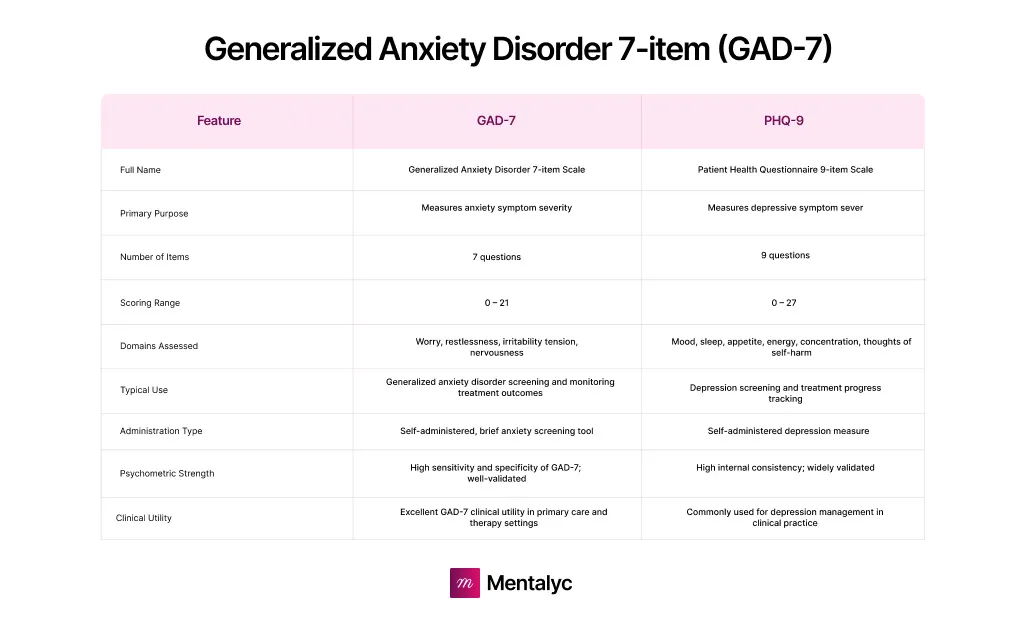
GAD-7 vs. PHQ-9: Understanding the Difference
| Feature | GAD-7 | PHQ-9 |
|---|---|---|
| Full Name | Generalized Anxiety Disorder 7-item Scale | Patient Health Questionnaire 9-item Scale |
| Primary Purpose | Measures anxiety symptom severity | Measures depressive symptom severity |
| Number of Items | 7 questions | 9 questions |
| Scoring Range | 0 – 21 | 0 – 27 |
| Domains Assessed | Worry, restlessness, irritability, tension, nervousness | Mood, sleep, appetite, energy, concentration, thoughts of self-harm |
| Typical Use | Generalized anxiety disorder screening and monitoring treatment outcomes | Depression screening and treatment progress tracking |
| Administration Type | Self-administered, brief anxiety screening tool | Self-administered depression measure |
| Psychometric Strength | High sensitivity and specificity of GAD-7; well-validated | High internal consistency; widely validated |
| Clinical Utility | Excellent GAD-7 clinical utility in primary care and therapy settings | Commonly used for depression management in clinical practice |
When comparing the PHQ-9 vs GAD-7 assessments, we find two valuable tools that aid in evaluating mental health conditions. The GAD-7 focuses specifically on measuring the severity of generalized anxiety disorder (GAD), while the PHQ-9 targets depressive symptoms.
Track progress and measure outcomes automatically
Turn your notes into measurable outcomes with built-in progress tracking & impact tools.
- Measure progress over time
- Symptoms tracking
- Goals tracking
- DSM-5 & ICD-10 ready
Transfer your notes to EHR with a single click. No more copy-pasting.

While both assessments use a similar format, with individuals rating the frequency and intensity of their symptoms over a specific timeframe, their primary focus differs. The GAD-7 hones in on anxiety-related symptoms, while the PHQ-9 delves into depressive symptoms.
These assessments serve as valuable resources for clinicians to gain a comprehensive understanding of clients’ mental health and provide tailored interventions to address their specific needs.
Screening for GAD Using the GAD-7 Tool: Suitability
The GAD-7 is a brief, 7-item questionnaire (anxiety self-assessment test) that can help determine if your client’s worries and physical symptoms are crossing over into a clinical disorder.
Taking just 1-2 minutes for the clients to complete, it assesses how often over the past two weeks they have experienced core anxiety symptoms.
Validated for diverse populations, the GAD-7 assessment tool is a reliable first step toward clarification and treatment.
When to Use the GAD-7?
The Generalized Anxiety Disorder 7-item scale (GAD-7) can be a valuable tool in both generalized anxiety disorder screening and monitoring anxiety treatment progress over time.
A. Screening
The brief 1-2 minute assessment makes the GAD-7 well-suited for initial anxiety screening in outpatient settings like primary care offices. It can provide a fast indication of whether clinically significant symptoms of GAD, panic disorder, social anxiety, or PTSD may be present.
B. Monitoring Treatment Progress
For those receiving therapy for an anxiety condition, the GAD-7 allows easy tracking of symptom improvement. By re-taking the questionnaire periodically, both patients and providers can gauge treatment effectiveness. It highlights what coping techniques or medication adjustments may be helping – or areas still needing more focus.
C. Self-Reflection Tool
On a personal level, the GAD-7 can promote self-reflection. Seeing how symptom severity may fluctuate over time helps individuals better understand their own anxiety experiences, triggers, and coping abilities. It fosters more open discussion with providers too.
Getting a Professional Diagnosis for Anxiety
While screening tools provide useful insight, only a medical professional can confirm a GAD diagnosis through a full evaluation.

A mental health professional will consider not only your symptoms but also potential underlying causes or co-occurring conditions.
Getting an official diagnosis opens the door to tailored treatment plans and community support resources, making the GAD-7 one of the most trusted anxiety questionnaire for adults in clinical and self-assessment contexts.
Empower Your Practice with The Right Solution
Tools like the GAD-7 give you valuable insight into how anxiety affects your clients but turning those scores and session notes into a clear picture of progress can take time. Mentalyc helps bridge that gap without using questionnairies by automatically capturing session details and tracking anxiety signals over time.
Try Mentalyc for free and see how it brings clarity and consistency to your anxiety documentation process — so your insights translate seamlessly into better care.
Mentalyc Plans & Pricing
| Plan | Price | Key Features |
| 14-Day Free Trial | $0 | 14 days of full PRO access, including 15 notes—no credit card required. |
| Mini | USD 14.99 /month | Record in-person sessions, upload audio files, use voice- to-text, or type notes directly, etc |
| Basic | USD 29.99 /month | Everything in Mini, plus: Alliance Genie™NEW! (limited access), Smart TP™ |
| Pro | USD 59.99 /month | EMDR, Play and Psychiatry modalities, 100+ custom templates incld. BIRP, PIRP, GIRP, PIE, and SIRP, Auto-computed CPT codes |
| Super | USD 99.99 /month | Everything in Pro, plus: Group therapy notes for each group member, Priority onboarding and support |
For more information, visit the pricing page on our website.
References:
- American Psychiatric Association. (1994). Diagnostic and statistical manual of mental disorders (4th ed.).
Frequently Asked Questions (FAQs) About Generalized Anxiety Disorder 7-item Scale (GAD-7)
Why other mental health professionals love Mentalyc

“It improves the quality of my work as I review my sessions … I bring a sense of continuity from session to session because of the really good summary and progress notes that Mentalyc gives me.”
Licensed Marriage and Family Therapist

“It helps align the note and the plan for moving forward with sessions … it’s been a really good aid in giving me direction.”
LPC

“I benefit tremendously every time I wrap up a session and then a few minutes later, I have this AI note … it makes me a better clinician in a variety of ways.”

“I go back and can read the notes, and it really helps me for the next session … it has made me a much better counselor.”
Licensed Professional Counselor